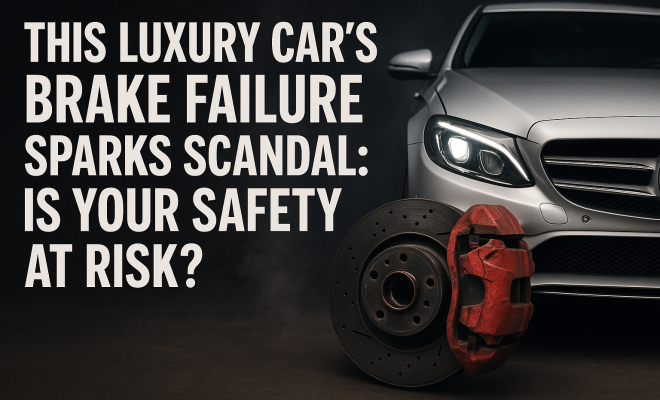
This Luxury Car’s Brake Failure Sparks Scandal: Is Your Safety at Risk?
Imagine you’re behind the wheel of a brand-new, luxurious MPV, cruising at highway speeds. You need to brake hard – perhaps an unexpected obstacle, or just a demanding test. You press the pedal, and instead of a smooth, controlled stop, you feel… a snap. The pedal goes limp. That’s the terrifying scenario that has recently gripped the automotive world, particularly in China, involving a major luxury car brand and a series of alarming brake pedal support failures.
The controversy ignited when a prominent automotive testing platform, Dongchedi, released a video documenting emergency braking tests on three Maextro V800 luxury MPVs. These weren’t just casual stops; they were repeated, high-intensity emergency braking maneuvers from 100 kilometers per hour. What transpired during these rigorous tests sent shockwaves through the industry and among consumers: the brake pedal supports on all three vehicles reportedly failed. Not simultaneously, but across different attempts, each incident highlighting a potentially critical flaw in what should be a fundamental safety component. This isn’t just a minor malfunction; we’re talking about the integrity of the very mechanism that allows you to stop your vehicle – a direct link to the driver’s ability to control the car in an emergency. The implications for driver and passenger safety are profound, sparking intense debate about engineering robustness, manufacturing quality control, and the very definition of ‘extreme’ testing conditions.
The story quickly went viral, fueling online speculation and public concern. Here’s why this incident resonates so deeply: it involves a premium vehicle, a dramatic and highly visible safety failure, and perhaps even hints of censorship, given the subsequent unavailability of the original video on some major Chinese platforms. For consumers, especially those investing in luxury vehicles, the question of reliability and safety becomes paramount. This isn’t merely about inconvenience; it’s about trust and the fundamental expectation that a vehicle, especially one designed for premium comfort and performance, will protect its occupants. The incident has thrust the spotlight onto Maextro, forcing them to address these serious allegations and take swift action to restore consumer confidence. What exactly happened, and what does it mean for the future of automotive safety, particularly in the rapidly evolving landscape of luxury electric vehicles?
The Dongchedi Test: A Glimpse into Potential Vulnerabilities
The catalyst for this entire controversy was a video published by Dongchedi, a well-known and respected automotive media outlet in China. Their testing methodology involved subjecting Maextro V800 MPVs to a series of emergency braking tests from a speed of 100 kilometers per hour. For many drivers, this is a standard highway speed, and the ability to execute an emergency stop reliably is non-negotiable. What Dongchedi’s video purportedly captured was truly unsettling: the physical failure of the brake pedal supports.
Think about that for a moment. When you stomp on the brake pedal in a panic situation, you’re exerting significant force. The brake pedal support is the structural component that anchors the pedal assembly to the vehicle’s chassis, transferring that force to the master cylinder, which then pressurizes the brake lines. If this support gives way, the pedal effectively becomes disconnected from the braking system. It’s like trying to stop a bicycle by pushing on a broken lever – the input simply doesn’t translate into action. The video reportedly showed these brake pedal support failures occurring on three different Maextro V800 vehicles, at various points during the repeated braking trials. This wasn’t an isolated incident; it suggested a systemic vulnerability, even if the conditions were rigorous. The fact that it happened across multiple vehicles amplified the concern, moving it beyond a single manufacturing defect to a potential design or material issue. For more on this, see revolutionary AI solutions.
The intention behind such extreme testing, from Dongchedi’s perspective, is often to push vehicles beyond their everyday operating limits to uncover potential weaknesses that might not surface under typical driving conditions. While some might argue that these tests are indeed ‘non-standard,’ as Maextro later claimed, they often mimic the kind of unexpected, high-stress situations that can occur on real roads. A child running into the street, a sudden traffic jam appearing over a blind hill, or an animal darting out – these scenarios demand maximum braking force, and a vehicle’s ability to withstand such demands is a cornerstone of its safety rating. The Dongchedi video served as a stark, visual demonstration of what could happen when a critical component like the brake pedal support reaches its breaking point.
Maextro’s Response: Acknowledgment and Action
In the wake of the viral video and the ensuing public outcry, Maextro, the luxury brand in question, was quick to issue a response. They acknowledged the incident but characterized Dongchedi’s testing methods as ‘non-standard.’ This distinction is crucial in the automotive world. Manufacturers typically design and test their vehicles to meet specific industry standards and regulatory requirements, which often involve defined loads, cycles, and environmental conditions. Any test that goes beyond these parameters can be deemed ‘non-standard,’ making it easier for a manufacturer to argue that the failure occurred outside of expected operating conditions.
However, Maextro didn’t stop there. Despite their reservations about the testing methodology, they took concrete steps to address the concerns. They announced plans to optimize the design of the brake pedal support component. This isn’t a minor tweak; it implies a re-evaluation of the engineering, potentially involving stronger materials, a redesigned geometry, or enhanced reinforcement. Furthermore, in a significant move to reassure their existing customer base, Maextro committed to offering free upgrades to all current V800 owners. This proactive recall, even if not formally termed a ‘recall’ in some jurisdictions, demonstrates a clear recognition of the potential safety implications and a willingness to invest in a solution for their customers. It’s a calculated decision, weighing the cost of upgrades against the immeasurable damage of a tarnished reputation and potential liability claims. (See: NHTSA on vehicle safety recalls.)
Beyond the immediate fixes, Maextro also stated that they would conduct a thorough internal review of the brake pedal support component. This review would likely involve material scientists, structural engineers, and quality control experts examining everything from the alloy composition to the manufacturing process, looking for any contributing factors to the failures. While their initial reaction included a degree of defensiveness regarding the test conditions, their subsequent actions suggest a serious commitment to addressing the underlying issue and upholding their brand’s reputation for luxury and safety.
The Disappearing Video: Fueling Speculation and Public Discourse
Perhaps one of the most intriguing and concerning aspects of this entire saga was the subsequent fate of the original Dongchedi video. Shortly after gaining significant traction online, the video reportedly became unavailable on major Chinese social media and video platforms. This disappearance, whether orchestrated or coincidental, only served to intensify public speculation and discussion. In the age of digital information, when something goes viral and then vanishes, it inevitably raises questions of censorship, corporate pressure, and the suppression of inconvenient truths.
When a piece of content that exposes a potential product flaw is removed, it can inadvertently lend more credence to the original claims. People naturally wonder, ‘If there’s nothing to hide, why was it taken down?’ This phenomenon, often referred to as the ‘Streisand effect,’ can lead to even greater dissemination of the information through alternative channels, screenshots, and word-of-mouth. The unavailability of the video fueled a fresh wave of online debate, not just about the brake pedal support failures themselves, but also about the broader implications for transparency, consumer rights, and the influence of powerful corporations in the digital sphere.
For many, the removal of the video transformed the incident from a simple product defect into a more complex narrative involving potential attempts to control public perception. It highlighted the power of online platforms and the delicate balance between corporate interests and public access to information, especially when safety is at stake. The disappearance, regardless of its true cause, became as much a part of the story as the brake failures themselves, adding another layer of intrigue and urgency to the unfolding events.
Safety Margins and Extreme Testing: Where Do We Draw the Line?
The debate surrounding the Maextro V800 brake pedal support failures inevitably leads to a fundamental question in automotive engineering: what constitutes a reasonable safety margin, and how extreme should testing conditions be? Manufacturers design vehicles to perform reliably within a defined set of parameters, often dictated by regulatory standards and anticipated real-world usage. These parameters include factors like typical speeds, braking forces, environmental conditions, and expected lifespan. Safety margins are built into every component, meaning they are designed to withstand stresses significantly greater than those they are expected to encounter in normal operation.
However, ‘extreme’ testing, like the repeated 100 km/h emergency braking conducted by Dongchedi, aims to push beyond these typical parameters. The goal is to find the breaking point, to identify weaknesses that might only manifest under the most severe, albeit rare, conditions. From a consumer perspective, a larger safety margin is always better; you want your vehicle to perform even when you ask it to do something extraordinary. From a manufacturer’s perspective, there’s a balance to strike between robustness, weight, cost, and overall performance. Over-engineering every component to withstand truly absurd forces would make cars prohibitively heavy and expensive.
The crux of the Maextro controversy lies in this tension. Maextro argued the tests were ‘non-standard,’ implying they exceeded reasonable design expectations. Dongchedi, and many consumers, would likely counter that if a critical component like a brake pedal support fails under conditions that, while extreme, are still within the realm of possible real-world emergencies, then the safety margin might not be adequate. This isn’t just about passing a baseline test; it’s about confidence that your vehicle won’t fail you when you need it most. The incident forces a re-evaluation of what constitutes ‘adequate’ safety in modern luxury vehicles, especially as performance capabilities continue to climb.
Quality Control in Luxury Vehicles: The Premium Expectation
When you purchase a luxury vehicle, you’re not just buying transportation; you’re investing in an experience. That experience encompasses advanced features, superior comfort, refined aesthetics, and, crucially, an expectation of impeccable quality and unwavering reliability. The Maextro V800 incident, involving brake pedal support failures, strikes at the very heart of this premium expectation. For many luxury car buyers, safety is a given, a foundational element that should never be compromised, regardless of the price point. (See: CDC on motor vehicle safety.)
Quality control processes in luxury automotive manufacturing are typically rigorous, involving multiple stages of inspection, testing, and validation. From the selection of raw materials to the final assembly, every component is scrutinized to ensure it meets exacting standards. A failure in a critical safety component like a brake pedal support suggests a potential breakdown somewhere in this elaborate chain. It could be a design flaw that wasn’t caught during initial validation, a material inconsistency that slipped through supplier checks, or an assembly error on the production line. Regardless of the specific cause, the perception is that something went wrong in ensuring the ‘luxury’ promise extended to fundamental safety. We covered China's tech safety reforms in more detail.
This incident serves as a potent reminder that even in the high-end segment, vigilance is paramount. Consumers pay a premium for peace of mind, and any highly publicized safety concern can disproportionately damage a luxury brand’s reputation. The free upgrades offered by Maextro are a tacit admission that their quality control, at least for this component, might not have met the elevated standards expected of a luxury marque. It underscores the idea that for luxury brands, the margin for error on safety-critical components is virtually non-existent; the trust of their clientele is far too valuable to risk.
The Broader Implications for Chinese Luxury Brands
The Maextro V800 controversy isn’t just a story about one car model or one brand; it carries broader implications for China’s burgeoning luxury automotive sector. For years, Chinese automakers have been working tirelessly to shed the perception of being merely manufacturers of budget-friendly, often derivative, vehicles. Brands like Maextro represent a new wave, aiming to compete directly with established global luxury giants by offering sophisticated design, advanced technology, and premium experiences.
However, building a luxury brand takes more than just stylish exteriors and high-tech interiors; it requires an ironclad reputation for engineering excellence, reliability, and, above all, safety. Incidents like the brake pedal support failures, especially when amplified by viral videos and questions of transparency, can be incredibly damaging to this nascent reputation. They feed into lingering doubts that some international consumers might still harbor about the quality and maturity of Chinese automotive engineering. next-gen electric vehicles offers useful background here.
On the flip side, how Maextro navigates this crisis will be a critical case study for other aspiring Chinese luxury brands. Their swift action to offer design optimization and free upgrades, despite questioning the testing methods, sets a precedent for responsible corporate behavior. If they can emerge from this stronger, with a demonstrably improved product and restored consumer trust, it could actually bolster confidence in the broader Chinese luxury segment. But any misstep, any perceived evasion or denial, could set back the collective efforts of the entire industry to establish itself on the global luxury stage. The stakes, therefore, are considerably higher than just the sales of one MPV model.
Consumer Risk and Buyer Intent: What Does This Mean for You?
For potential car buyers, particularly those considering a Maextro V800 or other luxury MPVs, the brake pedal support failures raise critical questions. The immediate concern is, of course, safety. If you’re looking at a vehicle that has had a public incident involving a critical safety component, it’s natural to hesitate. Will the ‘optimized design’ truly fix the issue? How quickly will existing vehicles receive the upgrade? These are practical, immediate concerns for anyone in the market for such a car.
Beyond the specific incident, this saga highlights the importance of due diligence when purchasing any vehicle, especially new models or those from emerging brands. While luxury vehicles often come with assurances of quality, incidents like this remind us that no brand is entirely immune to potential flaws. As a consumer, you’ll want to pay close attention to official statements from the manufacturer, any recall notices, and independent third-party reviews and safety ratings. Look for evidence that the manufacturer has genuinely addressed the problem, not just issued a press release. (See: Scientific research on automotive safety.)
This situation also influences broader buyer intent. Those prioritizing reliability might now pivot to established brands with long track records, even if it means foregoing some of the cutting-edge features or aggressive pricing of newer entrants. Conversely, buyers who are comfortable with early adoption and willing to trust a brand’s commitment to rectification might still consider the V800, especially with the promise of free upgrades. The incident will undoubtedly prompt more detailed searches for ‘Maextro V800 reliability,’ ‘luxury MPV safety ratings,’ and ‘brake pedal support failures’ – all indicators of a more cautious, informed consumer base demanding transparency and proven safety.
Navigating the Aftermath: Recalls, Warranties, and Trust
The aftermath of a significant safety controversy, like the Maextro V800’s brake pedal support failures, involves a complex interplay of recalls, warranty implications, and the arduous process of rebuilding consumer trust. Maextro’s commitment to offering free upgrades to existing owners is a crucial step, essentially functioning as a voluntary recall of the potentially faulty component. This proactive measure, while costly, is often less damaging in the long run than a government-mandated recall, which can carry a heavier stigma and imply a lack of corporate responsibility.
For current owners, understanding the upgrade process is key. How will they be notified? What’s the timeline for the fix? Will there be any disruption to their vehicle’s warranty? Typically, such upgrades are covered under the vehicle’s existing warranty or as a separate manufacturer-funded campaign, ensuring owners don’t bear the cost. However, the psychological impact of owning a vehicle that has been publicly identified with a safety concern can be lasting, potentially affecting resale value and overall brand loyalty.
Rebuilding trust is perhaps the most challenging aspect. It requires more than just fixing the immediate problem; it demands consistent transparency, robust communication, and a long-term commitment to quality and safety. Maextro will need to demonstrate, through future product releases and ongoing performance, that this incident was an anomaly and that their engineering processes are sound. For the automotive industry as a whole, this serves as a stark reminder that in an increasingly connected world, where information spreads instantly, safety failures can have devastating consequences for a brand’s image and its bottom line. The incident will undoubtedly lead to heightened scrutiny from regulators, competitors, and consumers alike, pushing all manufacturers to re-evaluate their safety protocols and component robustness.
The Maextro V800 brake pedal support failures have certainly thrown a wrench into the luxury MPV market, stirring up a potent cocktail of safety concerns, transparency debates, and brand reputation challenges. It’s a powerful reminder that even the most opulent vehicles must first and foremost be safe, and that in the digital age, a single viral video can ignite a global conversation about engineering integrity and corporate accountability. For consumers, the message is clear: when it comes to fundamental safety, no compromise is acceptable, and vigilance remains your best defense.
Trending Now
Frequently Asked Questions
What caused the brake failure in the luxury car?
The brake failure in the luxury Maextro V800 MPVs was attributed to a malfunction in the brake pedal support system, which was highlighted during emergency braking tests conducted by Dongchedi. The tests revealed that the brake pedal supports failed across multiple vehicles, raising serious safety concerns.
How does brake failure impact vehicle safety?
Brake failure directly compromises a driver's ability to stop the vehicle, especially in emergency situations. This flaw can lead to severe accidents, making it critical for automotive manufacturers to ensure the reliability of brake systems in luxury vehicles.
What are the implications of the brake pedal support failures?
The implications of the brake pedal support failures include potential risks to driver and passenger safety, erosion of consumer trust in luxury brands, and questions about the manufacturing quality control processes. This incident emphasizes the need for rigorous testing and accountability in the automotive industry.
Why is this brake failure scandal significant?
This brake failure scandal is significant due to its occurrence in a luxury vehicle, the dramatic nature of the safety failure, and the public's reaction. It raises concerns about engineering standards and the reliability of high-end vehicles, especially as the original test footage was removed from major platforms, hinting at possible censorship.
What should consumers consider after this incident?
Consumers should reconsider the reliability and safety of luxury vehicles, especially in light of the recent brake failure incident. It's essential to research vehicle safety features, manufacturer reputation, and any recalls or safety alerts before making a significant investment in a luxury car.
Have you experienced this yourself? We'd love to hear your story in the comments.