One Glaring Flaw: Quantum Computers Could Obliterate Our Encryption — And We’re Not Ready
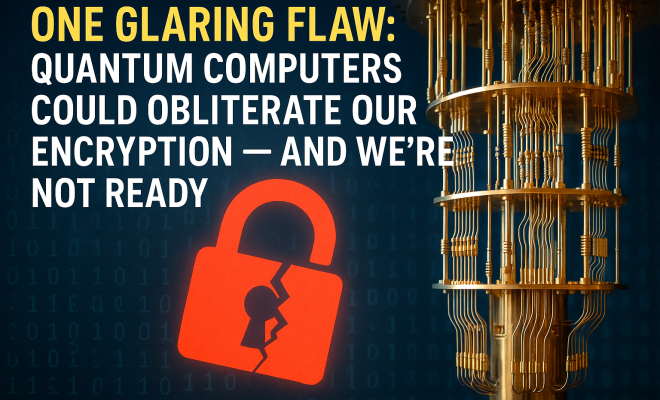
Imagine a world where every digital lock you rely on — from your bank account to classified government communications, even the private messages you send — could be picked effortlessly. Not by a master hacker painstakingly exploiting a vulnerability, but by a machine that simply brute-forces its way through, thanks to a fundamentally different way of processing information. This isn’t science fiction anymore. This is the very real, very urgent threat posed by the rapid advancements in quantum computing, a technology that could render our current global encryption standards utterly obsolete. And here’s the kicker: we might be closer to that reality than many realize, making the need to address the challenge of quantum computers encryption more pressing than ever.
For decades, our digital security has rested on the bedrock of cryptographic algorithms that are incredibly difficult, if not practically impossible, for even the most powerful conventional supercomputers to crack. These algorithms leverage mathematical problems that take an astronomical amount of time to solve. Think about it: trying every possible key for a strong encryption standard would take billions of years with today’s best machines. That’s why we feel secure. But quantum computers, operating on the bizarre principles of quantum mechanics, don’t play by the same rules. They have the potential to solve these ‘intractable’ problems in a fraction of the time, potentially reducing those billions of years to mere minutes or even seconds. The implications are staggering, and they touch every aspect of our digitally intertwined lives.
The Looming Quantum Threat: What Exactly Are We Up Against?
At its heart, the concern around quantum computers encryption stems from their ability to perform certain computations exponentially faster than classical computers. This isn’t just about faster processing; it’s about a fundamentally different paradigm. Classical computers use bits, which are either 0 or 1. Quantum computers use qubits, which can be 0, 1, or both simultaneously (a state called superposition). They can also be entangled, meaning their states are linked even when physically separated. These properties allow quantum machines to explore multiple possibilities at once, a massive advantage for certain types of problems.
Specifically, two well-known quantum algorithms pose a direct threat to our current cryptographic infrastructure: Shor’s algorithm and Grover’s algorithm. Shor’s algorithm, discovered by Peter Shor in 1994, is designed to efficiently factor large numbers into their prime components. This might sound obscure, but it’s the mathematical backbone of widely used public-key encryption schemes like RSA and elliptic curve cryptography (ECC). These are the algorithms that protect your online banking, secure web browsing (HTTPS), and countless other digital interactions. If Shor’s algorithm becomes practical on a sufficiently powerful quantum computer, these schemes will be broken.
Grover’s algorithm, while less devastating than Shor’s, offers a quadratic speedup for searching unsorted databases. This means it could significantly reduce the time it takes to crack symmetric-key encryption, like AES, by making brute-force attacks much more feasible. While it wouldn’t instantly break AES in the same way Shor’s could break RSA, it would weaken its security considerably, forcing us to adopt much longer key lengths, which in turn introduces its own set of performance challenges. The bottom line? The very foundations of our digital trust are at risk if we don’t start preparing for quantum computers encryption now.
Oratomic’s Alarming Research: A Ticking Clock?
The urgency of this threat was recently amplified by research coming out of Oratomic, a Caltech spinout. Their findings suggest that the quantum resources required to break some forms of encryption might be significantly less than previous estimates indicated. This is a critical development because it means the ‘quantum apocalypse’ — the point at which quantum computers become powerful enough to break current encryption — could arrive sooner than many cybersecurity experts had anticipated. Historically, the prevailing wisdom has been that we’d need truly massive, fault-tolerant quantum computers with millions of stable qubits to mount effective attacks against widely used encryption standards.
Oratomic’s work, while highly technical, essentially questions those resource estimates. If they are correct, then even smaller, noisier quantum machines that are already on the horizon, or perhaps even in existence in advanced research labs, could pose a credible threat. This isn’t just an academic debate; it has direct, real-world implications for how quickly we need to transition to quantum-resistant cryptography. It compresses the timeline for action, pushing governments, corporations, and individuals to accelerate their preparedness strategies. The ‘wait and see’ approach, always risky in cybersecurity, becomes even more perilous in the face of such potentially game-changing research.
The Global Stakes: What’s Really at Risk?
The potential fallout from a widespread encryption failure due to quantum computers is difficult to overstate. It’s not just about your personal data; it’s about the very fabric of our interconnected society. Think about financial transactions: every online payment, every wire transfer, every stock market trade relies on robust encryption. If that encryption is compromised, the global financial system could grind to a halt, leading to unprecedented economic chaos, identity theft on a scale we can barely imagine, and a complete loss of trust in digital commerce.
Then there’s government communication and national security. Classified data, intelligence reports, military communications, diplomatic cables – all currently protected by encryption standards that quantum computers could potentially shatter. This could expose state secrets, compromise military operations, and undermine national security infrastructures, potentially leading to geopolitical instability and a dramatic shift in global power dynamics. Critical infrastructure, like power grids, water treatment plants, and transportation systems, which increasingly rely on digital controls and encrypted communications, would also be vulnerable to widespread disruption and attack. The integrity of our healthcare records, intellectual property, and even democratic processes could be threatened. The entire concept of digital privacy, as we know it, would be fundamentally altered, making the need for robust quantum computers encryption solutions paramount. (See: NIST announces quantum-safe algorithms.)
The Challenge of ‘Harvest Now, Decrypt Later’
One of the most insidious aspects of the quantum threat isn’t just the immediate breaking of live communications. It’s the ‘harvest now, decrypt later’ scenario. Adversaries, whether nation-states or sophisticated criminal organizations, are already collecting vast amounts of encrypted data today. They’re storing this data, knowing that while they can’t break it with current classical computers, a future quantum computer might give them the key. Imagine decades of encrypted government communications, corporate secrets, or personal health records suddenly becoming readable. This creates a retroactive vulnerability that makes the quantum threat a present-day problem, not just a future one.
This means that even if a fully capable quantum computer is still five, ten, or even fifteen years away, the data you’re encrypting and transmitting today could be compromised by that future machine. This underscores the urgency: the transition to quantum-safe encryption isn’t something we can wait to begin until quantum computers are fully mature. We need to start now, not just to protect future communications, but to safeguard the sensitive information we’re generating every single day that has a long shelf life. The implications for long-term data archival and sensitive intelligence are particularly sobering. For more context, see AI Agents Just Hacked 7 Major Banks. This builds on encryption flaws uncovered.
Post-Quantum Cryptography: Our Best Hope
So, what’s the solution to this impending crisis? The answer lies in a new generation of cryptographic algorithms known as Post-Quantum Cryptography (PQC), or quantum-resistant cryptography. These are algorithms designed to run on classical computers but are believed to be resistant to attacks from both classical and quantum computers. The National Institute of Standards and Technology (NIST) has been leading a multi-year standardization process to identify and vet these new algorithms, a monumental undertaking that began in 2016 and is now nearing completion for several key algorithms.
The candidates for PQC rely on different mathematical problems than current encryption, problems that even quantum computers are expected to find hard to solve. These include lattice-based cryptography, code-based cryptography, multivariate polynomial cryptography, and hash-based cryptography. The selection process has been rigorous, involving multiple rounds of public scrutiny, cryptanalysis, and competition, with algorithms being evaluated for security, performance, and practicality. The goal is to provide a suite of standardized, quantum-resistant algorithms that can replace our current vulnerable ones across the entire digital ecosystem. This transition will be a massive undertaking, but it’s our most viable path forward to secure quantum computers encryption.
The Enormous Challenge of Transitioning to PQC
Moving from our current cryptographic standards to PQC is not a simple ‘patch and update’ operation. It’s an enormous, complex, and expensive undertaking, perhaps one of the largest IT infrastructure migrations in history. Think about the sheer number of systems, applications, devices, and protocols that rely on cryptography: every server, every router, every IoT device, every smartphone, every piece of software. Each one will eventually need to be updated to use quantum-resistant algorithms.
This transition will involve several critical steps: first, inventorying all cryptographic assets within an organization; second, prioritizing which systems need to be migrated first (often those with long data lifetimes or high sensitivity); third, developing and testing new PQC implementations; and finally, deploying these new algorithms across the entire infrastructure. This isn’t just about software; it’s about hardware, firmware, and embedded systems. Many legacy systems might not even be able to be updated, requiring costly replacements. The scale of this ‘crypto-agility’ challenge is truly daunting, demanding careful planning, significant investment, and international cooperation.
Washington’s Role: Leading the Charge
Given the global implications of this threat, governments, especially those with significant digital infrastructure and national security interests, have a crucial role to play. Washington, in particular, needs to be at the forefront of this effort. This isn’t just about protecting U.S. government systems; it’s about setting standards, encouraging innovation, and fostering a secure digital environment for the entire nation and its allies. The NIST standardization process is a fantastic start, but it’s just one piece of the puzzle.
Congress has already recognized this with legislation like the Quantum Computing Cybersecurity Preparedness Act, signed into law in 2022. This act mandates that federal agencies develop a plan to migrate to post-quantum cryptography. But legislation alone isn’t enough. There needs to be sustained funding, clear directives, and robust coordination across government agencies, industry, and academia. Washington needs to invest in research and development, develop workforce skills, and establish clear policies and guidelines to ensure a smooth, secure, and timely transition. A failure to lead on quantum computers encryption preparedness would have dire consequences for national security and economic stability.
Beyond Encryption: A Holistic Approach to Quantum Security
While post-quantum cryptography is the primary focus for securing our data against future quantum attacks, it’s important to remember that it’s just one piece of a larger cybersecurity puzzle. A holistic approach to quantum security also involves other considerations. For instance, quantum key distribution (QKD) is a method that uses the principles of quantum mechanics to establish cryptographic keys that are theoretically unhackable, even by quantum computers. While QKD has its own challenges in terms of distance and infrastructure, it’s an area of active research and could complement PQC in certain high-security applications.
Furthermore, organizations need to bolster their general cybersecurity hygiene. This includes robust access controls, multi-factor authentication, regular security audits, and employee training. Even the strongest quantum-resistant encryption won’t protect you if an adversary gains access through a simple phishing attack or an unpatched vulnerability. The advent of quantum computing serves as a powerful reminder that cybersecurity is an ongoing, evolving challenge, demanding constant vigilance and adaptation. It’s about building resilience into our digital systems, not just relying on a single silver bullet for quantum computers encryption. (See: Quantum computing and encryption challenges.)
Why the Urgency? The Economic Impact of a Quantum Attack
Beyond the immediate security and privacy concerns, a successful quantum attack on current encryption standards would have catastrophic economic consequences. The global economy is intrinsically linked to the security of digital transactions. In 2023, the total value of digital payment transactions worldwide reached over $9 trillion. Imagine even a fraction of that being compromised. The sheer volume of potential financial losses from fraud, intellectual property theft, and market manipulation would be unprecedented.
Consider the cost to businesses. Companies would face massive expenses for system overhauls, regulatory fines for data breaches, and a complete erosion of customer trust. Supply chains, increasingly digitized and reliant on secure communication, could crumble, leading to shortages and economic instability. Cybersecurity insurance premiums would skyrocket, or coverage might even become unavailable for quantum-related risks. The disruption to critical national infrastructure, like energy grids and transportation networks, could incur costs running into trillions of dollars, not just from direct damage but from lost productivity and recovery efforts. The economic incentive for bad actors, whether state-sponsored or criminal organizations, to develop or acquire quantum capabilities is immense, making the need for proactive defense an economic imperative, not just a security one. For more context, see Critical Infrastructure Faces Collapse From This Overlooked Threat.
The Role of International Cooperation and Standardization
Securing quantum computers encryption isn’t a task any single nation can tackle alone. Cryptography is inherently global; digital information flows across borders, and vulnerabilities in one country’s systems can impact others. This makes international cooperation absolutely essential. Organizations like NIST, though based in the U.S., have wisely engaged the global cryptographic community in their PQC standardization efforts. This ensures that the chosen algorithms are robust, widely understood, and can be implemented consistently worldwide.
Beyond algorithm selection, there’s a need for international collaboration on deployment strategies, best practices, and threat intelligence sharing. Governments need to work together to establish common regulatory frameworks that mandate or incentivize PQC adoption. Academic researchers globally are contributing to the cryptanalysis and development of new quantum-resistant schemes, and their work must be supported and coordinated. Without a unified, international front, individual nations or sectors that lag in their transition efforts will become weak links, exposing everyone to greater risk. This isn’t a zero-sum game; global digital security benefits all.
Expert Perspectives: What Leaders Are Saying
The quantum threat and the need for quantum computers encryption solutions are increasingly being highlighted by leaders across various sectors. Dr. Charles Tahan, Assistant Director for Quantum Information Science at the White House Office of Science and Technology Policy, has repeatedly emphasized the government’s commitment to PQC migration, calling it “a national priority.” He points to the significant investment and policy directives aimed at federal agencies transitioning their cryptographic systems.
From the private sector, prominent cybersecurity experts like Bruce Schneier have warned about the “crypto-apocalypse” if we fail to act decisively. He often stresses that the ‘harvest now, decrypt later’ threat means the clock is already ticking for data with long-term value. Industry leaders from companies like IBM, Google, and Microsoft, all heavily invested in quantum computing research, are also active participants in the PQC standardization process and are developing their own quantum-safe solutions, recognizing the immense market demand for such security. Their collective voices underscore that this isn’t a fringe concern but a mainstream, critical challenge for the digital age.
Comparing PQC Approaches: A Quick Look at the Algorithms
When we talk about Post-Quantum Cryptography, we’re not talking about a single algorithm but a family of different mathematical approaches. Each has its strengths and weaknesses in terms of security, performance, and implementation complexity.
- Lattice-based cryptography: This is currently the most prominent and well-studied family. It relies on the difficulty of solving certain problems in high-dimensional lattices. Algorithms like CRYSTALS-Kyber (for key encapsulation) and CRYSTALS-Dilithium (for digital signatures) are leading candidates in this category. They offer relatively good performance and are seen as highly promising.
- Hash-based cryptography: These schemes derive their security from the properties of cryptographic hash functions. XMSS and SPHINCS+ are examples. They are generally considered very secure and well-understood, but they can produce larger signatures and keys, making them less suitable for certain applications. They are often used for firmware signing and specific long-term archival needs.
- Code-based cryptography: This approach, primarily represented by the Classic McEliece algorithm, is based on error-correcting codes. It has a long history of study and is considered very secure against quantum attacks. However, it typically generates very large public keys, which can be a practical challenge for deployment in many current systems.
- Multivariate polynomial cryptography: Algorithms in this category rely on the difficulty of solving systems of multivariate polynomial equations over finite fields. While potentially offering compact signatures, they have historically been more prone to new cryptanalytic attacks, making them a more volatile choice, though research continues.
NIST’s multi-round competition has carefully weighed these factors, aiming to select a diverse portfolio of algorithms to ensure resilience even if one family were to be unexpectedly broken in the future. This diverse selection provides multiple layers of defense for quantum computers encryption.
Frequently Asked Questions about Quantum Computers and Encryption
Q1: When will quantum computers be powerful enough to break current encryption?
A: There’s no single, universally agreed-upon date. Estimates vary widely, from as early as 5-10 years (especially for forms of public-key encryption like RSA) to 15-20 years or more. Recent research, such as Oratomic’s, suggests the timeline might be shorter than previously thought. The ‘harvest now, decrypt later’ threat means that data encrypted today is already at risk from future quantum machines, so action is needed now. For more context, see Europe's New Regulations Are a Game-Changer. (See: BBC on quantum computing threats.)
Q2: Will quantum computers break ALL encryption?
A: Not necessarily. Shor’s algorithm primarily targets public-key cryptography (like RSA and ECC), which is used for key exchange and digital signatures. Grover’s algorithm could weaken symmetric-key cryptography (like AES) by speeding up brute-force attacks, but it wouldn’t break it instantly; it would require longer key lengths. Post-Quantum Cryptography (PQC) is being developed precisely to be resistant to quantum attacks.
Q3: What is Post-Quantum Cryptography (PQC)?
A: PQC refers to new cryptographic algorithms designed to run on classical computers but remain secure against attacks from both classical and future quantum computers. These algorithms are based on mathematical problems that are believed to be hard for quantum computers to solve, unlike the problems underlying current encryption standards.
Q4: How is NIST involved in securing quantum computers encryption?
A: The National Institute of Standards and Technology (NIST) has been leading a global, multi-year standardization process since 2016 to identify, evaluate, and standardize a suite of quantum-resistant cryptographic algorithms. This process involves multiple rounds of public review and cryptanalysis, ultimately aiming to provide a set of recommended PQC algorithms for widespread adoption.
Q5: What’s the biggest challenge in transitioning to PQC?
A: The biggest challenge is the sheer scale and complexity of the migration. Cryptography is embedded in countless systems, devices, and applications worldwide. Inventorying all cryptographic assets, developing and testing new PQC implementations, and then deploying them across entire infrastructures will be a monumental, costly, and time-consuming undertaking, requiring significant coordination and planning.
Q6: Does Quantum Key Distribution (QKD) solve the problem?
A: QKD is a promising technology that uses quantum mechanics to establish theoretically unbreakable keys. However, it has practical limitations, such as distance constraints and the need for dedicated quantum communication channels. It’s not a direct replacement for all current encryption uses and is more likely to complement PQC in specific high-security applications rather than being a universal solution for quantum computers encryption. For more on this, see Google's breakthrough in quantum computing.
The threat posed by quantum computers to our current encryption standards is no longer a distant possibility; it’s a tangible, rapidly approaching reality. The research from Oratomic and others only underscores the critical need for immediate and decisive action. The stakes couldn’t be higher: our financial systems, national security, critical infrastructure, and personal privacy are all on the line. The transition to post-quantum cryptography will be monumental, requiring unprecedented collaboration between governments, industry, and the scientific community. But delay is not an option. The time to prepare for quantum computers encryption is now, before the digital locks we rely on become nothing more than open doors.
Trending Now
- this guide on shocking: your smart ring knows when you’re having sex
- The SwiftRefi Scandal: 7 Astonishing Truths About Their ‘Zero-Fee’ Refinance
- this guide on the aion 2 scandal: why this korean mmo controversy is boiling over
- The Bombshell Truth About Gaming’s Legal…
- this guide on staggering: ai’s als breakthrough comes with a $5 million price tag
Frequently Asked Questions
What is the threat of quantum computing to encryption?
Quantum computing poses a significant threat to encryption by enabling the rapid solving of complex mathematical problems that currently secure our digital communications. Unlike conventional computers, quantum computers can process information in ways that could reduce the time needed to crack encryption from billions of years to mere minutes, jeopardizing the confidentiality of sensitive data.
How do quantum computers differ from classical computers?
Quantum computers operate on the principles of quantum mechanics, using qubits that can represent multiple states simultaneously, unlike classical computers that use bits as either 0 or 1. This allows quantum computers to perform certain calculations exponentially faster than classical systems, making them capable of breaking encryption methods that are currently considered secure.
Are we prepared for quantum computing's impact on digital security?
Currently, we are not fully prepared for the impact of quantum computing on digital security. The rapid advancements in quantum technology threaten to render existing encryption standards obsolete, highlighting the urgent need for new cryptographic solutions that can withstand the capabilities of quantum machines.
What will happen to encryption if quantum computers become mainstream?
If quantum computers become mainstream, they could effectively break the encryption that protects our online transactions, communications, and sensitive data. This could lead to widespread vulnerabilities, making it essential for industries to develop quantum-resistant encryption methods to safeguard information.
What steps are being taken to address quantum computing threats?
To address the threats posed by quantum computing, researchers and cryptographers are actively developing quantum-resistant algorithms and encryption methods. Initiatives are underway to transition current security protocols to more advanced systems that can withstand the computational power of quantum machines, ensuring digital security in the future.
Agree or disagree? Drop a comment and tell us what you think.