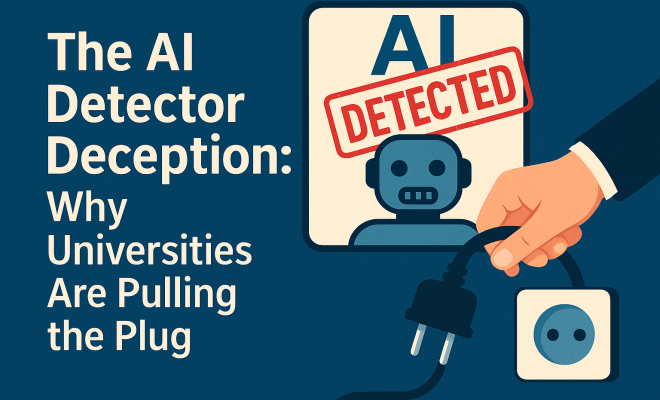
The AI Detector Deception: Why Universities Are Pulling the Plug
“`html
It feels like just yesterday we were being told that AI was going to revolutionize education, making everything smarter, faster, and more efficient. Yet, in what feels like a blink of an eye, a growing number of prominent universities are now hitting the brakes – hard – on one of the most touted applications: AI detectors. Institutions like Australia’s Curtin University and Singapore’s Nanyang Technological University are openly abandoning these tools, citing alarmingly high error rates and the profoundly unfair flagging of innocent students. This isn’t just a minor glitch; it’s a fundamental challenge to the very idea that AI detectors can reliably uphold academic integrity. And frankly, it raises some uncomfortable questions about how quickly we embraced these technologies without truly understanding their limitations.
The core issue here isn’t just about a few false positives; it’s about a systemic problem that disproportionately impacts vulnerable student populations, particularly those who write in English as a second language. Imagine the stress, the accusations, the potential disciplinary actions, all stemming from a flawed algorithm that can’t distinguish between a human struggling with syntax and a bot spitting out text. This situation has ignited a fierce debate that touches on everything from student privacy to the actual educational value of artificial intelligence, and it’s playing out in real-time across social media, academic forums, and university policy meetings. It’s a complex, emotionally charged discussion, and it’s forcing us to reconsider our reliance on technology when the stakes are so incredibly high.
The Unraveling Trust in AI Detectors
For a while, AI detectors were positioned as the silver bullet for academic integrity in the age of ChatGPT and other generative AI tools. The promise was simple: a quick scan, and you’d know if that essay was written by a student or a machine. Educators, grappling with the sudden explosion of AI’s capabilities, were understandably eager for a solution. Many institutions quickly adopted these tools, often without fully vetting their accuracy or understanding their potential biases. The appeal was undeniable – a seemingly objective, efficient way to maintain fairness and ensure students were doing their own work. But as the saying goes, if it sounds too good to be true, it probably is.
The reality, as many universities are now discovering, is far more complicated. The initial enthusiasm for AI detectors is rapidly giving way to skepticism, and in some cases, outright rejection. The decision by Curtin University and Nanyang Technological University to cease using these tools isn’t an isolated incident; it’s a canary in the coal mine, signaling a broader trend. These institutions are recognizing that the damage caused by false accusations, the erosion of trust between students and faculty, and the disproportionate impact on certain student demographics far outweigh any perceived benefits. It’s a stark reminder that technology, while powerful, is only as good as its underlying design and the ethical frameworks guiding its implementation.
The Alarming Error Rates and Unfair Flagging
Let’s get down to the brass tacks: the primary reason for this mass exodus from AI detectors is their demonstrably high error rates. We’re not talking about minor inaccuracies; we’re talking about tools that frequently misidentify human-written text as AI-generated, and vice-versa. This isn’t just an inconvenience; it’s a serious flaw with real-world consequences. Imagine a student pouring hours into an essay, only to have it flagged by an AI detector as machine-made. The immediate implication is academic dishonesty, a charge that can carry severe penalties, including failing grades, suspension, or even expulsion. The psychological toll on students facing such accusations, especially when they know they’ve done nothing wrong, can be immense.
One of the most troubling aspects of these errors is their disproportionate impact on second-language writers. Students who are still developing their English language proficiency often write in ways that AI detectors misinterpret as synthetic. Their sentence structures might be simpler, their vocabulary less varied, or their phrasing less idiomatic – all characteristics that can, ironically, make their writing appear ‘generic’ or ‘machine-like’ to an algorithm. This bias creates an incredibly unfair playing field, punishing students who are already working harder to express themselves in a non-native language. It’s an issue that directly undermines the principles of equity and inclusion that universities strive to uphold, turning a tool meant to ensure fairness into an instrument of discrimination.
AI’s Broader Impact on Student Learning and Outcomes
Beyond the specific failures of AI detectors, there’s a more pervasive concern about the overall impact of AI on student learning. When generative AI tools first emerged, there was a hopeful narrative that they could act as personalized tutors, research assistants, or brainstorming partners, ultimately enhancing the educational experience. Students would be freed from tedious tasks, allowing them to focus on higher-order thinking and creativity. But recent studies are painting a far less optimistic picture. It turns out that widespread AI use by students often correlates with worse academic outcomes, not better.
Why is this happening? One theory is that over-reliance on AI bypasses critical learning processes. If an AI can instantly generate an essay, a summary, or a solution to a problem, students might miss out on the crucial cognitive effort involved in research, critical analysis, synthesis, and original composition. These are the very skills that education is designed to cultivate. If students aren’t engaging in these processes, they aren’t truly learning. Instead, they might be developing a superficial understanding of subjects, relying on AI as a crutch rather than a tool for augmentation. This calls into question the fundamental purpose of higher education if AI becomes a substitute for genuine intellectual engagement.
The High-Stakes World of AI-Powered Proctoring
The controversy surrounding AI detectors isn’t an isolated incident; it’s part of a larger, more complex ethical minefield involving AI in education, particularly with AI-powered proctoring. During the pandemic, as online learning became the norm, many institutions turned to AI proctoring services to monitor students during exams. These systems use webcams, microphones, and advanced algorithms to detect suspicious behavior, flag eye movements, monitor background noise, and even analyze keystrokes. While the intention was to prevent cheating in a remote environment, the reality has been fraught with problems.
The issues are manifold. Privacy concerns are paramount, as these systems often require access to students’ personal spaces and sensitive biometric data. Fairness is another huge problem, with AI proctors frequently flagging innocent actions as suspicious, much like the AI detectors. A student looking away from the screen for a moment, a pet walking into the frame, or even a nervous fidget can trigger an alert, leading to undue stress and accusations. These systems have also been criticized for their biases, often struggling to accurately assess students with diverse physical characteristics or those in non-traditional testing environments. The backlash has been so significant that regulatory bodies, like those behind the EU AI Act, are now classifying AI-powered proctoring as a ‘high-risk’ application, demanding stringent oversight and ethical considerations. It’s a stark illustration of how quickly technological solutions can outpace ethical frameworks. (See: AI in education and detection tools.)
Navigating the Emotional Landscape of Academic Integrity
This entire debate is, understandably, incredibly emotionally charged. For educators, the core issue is academic integrity. They want to ensure that degrees are earned genuinely and that students are developing the skills they need to succeed. The proliferation of generative AI has presented an unprecedented challenge to this principle, leaving many feeling overwhelmed and scrambling for solutions. It’s a difficult position to be in, balancing the need to adapt to new technologies with the foundational values of education. For more context, see The Startling Truth About Liberal Arts vs Technical Education in the AI Era.
For students, the emotional stakes are even higher. Facing accusations of cheating, especially when unfounded, can be devastating. It undermines their trust in the institution, creates immense anxiety, and can unfairly tarnish their academic record. Imagine the frustration of knowing you’ve put in the work, only to be questioned by an impersonal algorithm. This creates an adversarial environment, where students might feel constantly under surveillance and presumed guilty until proven innocent. The social media engagement around this topic is immense precisely because it taps into these deep-seated feelings – fear of unfair treatment, frustration with technology, and the desire for a just academic system. It’s not just about policy; it’s about people’s lives and reputations.
The EU AI Act and High-Risk AI Applications
The regulatory landscape is finally catching up to the rapid pace of AI development. The European Union’s AI Act, a landmark piece of legislation, is a critical step in this direction. It categorizes AI systems based on their potential risk, with ‘high-risk’ applications facing the most stringent requirements. Notably, AI-powered proctoring and certain applications of AI in education, including those that could impact a person’s access to education or assessment outcomes, are falling squarely into this high-risk category. This classification isn’t just bureaucratic; it signifies a recognition of the profound societal impact these technologies can have and the need for robust safeguards.
What does ‘high-risk’ mean in practice? It translates to stricter rules around data quality, human oversight, transparency, accuracy, and cybersecurity. For developers and deployers of AI tools in education, it means a higher bar for compliance and a greater responsibility to ensure their systems are fair, accurate, and ethical. This regulatory pressure will undoubtedly influence how AI detectors and similar tools are developed and implemented globally, potentially leading to more responsible innovation. It’s a clear signal that the Wild West days of unchecked AI deployment are coming to an end, at least in some parts of the world.
Rethinking Academic Integrity in the AI Era
So, if AI detectors aren’t the answer, what is? This crisis forces us to fundamentally rethink how we approach academic integrity in an age where generative AI is ubiquitous. Banning AI outright is often impractical and, some would argue, counterproductive, as AI literacy is becoming an essential skill. The real solution likely lies in a multi-faceted approach that emphasizes pedagogical shifts, clear policy, and a renewed focus on authentic assessment.
Instead of trying to catch students using AI, perhaps we need to design assignments that make AI less useful for cheating and more useful for learning. This could involve more in-class writing, oral exams, project-based learning, or assignments that require critical thinking, synthesis, and personal reflection that AI struggles to replicate authentically. We might also need to explicitly teach students how to use AI ethically and effectively, viewing it as a tool for augmentation rather than replacement. The conversation needs to shift from ‘did you use AI?’ to ‘how did you use AI, and did it enhance your learning?’ It’s a challenging pivot, but one that is essential for the long-term relevance and integrity of education.
The Path Forward: Ethical AI and Educational Innovation
The current turbulence around AI detectors highlights a crucial truth: technology alone cannot solve complex human problems, especially in education. The path forward requires a thoughtful, ethical approach to AI integration, combined with genuine educational innovation. We need to move beyond simply adopting the latest tech gadget and instead focus on how AI can truly serve pedagogical goals and support student success, without compromising integrity or fairness.
This means investing in research to understand the genuine impacts of AI on learning, developing robust ethical guidelines for AI use in educational settings, and fostering a culture of critical AI literacy among both students and faculty. It also opens up significant opportunities for EdTech solutions that prioritize ethical AI design, robust cybersecurity for educational institutions, and online courses that equip individuals with the skills to navigate the AI landscape responsibly. The demand for comparison and solution-oriented content in this space is massive, targeting everyone from university administrators to individual students. Ultimately, the goal isn’t to demonize AI, but to harness its potential responsibly, ensuring that it enhances, rather than undermines, the fundamental mission of education.
The Technical Underbelly: Why AI Detectors Struggle
To really grasp why AI detectors are failing, it helps to understand a bit about how they theoretically work and where those theories break down in practice. Most AI detectors rely on statistical analysis of text patterns. They’re trained on massive datasets of both human-written and AI-generated text. The idea is that AI-generated text, especially from earlier models, often exhibits certain predictable characteristics: lower perplexity (meaning less variability in word choice), higher burstiness (less variation in sentence length), and a tendency towards common phrases or grammatical structures. Humans, on the other hand, are delightfully messy. We use slang, make grammatical errors, have unique stylistic quirks, and sometimes even write brilliantly convoluted sentences.
The problem is that newer AI models are constantly evolving, becoming far more sophisticated and adept at mimicking human writing. They’re explicitly trained to reduce those detectable ‘AI-isms.’ Imagine trying to catch a shapeshifter when they’re getting really good at shifting shapes. Furthermore, the very nature of language makes definitive classification incredibly hard. There’s no single “AI fingerprint” for text, and what looks “synthetic” to an algorithm might just be a student adhering strictly to a rubric, or as mentioned, someone whose natural writing style in a second language aligns with what the algorithm perceives as ‘generic.’ (See: impact of technology on youth.)
Another challenge is the “human-in-the-loop” issue. Even if an AI detector flags something, a human still has to review it. But if the human reviewer is biased, or doesn’t understand the nuances of the student’s background, or is simply overwhelmed by the sheer volume of flagged content, the tool’s initial inaccuracies are compounded. The technical limitations aren’t just about the algorithms; they’re also about the impossibility of achieving perfect accuracy in such a subjective domain and the human element in interpretation.
Expert Perspectives: Educators Weigh In
When you talk to educators on the front lines, the sentiment against AI detectors is often palpable. Dr. Anya Sharma, an English professor at a major public university, described her experience: “We tried using one for a semester, and it was a nightmare. I spent more time dealing with false positives and upset students than I did actually teaching. It created an atmosphere of distrust. My students were afraid to write in a clear, concise way because they thought it would get flagged.” This anecdote highlights a critical, often overlooked consequence: AI detectors can stifle genuine academic expression and creativity, pushing students towards deliberately less coherent writing just to avoid suspicion. For more context, see One Reckless Assumption About AI Could Ruin Healthcare.
From a pedagogical standpoint, Professor Mark Johnson, who teaches computer science, raises a different concern: “If we’re just trying to ‘catch’ students, we’re missing the point. AI is here to stay. Our job isn’t to pretend it doesn’t exist, but to teach students how to engage with it critically and ethically. Focusing on AI detectors is a distraction from the real work of integrating AI literacy into our curriculum.” This perspective suggests a shift from policing to educating, a more sustainable and forward-looking approach to the AI challenge in academia.
These expert voices underscore that the issue isn’t just technical; it’s deeply human and pedagogical. The tools are failing not just because of code, but because they fundamentally misunderstand the learning process and the diverse ways students engage with academic tasks.
The Cost of Inaccuracy: Beyond Academic Penalties
The immediate consequence of a false positive from an AI detector is usually an academic penalty or an investigation. But the costs ripple far beyond that. Think about the mental health impact. A student accused of cheating, especially one who genuinely put in the effort, can experience significant anxiety, depression, and a loss of self-esteem. Their trust in the institution, and in their instructors, can be severely damaged. This adversarial dynamic undermines the very purpose of education, which should be about fostering growth and intellectual curiosity, not suspicion.
There’s also the administrative burden. Investigating every flagged assignment takes time and resources – faculty time, administrative staff time, and sometimes even legal counsel. This diverts valuable resources away from actual teaching, research, and student support services. The “efficiency” promised by AI detectors often turns into an administrative quagmire, proving to be more expensive and time-consuming in the long run than traditional methods of assessing academic integrity.
Finally, there’s the reputational cost for universities. Institutions that continue to rely on flawed AI detection tools risk being seen as unfair, technologically inept, or even discriminatory. In an increasingly competitive global education market, a reputation for unjust academic practices can significantly impact student enrollment and faculty recruitment. The perceived benefit of catching a few cheaters might come at the expense of alienating a much larger population of honest, hardworking students and talented educators.
FAQ: Understanding AI Detectors and Academic Integrity
Q1: What exactly are AI detectors and how do they claim to work?
AI detectors are software tools designed to analyze text and determine whether it was written by a human or generated by an artificial intelligence model, like ChatGPT. They typically work by looking for statistical patterns, like low “perplexity” (predictability of words) and low “burstiness” (uniformity of sentence length), which were once common in early AI-generated text. They compare the analyzed text against large datasets of both human and AI writing to make a judgment.
Q2: Why are universities abandoning AI detectors?
Universities are abandoning AI detectors primarily due to their high error rates. These tools frequently produce “false positives,” incorrectly flagging human-written content as AI-generated, leading to unfair accusations against innocent students. They also exhibit biases, disproportionately affecting non-native English speakers or students with unique writing styles. The damage to student trust and the administrative burden of handling appeals often outweigh any perceived benefits. (See: Harvard University research on AI.)
Q3: What is a “false positive” in the context of AI detectors?
A false positive occurs when an AI detector incorrectly identifies human-written text as being generated by AI. For example, a student could write an essay entirely on their own, submit it, and the AI detector would report a high probability of AI involvement. These false accusations can lead to severe academic penalties and significant emotional distress for students.
Q4: How do AI detectors disproportionately affect non-native English speakers?
Non-native English speakers often write with simpler sentence structures, more direct phrasing, or a less varied vocabulary as they develop their proficiency. These characteristics can sometimes be misinterpreted by AI detectors as signs of AI generation, which tends to produce clear, grammatically correct, but sometimes generic text. This bias unfairly penalizes students who are already working hard to express themselves in a second language.
Q5: If AI detectors aren’t reliable, what are universities doing to uphold academic integrity?
Universities are shifting towards more holistic approaches. This includes redesigning assignments to require critical thinking, personal reflection, and in-class work that AI struggles to replicate. They’re also focusing on educating students about ethical AI use, fostering open dialogue about academic integrity, and using traditional assessment methods like oral exams, presentations, and project-based learning that emphasize the learning process over just the final product.
Q6: Are AI detection tools the same as AI-powered proctoring?
No, they are distinct but both fall under the umbrella of AI in education. AI detectors analyze written text for AI generation. AI-powered proctoring systems, on the other hand, monitor students during online exams using webcams, microphones, and algorithms to detect suspicious behavior, eye movements, and background noise. Both have faced significant criticism regarding accuracy, privacy, and fairness.
Q7: What is the EU AI Act, and how does it relate to AI in education?
The EU AI Act is a landmark regulation that categorizes AI systems based on their risk level. Certain AI applications in education, particularly those that impact assessment outcomes (like grading or admissions) or monitor individuals (like AI proctoring), are classified as “high-risk.” This means they’ll face stringent requirements for accuracy, transparency, human oversight, and data quality to ensure they are fair and ethical. This act sets a precedent for how AI in education might be regulated globally. There’s a fuller look at AI detection issues.
Q8: Can students use AI tools ethically in their academic work?
Yes, many educators believe AI tools can be used ethically and effectively as learning aids. This might involve using AI for brainstorming ideas, summarizing complex texts, refining grammar, or generating outlines. The key is to use AI as an augmentation tool to support personal learning and critical thinking, rather than as a replacement for original thought, and always with transparency and adherence to university policies.
Q9: What should students do if their work is falsely flagged by an AI detector?
If your work is falsely flagged, the first step is to gather all evidence of your writing process (drafts, notes, research materials, version history). Then, calmly and respectfully communicate with your instructor or the relevant academic integrity office. Explain your process, present your evidence, and ask for a fair review of your work by a human, emphasizing the known inaccuracies of AI detection tools. Seek support from student services or an ombudsman if available.
“`
Trending Now
Frequently Asked Questions
Why are universities abandoning AI detectors?
Universities like Curtin University and Nanyang Technological University are abandoning AI detectors due to alarmingly high error rates and the unfair flagging of innocent students. These tools have proven unreliable in distinguishing between human writing and AI-generated text, leading to significant concerns about academic integrity and the potential stress inflicted on vulnerable student populations.
What are the limitations of AI detectors in education?
AI detectors face significant limitations, including high false positive rates that disproportionately affect non-native English speakers. They often struggle to accurately differentiate between struggling students and AI-generated content, raising concerns about their reliability and fairness in maintaining academic integrity.
How do AI detectors impact students?
AI detectors can create undue stress for students, particularly those who are non-native English speakers. The potential for false accusations based on flawed algorithms can lead to disciplinary actions, affecting students' academic records and mental well-being.
What are the concerns surrounding AI detectors in academic settings?
Concerns about AI detectors in academia include their high error rates, potential for unfair treatment of students, and implications for student privacy. These issues raise broader questions about the role of technology in education and its impact on learning outcomes.
What is the debate over AI detectors in education?
The debate centers on the effectiveness and fairness of AI detectors in upholding academic integrity. Critics argue that reliance on these tools can harm vulnerable student groups and that the technology was embraced too quickly without fully understanding its limitations.
Agree or disagree? Drop a comment and tell us what you think.