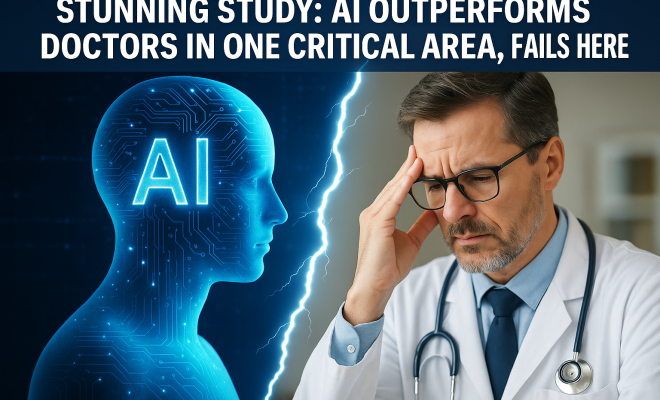
Stunning Study: AI Outperforms Doctors in ONE Critical Area, Fails Here
The promise of artificial intelligence in healthcare has long captivated our collective imagination. We envision a future where AI acts as an infallible co-pilot, guiding medical decisions with unparalleled precision, reducing errors, and ultimately saving lives. But how close are we to that reality? A groundbreaking Israeli study, recently published in the Annals of Internal Medicine on October 21, 2026, offers some fascinating, and at times perplexing, insights into the capabilities of leading large language models (LLMs) when it comes to a very specific, yet critical, aspect of medicine: recommending medical tests.
What this research reveals is a nuanced picture. On one hand, AI demonstrates a remarkable ability to identify when certain medical interventions are simply not needed, showing an impressive restraint that mirrors — and in some cases, even surpasses — human clinicians. On the other hand, the study uncovers a significant Achilles’ heel for AI: its accuracy plummets precisely in those complex scenarios where human medical consensus is already divided. This dichotomy forces us to confront some fundamental questions about the role of AI vs human doctors decision-making in medical tests, patient safety, and the indispensable need for human oversight, especially when we consider the ever-present shadow of patient data privacy concerns.
The Alarming Efficiency of AI in Avoiding Unnecessary Care
Let’s start with the good news, and it’s genuinely impressive. The Israeli study, spearheaded by researchers from Ben-Gurion University of the Negev and Clalit Health Services, including Dr. Dean Ariel and Dr. Guy Laban, found that these sophisticated LLMs were surprisingly adept at spotting situations where ordering additional medical tests or procedures would be superfluous. In fact, the AI models recommended unnecessary care in a mere 5.4% of cases. Think about that for a moment. This isn’t just a minor improvement; it’s a significant reduction in potential over-treatment, over-diagnosis, and the associated financial and emotional burden on patients.
For years, healthcare systems globally have grappled with the issue of unnecessary medical tests. From routine blood work that yields no actionable insights to advanced imaging scans performed out of an abundance of caution rather than clinical necessity, the problem is pervasive. These tests not only drive up healthcare costs but can also lead to patient anxiety, false positives, and subsequent invasive procedures that carry their own risks. An AI that can reliably flag such instances could be a monumental asset, streamlining care, reducing waste, and focusing resources where they’re truly needed. It suggests a future where the initial screening for test necessity could be significantly optimized, freeing up human doctors to concentrate on more intricate diagnostic puzzles.
Where AI Stumbles: The Thorny Landscape of Medical Disagreement
Here’s where the plot thickens, and where the enthusiasm for AI’s infallibility needs a dose of reality. While AI performs admirably in straightforward scenarios, its accuracy takes a noticeable nosedive when confronted with medical situations where human doctors themselves can’t agree. The study specifically highlighted that the AI’s ability to exercise restraint in ordering tests mirrors human doctors’ habits, stumbling precisely where clinicians themselves hesitate. This isn’t just a coincidence; it’s a profound observation.
Medicine, despite its scientific foundations, is often as much an art as a science. There are countless grey areas, emerging evidence, and patient-specific nuances that make black-and-white decisions impossible. When a consensus hasn’t fully formed within the medical community on the best course of action for a particular condition or symptom presentation, AI struggles to fill that void. It’s almost as if the AI, having been trained on vast datasets of human medical knowledge, inherits the uncertainties and disagreements embedded within that data. It can’t magically conjure a definitive answer where one doesn’t yet exist among its human teachers.
The Echo Chamber Effect: AI Reflecting Human Uncertainty
This finding isn’t just interesting; it’s a crucial point of reflection for anyone considering the future of AI in clinical settings. What this study suggests is that AI, particularly LLMs trained on existing medical literature and clinical notes, essentially acts as a sophisticated echo chamber. When the human medical community speaks with a clear, unified voice about the necessity (or lack thereof) of a particular test, the AI echoes that clarity. It learns the patterns, the guidelines, and the established best practices.
However, when the human medical community produces a cacophony of differing opinions, conflicting studies, or simply a lack of definitive evidence, the AI’s output becomes similarly muddled. It can’t synthesize a consensus that isn’t there. This isn’t necessarily a failure of the AI itself, but rather a reflection of its foundational training. It underscores that while AI can process information at an unprecedented scale, its ‘intelligence’ is, for now, largely derived from and constrained by the human knowledge it consumes. This dynamic is particularly relevant when evaluating AI vs human doctors decision-making in medical tests, as it highlights the inherent limitations of current AI models.
Implications for Clinical Decision-Making and Patient Safety
The implications of this study for clinical decision-making are profound. On one hand, the prospect of AI efficiently sifting through potential unnecessary tests offers a tantalizing vision of a more streamlined, cost-effective, and patient-centric healthcare system. Imagine a future where AI flags a request for an MRI that’s unlikely to change management, prompting the human doctor to reconsider or seek further justification. This could reduce unnecessary radiation exposure, invasive procedures, and financial burdens on patients and insurers alike.
On the other hand, the AI’s struggle in areas of medical disagreement raises significant patient safety concerns. If an AI, acting as an autonomous or semi-autonomous decision-maker, makes a recommendation in a medically contentious area, could it inadvertently lead to sub-optimal care? What if its recommendation, based on an incomplete or biased interpretation of conflicting evidence, deviates from what a human expert might consider reasonable? This isn’t just theoretical; it touches upon the very real responsibility of ensuring that AI integration genuinely enhances, rather than compromises, patient well-being. (See: Annals of Internal Medicine study.)
The Indispensable Role of Human Oversight
Given these findings, the necessity of robust human oversight in AI-driven healthcare becomes even more glaringly obvious. The study doesn’t suggest replacing human doctors with AI; rather, it makes a compelling case for AI as a powerful diagnostic and decision-support tool that requires expert human guidance. Think of AI as an incredibly intelligent, but still developing, junior colleague.
A human physician brings not just a vast repository of medical knowledge, but also critical thinking, ethical reasoning, empathy, and the ability to interpret nuance that current AI models simply lack. They can weigh conflicting evidence, consider patient preferences and values, and apply clinical judgment in situations where no clear-cut answer exists. In essence, the human doctor serves as the ultimate arbiter, validating AI recommendations in straightforward cases and critically evaluating them – or overriding them entirely – in complex, ambiguous, or contentious scenarios. This collaborative approach between AI and human doctors decision-making in medical tests seems to be the most prudent path forward. For more context, see AI healthcare startup revolutionizing patient care.
Navigating the Ethical Minefield: Trust, Accountability, and Data Privacy
The introduction of AI into sensitive areas like medical test recommendations immediately throws us into a complex ethical minefield. Who is accountable if an AI makes a wrong recommendation that leads to patient harm? Is it the developer of the AI, the hospital that implements it, or the physician who uses it? These questions are far from settled and will require careful deliberation by legal, ethical, and medical experts.
Then there’s the ever-present shadow of patient data privacy. AI models, particularly LLMs, thrive on vast amounts of data. In healthcare, this data is inherently sensitive and protected. Ensuring that patient information is used ethically, securely, and in compliance with stringent regulations like HIPAA (in the US) or GDPR (in Europe) is paramount. Any breach or misuse could erode public trust, which is already a delicate commodity in healthcare. The integration of AI must not come at the cost of patient confidentiality or autonomy.
Building Trust: Transparency and Explainability in AI
For AI to truly gain widespread acceptance and trust in clinical settings, especially when influencing decisions like ordering medical tests, it needs to be more than just accurate; it needs to be transparent and explainable. What does that mean? It means healthcare professionals and patients alike need to understand how the AI arrived at its recommendation. It’s not enough for the AI to simply say, “don’t order this test.” It needs to provide a rationale, citing the evidence or the patterns it identified that led to that conclusion.
This is where the concept of “explainable AI” (XAI) becomes critical. If an AI can articulate its reasoning, even in complex scenarios where doctors disagree, it allows human clinicians to critically evaluate that reasoning, identify potential biases, and ultimately make a more informed decision. Without transparency, AI recommendations will always be viewed with a degree of suspicion, especially in high-stakes situations where human lives are on the line. Building this trust is fundamental for the successful integration of AI vs human doctors decision-making in medical tests.
The Future Is Hybrid: Collaboration Over Replacement
What this Israeli study ultimately reinforces is a vision of the future that isn’t about AI replacing human doctors, but rather about a powerful collaboration. Imagine a scenario where an AI acts as an incredibly efficient first-pass filter, flagging potentially unnecessary tests with high confidence, thus freeing up a doctor’s valuable time. The doctor can then focus their expertise on the more challenging cases, the ones where the AI falters, where nuance, empathy, and deeply human judgment are indispensable.
This hybrid model leverages the strengths of both. AI offers unparalleled data processing speed and pattern recognition across massive datasets, identifying efficiencies and potential pitfalls that a single human might miss. Human doctors provide the critical thinking, ethical framework, emotional intelligence, and ability to navigate ambiguity that AI currently lacks. The challenge now lies in meticulously designing the interfaces, workflows, and regulatory frameworks that allow this collaboration to flourish safely and effectively, ensuring that the patient always remains at the center of this technological revolution.
Training the Next Generation of Clinicians for the AI Era
This evolving landscape also has profound implications for medical education. Future generations of doctors won’t just need to be experts in anatomy, physiology, and pathology; they’ll also need to be adept at interacting with AI systems. This means understanding how AI works, its capabilities, its limitations, and how to critically evaluate its recommendations. They’ll need to learn to collaborate with AI, not just as a tool, but as an integral part of their diagnostic and treatment arsenal.
Medical schools and continuing education programs will need to adapt, incorporating curricula on AI ethics, data science fundamentals, and the practical application of AI in clinical settings. The goal isn’t to turn doctors into computer scientists, but to empower them to be intelligent users and supervisors of AI. This shift in education will be crucial in maximizing the benefits of AI vs human doctors decision-making in medical tests while mitigating its risks, ensuring that the human element remains central to patient care.
The Impact of AI on Healthcare Costs and Resource Allocation
Beyond individual patient care, the study’s findings about AI’s ability to reduce unnecessary testing have significant macroeconomic implications for healthcare systems. Global healthcare spending continues to rise, driven by factors like aging populations, chronic diseases, and, yes, over-utilization of diagnostic tests. The U.S. alone spends trillions annually on healthcare, a substantial portion of which is attributable to diagnostic services. Studies from organizations like the Institute of Medicine have repeatedly highlighted the problem of waste in healthcare, with unnecessary services being a major contributor.
An AI system that consistently reduces unnecessary tests by even a small percentage across a large population could translate into billions of dollars in savings. These savings aren’t just about reducing the financial burden; they’re about reallocating resources. Imagine if the money saved from superfluous imaging scans or lab tests could be invested in preventive care programs, mental health services, or addressing healthcare disparities. AI could act as a powerful lever for optimizing resource allocation, ensuring that expensive medical equipment and personnel are utilized for cases where they are genuinely needed, rather than being tied up by low-value interventions. This efficiency gain is a compelling argument for integrating AI into the decision-making process for medical tests, particularly in resource-constrained environments. (See: CDC on healthcare decision-making.)
Addressing Bias in AI: A Critical Challenge for Equitable Healthcare
While the Israeli study highlights AI’s strengths and weaknesses in clinical scenarios, it also implicitly touches upon a crucial, often overlooked, aspect: bias. AI models are only as unbiased as the data they are trained on. If the historical medical data used to train an LLM disproportionately represents certain demographics (e.g., specific racial groups, socioeconomic classes, or geographic regions) or reflects existing biases in human medical practice, the AI will inherit and potentially amplify those biases.
For example, if past medical records show that a particular test was historically under-ordered for certain minority groups due to systemic biases in healthcare, an AI trained on this data might perpetuate that under-ordering. This could lead to significant health inequities, where AI recommendations inadvertently worsen existing disparities in diagnosis and treatment. Developing truly equitable AI requires not just vast datasets, but representative and unbiased datasets. Researchers and developers must actively work to identify and mitigate these biases, perhaps by oversampling underrepresented groups or using specialized algorithms designed to detect and correct for bias. This ethical imperative is paramount when considering the role of AI vs human doctors decision-making in medical tests, as it directly impacts patient outcomes and trust. For more context, see AI drug discovery problem in healthcare.
The Role of Real-World Data and Continuous Learning
The Israeli study used existing LLMs, presumably trained on a static dataset up to a certain point. However, the future of AI in medicine isn’t static. It’s about continuous learning from real-world data. Imagine AI models that don’t just learn from historical records but continuously update their knowledge base as new medical research emerges, new guidelines are published, and new patient outcomes are recorded. This dynamic learning would allow AI to adapt to the ever-evolving landscape of medical science.
This continuous feedback loop could refine AI’s ability to navigate those “grey areas” where human consensus is divided. As more data becomes available from diverse patient populations and different treatment approaches, AI might start to identify subtle patterns or emerging best practices that human analysis alone might miss. This isn’t to say AI will magically solve medical disagreements, but it could provide new insights or highlight specific evidence points that help shift the needle towards consensus. The challenge here is managing the quality and reliability of this continuous input, ensuring that the AI learns from accurate, peer-reviewed data and not from anecdotal or flawed information.
Patient Engagement and Shared Decision-Making with AI Assistance
Ultimately, medical decisions, especially those involving tests and procedures, should always be a collaborative effort between the doctor and the patient, known as shared decision-making. AI can play a supportive role in this process too. By providing clearer, more digestible information about the pros and cons of various tests, their likelihood of providing actionable insights, and potential risks, AI could empower patients to be more active participants in their care.
For instance, an AI tool could present a patient with personalized statistics on the probability of a certain test detecting a condition, based on their individual risk factors and symptoms. It could also outline the costs, potential side effects, and what different results might mean. This level of personalized, data-driven information, presented in an understandable format, could significantly enhance patient literacy and facilitate more meaningful conversations with their doctors. The goal isn’t for AI to dictate choices, but to provide a robust informational foundation that helps patients and doctors make the best decisions together. This strengthens the collaborative framework of AI vs human doctors decision-making in medical tests.
Frequently Asked Questions about AI vs Human Doctors in Medical Test Decisions
What is the core finding of the Israeli study regarding AI in medical test recommendations?
The study found that AI (specifically LLMs) is remarkably good at identifying when medical tests are unnecessary, recommending them in only 5.4% of cases. However, its accuracy significantly drops in complex scenarios where human doctors themselves have divided opinions or lack clear consensus.
Can AI replace human doctors in deciding which medical tests to order?
No, the study strongly suggests a hybrid model where AI acts as a powerful decision-support tool, not a replacement. Human doctors remain essential for critical thinking, ethical judgment, interpreting nuance, and navigating complex, ambiguous cases where AI currently struggles.
How can AI help reduce healthcare costs related to medical tests?
By efficiently identifying and flagging potentially unnecessary tests, AI can help reduce over-treatment, over-diagnosis, and the associated financial and emotional burdens on patients and healthcare systems. This can free up resources for more critical areas of care.
What are the main ethical concerns with AI making medical test recommendations?
Key concerns include accountability for errors (who is responsible if AI makes a wrong recommendation?), patient data privacy and security, and the potential for AI to perpetuate or amplify existing biases present in its training data, leading to health inequities. For more context, see breakthroughs in cancer treatment. (See: WHO on AI in healthcare.)
What is “explainable AI” (XAI) and why is it important in healthcare?
Explainable AI refers to AI systems that can provide a clear rationale for their recommendations, showing how they arrived at a particular conclusion. This transparency is crucial in healthcare for building trust, allowing clinicians to critically evaluate AI suggestions, and ensuring patient safety.
How will medical education need to adapt to the increasing role of AI in healthcare?
Future clinicians will need training in AI ethics, data science fundamentals, and the practical application and critical evaluation of AI tools in clinical settings. The focus will be on learning to collaborate with AI effectively, understanding its capabilities and limitations, rather than becoming AI developers.
Does AI’s struggle in areas of medical disagreement mean it’s flawed?
Not necessarily. The study suggests that AI, trained on human medical knowledge, reflects the uncertainties and disagreements already present within that knowledge. It acts as an “echo chamber,” highlighting areas where human consensus is still forming, rather than creating new uncertainties.
How can AI help with patient engagement and shared decision-making?
AI can provide patients with personalized, clear, and data-driven information about various tests, their probabilities, risks, and implications. This empowers patients to better understand their options and have more informed discussions with their doctors, fostering shared decision-making.
What are the challenges in preventing bias in AI medical recommendations?
The primary challenge is ensuring that the vast datasets used to train AI are representative and free from historical biases that might be embedded in medical records. If training data disproportionately represents certain demographics, the AI might perpetuate or even amplify existing health disparities.
What is the long-term vision for AI and human doctors working together in medical test decisions?
The vision is a hybrid model: AI handles routine, high-volume tasks like initial screening for test necessity, increasing efficiency and reducing waste. Human doctors then focus their expertise, critical thinking, and empathy on complex, ambiguous, and ethically challenging cases, ensuring patient-centered care and optimal outcomes.
The Israeli study offers a compelling snapshot of AI’s current capabilities in healthcare. It shows us an AI that is remarkably efficient at identifying when to exercise restraint in ordering medical tests, demonstrating a keen eye for unnecessary interventions. But it also reveals an AI that, for now, is still finding its footing in the complex, grey areas of medicine where human experts themselves diverge. This isn’t a flaw in AI necessarily, but a mirror reflecting the inherent complexities of medical science. The path forward is clear: it’s not AI versus human doctors, but AI with human doctors, a partnership built on trust, transparency, and an unwavering commitment to patient well-being.
Trending Now
Frequently Asked Questions
How does AI compare to doctors in recommending medical tests?
A recent study shows that AI outperforms doctors in identifying unnecessary medical tests, recommending them in only 5.4% of cases. This suggests that AI can effectively reduce unnecessary interventions, showcasing its potential as a valuable tool in healthcare decision-making.
What are the limitations of AI in healthcare?
The study highlights a significant limitation of AI, particularly in complex scenarios where medical consensus is divided. In such cases, AI's accuracy declines, emphasizing the need for human oversight in critical medical decisions.
What did the Israeli study reveal about AI's capabilities?
The Israeli study published in the Annals of Internal Medicine found that AI excels at recognizing when medical tests are not needed, often surpassing human clinicians in this area. However, it struggles in ambiguous situations where doctors themselves may disagree.
Why is human oversight important in AI healthcare applications?
Human oversight is crucial in AI healthcare applications because AI can falter in complex decision-making scenarios. Ensuring that human clinicians review AI recommendations helps maintain patient safety and addresses concerns regarding data privacy.
What impact does AI have on patient safety in healthcare?
AI has the potential to enhance patient safety by reducing unnecessary medical tests and interventions. However, its limitations in certain complex cases necessitate careful human oversight to ensure that patients receive appropriate care.
Have you experienced this yourself? We'd love to hear your story in the comments.