StarCraft: Mastering Strategy, Skill & Asymmetrical Races
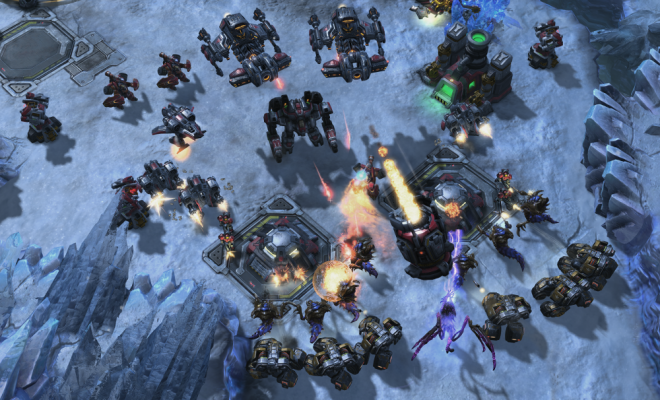
At the heart of StarCraft’s enduring popularity lies its intricate and finely tuned gameplay mechanics. The game’s design philosophy of “easy to learn, difficult to master” has created a gaming experience that is accessible to newcomers yet deep enough to sustain professional-level play for decades.
The core of StarCraft’s gameplay revolves around resource management, base building, and army control. Players must gather two types of resources – minerals and vespene gas – to fund the construction of structures and units. This economic aspect of the game creates a constant tension: players must balance economic growth with military production and expansion.
One of StarCraft’s most innovative features is its asymmetrical race design. The Terrans, Zerg, and Protoss each have unique mechanics that dramatically affect how they’re played:
- Terrans excel at defensive play and positional warfare. Their ability to lift and relocate buildings gives them unparalleled flexibility.
- Zerg embody a swarm mentality, capable of rapidly producing large numbers of relatively cheap units. Their unique larva mechanic allows for sudden swings in army composition.
- Protoss units are generally more expensive and powerful, emphasizing quality over quantity. Their warp-in mechanic for producing units adds a layer of strategic depth.
Despite these differences, the races are remarkably well-balanced, a testament to Blizzard’s careful design and ongoing balance patches.
The concept of “macro” and “micro” management is central to StarCraft gameplay. Macro refers to large-scale economic decisions and production, while micro involves the fine control of individual units in combat. Mastery of both is essential for high-level play.
StarCraft’s pacing is another crucial element of its design. Games typically start slow, with players building up their economies and defenses. As resources accumulate and technologies are researched, the pace quickens, often culminating in massive, army-destroying battles.
The fog of war mechanic adds an element of uncertainty and encourages scouting. Players must actively gather information about their opponent’s strategies and adapt accordingly, adding a psychological dimension to the game.
StarCraft also pioneered several gameplay mechanics that have become standard in the RTS genre:
- Control groups allow players to quickly select and command specific sets of units.
- Production queues enable continuous unit production without constant player input.
- Waypoints and patrol commands provide options for automated unit movement.
- Unit counters create a rock-paper-scissors dynamic that encourages diverse army compositions.
The game’s map design is another critical component of its gameplay. Maps are carefully crafted to balance resource distribution, choke points, and expansion opportunities. The variety of map layouts ensures that players must adapt their strategies for each game.
StarCraft II introduced several new mechanics while maintaining the core gameplay of its predecessor. Additions like the Zerg Queen’s larva inject ability and the Protoss Mothership Core (later replaced by the Shield Battery) added new layers of strategic depth.
The multiplayer ladder system, refined in StarCraft II, provides a compelling progression system for players of all skill levels. The matchmaking algorithm ensures that players are consistently challenged with opponents of similar skill.
Custom games and map editors have always been a significant part of StarCraft’s appeal.