Solar Storm and Earthquake: A Cosmic Connection Unveiled
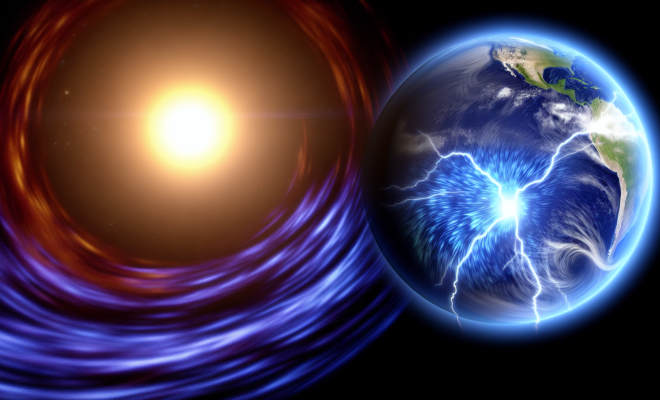
Recent developments in solar activity have sparked a wave of interest and concern within the scientific community, particularly regarding the potential influence of solar storms on Earth’s geological stability. A substantial solar storm has recently triggered a G3 geomagnetic storm on Earth, coinciding with two significant seismic events in 2026—two earthquakes registering magnitudes of 6.6 and 6.7, which occurred within a mere 36-hour window.
Understanding the Solar Storm
The solar storm in question was marked by an extraordinary increase in solar wind strength, reaching levels rarely observed before. According to geophysicist Stefan Burns, the magnetic field strength (Bt) peaked at approximately 40 nanoteslas (nT), indicating a surge in solar activity that has heightened global energetic volatility.
The Role of Solar Wind
Solar wind is a stream of charged particles emitted by the Sun, and variations in its strength can have profound effects on the Earth’s magnetosphere. An increase in solar wind can disturb the natural balance of Earth’s magnetic field, potentially leading to geomagnetic storms. These storms can disrupt satellite operations, communications, and even power grids on Earth.
The Correlation with Earthquakes
What makes this particular incident noteworthy is the timing of the solar storm with the occurrence of the two earthquakes. The first earthquake struck with a magnitude of 6.6, followed shortly by a 6.7 magnitude quake. These seismic events raised eyebrows among scientists, who began examining the possible connections between solar activity and tectonic movements.
The Gigantic Coronal Hole
A significant factor in the recent solar events is a gigantic coronal hole located on the Earth-facing side of the Sun. This hole, which allows solar wind to escape more freely, was perfectly aligned with Earth during the time of the earthquakes. Coronal holes are areas where the Sun’s magnetic field opens up, permitting solar wind to flow more rapidly and influence the Earth’s environment.
Experts believe that the presence of such a coronal hole can enhance the likelihood of geomagnetic storms. The alignment of the coronal hole with Earth created a scenario ripe for increased solar wind activity, which, in turn, may have played a role in destabilizing geological structures on our planet.
The Impact of Planetary Alignments
Adding another layer of complexity to this situation is the rare planetary alignment involving Saturn and Neptune. These celestial bodies were positioned in a unique configuration, termed a “kazmi,” which refers to their alignment with Earth and the Sun. Such alignments are believed to exert gravitational influences that could affect geological processes.
What This Means for Earth
The combination of heightened solar activity, the presence of a coronal hole, and the unusual planetary alignments suggests that Earth is currently in a state of higher-than-normal energetic volatility. This condition may create an environment conducive to further seismic activity.
While the scientific community is still investigating the precise mechanisms through which solar storms might influence earthquakes, there is a growing body of evidence suggesting that geomagnetic disturbances can have effects on tectonic stress. Earthquakes are complex phenomena influenced by a multitude of factors, but the role of solar activity is an area of increasing interest.
Future Implications
As scientists continue to gather data and perform analyses, the implications of this solar storm and its correlation with seismic activity will be closely monitored. The observations made during this period may provide valuable insights into the dynamics of Earth’s geology and the potential influence of solar phenomena.
Understanding these connections could lead to better predictive models for both solar storms and earthquakes, potentially enhancing our preparedness for such natural events. The need for ongoing research in this area is critical, especially as we enter an era of increased solar activity.
Conclusion
In conclusion, the recent solar storm and its coincidental timing with significant earthquakes prompt a fascinating exploration into the interconnections between solar activity and geological events on Earth. As we look to the future, the importance of studying these phenomena becomes increasingly clear, offering the potential for improved safety and awareness in the face of natural disasters.
Stay tuned as researchers delve deeper into this intriguing relationship, and prepare for a future where our understanding of the cosmos enhances our ability to navigate life on Earth.