JWST Unveils Hidden Wonders of the W51 Starbirth Region
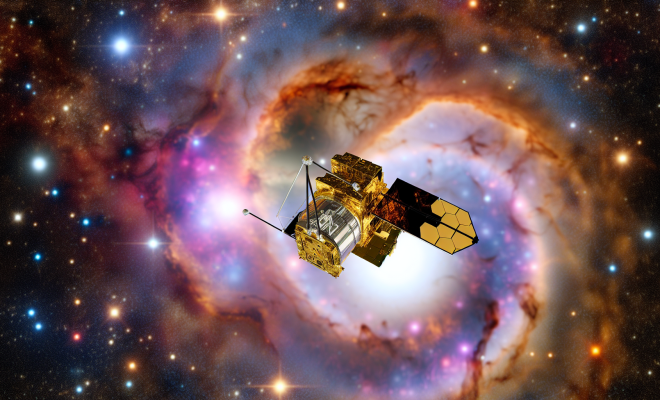
The James Webb Space Telescope (JWST) has taken a giant leap forward in our understanding of stellar nurseries with its latest observations of the W51 starbirth region. This newly revealed domain of star formation, known as W51, is a colossal crèche where new stars are born, and JWST’s advanced capabilities have unveiled previously hidden details that promise to reshape our comprehension of these celestial phenomena.
Unveiling the W51 Starbirth Region
Located approximately 17,000 light-years away from Earth in the constellation Aquila, the W51 region is one of the most massive star-forming areas in our galaxy. This stellar nursery is not just a singular entity but a complex structure that contains multiple clusters of stars and dense molecular clouds. The JWST’s infrared vision allows scientists to peer through the thick dust that often obscures such regions, revealing the dynamic processes that take place during star formation.
Advanced Observational Capabilities
Launched in December 2021, the JWST is equipped with state-of-the-art instruments that are designed to observe the universe in infrared wavelengths. This capability is crucial for studying starbirth regions like W51, where the dense clouds of gas and dust can block visible light. The telescope’s Near Infrared Camera (NIRCam) and Mid-Infrared Instrument (MIRI) have been pivotal in providing a clearer picture of the star formation processes occurring within W51.
New Insights into Star Formation Processes
The recent findings from JWST have shed light on several key aspects of star formation in W51. Observations reveal that the region hosts both young and mature stars, alongside the raw materials necessary for star formation: gas and dust. This rich environment is instrumental in understanding how stars like our Sun came into existence.
- Stellar Clusters: JWST has identified numerous stellar clusters within W51, each containing young stars in various stages of development. These clusters provide insight into the lifecycle of stars and their interactions within dense environments.
- Molecular Clouds: The telescope’s observations of molecular clouds have revealed intricate structures that are essential for star formation. These clouds are the sites where gravity pulls together gas and dust to form protostars.
- Feedback Mechanisms: JWST has documented stellar feedback processes—where massive stars influence their environments through stellar winds and radiation. This feedback is critical for understanding how stars affect the surrounding material and influence future generations of star formation.
Comparison with Previous Observations
Prior to the JWST’s observations, studies of the W51 region primarily relied on data from ground-based telescopes and earlier space observatories, such as the Hubble Space Telescope. While these instruments provided valuable insights, they were limited in their ability to penetrate the dense dust clouds that characterize regions like W51. JWST’s advanced infrared capabilities have allowed astronomers to gather more detailed and comprehensive data.
Implications for Galactic Evolution
The findings from JWST not only enhance our understanding of the W51 region but also have broader implications for the study of galactic evolution. By examining how stars form and evolve in regions like W51, researchers can gain insights into the processes that govern the lifecycle of galaxies themselves.
Understanding star formation is crucial because stars are the building blocks of galaxies. They generate heavy elements through nuclear fusion, which are then dispersed into the interstellar medium when stars die. This process enriches the galaxy and contributes to ongoing star formation cycles.
The Future of Stellar Research
As JWST continues its mission, astronomers anticipate that more discoveries will emerge from its observations of star-forming regions like W51. Each new finding has the potential to refine existing models of star formation and contribute to our understanding of the universe.
In addition to W51, JWST is set to explore other star-forming regions across the cosmos, providing a comparative framework for understanding the diversity of star formation processes. As researchers analyze the data collected from these observations, they aim to answer fundamental questions about the origins of stars and the evolution of galaxies.
Conclusion
The James Webb Space Telescope has opened a new chapter in the study of star formation, particularly in regions like W51. By revealing hidden treasures within this massive stellar nursery, JWST not only enriches our knowledge of the cosmos but also enhances our comprehension of the fundamental processes that govern the universe. As more data comes to light, the scientific community eagerly awaits the insights that will emerge from this unprecedented observatory, further illuminating the intricate tapestry of star formation and galactic evolution.