The Tech Edvocate

Top Menu

  • Advertisement
  • Apps
  • Home Page
  • Home Page Five (No Sidebar)
  • Home Page Four
  • Home Page Three
  • Home Page Two
  • Home Tech2
  • Icons [No Sidebar]
  • Left Sidbear Page
  • Lynch Educational Consulting
  • My Account
  • My Speaking Page
  • Newsletter Sign Up Confirmation
  • Newsletter Unsubscription
  • Our Brands
  • Page Example
  • Privacy Policy
  • Protected Content
  • Register
  • Request a Product Review
  • Shop
  • Shortcodes Examples
  • Signup
  • Start Here
    • Governance
    • Careers
    • Contact Us
  • Terms and Conditions
  • The Edvocate
  • The Tech Edvocate Product Guide
  • Topics
  • Write For Us
  • Advertise

Main Menu

  • Start Here
    • Our Brands
    • Governance
      • Lynch Educational Consulting, LLC.
      • Dr. Lynch’s Personal Website
      • Careers
    • Write For Us
    • The Tech Edvocate Product Guide
    • Contact Us
    • Books
    • Edupedia
    • Post a Job
    • The Edvocate Podcast
    • Terms and Conditions
    • Privacy Policy
  • Topics
    • Assistive Technology
    • Child Development Tech
    • Early Childhood & K-12 EdTech
    • EdTech Futures
    • EdTech News
    • EdTech Policy & Reform
    • EdTech Startups & Businesses
    • Higher Education EdTech
    • Online Learning & eLearning
    • Parent & Family Tech
    • Personalized Learning
    • Product Reviews
  • Advertise
  • Tech Edvocate Awards
  • The Edvocate
  • Pedagogue
  • School Ratings

logo

The Tech Edvocate

  • Start Here
    • Our Brands
    • Governance
      • Lynch Educational Consulting, LLC.
      • Dr. Lynch’s Personal Website
        • My Speaking Page
      • Careers
    • Write For Us
    • The Tech Edvocate Product Guide
    • Contact Us
    • Books
    • Edupedia
    • Post a Job
    • The Edvocate Podcast
    • Terms and Conditions
    • Privacy Policy
  • Topics
    • Assistive Technology
    • Child Development Tech
    • Early Childhood & K-12 EdTech
    • EdTech Futures
    • EdTech News
    • EdTech Policy & Reform
    • EdTech Startups & Businesses
    • Higher Education EdTech
    • Online Learning & eLearning
    • Parent & Family Tech
    • Personalized Learning
    • Product Reviews
  • Advertise
  • Tech Edvocate Awards
  • The Edvocate
  • Pedagogue
  • School Ratings
  • Viaim Opennote Review: The AI Note-Taker That Disappears Into Your Daily Routine

  • A Visitors Guide to Long Beach (CA), United States

  • A Visitor’s Guide to Fresno (CA), United States

  • A Visitors Guide to New Orleans (LA), United States

  • A Visitors Guide to Sacramento (CA), United States

  • A Visitors Guide to Lyon, France

  • JisuLife Ultra2 Portable Fan: A Powerful Multi-Function Cooling Solution

  • A Visitors Guide to Viña del Mar, Chile

  • A Visitors Guide to Århus, Denmark

  • A Visitors Guide to Bakersfield (CA), United States

Online Learning & eLearning
Home›Online Learning & eLearning›Passive Polarized vs Active Shutter: Which 3D Glasses Are Better?

Passive Polarized vs Active Shutter: Which 3D Glasses Are Better?
By Matthew Lynch
June 10, 2023
0
Spread the love

Over the years, 3D technology has come a long way from the old red and blue glasses we used to use at the cinema. Today, 3D movies and television shows can be viewed using either passive polarized or active shutter glasses, but which is better?

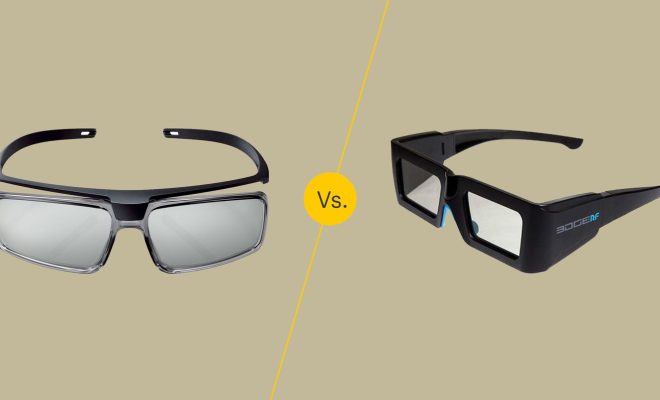
Passive Polarized 3D Glasses

Passive polarized glasses are the most popular type of 3D glasses used today. These glasses work by filtering out light in a specific direction to each eye, creating two slightly different images that our brains then combine to create a 3D image.

One of the main advantages of passive polarized glasses is that they are inexpensive to produce, making them a more affordable option for consumers. They are also lightweight and comfortable to wear as they do not require batteries or any extra technology.

Another benefit of passive polarized glasses is that they do not flicker, which can be an issue with active shutter glasses. They are also known for delivering bright, vivid colors that remain consistent throughout the viewing experience.

However, one drawback of passive polarized glasses is that the 3D effect may not be as pronounced as with active shutter glasses, there may be some loss of resolution, and there can be ghosting or cross-talk, which occurs when the images meant for each eye overlap.

Active Shutter 3D Glasses

Active shutter glasses work by alternately shuttering the lenses, blocking one eye and then the other, as the image on-screen changes at a high speed. This allows each eye to see a different image, creating a 3D effect.

Active shutter glasses offer several advantages over passive polarized glasses. They provide a more pronounced 3D effect, with more depth and sharper images. They also have a higher resolution and less cross-talk, which means there is less overlap between the two images meant for each eye.

However, there are some drawbacks to using active shutter glasses. They are heavier and bulkier since they require batteries and an electronic shutter system. The batteries will also need to be charged or replaced frequently, which can be inconvenient. Active shutter glasses can also flicker at times, which can be distracting and uncomfortable for some people.

Both passive polarized and active shutter glasses have their pros and cons, and ultimately, the choice comes down to personal preference. If you prefer a more affordable, lightweight and comfortable option, passive polarized glasses may be the way to go. But if a more pronounced 3D effect with sharper images is important to you, then active shutter glasses may be the better choice.

In the end, it is worth considering the cost, comfort, and visual quality when deciding which type of glasses to use for your 3D viewing experience. 

Previous Article

Use Excel Shortcut Keys to Quickly Save ...

Next Article

How to Fix STOP 0x0000007B Errors

Matthew Lynch

Related articles More from author

  • Online Learning & eLearning

    Best Full Stack Web Developer Course Online

    March 5, 2024
    By Matthew Lynch
  • Online Learning & eLearning

    Data-Driven Landscape Increases Pressure on Privacy Concerns

    November 23, 2021
    By Matthew Lynch
  • Digital & Mobile TechnologyOnline Learning & eLearning

    The Best JBL Bluetooth Speakers

    June 13, 2023
    By Matthew Lynch
  • Online Learning & eLearning

    10 Features That Every Great eLearning Authoring Tool Should Have

    April 13, 2018
    By Matthew Lynch
  • Online Learning & eLearning

    How to Overcome Resistance to Online Education in Higher Ed

    September 4, 2020
    By Matthew Lynch
  • Online Learning & eLearning

    Top 5 Monitor Light Bars

    April 2, 2023
    By Matthew Lynch

Search

Login & Registration

  • Register
  • Log in
  • Entries feed
  • Comments feed
  • WordPress.org

Newsletter

Signup for The Tech Edvocate Newsletter and have the latest in EdTech news and opinion delivered to your email address!

About Us

Since technology is not going anywhere and does more good than harm, adapting is the best course of action. That is where The Tech Edvocate comes in. We plan to cover the PreK-12 and Higher Education EdTech sectors and provide our readers with the latest news and opinion on the subject. From time to time, I will invite other voices to weigh in on important issues in EdTech. We hope to provide a well-rounded, multi-faceted look at the past, present, the future of EdTech in the US and internationally.

We started this journey back in June 2016, and we plan to continue it for many more years to come. I hope that you will join us in this discussion of the past, present and future of EdTech and lend your own insight to the issues that are discussed.

Newsletter

Signup for The Tech Edvocate Newsletter and have the latest in EdTech news and opinion delivered to your email address!

Contact Us

The Tech Edvocate
910 Goddin Street
Richmond, VA 23231
(601) 630-5238
[email protected]

Copyright © 2025 Matthew Lynch. All rights reserved.