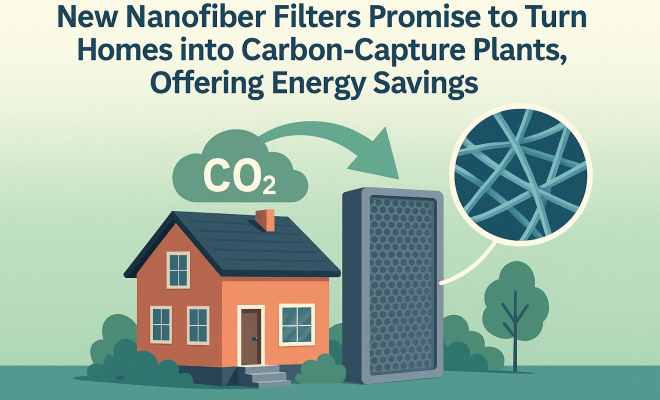
New Nanofiber Filters Promise to Turn Homes into Carbon-Capture Plants, Offering Energy Savings
“`html
Imagine your home, not just as a shelter, but as an active participant in solving one of the planet’s biggest challenges. What if every breath you took indoors, every flick of your HVAC system, was quietly working to remove carbon dioxide from the atmosphere? It sounds like something out of a sci-fi novel, right? Well, thanks to a groundbreaking innovation from the University of Chicago Pritzker School of Molecular Engineering, that future might be far closer than you think. They’ve unveiled a game-changing technology: distributed carbon nanofiber direct air capture (DAC) filters that promise to transform ordinary building ventilation systems into powerful carbon-capture plants.
And here’s the kicker, the part that’s generating genuine buzz among homeowners and environmental advocates alike: this isn’t just about cleaning the air. This technology is projected to significantly cut your energy bills. Yes, you read that right. These nanofiber carbon capture filters could actually save you money while making your home a cleaner, greener space. It’s a counterintuitive, yet incredibly exciting, development that could fundamentally reshape how we think about residential energy efficiency and climate action.
1. The Innovation Behind the Air: Nanofiber Carbon Capture Filters
At the heart of this transformative technology are specialized nanofiber carbon capture filters. These aren’t your typical HVAC filters designed to trap dust and pollen. We’re talking about a sophisticated material engineered at the molecular level. Researchers at the University of Chicago Pritzker School of Molecular Engineering have developed a unique filter made from carbon nanofibers. Think of these as incredibly thin, microscopic strands of carbon, woven together to create a high-surface-area material. This intricate structure is crucial because it maximizes the contact points for air to pass through, making the capture process incredibly efficient.
What makes these nanofiber carbon capture filters truly special is their coating. Each carbon nanofiber is meticulously coated with a polyethylenimine (PEI) polymer. This polymer acts as the active ingredient, a kind of molecular sponge specifically designed to attract and bind with carbon dioxide molecules. As indoor air circulates through your existing ventilation system and passes over these PEI-coated nanofibers, CO2 is passively captured and held within the filter material. It’s an elegant solution that leverages existing infrastructure – your home’s vents and ducts – to perform a vital environmental service.
2. Turning Your Home into a Carbon-Capture Plant
The vision here is nothing short of revolutionary: to decentralize carbon capture, moving it from massive industrial facilities to the very places we live and work. By integrating these nanofiber carbon capture filters into standard residential and commercial building ventilation systems, every structure essentially becomes a miniature direct air capture plant. Instead of relying solely on large-scale, energy-intensive operations that are often located far from population centers, this distributed approach brings the solution directly to where people are, capturing CO2 right from the air we breathe indoors.
This distributed model has several compelling advantages. First, it taps into an enormous, existing network of potential capture sites: millions of buildings worldwide. Second, it shifts the paradigm from active, energy-demanding capture to a more passive process. The filters simply sit within your existing air handling units, doing their work as air naturally circulates. And perhaps most importantly, it offers a tangible way for individual homeowners and businesses to contribute directly to climate mitigation efforts, turning a passive building function into an active environmental solution. It’s a powerful idea that empowers individuals to be part of the climate solution, right from their living room.
3. Astounding Efficiency: A 92.1% CO2 Removal Rate
When we talk about environmental technologies, skepticism is often warranted, especially when bold claims are made. But the numbers behind these nanofiber carbon capture filters are genuinely impressive. A rigorous life-cycle analysis of the technology revealed a remarkable 92.1% efficiency in removing carbon dioxide. Let that sink in for a moment: over nine out of ten CO2 molecules passing through these filters can be captured. This isn’t just an experimental lab result; this figure accounts for the entire lifecycle of the filters, including the energy and resources required for their manufacturing, deployment, and eventual disposal.
Achieving such high efficiency, even after factoring in the full ecological footprint, is a testament to the intelligent design and material science at play. It suggests that the energy and resources invested in producing these filters are more than offset by their CO2 capture capabilities. This level of efficiency is crucial for any carbon capture technology to be truly impactful and scalable, moving it beyond a niche solution to a viable, widespread tool in the fight against climate change. It means we’re not just moving the problem around; we’re genuinely reducing atmospheric carbon. (See: carbon capture technology advancements.)
4. The Regeneration Revolution: Sunlight and Renewable Electricity
A major challenge for any carbon capture technology is the regeneration process – how do you release the captured CO2 so the filter can be reused? Many existing methods are energy-intensive, requiring high temperatures or chemical reactions that can offset some of the environmental benefits. This is where the University of Chicago’s nanofiber carbon capture filters shine with another brilliant innovation. These filters are designed to be regenerated using low-cost, renewable energy sources: sunlight or renewable electricity.
Imagine your air filter, after passively capturing CO2 all day, being exposed to a bit of sunlight to release its bounty, ready to capture more. This passive, low-energy regeneration mechanism is a game-changer. It means the ongoing operational costs and environmental impact of keeping these filters running are dramatically reduced. By harnessing solar energy or drawing from a grid powered by renewables, the entire carbon capture cycle becomes far more sustainable and truly net-positive. This elegant solution addresses one of the most persistent hurdles in DAC technology, paving the way for widespread, economically viable adoption.
5. The Energy Bill Surprise: Up to 21.66% in Savings
Here’s where the story gets really interesting, and frankly, quite astonishing. You’d think adding a sophisticated filter to your ventilation system might increase energy consumption, right? More material for air to pass through, perhaps a slight increase in fan power? That’s the intuitive assumption. But the research points to a counterintuitive, yet profoundly impactful, outcome: these nanofiber carbon capture filters are projected to significantly cut homeowners’ energy bills, with some studies indicating savings of up to 21.66%. That’s a massive chunk of change for many households.
How is this possible? The secret lies in ventilation. Current building codes often require a certain amount of outdoor air to be pulled into a building to maintain acceptable indoor air quality. This is necessary to dilute indoor pollutants, including CO2 produced by occupants. However, conditioning this outside air – heating it in winter or cooling it in summer – is a major energy drain. By actively capturing CO2 indoors with these nanofiber carbon capture filters, the need to constantly pull in and condition fresh outdoor air is dramatically reduced. Your HVAC system doesn’t have to work as hard, leading directly to lower energy consumption and, consequently, lower bills. It’s a win-win that transforms a climate solution into an immediate financial benefit for homeowners.
6. Beyond Environmentalism: A Smart Home Energy Solution
The implications of this technology extend far beyond just environmentalism; they position nanofiber carbon capture filters as a premier smart home energy solution. For years, homeowners have sought ways to make their homes more efficient, investing in better insulation, smart thermostats, and energy-efficient appliances. This new filter technology offers a fundamentally different, yet equally powerful, avenue for savings and comfort. By mitigating the need for extensive outside air exchange, it directly addresses one of the biggest energy hogs in any home: the HVAC system’s load from conditioning external air.
Think about it: if your home can maintain optimal indoor air quality and CO2 levels without constantly battling external temperatures, your heating and cooling systems operate far less frequently and intensely. This isn’t just about saving money; it’s about creating a more stable, comfortable indoor environment. Less fluctuation in temperature, less strain on your equipment, and a quieter home are all potential benefits. As smart home technology continues to evolve, integrating these nanofiber carbon capture filters could become a standard feature, offering a truly holistic approach to residential energy management and indoor environmental quality.
7. The Broader Impact: Monetization and Market Potential
The viral interest in these nanofiber carbon capture filters isn’t just from environmentalists; it’s also piqued the attention of industries spanning solar/energy, HVAC, and real estate. The potential for monetization and market disruption is enormous. For the solar and energy sectors, this technology presents a new demand for renewable electricity for filter regeneration and further validates the economic benefits of energy efficiency upgrades. Imagine solar panel installations being paired with these filters, creating a truly self-sufficient, carbon-negative home. It’s a compelling narrative for clean energy providers.
In the HVAC industry, this represents a significant upgrade opportunity. HVAC companies could offer installation services for these filters, positioning them as a premium, high-efficiency solution. For real estate, homes equipped with this technology could command higher values, appealing to environmentally conscious buyers and those seeking long-term energy savings. The concept of ‘residential carbon capture cost’ will become a new metric for homeowners, alongside traditional energy efficiency ratings. Furthermore, there are clear affiliate opportunities for related green building products, smart home energy solutions, and even carbon offset programs linked to these home-based capture systems. This isn’t just a filter; it’s a foundation for a new green economy built around the home.
8. Overcoming Hurdles: Cost and Adoption
As with any groundbreaking technology, the path to widespread adoption for nanofiber carbon capture filters won’t be without its challenges. The initial manufacturing cost is always a primary concern. While the long-term energy savings are substantial, the upfront investment for homeowners will need to be competitive and clearly communicated. Will these filters be significantly more expensive than traditional HVAC filters? How often will they need to be replaced, and what will that replacement cost entail? These are crucial questions that will dictate consumer uptake.
Another hurdle is integration. While the technology is designed to work with existing ventilation systems, there might be nuances depending on the age and type of HVAC unit. Will professional installation be required, adding another layer of cost? Education will also be key. Homeowners are familiar with air filters that clean dust; convincing them that a filter can also effectively capture CO2 and save them money will require clear, compelling messaging. Building codes and regulatory frameworks might also need to adapt to recognize the benefits of distributed carbon capture, potentially offering incentives for early adopters. It’s a complex ecosystem, but the benefits are so compelling that these hurdles are certainly worth tackling. (See: nanofiber technology in air filtration.)
9. The Future of Home Energy and Climate Action
The development of these nanofiber carbon capture filters marks a pivotal moment in the intersection of home energy efficiency and climate action. It moves the conversation beyond just reducing emissions to actively removing carbon from our environment, all while putting money back into homeowners’ pockets. This isn’t just about a new product; it’s about a new paradigm for how we conceive of our living spaces and their role in a sustainable future. Imagine a world where every home, office, and commercial building is not just passively consuming energy, but actively contributing to a cleaner planet.
This innovation from the University of Chicago Pritzker School of Molecular Engineering offers a tangible, scalable, and economically attractive solution to a global problem. It’s a testament to human ingenuity and the power of molecular engineering to address grand challenges. As this technology matures and becomes more widely available, we could see a dramatic shift in both residential energy consumption patterns and our collective ability to mitigate climate change. Your home, once just a place to live, could very well become a silent, powerful ally in the fight for a healthier planet, all while saving you a significant chunk of change on your monthly bills. That’s a future worth investing in.
10. A Deeper Look: How Nanofibers Outperform Traditional Materials
To truly appreciate the breakthrough of nanofiber carbon capture filters, it’s helpful to understand why nanofibers are so effective compared to other materials. Traditional filters, even those designed for gas adsorption, often rely on larger pores and less surface area. Think of a regular sponge versus a super-fine microfiber cloth. The microfiber cloth, with its incredibly thin strands and dense weave, has exponentially more surface area packed into the same volume. Nanofibers take this concept to an extreme.
The “nano” in nanofiber refers to their size – typically diameters less than 100 nanometers. To give you some perspective, a single human hair is about 80,000 to 100,000 nanometers thick. This minuscule size allows for an unprecedented surface-area-to-volume ratio. Why does this matter for carbon capture? More surface area means more potential sites for the PEI polymer to be coated, and thus, more places for CO2 molecules to bind. This isn’t just about having more binding sites; it’s also about the kinetics – how quickly those molecules can find and attach to a site. The vast, interconnected network of nanofibers creates a highly tortuous path for air, ensuring maximum contact time and efficiency in a relatively small filter volume. This structural advantage is a key reason for the reported 92.1% CO2 removal rate, making these filters far superior to bulkier, less efficient alternatives.
11. The Role of Polyethylenimine (PEI) and Its Environmental Profile
The PEI polymer coating is the unsung hero of these nanofiber carbon capture filters. It’s a type of amine, known for its strong affinity for CO2. What makes PEI particularly suitable is its chemical stability and relatively low toxicity. The process of CO2 binding to PEI is often described as chemisorption, meaning it forms a weak chemical bond rather than just a physical attraction. This bond is strong enough to capture CO2 effectively, but weak enough to be broken with a modest input of energy – precisely why sunlight or low-grade renewable electricity can be used for regeneration.
When considering the environmental profile of the entire system, the choice of PEI is crucial. Researchers have carefully selected a polymer that doesn’t significantly degrade over repeated cycles of capture and release, minimizing the release of harmful byproducts into the environment. Its regeneration process avoids the use of harsh chemicals or extremely high temperatures, which would otherwise contribute to the overall carbon footprint of the capture system. Understanding the material science behind PEI highlights the thoughtful engineering that went into creating a truly sustainable and efficient carbon capture solution, moving beyond just the physical structure of the nanofibers to the very chemistry of the capture agent.
12. Comparing with Other Direct Air Capture Technologies
While the concept of Direct Air Capture (DAC) isn’t new, the University of Chicago’s nanofiber carbon capture filters stand out when compared to other DAC technologies. Most large-scale DAC plants, like those being developed by companies like Carbon Engineering or Climeworks, rely on massive industrial infrastructure. These often use large fans to pull vast quantities of air through chemical sorbents or liquid solutions, requiring significant land area and substantial energy inputs, often from dedicated power plants, to operate and regenerate. (See: impact of carbon capture on energy savings.)
The key differentiators for the nanofiber approach are its distributed nature and low energy regeneration. Centralized DAC plants are designed to capture thousands or even millions of tons of CO2 annually, but their scale means they are costly to build and operate, and their CO2 transport infrastructure needs careful planning. In contrast, the nanofiber filters integrate into existing building systems, capturing CO2 at the source where people are, and crucially, doing so with minimal additional energy. The ability to regenerate with ambient sunlight or modest electrical input from renewables gives it a distinct advantage in terms of both economic viability for homeowners and overall environmental impact, potentially making it a more scalable and accessible solution for everyday carbon removal.
Frequently Asked Questions About Nanofiber Carbon Capture Filters
Q1: How often would these nanofiber carbon capture filters need to be replaced or regenerated?
The University of Chicago’s research highlights a key advantage: these filters are designed for regeneration, not constant replacement. Instead of throwing them out like traditional HVAC filters, they’re meant to be “reset.” The exact frequency of regeneration would depend on factors like the building’s size, occupancy, and ambient CO2 levels. However, the goal is for the regeneration process to be largely automated or easily initiated, perhaps on a daily or weekly cycle, using integrated solar panels or a simple electrical connection. This significantly reduces waste and ongoing material costs compared to disposable filters.
Q2: Can these filters be installed in any existing HVAC system?
The technology is designed to be compatible with standard residential and commercial ventilation systems. This means they should fit into existing air handling units where traditional filters are currently housed. However, as with any new component, there might be specific sizing requirements or minor modifications needed for optimal performance depending on the age and model of your HVAC unit. Professional installation would likely ensure proper integration and maximize efficiency, preventing air bypass and ensuring the filters are working as intended.
Q3: What happens to the captured CO2 after regeneration? Is it released back into the atmosphere?
That’s a critical question! The CO2 released during regeneration is indeed expelled from the filter. The vision for these distributed systems is to either vent this concentrated CO2 outside the building, effectively removing it from the indoor air and localizing its release, or, in more advanced scenarios, to capture and store it for beneficial reuse. For residential applications, the primary goal is to lower indoor CO2 and reduce the need for external ventilation. For larger commercial buildings, there’s potential to aggregate the released CO2 for sequestration or use in industrial processes, such as concrete curing or synthetic fuel production. The goal is net removal from the atmosphere, not just moving it around.
Q4: Are there any health concerns related to the materials used or the captured CO2?
The materials, particularly the PEI polymer, are chosen for their stability and relatively low toxicity. The filters are designed to safely capture CO2 without releasing harmful chemicals into your indoor air. CO2 itself isn’t toxic at the typical concentrations found indoors or even slightly elevated levels during regeneration. The purpose is to reduce overall CO2 levels, which can lead to better cognitive function and comfort. Rigorous testing and safety certifications will be essential as these products approach commercialization to ensure they meet all health and environmental standards.
Q5: When can homeowners expect to see these nanofiber carbon capture filters on the market?
While the technology is incredibly promising and has generated significant buzz, it’s still in the research and development phase, moving towards commercialization. The University of Chicago’s breakthrough is a strong proof-of-concept. Typically, it takes several years for such innovations to move from lab to widespread consumer availability, involving further optimization, scaling up manufacturing, rigorous testing, and navigating regulatory approvals. Keep an eye on announcements from the University of Chicago and any spin-off companies, but it’s likely a few years away before you can purchase one for your home.
“`
Frequently Asked Questions
What are nanofiber filters and how do they work?
Nanofiber filters are advanced materials made from ultra-thin strands of carbon, engineered to maximize air contact. They capture carbon dioxide efficiently as air passes through them, transforming ordinary HVAC systems into effective carbon-capture units.
How can nanofiber filters reduce energy bills?
By integrating nanofiber carbon capture filters into home ventilation systems, homeowners can improve air quality while potentially reducing energy consumption, leading to lower energy bills due to enhanced efficiency in heating and cooling.
What are the benefits of using carbon capture technology at home?
Using carbon capture technology at home not only helps clean indoor air by removing CO2 but also contributes to environmental sustainability. Additionally, it can provide cost savings on energy bills through improved HVAC efficiency.
Where was the nanofiber filter technology developed?
The innovative nanofiber filter technology was developed by researchers at the University of Chicago Pritzker School of Molecular Engineering, focusing on creating efficient direct air capture solutions for residential use.
Is carbon capture technology feasible for residential homes?
Yes, the new nanofiber carbon capture filters are designed specifically for residential applications, making it feasible for homeowners to actively participate in carbon reduction efforts while enjoying potential energy savings.
Have you experienced this yourself? We'd love to hear your story in the comments.