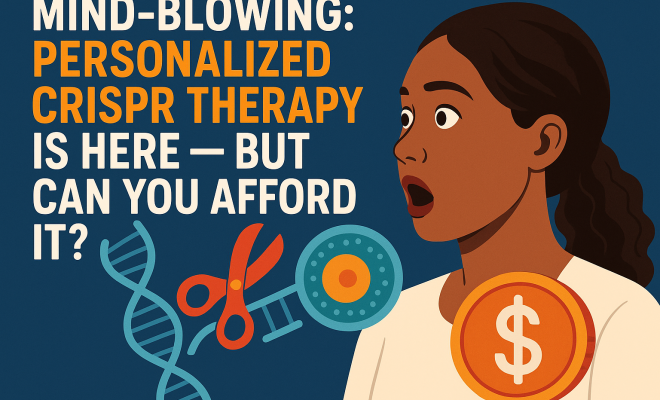
Mind-Blowing: Personalized CRISPR Therapy Is Here — But Can You Afford It?
Imagine a scenario where a devastating, previously incurable genetic disease in an infant isn’t a life sentence, but a challenge that can be met with a custom-designed molecular intervention. This isn’t science fiction anymore; it’s the emerging reality of personalized CRISPR gene therapy. We’re on the cusp of a medical revolution, one where treatments are tailored not just to a disease, but to an individual’s unique genetic code. It’s a breathtaking prospect, offering hope to families facing unimaginable diagnoses. But as with any groundbreaking medical advancement, the practicalities, especially the financial ones, quickly come into sharp focus. For parents grappling with a child’s rare disease, understanding the cost of personalized CRISPR gene therapy becomes a paramount, often overwhelming, concern.
The year 2026 is shaping up to be a pivotal moment in this journey. We’re moving beyond the theoretical discussions of CRISPR’s potential and into an era where it’s delivering tangible, life-altering results. The story of KJ Muldoon, an infant born with a fatal metabolic disorder, serves as a powerful illustration. In February 2025, a bespoke base-editing therapy, developed by researchers at Children’s Hospital of Philadelphia and Penn Medicine, was administered to KJ. By early 2026, the child was showing only mild symptoms of what was once considered a death sentence. This incredible success didn’t just save a life; it ignited a broader discussion and prompted the FDA to publish draft guidance on a ‘plausible mechanism framework’ for individualized genomic therapies. This framework is a game-changer, allowing a single clinical trial to test platform technologies customized for each patient, paving the way for more rapid development of these highly specialized treatments.
As personalized gene editing transitions from a scientific marvel to a clinical reality, it brings with it a host of ethical implications, public discussions, and, of course, significant financial questions. For families, especially those with infants diagnosed with rare diseases, the promise of a cure is tempered by the daunting prospect of unprecedented medical expenses. Let’s dig into what this means for you, your family, and the future of healthcare.
The Dawn of Personalized Medicine: A Paradigm Shift
For decades, medicine has largely operated on a ‘one-size-fits-most’ model. Doctors diagnose a condition and prescribe treatments that, while effective for many, might not be optimal for everyone due to individual genetic variations. Personalized medicine flips this script entirely. It’s about tailoring medical decisions, treatments, practices, and products to the individual patient, often based on their predicted response or risk of disease. Gene therapy, and particularly CRISPR-based gene editing, represents the pinnacle of this approach.
Think about it: instead of managing symptoms, we’re talking about correcting the root cause of a genetic disorder at the molecular level. This isn’t just about treating a disease; it’s about potentially curing it, altering the very blueprint of life. The case of KJ Muldoon vividly demonstrates this shift. Here was an infant facing a fatal metabolic disorder, and instead of palliative care or symptomatic management, scientists designed a highly specific gene-editing tool to correct the precise genetic error causing the illness. This level of customization is what makes these therapies so revolutionary, yet also so complex and, inevitably, expensive.
This paradigm shift has profound implications for how we think about healthcare. It moves us away from broad population-level interventions to highly targeted, individualized ones. While the initial focus is on rare, often devastating, genetic diseases, the underlying principles could eventually extend to more common conditions, from certain cancers to neurodegenerative disorders. The potential is truly mind-boggling, but so are the challenges in scaling such individualized solutions and making them accessible.
Understanding CRISPR: The Genetic Scissors
Before we dissect the financial aspects, it’s crucial to grasp what CRISPR actually is and why it’s so powerful. CRISPR, which stands for Clustered Regularly Interspaced Short Palindromic Repeats, is a revolutionary gene-editing tool. Essentially, it’s a natural defense mechanism found in bacteria that scientists have repurposed to precisely cut, paste, or modify DNA sequences in living cells. Think of it as molecular scissors that can be guided to a specific spot in the genome to make incredibly precise changes.
There are different flavors of CRISPR technology. The initial versions, like CRISPR-Cas9, were great at making cuts. Newer iterations, such as base editing (which was used in KJ Muldoon’s case), are even more refined. Base editing allows for single-letter changes in the genetic code without cutting the DNA double helix. This precision reduces the risk of unintended edits, known as ‘off-target effects,’ which has always been a major concern in gene therapy. The ability to make such subtle, yet impactful, corrections is what makes personalized CRISPR gene therapy so promising for a vast array of genetic conditions.
The beauty of CRISPR lies in its relative simplicity and versatility compared to earlier gene-editing techniques. This has accelerated research and development at an unprecedented pace. However, ‘simple’ in a laboratory setting doesn’t necessarily translate to ‘cheap’ or ‘easy’ when it comes to human application. Each personalized therapy requires intricate design, rigorous testing, and highly specialized delivery mechanisms, all contributing significantly to the cost. (See: NIH funds research on personalized CRISPR therapy.)
The Staggering Initial Price Tag: Why Is It So High?
Let’s not mince words: the cost of personalized CRISPR gene therapy is, for now, incredibly high. We’re talking about figures that can easily reach into the millions of dollars for a single treatment. Why such a colossal price tag? It’s a confluence of factors, each adding layers of expense to an already complex process. For more context, see the implications of genetic research on health.
Firstly, these therapies are bespoke. They are designed for one patient, or at most, a handful of patients with the exact same ultra-rare mutation. This isn’t like manufacturing a pill for millions. The research and development for each specific genetic correction, the design of the guide RNA (the ‘GPS’ for CRISPR), and the choice of the appropriate Cas enzyme or base editor are all highly individualized. This process requires significant intellectual capital, advanced bioinformatics, and specialized laboratory work.
Secondly, the manufacturing process is incredibly complex and takes place in highly specialized facilities. Delivering the gene-editing machinery into the target cells often involves using modified viruses (like adeno-associated viruses or AAVs) as ‘vectors.’ Producing clinical-grade AAV vectors is an intricate, time-consuming, and expensive endeavor. These vectors must be pure, potent, and safe, free from contaminants, and produced under stringent Good Manufacturing Practice (GMP) conditions. Quality control alone is a massive undertaking.
Finally, the clinical trials, even under the FDA’s new ‘plausible mechanism framework,’ are intensive. While the framework aims to streamline the process, each patient still requires meticulous monitoring, specialized medical personnel, and long-term follow-up to assess efficacy and safety. The rarity of the diseases also means that patient recruitment for traditional trials is challenging, pushing up the per-patient cost. All these elements combine to create a sticker price that can be genuinely eye-watering for families.
Navigating Insurance Coverage for Genetic Treatments
So, you’re looking at a potential multi-million-dollar therapy. Your immediate thought, quite understandably, is: will insurance cover this? This is where things get incredibly complicated and, frankly, often frustrating for families. Insurance companies are still grappling with how to integrate these revolutionary, high-cost therapies into their existing models.
Historically, insurers base coverage decisions on established efficacy, FDA approval, and cost-effectiveness compared to existing treatments. For therapies as new and individualized as personalized CRISPR, this framework is strained. Many plans may consider these treatments ‘experimental’ or ‘investigational,’ particularly in their early stages of development and approval, which can lead to outright denial. Even with FDA guidance like the ‘plausible mechanism framework,’ insurers might still hesitate due to the sheer cost and the limited patient population.
However, there’s a growing recognition within the insurance industry that these therapies represent a new frontier. Some innovative models are emerging, such as outcome-based agreements where payments are tied to the therapy’s success. For instance, an insurer might pay a portion upfront and the rest over several years, contingent on the patient maintaining positive outcomes. This shifts some of the financial risk from the payer to the pharmaceutical company. Nonetheless, securing full coverage for the cost of personalized CRISPR gene therapy will likely require significant advocacy, appeals processes, and potentially legal intervention for many families in the coming years.
Financial Assistance and Support Options
Given the immense cost of personalized CRISPR gene therapy, most families simply cannot shoulder the burden alone. Thankfully, a growing ecosystem of financial assistance and support options is emerging to help bridge this gap. It requires diligence, persistence, and often, a dedicated support network, but help is out there.
Firstly, pharmaceutical companies developing these therapies often have patient assistance programs. These programs can offer direct financial aid, help with navigating insurance appeals, or provide the drug at a reduced cost or even free, based on financial need and specific criteria. It’s always one of the first avenues to explore.
Secondly, numerous non-profit organizations and disease-specific foundations are dedicated to supporting families affected by rare genetic disorders. Many offer grants, crowdfunding support, or direct financial assistance for treatment, travel, and related expenses. Organizations like the National Organization for Rare Disorders (NORD) or specific disease foundations (e.g., for metabolic disorders, muscular dystrophies) are excellent resources. They often have navigators who can guide families through the labyrinthine process of finding aid. (See: CDC's overview of genomics and gene therapy.)
Thirdly, hospital financial aid programs can be invaluable. Major academic medical centers and children’s hospitals that are at the forefront of gene therapy often have robust financial counseling services. They can help families apply for various forms of assistance, negotiate payment plans, or identify state and federal programs that might offer support. Don’t underestimate the power of social workers and patient advocates within these institutions; they are often unsung heroes in these journeys. For more context, see financial challenges of medical advancements.
Finally, crowdfunding platforms like GoFundMe have become a common way for families to raise significant funds from their communities. While not a guaranteed solution, the power of collective generosity can be truly astonishing when a child’s life is on the line. The key is to explore every single avenue; no stone should be left unturned when trying to manage the cost of personalized CRISPR gene therapy.
Ethical Considerations and Equity in Access
The advent of personalized CRISPR gene therapy, while incredibly promising, brings with it a host of profound ethical considerations, particularly concerning equity in access. If these treatments are so effective but so expensive, who gets them? Will they only be available to the wealthy, creating a stark divide in healthcare outcomes?
This is not a hypothetical concern. The ‘postcode lottery’ of healthcare access is already a reality in many parts of the world, and highly specialized, exorbitantly priced therapies exacerbate this. Ensuring equitable access means grappling with difficult questions about societal responsibility, healthcare funding models, and the value we place on human life. Do we cap prices? Do governments step in to fund these therapies universally? What about patients in developing nations?
There are also ethical dilemmas around ‘designer babies.’ While personalized CRISPR gene therapy currently focuses on correcting debilitating diseases, the line between therapy and enhancement can feel blurry to some. The scientific community is largely united in opposing germline editing (editing sperm, eggs, or embryos) that would lead to heritable changes, but public discourse often conflates these issues. Clear ethical guidelines, robust public education, and open dialogue are crucial to navigating this rapidly evolving landscape responsibly. The societal implications of widespread personalized gene editing are driving significant public discussion and viral sharing, highlighting the urgency of these conversations.
The FDA’s ‘Plausible Mechanism Framework’ and Future Approvals
The FDA’s proactive stance in February 2026, publishing draft guidance for a ‘plausible mechanism framework’ for individualized genomic therapies, is a critical development. This framework represents a pragmatic and forward-thinking approach to accelerating the approval of highly personalized treatments that don’t fit the traditional clinical trial model.
Traditionally, drug approval requires large, randomized controlled trials demonstrating safety and efficacy across a broad patient population. For ultra-rare diseases, especially those affecting only a handful of individuals worldwide, such trials are simply impossible. The new framework acknowledges this reality. It allows for a single clinical trial to test ‘platform technologies’ that can be customized for each patient. This means that once the underlying gene-editing platform (e.g., a specific AAV vector delivering a base editor) is deemed safe and effective in principle, subsequent individualized versions for different genetic mutations might require less extensive, patient-specific trial data for approval.
This streamlined pathway could dramatically reduce the time and cost associated with regulatory approval, bringing life-saving therapies to patients much faster. It’s a recognition that for conditions like KJ Muldoon’s fatal metabolic disorder, time is of the essence. However, it also places a greater emphasis on robust preclinical data, advanced analytical methods, and careful post-market surveillance to ensure ongoing safety and efficacy. This framework is a testament to the FDA’s adaptability in the face of scientific innovation, and it will undoubtedly shape the landscape for the cost of personalized CRISPR gene therapy moving forward. (See: Scientific article on CRISPR and gene therapy.)
Long-Term Outlook: Will Costs Come Down?
The multi-million-dollar question is whether the cost of personalized CRISPR gene therapy will eventually decrease. History suggests that groundbreaking medical technologies, while initially exorbitant, tend to become more affordable over time due to economies of scale, technological advancements, and increased competition.
We’ve seen this pattern with everything from organ transplants to advanced imaging techniques. As more gene therapies gain approval, as manufacturing processes become more efficient and automated, and as research yields less costly delivery methods, the price point should, in theory, come down. Increased competition among pharmaceutical and biotech companies will also play a role in driving down prices. The ‘plausible mechanism framework’ itself could contribute by making the development and approval process more efficient, thereby reducing some of the upfront R&D costs.
However, it’s important to temper expectations. These are not simple drugs. The inherent complexity of designing and manufacturing a bespoke biological product for each patient means that personalized CRISPR gene therapy will likely always command a premium compared to traditional pharmaceuticals. The ‘floor’ for these costs may still be very high. We might see a stabilization at a high but more manageable level, perhaps in the hundreds of thousands rather than millions of dollars, but a future where they are as cheap as a generic antibiotic is highly improbable. The long-term outlook will heavily depend on continued innovation in both the scientific and manufacturing realms.
The Future Is Now: What Parents Need to Know Today
For parents facing a diagnosis of a rare genetic disease in their infant today, the information about personalized CRISPR gene therapy can feel both incredibly hopeful and utterly overwhelming. The future is arriving at an astonishing pace, and it brings with it both unprecedented opportunities and significant challenges, especially concerning the cost of personalized CRISPR gene therapy.
What you need to know, above all, is that hope exists. Cases like KJ Muldoon’s are not isolated miracles but harbingers of a new era. If your family is confronted with such a diagnosis, your immediate steps should involve seeking out specialists at leading academic medical centers. These institutions are often at the forefront of gene therapy research and clinical trials. They will have the most up-to-date information on experimental therapies, available trials, and the complex financial navigation required.
Don’t be afraid to ask tough questions about costs, insurance coverage, and financial assistance from the outset. Engage with patient advocacy groups and rare disease foundations; their networks and resources are invaluable. Understand that this journey will be arduous, requiring immense emotional, intellectual, and financial resilience. But also know that you are not alone, and the scientific community is working tirelessly to make these life-saving breakthroughs more accessible. The dream of curing previously untreatable diseases is rapidly becoming a reality, and while the financial hurdles are significant, the drive to overcome them is just as powerful.
Trending Now
Frequently Asked Questions
What is personalized CRISPR therapy?
Personalized CRISPR therapy is a groundbreaking medical approach that uses gene editing technology to create tailored treatments for individuals based on their unique genetic makeup. This therapy aims to address previously incurable genetic diseases by designing specific molecular interventions that can effectively target and modify the problematic genes.
How much does personalized CRISPR therapy cost?
The cost of personalized CRISPR therapy can vary significantly depending on various factors, including the complexity of the treatment and the specific genetic condition being addressed. As this technology is still emerging, many families find understanding the financial implications overwhelming, with prices potentially reaching hundreds of thousands of dollars.
What are the success stories of CRISPR gene therapy?
One notable success story is that of KJ Muldoon, an infant who received a bespoke base-editing therapy for a fatal metabolic disorder in early 2025. By early 2026, KJ showed only mild symptoms, showcasing the potential of personalized CRISPR treatments to transform lives and offer hope to families facing dire diagnoses.
What are the ethical implications of CRISPR therapy?
The rise of personalized CRISPR therapy brings various ethical implications, including concerns about accessibility, equity in healthcare, and the potential for unintended consequences in genetic modification. As these treatments develop, public discussions will be crucial to navigate the moral landscape surrounding gene editing technologies.
How does CRISPR therapy work?
CRISPR therapy works by utilizing a technology that can precisely edit genes within an organism's DNA. It involves creating a guide RNA that matches the target gene sequence, allowing the CRISPR system to cut the DNA at specific locations, enabling the introduction of desired genetic changes that can correct mutations or modify gene expression.
What did we miss? Let us know in the comments and join the conversation.