The Tech Edvocate

Top Menu

  • Advertisement
  • Apps
  • Home Page
  • Home Page Five (No Sidebar)
  • Home Page Four
  • Home Page Three
  • Home Page Two
  • Home Tech2
  • Icons [No Sidebar]
  • Left Sidbear Page
  • Lynch Educational Consulting
  • My Account
  • My Speaking Page
  • Newsletter Sign Up Confirmation
  • Newsletter Unsubscription
  • Our Brands
  • Page Example
  • Privacy Policy
  • Protected Content
  • Register
  • Request a Product Review
  • Shop
  • Shortcodes Examples
  • Signup
  • Start Here
    • Governance
    • Careers
    • Contact Us
  • Terms and Conditions
  • The Edvocate
  • The Tech Edvocate Product Guide
  • Topics
  • Write For Us
  • Advertise

Main Menu

  • Start Here
    • Our Brands
    • Governance
      • Lynch Educational Consulting, LLC.
      • Dr. Lynch’s Personal Website
      • Careers
    • Write For Us
    • The Tech Edvocate Product Guide
    • Contact Us
    • Books
    • Edupedia
    • Post a Job
    • The Edvocate Podcast
    • Terms and Conditions
    • Privacy Policy
  • Topics
    • Assistive Technology
    • Child Development Tech
    • Early Childhood & K-12 EdTech
    • EdTech Futures
    • EdTech News
    • EdTech Policy & Reform
    • EdTech Startups & Businesses
    • Higher Education EdTech
    • Online Learning & eLearning
    • Parent & Family Tech
    • Personalized Learning
    • Product Reviews
  • Advertise
  • Tech Edvocate Awards
  • The Edvocate
  • Pedagogue
  • School Ratings

logo

The Tech Edvocate

  • Start Here
    • Our Brands
    • Governance
      • Lynch Educational Consulting, LLC.
      • Dr. Lynch’s Personal Website
        • My Speaking Page
      • Careers
    • Write For Us
    • The Tech Edvocate Product Guide
    • Contact Us
    • Books
    • Edupedia
    • Post a Job
    • The Edvocate Podcast
    • Terms and Conditions
    • Privacy Policy
  • Topics
    • Assistive Technology
    • Child Development Tech
    • Early Childhood & K-12 EdTech
    • EdTech Futures
    • EdTech News
    • EdTech Policy & Reform
    • EdTech Startups & Businesses
    • Higher Education EdTech
    • Online Learning & eLearning
    • Parent & Family Tech
    • Personalized Learning
    • Product Reviews
  • Advertise
  • Tech Edvocate Awards
  • The Edvocate
  • Pedagogue
  • School Ratings
  • A Visitors Guide to Long Beach (CA), United States

  • A Visitor’s Guide to Fresno (CA), United States

  • A Visitors Guide to New Orleans (LA), United States

  • A Visitors Guide to Sacramento (CA), United States

  • A Visitors Guide to Lyon, France

  • JisuLife Ultra2 Portable Fan: A Powerful Multi-Function Cooling Solution

  • A Visitors Guide to Viña del Mar, Chile

  • A Visitors Guide to Århus, Denmark

  • A Visitors Guide to Bakersfield (CA), United States

  • A Visitors Guide to Aurora (CO), United States

Digital & Mobile Technology
Home›Digital & Mobile Technology›How to Use the PI Function in Excel

How to Use the PI Function in Excel
By Matthew Lynch
June 15, 2023
0
Spread the love

Excel is a powerful tool in the world of statistics and data analysis. With its wide range of functions and capabilities, it can help you solve complex problems with ease. One of the most important functions in Excel is the PI function. In this article, we will explore the PI function, its function syntax, and how to use it.

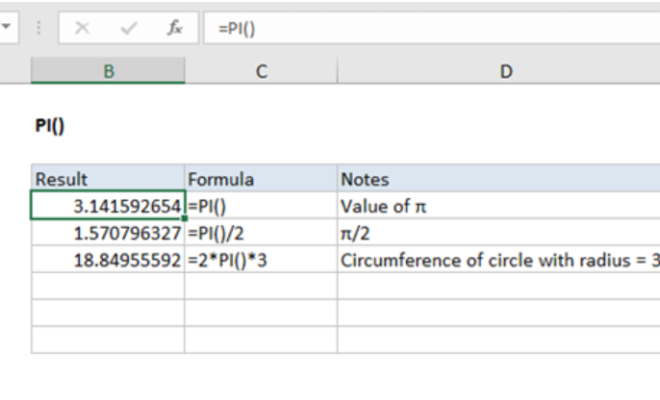
The PI function in Excel is a mathematical function that returns the value of pi, which is a mathematical constant that represents the ratio of the circumference of a circle to its diameter. The value of pi is approximately 3.141592653589793. By using the PI function, we can access this constant value in our calculations.

The syntax of the PI function is quite simple. To use the PI function, you simply need to enter the function name followed by an opening and closing parenthesis, like this: =PI(). When you enter this formula in a cell, Excel will automatically return the value of pi.

There are several ways in which you can use the PI function in Excel. Here are some common examples:

1. Calculating the area of a circle

To calculate the area of a circle, you need to know the value of pi. You can use the PI function in Excel to find the value of pi and then use it in your calculation. For example, if the radius of a circle is 5, you can calculate the area using the following formula: =PI()*(5^2). This formula will return the value of pi multiplied by the radius squared, which is the area of the circle.

2. Calculating the circumference of a circle

To calculate the circumference of a circle, you also need to know the value of pi. You can use the PI function in Excel to find the value of pi and then use it in your calculation. For example, if the radius of a circle is 5, you can calculate the circumference using the following formula: =2*PI()*5. This formula will return the value of pi times the diameter of the circle, which is the circumference.

3. Creating a sine or cosine wave

You can also use the PI function in Excel to create a sine or cosine wave. To do this, you need to use the SIN or COS function along with the PI function. For example, to create a sine wave with a period of 2π, you can use the following formula: =SIN(2*PI()*A1), where A1 is the cell containing the input value. This formula will return the sine wave value for the input value.

In conclusion, the PI function in Excel is a powerful tool that can help you perform complex calculations quickly and easily. By understanding the syntax of the function and its applications, you can use it to solve a wide range of problems in statistics and data analysis. Whether you are calculating the area of a circle, the circumference of a circle, or creating a sine or cosine wave, the PI function can help.


Previous Article

How to Add a Second Person’s Face ...

Next Article

What Is the Windows 10 LTSC Version?

Matthew Lynch

Related articles More from author

  • Digital & Mobile Technology

    What Are Lurkers on Twitch? A Complete Guide

    June 5, 2023
    By Matthew Lynch
  • Digital & Mobile Technology

    How to Create an Email Group in Mail App on Mac

    May 27, 2023
    By Matthew Lynch
  • Digital & Mobile Technology

    What is Test Data Management?

    May 12, 2023
    By Matthew Lynch
  • Digital & Mobile Technology

    How to Fix It When Your Laptop Won’t Turn On

    May 31, 2023
    By Matthew Lynch
  • Digital & Mobile Technology

    How to Find a Hidden GPS Tracker on Your Car

    May 31, 2023
    By Matthew Lynch
  • Digital & Mobile Technology

    How to Use the Microsoft Windows Update Catalog for Windows Updates

    June 22, 2023
    By Matthew Lynch

Search

Login & Registration

  • Register
  • Log in
  • Entries feed
  • Comments feed
  • WordPress.org

Newsletter

Signup for The Tech Edvocate Newsletter and have the latest in EdTech news and opinion delivered to your email address!

About Us

Since technology is not going anywhere and does more good than harm, adapting is the best course of action. That is where The Tech Edvocate comes in. We plan to cover the PreK-12 and Higher Education EdTech sectors and provide our readers with the latest news and opinion on the subject. From time to time, I will invite other voices to weigh in on important issues in EdTech. We hope to provide a well-rounded, multi-faceted look at the past, present, the future of EdTech in the US and internationally.

We started this journey back in June 2016, and we plan to continue it for many more years to come. I hope that you will join us in this discussion of the past, present and future of EdTech and lend your own insight to the issues that are discussed.

Newsletter

Signup for The Tech Edvocate Newsletter and have the latest in EdTech news and opinion delivered to your email address!

Contact Us

The Tech Edvocate
910 Goddin Street
Richmond, VA 23231
(601) 630-5238
[email protected]

Copyright © 2025 Matthew Lynch. All rights reserved.