The Tech Edvocate

Top Menu

  • Advertisement
  • Apps
  • Home Page
  • Home Page Five (No Sidebar)
  • Home Page Four
  • Home Page Three
  • Home Page Two
  • Home Tech2
  • Icons [No Sidebar]
  • Left Sidbear Page
  • Lynch Educational Consulting
  • My Account
  • My Speaking Page
  • Newsletter Sign Up Confirmation
  • Newsletter Unsubscription
  • Our Brands
  • Page Example
  • Privacy Policy
  • Protected Content
  • Register
  • Request a Product Review
  • Shop
  • Shortcodes Examples
  • Signup
  • Start Here
    • Governance
    • Careers
    • Contact Us
  • Terms and Conditions
  • The Edvocate
  • The Tech Edvocate Product Guide
  • Topics
  • Write For Us
  • Advertise

Main Menu

  • Start Here
    • Our Brands
    • Governance
      • Lynch Educational Consulting, LLC.
      • Dr. Lynch’s Personal Website
      • Careers
    • Write For Us
    • The Tech Edvocate Product Guide
    • Contact Us
    • Books
    • Edupedia
    • Post a Job
    • The Edvocate Podcast
    • Terms and Conditions
    • Privacy Policy
  • Topics
    • Assistive Technology
    • Child Development Tech
    • Early Childhood & K-12 EdTech
    • EdTech Futures
    • EdTech News
    • EdTech Policy & Reform
    • EdTech Startups & Businesses
    • Higher Education EdTech
    • Online Learning & eLearning
    • Parent & Family Tech
    • Personalized Learning
    • Product Reviews
  • Advertise
  • Tech Edvocate Awards
  • The Edvocate
  • Pedagogue
  • School Ratings

logo

The Tech Edvocate

  • Start Here
    • Our Brands
    • Governance
      • Lynch Educational Consulting, LLC.
      • Dr. Lynch’s Personal Website
        • My Speaking Page
      • Careers
    • Write For Us
    • The Tech Edvocate Product Guide
    • Contact Us
    • Books
    • Edupedia
    • Post a Job
    • The Edvocate Podcast
    • Terms and Conditions
    • Privacy Policy
  • Topics
    • Assistive Technology
    • Child Development Tech
    • Early Childhood & K-12 EdTech
    • EdTech Futures
    • EdTech News
    • EdTech Policy & Reform
    • EdTech Startups & Businesses
    • Higher Education EdTech
    • Online Learning & eLearning
    • Parent & Family Tech
    • Personalized Learning
    • Product Reviews
  • Advertise
  • Tech Edvocate Awards
  • The Edvocate
  • Pedagogue
  • School Ratings
  • A Visitors Guide to Colorado Springs (CO), United States

  • 5 Pairs of Shoes That Will Instantly Step Your Shoe Game Up

  • Radiant Youthful Skin is the Perfect Christmas Gift

  • Give Your Loved One the Gift of Youthful, Radiant Skin this Christmas

  • Give Your Loved One the Gift of a Restful Night Sleep this Christmas

  • Nex Playground’s Holiday Sales Bring Active Play Indoors This Seaso

  • A Visitors Guide to Louisville (KY), United States

  • A Visitor’s Guide to Nashville-Davidson (TN), United States

  • A Visitors Guide to Portland (OR), United States

  • 7 Men’s Bruno Marc Shoes That Are the Perfect Christmas Gift

Digital & Mobile Technology
Home›Digital & Mobile Technology›How to Use SSH in Windows: Easy Ways

How to Use SSH in Windows: Easy Ways
By Matthew Lynch
June 21, 2023
0
Spread the love

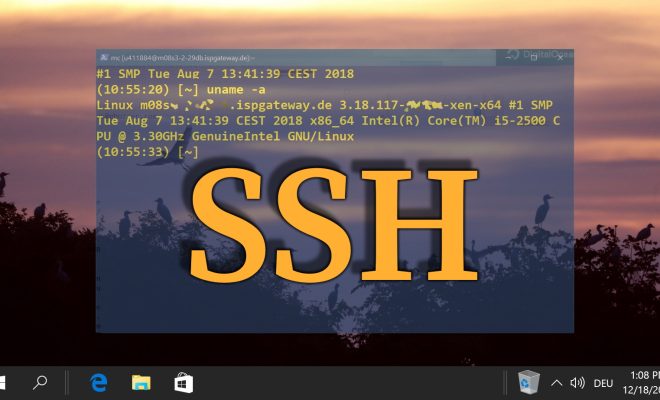
Secure Shell (SSH) is a cryptographic network protocol used for secure communication between computers. If you have a remote server that you need to communicate with securely, you will need to use SSH. In the past, SSH was mainly used by Linux and Unix users, but now, Windows users can also use it. In this article, we will walk you through on how to use SSH in Windows.

1. Installing SSH Client:

To use SSH on Windows, you will need to install an SSH client. There are a few options available but one of the easiest ways to get started is by installing Putty. Putty is a free open-source SSH client that can be easily downloaded from its official website. Once downloaded, run the installer and follow the on-screen instructions to install it on your computer.

2. Connect to Your Server:

Once you have installed Putty, the next step is to connect to your remote server. Launch Putty and type in the IP address of the server you want to connect to. Then, select the SSH protocol and click on the Open button. You will then be prompted to enter your username and password.

3. Verify Server Fingerprint:

After you enter your username and password, Putty will show you the fingerprint of the server you are connecting to. This is to verify that you are indeed connecting to the correct server. If the fingerprint matches with what you are expecting, you can click on Yes to continue with the connection.

4. Start SSH Session:

Once you have verified the server’s fingerprint, a terminal window will be opened, and you will be logged into your server. In the terminal, you can now enter commands to interact with your server.

5. Managing SSH Keys:

Using SSH keys is a safer way to connect to a remote server than using a password. SSH keys are a set of cryptographic keys that can be used instead of a password to authenticate your connection to a server. You can generate SSH keys using tools like Puttygen or using command-line tools on Linux or MacOS.

6. Configure SSH Client:

If you are going to use SSH frequently, it may be necessary to configure your SSH client. For example, you can configure your SSH client to use a specific port for connection or to automatically use a specific SSH key for authentication. This can be done using the SSH configuration file located in the .ssh directory in your user’s home directory.

In conclusion, using SSH on Windows is not as difficult as it used to be. With the availability of free SSH clients like Putty, it has become much easier to connect to remote servers securely. By following the steps outlined in this article, you can start using SSH in Windows and enjoy a more secure way of communicating with your servers.


Previous Article

How to Detect and Disable Apple AirTags ...

Next Article

How to View All Drives in “This ...

Matthew Lynch

Related articles More from author

  • Digital & Mobile Technology

    How to Find Out If Someone Has Blocked Your Phone Number

    August 3, 2023
    By Matthew Lynch
  • Digital & Mobile Technology

    Top App Development Companies for Your Next Project

    June 14, 2023
    By Matthew Lynch
  • Digital & Mobile Technology

    How to Set Up Remote Desktop on a Windows 11 PC

    May 8, 2023
    By Matthew Lynch
  • Digital & Mobile Technology

    How to Use Voice Control on iPhone and iPod Touch

    June 9, 2023
    By Matthew Lynch
  • Digital & Mobile Technology

    What Is an ESD File?

    June 11, 2023
    By Matthew Lynch
  • Digital & Mobile Technology

    What is Print Quality?

    May 10, 2023
    By Matthew Lynch

Search

Login & Registration

  • Register
  • Log in
  • Entries feed
  • Comments feed
  • WordPress.org

Newsletter

Signup for The Tech Edvocate Newsletter and have the latest in EdTech news and opinion delivered to your email address!

About Us

Since technology is not going anywhere and does more good than harm, adapting is the best course of action. That is where The Tech Edvocate comes in. We plan to cover the PreK-12 and Higher Education EdTech sectors and provide our readers with the latest news and opinion on the subject. From time to time, I will invite other voices to weigh in on important issues in EdTech. We hope to provide a well-rounded, multi-faceted look at the past, present, the future of EdTech in the US and internationally.

We started this journey back in June 2016, and we plan to continue it for many more years to come. I hope that you will join us in this discussion of the past, present and future of EdTech and lend your own insight to the issues that are discussed.

Newsletter

Signup for The Tech Edvocate Newsletter and have the latest in EdTech news and opinion delivered to your email address!

Contact Us

The Tech Edvocate
910 Goddin Street
Richmond, VA 23231
(601) 630-5238
[email protected]

Copyright © 2025 Matthew Lynch. All rights reserved.