The Tech Edvocate

Top Menu

  • Advertisement
  • Apps
  • Home Page
  • Home Page Five (No Sidebar)
  • Home Page Four
  • Home Page Three
  • Home Page Two
  • Home Tech2
  • Icons [No Sidebar]
  • Left Sidbear Page
  • Lynch Educational Consulting
  • My Account
  • My Speaking Page
  • Newsletter Sign Up Confirmation
  • Newsletter Unsubscription
  • Our Brands
  • Page Example
  • Privacy Policy
  • Protected Content
  • Register
  • Request a Product Review
  • Shop
  • Shortcodes Examples
  • Signup
  • Start Here
    • Governance
    • Careers
    • Contact Us
  • Terms and Conditions
  • The Edvocate
  • The Tech Edvocate Product Guide
  • Topics
  • Write For Us
  • Advertise

Main Menu

  • Start Here
    • Our Brands
    • Governance
      • Lynch Educational Consulting, LLC.
      • Dr. Lynch’s Personal Website
      • Careers
    • Write For Us
    • The Tech Edvocate Product Guide
    • Contact Us
    • Books
    • Edupedia
    • Post a Job
    • The Edvocate Podcast
    • Terms and Conditions
    • Privacy Policy
  • Topics
    • Assistive Technology
    • Child Development Tech
    • Early Childhood & K-12 EdTech
    • EdTech Futures
    • EdTech News
    • EdTech Policy & Reform
    • EdTech Startups & Businesses
    • Higher Education EdTech
    • Online Learning & eLearning
    • Parent & Family Tech
    • Personalized Learning
    • Product Reviews
  • Advertise
  • Tech Edvocate Awards
  • The Edvocate
  • Pedagogue
  • School Ratings

logo

The Tech Edvocate

  • Start Here
    • Our Brands
    • Governance
      • Lynch Educational Consulting, LLC.
      • Dr. Lynch’s Personal Website
        • My Speaking Page
      • Careers
    • Write For Us
    • The Tech Edvocate Product Guide
    • Contact Us
    • Books
    • Edupedia
    • Post a Job
    • The Edvocate Podcast
    • Terms and Conditions
    • Privacy Policy
  • Topics
    • Assistive Technology
    • Child Development Tech
    • Early Childhood & K-12 EdTech
    • EdTech Futures
    • EdTech News
    • EdTech Policy & Reform
    • EdTech Startups & Businesses
    • Higher Education EdTech
    • Online Learning & eLearning
    • Parent & Family Tech
    • Personalized Learning
    • Product Reviews
  • Advertise
  • Tech Edvocate Awards
  • The Edvocate
  • Pedagogue
  • School Ratings
  • A Visitors Guide to Long Beach (CA), United States

  • A Visitor’s Guide to Fresno (CA), United States

  • A Visitors Guide to New Orleans (LA), United States

  • A Visitors Guide to Sacramento (CA), United States

  • A Visitors Guide to Lyon, France

  • JisuLife Ultra2 Portable Fan: A Powerful Multi-Function Cooling Solution

  • A Visitors Guide to Viña del Mar, Chile

  • A Visitors Guide to Århus, Denmark

  • A Visitors Guide to Bakersfield (CA), United States

  • A Visitors Guide to Aurora (CO), United States

Digital & Mobile Technology
Home›Digital & Mobile Technology›How to Create a ‘Mailto’ Form in Dreamweaver

How to Create a ‘Mailto’ Form in Dreamweaver
By Matthew Lynch
July 28, 2023
0
Spread the love

As a website owner or developer, one of the important functions to include on your website is a means for visitors to communicate directly with you. One way to do this is to create a ‘mailto’ form in Dreamweaver that visitors can use to send you an email directly from your website.

Here are the steps to creating a ‘mailto’ form in Dreamweaver:

Step 1: Open Dreamweaver and create a new HTML document.

Before you start creating the ‘mailto’ form, you need to have a new HTML document in which to place the form.

Step 2: Create the ‘mailto’ link.

To create the ‘mailto’ link, you need to add a hyperlink to the page that will trigger the user’s email program to open with your email address pre-populated in the “To” field. To do this, you can simply type the following HTML code anywhere on the page:

Contact Us

Replace “youremailaddresshere” with your actual email address and “Contact Us” with the text you want to appear as the link on your website.

Step 3: Create the ‘mailto’ form.

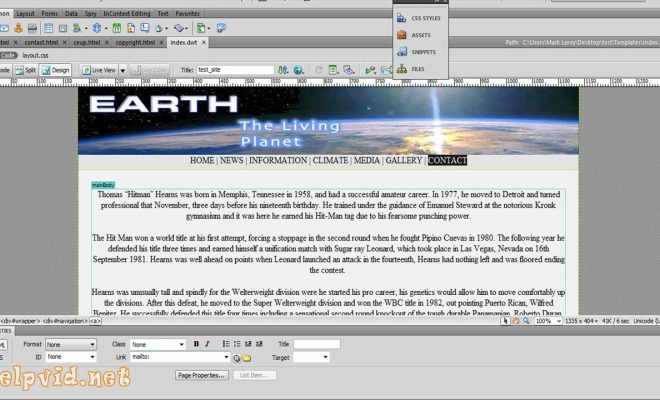
To create a form that allows visitors to send you an email directly from your website, you need to create a form that includes several fields such as name, email address, subject, and message. You can create this form using HTML code or using the Dreamweaver built-in form tools, depending on your preference and level of expertise.

To create a form using Dreamweaver’s form tools, follow these steps:

1. In Dreamweaver, click on “Insert” and then “Form” from the top menu.

2. Choose the type of form you want to create (e.g. “Text Field,” “Checkbox,” etc.) and drag it onto the page where you want the form to appear.

3. Customize the form fields by right-clicking on them and selecting “Properties” to set the size, font, color, and other attributes.

4. Repeat steps 2 and 3 to create additional form fields.

5. After creating the form, you can add the ‘mailto’ link created in step 2 to the “Submit” button using this HTML code:

Replace “youremailaddresshere” with your actual email address. This code will pre-populate the email’s subject and message fields with the user’s input from the form.

Step 4: Finalize the design and test the form.

Once you have created the ‘mailto’ form, you can finalize the design and test it to ensure that it is working properly. You can do this by clicking on the “Preview” button in Dreamweaver to see how the form looks on the website and by clicking on the ‘mailto’ link and submitting the form to see if you receive the email message.

In conclusion, creating a ‘mailto’ form in Dreamweaver is a simple process that can be done by following these steps. By including this form on your website, you will be providing your visitors with an easy way to communicate with you, which can lead to increased engagement and customer satisfaction.


Previous Article

How to Check RAM in Android

Next Article

Ficmax Ergonomic Gaming Chair Review

Matthew Lynch

Related articles More from author

  • Digital & Mobile Technology

    How to Get Google Docs to Read to You

    June 15, 2023
    By Matthew Lynch
  • Digital & Mobile Technology

    What to Do When Your Mac Won’t Turn On

    June 12, 2023
    By Matthew Lynch
  • Digital & Mobile Technology

    Are You a Toxic Gamer? Ways You Can Tell

    October 1, 2024
    By Matthew Lynch
  • Digital & Mobile Technology

    How to Repair Damaged MP3 Files

    June 4, 2023
    By Matthew Lynch
  • Digital & Mobile Technology

    The Best Windows Keyboard Shortcuts in 2023

    June 10, 2023
    By Matthew Lynch
  • Digital & Mobile Technology

    What is a Managed Security Service Provider (MSSP)?

    April 18, 2023
    By Matthew Lynch

Search

Login & Registration

  • Register
  • Log in
  • Entries feed
  • Comments feed
  • WordPress.org

Newsletter

Signup for The Tech Edvocate Newsletter and have the latest in EdTech news and opinion delivered to your email address!

About Us

Since technology is not going anywhere and does more good than harm, adapting is the best course of action. That is where The Tech Edvocate comes in. We plan to cover the PreK-12 and Higher Education EdTech sectors and provide our readers with the latest news and opinion on the subject. From time to time, I will invite other voices to weigh in on important issues in EdTech. We hope to provide a well-rounded, multi-faceted look at the past, present, the future of EdTech in the US and internationally.

We started this journey back in June 2016, and we plan to continue it for many more years to come. I hope that you will join us in this discussion of the past, present and future of EdTech and lend your own insight to the issues that are discussed.

Newsletter

Signup for The Tech Edvocate Newsletter and have the latest in EdTech news and opinion delivered to your email address!

Contact Us

The Tech Edvocate
910 Goddin Street
Richmond, VA 23231
(601) 630-5238
[email protected]

Copyright © 2025 Matthew Lynch. All rights reserved.