The Tech Edvocate

Top Menu

  • Advertisement
  • Apps
  • Home Page
  • Home Page Five (No Sidebar)
  • Home Page Four
  • Home Page Three
  • Home Page Two
  • Home Tech2
  • Icons [No Sidebar]
  • Left Sidbear Page
  • Lynch Educational Consulting
  • My Account
  • My Speaking Page
  • Newsletter Sign Up Confirmation
  • Newsletter Unsubscription
  • Our Brands
  • Page Example
  • Privacy Policy
  • Protected Content
  • Register
  • Request a Product Review
  • Shop
  • Shortcodes Examples
  • Signup
  • Start Here
    • Governance
    • Careers
    • Contact Us
  • Terms and Conditions
  • The Edvocate
  • The Tech Edvocate Product Guide
  • Topics
  • Write For Us
  • Advertise

Main Menu

  • Start Here
    • Our Brands
    • Governance
      • Lynch Educational Consulting, LLC.
      • Dr. Lynch’s Personal Website
      • Careers
    • Write For Us
    • The Tech Edvocate Product Guide
    • Contact Us
    • Books
    • Edupedia
    • Post a Job
    • The Edvocate Podcast
    • Terms and Conditions
    • Privacy Policy
  • Topics
    • Assistive Technology
    • Child Development Tech
    • Early Childhood & K-12 EdTech
    • EdTech Futures
    • EdTech News
    • EdTech Policy & Reform
    • EdTech Startups & Businesses
    • Higher Education EdTech
    • Online Learning & eLearning
    • Parent & Family Tech
    • Personalized Learning
    • Product Reviews
  • Advertise
  • Tech Edvocate Awards
  • The Edvocate
  • Pedagogue
  • School Ratings

logo

The Tech Edvocate

  • Start Here
    • Our Brands
    • Governance
      • Lynch Educational Consulting, LLC.
      • Dr. Lynch’s Personal Website
        • My Speaking Page
      • Careers
    • Write For Us
    • The Tech Edvocate Product Guide
    • Contact Us
    • Books
    • Edupedia
    • Post a Job
    • The Edvocate Podcast
    • Terms and Conditions
    • Privacy Policy
  • Topics
    • Assistive Technology
    • Child Development Tech
    • Early Childhood & K-12 EdTech
    • EdTech Futures
    • EdTech News
    • EdTech Policy & Reform
    • EdTech Startups & Businesses
    • Higher Education EdTech
    • Online Learning & eLearning
    • Parent & Family Tech
    • Personalized Learning
    • Product Reviews
  • Advertise
  • Tech Edvocate Awards
  • The Edvocate
  • Pedagogue
  • School Ratings
  • Πώς οι γιορτινοί κουλοχέρηδες αλλάζουν τον ρυθμό των διαδικτυακών καζίνο

  • iClever Q950 Kids Headphones Review: Premium Sound and Safety for Young Listeners

  • The Reckless Ben Controversy: An Outrageous Fight for Justice

  • Outrageous: The Sydney Sweeney Ad Controversy You Didn’t See Coming — And Why It’s Working

  • The AI CRM War: Why Salesforce Just Made a $2 Billion Bid for a Startup

  • OpenAI’s Navier-Stokes ‘Solution’ Ignites Firestorm: Did They Steal It?

  • Blizzard’s Boldest Bet: Why a StarCraft Shooter in 2030 Could Redefine Gaming

  • Volatile: Why Top AI Bosses Just Triggered a Massive AI Stocks Decline

  • ‘Godfather of AI’ backs Anthropic chief’s call to slow down development

  • Why Millions Are Flocking to Trade Schools as AI Reshapes the Job Market

Digital & Mobile Technology
Home›Digital & Mobile Technology›How to Convert PDF Files to JPG Format

How to Convert PDF Files to JPG Format
By Matthew Lynch
July 26, 2023
0
Spread the love

PDF files are great for sharing documents, but sometimes you need to convert them to a different format, such as JPG. JPG images are ideal for use on websites, social media, and other digital platforms. Fortunately, it’s easy to convert PDF files to JPG format. Here’s how to do it:

Method 1: Using Adobe Acrobat

1.Open the PDF file in Adobe Acrobat.

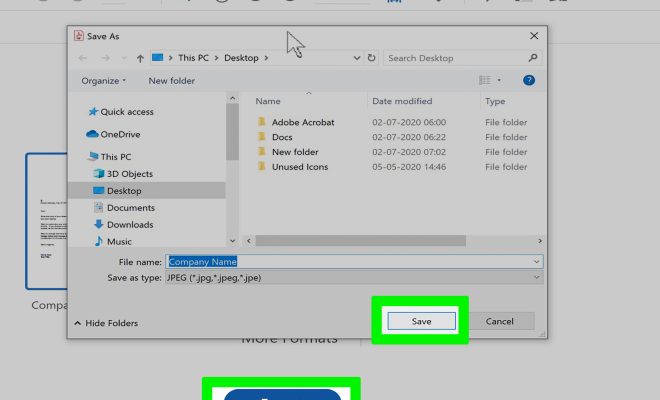
2.Click on the “File” menu and select “Export To” > “Image” > “JPEG.”

3.Choose the image quality and resolution you want, then click “Export.”

4.Choose a location to save the JPG file and click “Save.”

Method 2: Using Online Tools

If you don’t have Adobe Acrobat, you can use an online tool to convert your PDF files to JPG format. Here are a few popular options:

1. Smallpdf

1.Go to Smallpdf in your web browser.

2.Click on “Choose Files” and select the PDF file you want to convert.

3.Wait for the file to upload and convert to JPG format.

4.Click “Download” to save the JPG file to your computer.

2. Zamzar

1.Go to Zamzar in your web browser.

2.Click on “Add Files” and select the PDF file you want to convert.

3.Choose “JPG” as the output format.

4.Enter your email address and click “Convert.”

5.Wait for the email from Zamzar with a link to download your converted file.

3. Online-Convert

1.Go to Online-Convert in your web browser.

2.Click on “Convert to JPG.”

3.Click “Choose File” and select the PDF file you want to convert.

4.Wait for the file to upload and convert to JPG format.

5.Click “Download” to save the JPG file to your computer.

That’s it! With these simple methods, you can easily convert your PDF files to JPG format and use them for a variety of digital purposes.

How to Combine the MIN and IF Functions in an Excel Array Formula

Excel is a powerful tool for analyzing data, and the MIN and IF functions are two of the most commonly used functions in Excel. By combining these two functions in an array formula, you can quickly and easily find the minimum value in a range of cells that meets a certain condition. Here’s how to do it:

1.Start by selecting the cell where you want to display the result of your formula.

2.Type the following formula into the formula bar:

1{=MIN(IF(range=condition,values))}

Note that this is an array formula, which means that you must press Ctrl + Shift + Enter instead of just Enter to enter the formula.

1.Replace “range” with the range of cells that you want to search for the minimum value.

2.Replace “condition” with the condition that you want to test for. For example, if you want to find the minimum value in a range of cells that are greater than 10, you would replace “condition” with “>10”.

3.Replace “values” with the range of cells that contains the values that you want to test.

4.Press Ctrl + Shift + Enter to enter the formula.

Excel will then search the range of cells specified in step 3 for values that meet the condition specified in step 4. The IF function will return an array of TRUE and FALSE values, depending on whether each value in the range meets the condition. The MIN function will then find the minimum value in the range of cells specified in step 5, but only for the cells where the IF function returned TRUE.

By combining the MIN and IF functions in an array formula, you can quickly and easily find the minimum value in a range of cells that meets a certain condition. This can be a powerful tool for analyzing data in Excel, and can save you a lot of time and effort.


Previous Article

Alexa Notifications: Everything You Need to Know

Next Article

How Do Mail.com and GMX Mail Stack ...

Matthew Lynch

Related articles More from author

  • Digital & Mobile Technology

    What Are Live Service Games and How Do They Work?

    June 9, 2023
    By Matthew Lynch
  • Digital & Mobile Technology

    What Does a Restricted Number Mean?

    April 15, 2023
    By Matthew Lynch
  • Digital & Mobile Technology

    Things About Mini PCs You Should Consider Before Buying

    June 23, 2023
    By Matthew Lynch
  • Digital & Mobile Technology

    How to Delete Your Hotmail or Outlook Email Account

    June 23, 2023
    By Matthew Lynch
  • Digital & Mobile Technology

    How to Cancel Your HBO Max Subscription Fast

    July 6, 2023
    By Matthew Lynch
  • Digital & Mobile Technology

    Best Samsung Galaxy Watch Faces of 2023

    June 23, 2023
    By Matthew Lynch

Search

Login & Registration

  • Log in
  • Entries feed
  • Comments feed
  • WordPress.org

Newsletter

Signup for The Tech Edvocate Newsletter and have the latest in EdTech news and opinion delivered to your email address!

About Us

Since technology is not going anywhere and does more good than harm, adapting is the best course of action. That is where The Tech Edvocate comes in. We plan to cover the PreK-12 and Higher Education EdTech sectors and provide our readers with the latest news and opinion on the subject. From time to time, I will invite other voices to weigh in on important issues in EdTech. We hope to provide a well-rounded, multi-faceted look at the past, present, the future of EdTech in the US and internationally.

We started this journey back in June 2016, and we plan to continue it for many more years to come. I hope that you will join us in this discussion of the past, present and future of EdTech and lend your own insight to the issues that are discussed.

Newsletter

Signup for The Tech Edvocate Newsletter and have the latest in EdTech news and opinion delivered to your email address!

Contact Us

The Tech Edvocate
910 Goddin Street
Richmond, VA 23231
(601) 630-5238
[email protected]

Copyright © 2026 Matthew Lynch. All rights reserved.