The Tech Edvocate

Top Menu

  • Advertisement
  • Apps
  • Home Page
  • Home Page Five (No Sidebar)
  • Home Page Four
  • Home Page Three
  • Home Page Two
  • Home Tech2
  • Icons [No Sidebar]
  • Left Sidbear Page
  • Lynch Educational Consulting
  • My Account
  • My Speaking Page
  • Newsletter Sign Up Confirmation
  • Newsletter Unsubscription
  • Our Brands
  • Page Example
  • Privacy Policy
  • Protected Content
  • Register
  • Request a Product Review
  • Shop
  • Shortcodes Examples
  • Signup
  • Start Here
    • Governance
    • Careers
    • Contact Us
  • Terms and Conditions
  • The Edvocate
  • The Tech Edvocate Product Guide
  • Topics
  • Write For Us
  • Advertise

Main Menu

  • Start Here
    • Our Brands
    • Governance
      • Lynch Educational Consulting, LLC.
      • Dr. Lynch’s Personal Website
      • Careers
    • Write For Us
    • The Tech Edvocate Product Guide
    • Contact Us
    • Books
    • Edupedia
    • Post a Job
    • The Edvocate Podcast
    • Terms and Conditions
    • Privacy Policy
  • Topics
    • Assistive Technology
    • Child Development Tech
    • Early Childhood & K-12 EdTech
    • EdTech Futures
    • EdTech News
    • EdTech Policy & Reform
    • EdTech Startups & Businesses
    • Higher Education EdTech
    • Online Learning & eLearning
    • Parent & Family Tech
    • Personalized Learning
    • Product Reviews
  • Advertise
  • Tech Edvocate Awards
  • The Edvocate
  • Pedagogue
  • School Ratings

logo

The Tech Edvocate

  • Start Here
    • Our Brands
    • Governance
      • Lynch Educational Consulting, LLC.
      • Dr. Lynch’s Personal Website
        • My Speaking Page
      • Careers
    • Write For Us
    • The Tech Edvocate Product Guide
    • Contact Us
    • Books
    • Edupedia
    • Post a Job
    • The Edvocate Podcast
    • Terms and Conditions
    • Privacy Policy
  • Topics
    • Assistive Technology
    • Child Development Tech
    • Early Childhood & K-12 EdTech
    • EdTech Futures
    • EdTech News
    • EdTech Policy & Reform
    • EdTech Startups & Businesses
    • Higher Education EdTech
    • Online Learning & eLearning
    • Parent & Family Tech
    • Personalized Learning
    • Product Reviews
  • Advertise
  • Tech Edvocate Awards
  • The Edvocate
  • Pedagogue
  • School Ratings
  • A Visitors Guide to Long Beach (CA), United States

  • A Visitor’s Guide to Fresno (CA), United States

  • A Visitors Guide to New Orleans (LA), United States

  • A Visitors Guide to Sacramento (CA), United States

  • A Visitors Guide to Lyon, France

  • JisuLife Ultra2 Portable Fan: A Powerful Multi-Function Cooling Solution

  • A Visitors Guide to Viña del Mar, Chile

  • A Visitors Guide to Århus, Denmark

  • A Visitors Guide to Bakersfield (CA), United States

  • A Visitors Guide to Aurora (CO), United States

Digital & Mobile Technology
Home›Digital & Mobile Technology›How to Connect Your Android Phone With a Flash Drive

How to Connect Your Android Phone With a Flash Drive
By Matthew Lynch
June 4, 2023
0
Spread the love

It’s an exciting experience to have a mobile device with excellent specs and storage. However, no matter how much storage your Android phone may have, you will inevitably run out of space as you accumulate more data. Fortunately, you can connect a flash drive to your Android phone and expand your storage capacity effortlessly. Here is a guide on how to connect your Android phone with a flash drive.

Step 1: Ensure Your Phone Supports USB OTG

The first step is to verify whether your phone supports USB On-The-Go (OTG) functionality. This feature allows your device to communicate with other USB devices, such as flash drives. The easiest way to check if your phone supports OTG is to connect a USB keyboard or mouse to it using a USB OTG cable. If they work as expected, your smartphone supports USB OTG.

Step 2: Get a USB OTG Cable or Adapter

If your phone supports USB OTG, the next step is to buy a USB OTG cable or adapter. An adapter is a device that allows you to connect a standard USB cable to your phone’s charging port. On the other hand, an OTG cable has a standard USB port on one side and a micro USB port on the other.

Step 3: Connect the USB OTG Cable or Adapter to Your Android Phone

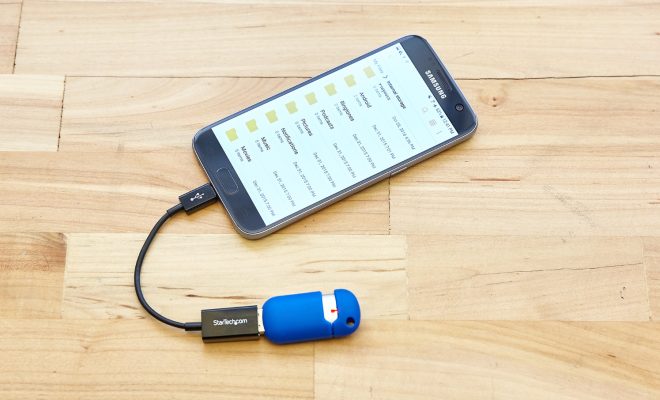
After getting a USB OTG cable or adapter, plug it into your smartphone’s micro USB port. Ensure that the connection is tight and that your phone properly recognizes the device. Android will show a pop-up asking what you want to do with the connected device.

Step 4: Connect Your Flash Drive

Now, it’s time to connect your flash drive to the other side of the USB OTG cable or Adapter. Once you plug the flash drive in, Android should detect it and provide options on how to use it, such as file transfer or viewing the files on the drive.

Step 5: Transfer or View Files

With the flash drive connected to your phone, you can transfer files from your device to the drive or view files saved on the flash drive. Some Android devices might require that you download a file manager app to access the flash drive’s files.

Step 6: Safely Eject the Flash Drive

After transferring or viewing files, ensure to safely eject the flash drive from your phone. If you unplug the flash drive abruptly, you risk losing data or damaging the device. Android has a feature that allows you to unmount the flash drive correctly. Pull down the notification bar and tap on ‘Safely remove USB storage.’

Conclusion

Connecting your Android phone to a flash drive is simple and enables you to expand your storage capacity without much hassle. Ensure to double-check if your phone supports USB OTG and purchase a USB OTG cable or adapter if it does. Connect the flash drive to your phone and enjoy extra storage space that is portable and easy to use.

Previous Article

BIOS Setup Utility Access Keys for Popular ...

Next Article

I Have Apple Music. Do I Need ...

Matthew Lynch

Related articles More from author

  • Digital & Mobile Technology

    Best Stretching Apps to Improve Your Flexibility

    June 13, 2023
    By Matthew Lynch
  • Digital & Mobile Technology

    What to Do When Your Xbox One Controller Won’t Connect

    June 2, 2023
    By Matthew Lynch
  • Digital & Mobile Technology

    What Is Network Discovery on Windows 10? How to Turn It On or Off

    August 5, 2023
    By Matthew Lynch
  • Digital & Mobile Technology

    How to Network File Share in Windows 10

    June 6, 2023
    By Matthew Lynch
  • Digital & Mobile Technology

    Do Apple AirPods Only Work on the iPhone?

    July 31, 2023
    By Matthew Lynch
  • Digital & Mobile Technology

    Entity-Relationship Diagram Definition

    June 12, 2023
    By Matthew Lynch

Search

Login & Registration

  • Register
  • Log in
  • Entries feed
  • Comments feed
  • WordPress.org

Newsletter

Signup for The Tech Edvocate Newsletter and have the latest in EdTech news and opinion delivered to your email address!

About Us

Since technology is not going anywhere and does more good than harm, adapting is the best course of action. That is where The Tech Edvocate comes in. We plan to cover the PreK-12 and Higher Education EdTech sectors and provide our readers with the latest news and opinion on the subject. From time to time, I will invite other voices to weigh in on important issues in EdTech. We hope to provide a well-rounded, multi-faceted look at the past, present, the future of EdTech in the US and internationally.

We started this journey back in June 2016, and we plan to continue it for many more years to come. I hope that you will join us in this discussion of the past, present and future of EdTech and lend your own insight to the issues that are discussed.

Newsletter

Signup for The Tech Edvocate Newsletter and have the latest in EdTech news and opinion delivered to your email address!

Contact Us

The Tech Edvocate
910 Goddin Street
Richmond, VA 23231
(601) 630-5238
[email protected]

Copyright © 2025 Matthew Lynch. All rights reserved.