The Tech Edvocate

Top Menu

  • Advertisement
  • Apps
  • Home Page
  • Home Page Five (No Sidebar)
  • Home Page Four
  • Home Page Three
  • Home Page Two
  • Home Tech2
  • Icons [No Sidebar]
  • Left Sidbear Page
  • Lynch Educational Consulting
  • My Account
  • My Speaking Page
  • Newsletter Sign Up Confirmation
  • Newsletter Unsubscription
  • Our Brands
  • Page Example
  • Privacy Policy
  • Protected Content
  • Register
  • Request a Product Review
  • Shop
  • Shortcodes Examples
  • Signup
  • Start Here
    • Governance
    • Careers
    • Contact Us
  • Terms and Conditions
  • The Edvocate
  • The Tech Edvocate Product Guide
  • Topics
  • Write For Us
  • Advertise

Main Menu

  • Start Here
    • Our Brands
    • Governance
      • Lynch Educational Consulting, LLC.
      • Dr. Lynch’s Personal Website
      • Careers
    • Write For Us
    • The Tech Edvocate Product Guide
    • Contact Us
    • Books
    • Edupedia
    • Post a Job
    • The Edvocate Podcast
    • Terms and Conditions
    • Privacy Policy
  • Topics
    • Assistive Technology
    • Child Development Tech
    • Early Childhood & K-12 EdTech
    • EdTech Futures
    • EdTech News
    • EdTech Policy & Reform
    • EdTech Startups & Businesses
    • Higher Education EdTech
    • Online Learning & eLearning
    • Parent & Family Tech
    • Personalized Learning
    • Product Reviews
  • Advertise
  • Tech Edvocate Awards
  • The Edvocate
  • Pedagogue
  • School Ratings

logo

The Tech Edvocate

  • Start Here
    • Our Brands
    • Governance
      • Lynch Educational Consulting, LLC.
      • Dr. Lynch’s Personal Website
        • My Speaking Page
      • Careers
    • Write For Us
    • The Tech Edvocate Product Guide
    • Contact Us
    • Books
    • Edupedia
    • Post a Job
    • The Edvocate Podcast
    • Terms and Conditions
    • Privacy Policy
  • Topics
    • Assistive Technology
    • Child Development Tech
    • Early Childhood & K-12 EdTech
    • EdTech Futures
    • EdTech News
    • EdTech Policy & Reform
    • EdTech Startups & Businesses
    • Higher Education EdTech
    • Online Learning & eLearning
    • Parent & Family Tech
    • Personalized Learning
    • Product Reviews
  • Advertise
  • Tech Edvocate Awards
  • The Edvocate
  • Pedagogue
  • School Ratings
  • RayNeo iO Smart Glasses: A Comprehensive Review

  • Glo Skin Beauty: The Aesthetician-Backed Brand Taking 25% Off for October Prime Day

  • The Shocking Truth: ESG Training Programs Are Quietly Reshaping Your Career Path

  • Why Millions of People Are Switching to These Green Energy Certifications Right Now

  • The green skills gap in 2026: How to address this growing problem

  • The Shocking Truth: Your Degree Won’t Land You the Best IT Jobs in 2026

  • The Brutal Truth About Degrees: Why Micro-Credentials Are Quietly Dominating Careers by 2026

  • Why 96% of Employers Now Prefer Skills Over Degrees: The Micro-Credential Revolution

  • This Crucial Mistake With AI Is Stunting Student Minds: Here’s How to Fix It

  • The AI ‘Cognitive Surrender’ Crisis: 7 Tools Every Educator Needs NOW

Assistive Technology
Home›Assistive Technology›How Do Solid-State Drives Work?

How Do Solid-State Drives Work?
By Matthew Lynch
June 5, 2023
0
Spread the love

Solid-state drives (SSDs) are quickly becoming the storage solution of choice for computer users. They offer faster data access, better power efficiency, and increased reliability compared to traditional hard disk drives (HDDs). But how do they work? In this article, we will take a closer look at the technology behind SSDs.

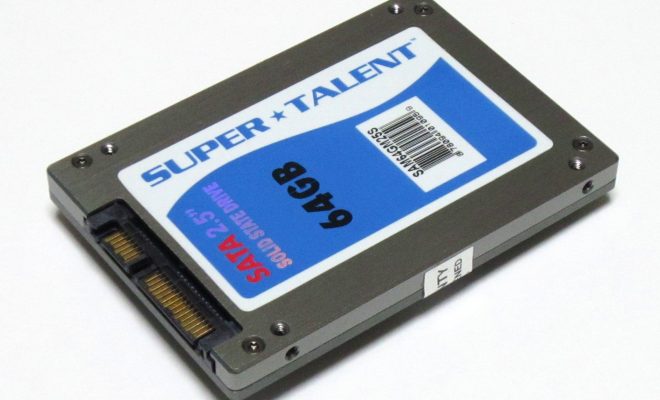
Essentially, an SSD is a type of storage device that stores data on flash memory chips. Unlike HDDs, which store data on spinning disks, SSDs have no moving parts. Instead, they use electrically erasable and programmable read-only memory (EEPROM) to store data.

When you save data to an SSD, the information is first sent to a controller chip. This chip then manages the data and spreads it evenly across different memory modules to prevent wear and tear. The controller chip also helps the SSD to retrieve data faster by determining the best location to access the data from.

The flash memory chips themselves are made up of a grid of memory cells, with each cell capable of storing a single bit of data. These cells are made up of two layers of materials: a conductive layer and an insulating layer. The conductive layer is made up of polysilicon, while the insulating layer is made up of silicon oxide.

Data is stored as electrical charges in the insulating layer. When a cell needs to be programmed, a voltage is applied to the conductive layer, which creates an electric field. This field causes electrons to tunnel through the insulating layer and become trapped in it. This trapped charge will remain there until it is erased or overwritten.

To read data from an SSD, the controller chip sends a voltage to the cell, which causes a current to flow through the insulating layer. This current can be measured to determine whether a cell is storing a 1 or a 0.

One of the benefits of SSDs is their speed. Because there are no moving parts, data can be accessed much faster than on an HDD. The average access time for an SSD is around 0.1 milliseconds, compared to around 7-8 milliseconds for an HDD.

Another benefit is power efficiency. Because there are no moving parts, SSDs consume less power than HDDs. This results in longer battery life for laptops and other portable devices.

Finally, SSDs are more reliable than HDDs because they are not as susceptible to physical damage. Because there are no moving parts, there is no risk of mechanical failure. Additionally, because data is spread evenly across memory modules, if one module fails, data can be recovered from other modules that are still functioning.

In conclusion, SSDs are a new generation of storage devices that offer many benefits over traditional HDDs. Their speed, power efficiency, and reliability make them a popular choice for computer users. By using flash memory chips and a controller chip, SSDs are able to store and retrieve data quickly and efficiently. As technology continues to advance, we can expect to see even more improvements in SSD technology.


Previous Article

How to Fix Call of Duty: Warzone’s ...

Next Article

Getting Started With Swap Files on Linux

Matthew Lynch

Related articles More from author

  • Assistive Technology

    Ways to Fix the Bluetooth “Setup Incomplete Because of a Metered Connection” Error on Windows

    June 11, 2023
    By Matthew Lynch
  • Assistive Technology

    How to Install Octoprint on a Raspberry Pi and Manage Your 3D Prints from Anywhere

    June 23, 2023
    By Matthew Lynch
  • Assistive Technology

    How to Fix It When HBO Max Is Not Working on a Fire Stick

    June 10, 2023
    By Matthew Lynch
  • Assistive Technology

    How to Use Microsoft Outlook for Project Management

    June 11, 2023
    By Matthew Lynch
  • Assistive Technology

    How to Set Up YouTube TV Family Sharing

    June 6, 2023
    By Matthew Lynch
  • Assistive Technology

    Android Phone Buttons Don’t Work? 5 Fixes and Workarounds

    June 23, 2023
    By Matthew Lynch

Search

Login & Registration

  • Log in
  • Entries feed
  • Comments feed
  • WordPress.org

Newsletter

Signup for The Tech Edvocate Newsletter and have the latest in EdTech news and opinion delivered to your email address!

About Us

Since technology is not going anywhere and does more good than harm, adapting is the best course of action. That is where The Tech Edvocate comes in. We plan to cover the PreK-12 and Higher Education EdTech sectors and provide our readers with the latest news and opinion on the subject. From time to time, I will invite other voices to weigh in on important issues in EdTech. We hope to provide a well-rounded, multi-faceted look at the past, present, the future of EdTech in the US and internationally.

We started this journey back in June 2016, and we plan to continue it for many more years to come. I hope that you will join us in this discussion of the past, present and future of EdTech and lend your own insight to the issues that are discussed.

Newsletter

Signup for The Tech Edvocate Newsletter and have the latest in EdTech news and opinion delivered to your email address!

Contact Us

The Tech Edvocate
910 Goddin Street
Richmond, VA 23231
(601) 630-5238
[email protected]

Copyright © 2026 Matthew Lynch. All rights reserved.