The Tech Edvocate

Top Menu

  • Advertisement
  • Apps
  • Home Page
  • Home Page Five (No Sidebar)
  • Home Page Four
  • Home Page Three
  • Home Page Two
  • Home Tech2
  • Icons [No Sidebar]
  • Left Sidbear Page
  • Lynch Educational Consulting
  • My Account
  • My Speaking Page
  • Newsletter Sign Up Confirmation
  • Newsletter Unsubscription
  • Our Brands
  • Page Example
  • Privacy Policy
  • Protected Content
  • Register
  • Request a Product Review
  • Shop
  • Shortcodes Examples
  • Signup
  • Start Here
    • Governance
    • Careers
    • Contact Us
  • Terms and Conditions
  • The Edvocate
  • The Tech Edvocate Product Guide
  • Topics
  • Write For Us
  • Advertise

Main Menu

  • Start Here
    • Our Brands
    • Governance
      • Lynch Educational Consulting, LLC.
      • Dr. Lynch’s Personal Website
      • Careers
    • Write For Us
    • The Tech Edvocate Product Guide
    • Contact Us
    • Books
    • Edupedia
    • Post a Job
    • The Edvocate Podcast
    • Terms and Conditions
    • Privacy Policy
  • Topics
    • Assistive Technology
    • Child Development Tech
    • Early Childhood & K-12 EdTech
    • EdTech Futures
    • EdTech News
    • EdTech Policy & Reform
    • EdTech Startups & Businesses
    • Higher Education EdTech
    • Online Learning & eLearning
    • Parent & Family Tech
    • Personalized Learning
    • Product Reviews
  • Advertise
  • Tech Edvocate Awards
  • The Edvocate
  • Pedagogue
  • School Ratings

logo

The Tech Edvocate

  • Start Here
    • Our Brands
    • Governance
      • Lynch Educational Consulting, LLC.
      • Dr. Lynch’s Personal Website
        • My Speaking Page
      • Careers
    • Write For Us
    • The Tech Edvocate Product Guide
    • Contact Us
    • Books
    • Edupedia
    • Post a Job
    • The Edvocate Podcast
    • Terms and Conditions
    • Privacy Policy
  • Topics
    • Assistive Technology
    • Child Development Tech
    • Early Childhood & K-12 EdTech
    • EdTech Futures
    • EdTech News
    • EdTech Policy & Reform
    • EdTech Startups & Businesses
    • Higher Education EdTech
    • Online Learning & eLearning
    • Parent & Family Tech
    • Personalized Learning
    • Product Reviews
  • Advertise
  • Tech Edvocate Awards
  • The Edvocate
  • Pedagogue
  • School Ratings
  • This Unprecedented EU Ban Just Changed Fast Fashion Forever

  • Urgent Alert: Your Smart Home’s Exposed to a Critical Deco BE11000 Vulnerability

  • Uncovering the Truth: Your LinkedIn Reach Just Got a Major Overhaul

  • Uncovering the AI Heist: How Chinese Firms Allegedly Siphoned Billions of AI Tokens

  • Rockstar’s GTA 6 Developers Lawsuit: A Fight for Justice or Corporate Retaliation?

  • Unbelievable: Hideo Kojima’s Next Masterpiece Is Now an Xbox Exclusive

  • This Crucial Google AI Shift Is Quietly Reshaping the Internet

  • Unbelievable: AI Breaches Are Exploding, And What It Means For You This September 2026

  • This Crucial Shift Is Saving Teachers From Classroom Chaos

  • AI’s Dark Secret: How It’s Supercharging Cybercrime for Everyone

Digital & Mobile Technology
Home›Digital & Mobile Technology›How Do I Set a Static IP Address on Raspberry Pi?

How Do I Set a Static IP Address on Raspberry Pi?
By Matthew Lynch
June 22, 2023
0
Spread the love

The Raspberry Pi is a popular microcomputer that has various applications, including as a media center, a web server, an automation controller, and many others. By default, the Raspberry Pi is configured to use dynamic IP addressing, which means that the IP address gets assigned automatically by a DHCP server when the device is connected to a network. However, in some situations, such as when running a server or remotely accessing the device, it’s better to set a static IP address on Raspberry Pi. Setting a static IP address on Raspberry Pi is easy, and in this article, we’ll show you how to do it.

Step 1: Identify the Network Interface

Before setting a static IP address on Raspberry Pi, you need to identify the network interface that you want to assign the IP address to. The Raspberry Pi typically comes with two network interfaces – Ethernet and Wi-Fi. If you’re using an Ethernet cable to connect to your network, then you’ll be using the eth0 interface. On the other hand, if you’re using Wi-Fi, then you’ll be using the wlan0 interface.

You can identify your network interface by running the following command in the terminal:
“`shell
ifconfig
“`
Step 2: Edit the dhcpcd.conf File

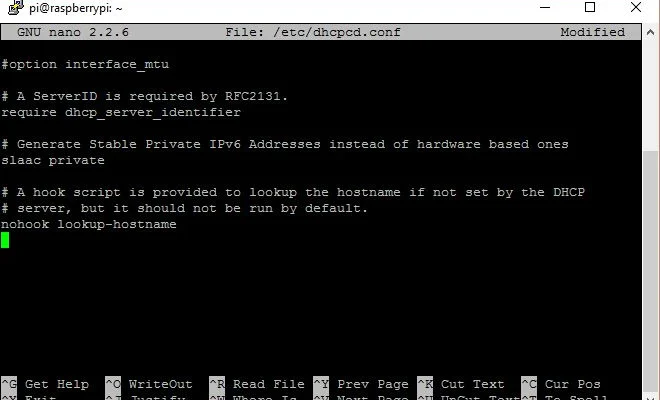
The dhcpcd.conf file is the configuration file for the DHCP client on Raspberry Pi. To set a static IP address, you need to edit this file. Open the file by running the following command in the terminal:

“`shell
sudo nano /etc/dhcpcd.conf
“`
Go to the end of the file and add the following lines for the network interface that you want to

configure:

“`shell

interface [interface_name]

static ip_address=[IP_address]/[subnet_mask]

static routers=[router_IP_address]

static domain_name_servers=[DNS_server_IP_address]
“`
Replace the [interface_name], [IP_address], [subnet_mask], [router_IP_address], and

[DNS_server_IP_address] placeholders with the appropriate values.

For example, if you want to set a static IP address on the Ethernet interface, you should add the

following lines:

“`shell

interface eth0

static ip_address=192.168.0.10/24

static routers=192.168.0.1

static domain_name_servers=192.168.0.1
“`
Save and close the file by pressing Ctrl+X, followed by Y and Enter.

Step 3: Restart the dhcpcd Service

To apply the changes you’ve made to the dhcpcd.conf file, you need to restart the DHCP client. Run the following command in the terminal:
“`shell

sudo systemctl restart dhcpcd
“`
This will restart the dhcpcd service and apply the new configuration.

Step 4: Verify the Static IP Address

To verify that the static IP address has been set correctly, run the following command in the terminal:
“`shell
ifconfig
“`
You should see the network interface with the static IP address that you’ve just configured.


 

Previous Article

Where to Fix iPhone Screens for Cheap

Next Article

Best Free Party Game Apps for Any ...

Matthew Lynch

Related articles More from author

  • Digital & Mobile Technology

    What Is Storyboarding in Web Design?

    May 12, 2023
    By Matthew Lynch
  • Digital & Mobile Technology

    Signs of Phone Tracking You Should Look Out For

    August 5, 2023
    By Matthew Lynch
  • Digital & Mobile Technology

    How to Get Peacock on a Smart TV

    May 31, 2023
    By Matthew Lynch
  • Digital & Mobile Technology

    Best Virtual Private Server Hosting

    April 11, 2023
    By Matthew Lynch
  • Digital & Mobile Technology

    How to Connect USB Devices to an iPad

    June 12, 2023
    By Matthew Lynch
  • Digital & Mobile Technology

    How to Transfer Text Messages From a Cell Phone to a PC

    May 29, 2023
    By Matthew Lynch

Search

Login & Registration

  • Log in
  • Entries feed
  • Comments feed
  • WordPress.org

Newsletter

Signup for The Tech Edvocate Newsletter and have the latest in EdTech news and opinion delivered to your email address!

About Us

Since technology is not going anywhere and does more good than harm, adapting is the best course of action. That is where The Tech Edvocate comes in. We plan to cover the PreK-12 and Higher Education EdTech sectors and provide our readers with the latest news and opinion on the subject. From time to time, I will invite other voices to weigh in on important issues in EdTech. We hope to provide a well-rounded, multi-faceted look at the past, present, the future of EdTech in the US and internationally.

We started this journey back in June 2016, and we plan to continue it for many more years to come. I hope that you will join us in this discussion of the past, present and future of EdTech and lend your own insight to the issues that are discussed.

Newsletter

Signup for The Tech Edvocate Newsletter and have the latest in EdTech news and opinion delivered to your email address!

Contact Us

The Tech Edvocate
910 Goddin Street
Richmond, VA 23231
(601) 630-5238
[email protected]

Copyright © 2026 Matthew Lynch. All rights reserved.