Earth-Directed Solar Storm: March 19, 2026 Forecast
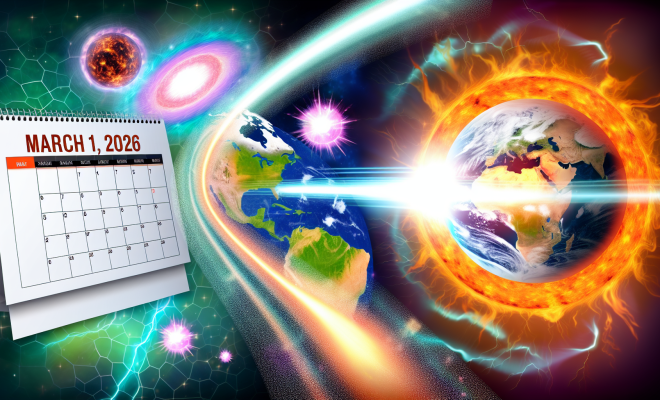
As space weather continues to influence our planet, a significant solar event is on the horizon. A forecast has announced that an earth-directed solar storm is expected to impact Earth between early and midday on March 19, 2026. This forecast follows a period of unsettled conditions triggered by fast solar wind emanating from a coronal hole.
Understanding Solar Storms
Solar storms, also known as geomagnetic storms, occur when solar wind interacts with Earth’s magnetic field. These storms can have a range of effects on our planet, from beautiful auroras in the polar regions to disruptions in satellite operations and radio communications. The upcoming storm is characterized as a G1 minor geomagnetic storm, with a potential 20% chance of escalating to a G2 level at mid-latitudes.
What Causes These Events?
The source of this particular solar storm is a coronal hole—a region on the sun’s surface that allows solar wind to escape more freely. When the solar wind is accelerated, it can lead to heightened geomagnetic activity upon reaching Earth. This fast solar wind will begin to create unsettled conditions starting from March 18, setting the stage for the storm’s impact the following day.
What to Expect on March 19, 2026
The forecast predicts that the geomagnetic storm will manifest as minor conditions, classified as G1. This level of storm can cause:
- Weak power grid fluctuations
- Minor impact on satellite operations
- Possible auroras visible at lower latitudes
However, the situation may become more serious, with a 20% chance of reaching G2 conditions. Should this occur, effects may include:
- More significant power grid fluctuations
- Increased risk of satellite drag
- Widespread auroral displays visible in regions not typically associated with such phenomena
Radiation Storm Risk
While the solar storm poses risks to technology and infrastructure, the radiation storm risk remains low. The forecast indicates a minimal chance (1-5%) of a radiation storm, which is crucial for the safety of astronauts in space and for high-altitude flights that may pass over polar regions.
The Science Behind the Forecast
The data informing this forecast comes from a variety of sources, including the GOES magnetometer and the NOAA scales. The GOES (Geostationary Operational Environmental Satellites) provide real-time monitoring of solar activity, while NOAA (National Oceanic and Atmospheric Administration) scales assess the impact of geomagnetic storms on Earth’s magnetosphere and ionosphere.
These scientific tools help meteorologists and space weather experts warn the public and relevant sectors about potential disruptions. Understanding the behavior of the sun and its impact on Earth’s environment is crucial for preparing for these events.
Preparing for Solar Storms
As solar storms can lead to various disruptions, it is essential for individuals and organizations to be aware of the potential impacts and prepare accordingly. Here are some steps that can be taken:
- Stay Informed: Follow updates from credible sources such as NOAA and NASA regarding space weather forecasts.
- Check Equipment: Businesses that rely on satellite technology or have sensitive electronic systems should have contingency plans in place.
- Enjoy the Show: If conditions allow, take advantage of the opportunity to witness auroras, which can be a spectacular natural phenomenon.
The Importance of Monitoring Solar Activity
Monitoring solar activity is not just for scientific interest; it has practical implications for modern society. As our reliance on technology grows, understanding and preparing for solar storms become increasingly important. The potential for geomagnetic storms to disrupt communication systems, power grids, and navigation systems cannot be overstated.
In the past, severe solar storms have caused widespread blackouts and satellite damage. Therefore, ongoing research and real-time monitoring are critical in mitigating the impacts of future solar events.
Conclusion
As we approach March 19, 2026, awareness and preparedness regarding the upcoming solar storm will be key. With predictions indicating a G1 storm with a chance of escalating to G2 conditions, individuals and organizations alike should remain vigilant. By understanding the science behind these events and preparing for potential disruptions, we can better navigate the challenges posed by our ever-dynamic solar environment.