Milky Way’s Stellar Halo: Self-Made, Not Just Ancient Collisions
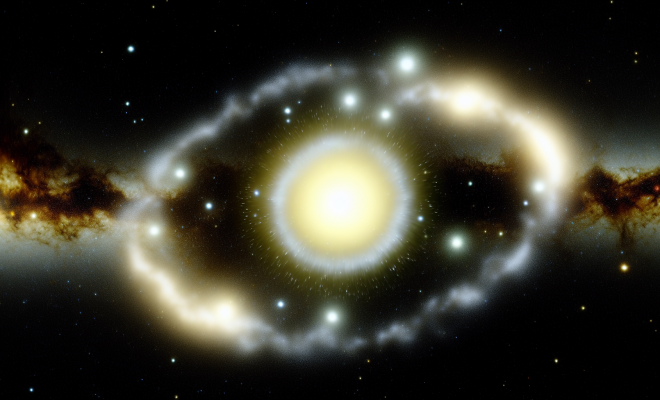
The mysteries of our Milky Way galaxy continue to captivate astronomers and space enthusiasts alike, but recent findings challenge long-held beliefs regarding its formation. A groundbreaking study published in the Monthly Notices of the Royal Astronomical Society reveals that the stellar halo of the Milky Way could be significantly influenced by internal structures, particularly the galaxy’s central bar, rather than solely from ancient merger events. This revelation not only reshapes our understanding of the Milky Way’s history but also ignites a fascinating debate in the astronomical community.
The Stellar Halo Revisited
At the heart of this discussion is the concept of the stellar halo, a vast, diffuse region surrounding the Milky Way filled with stars, gas, and dark matter. Traditionally, scientists believed that the peculiar features observed within the stellar halo—often seen as substructures—were remnants of past galactic mergers. Such views painted a picture of the Milky Way as a product of cosmic collisions, akin to a mosaic of ancient histories.
However, the latest high-resolution cosmological simulation of a Milky Way-like galaxy presents a starkly different narrative. Conducted by a team of researchers, this simulation demonstrates that the Milky Way’s central bar can induce prominent ‘ridges’ and substructures in the stellar halo. These formations can mimic features that were previously attributed to external forces, such as those resulting from ancient galaxy mergers.
Understanding the Simulation
Published on May 4, 2026, the study showcases how bar-driven resonances in energy-angular momentum space can create intricate patterns within the halo. With the use of advanced computational techniques, the researchers were able to model the dynamics of galactic bars and their effects on stellar populations, thereby revealing that these structures could generate a misleading appearance of accreted debris.
- High-resolution simulations: The research utilized cutting-edge technology to simulate a Milky Way-like galaxy, allowing for precise observations of internal dynamics.
- Bar-driven resonance: The central bar’s gravitational influence was shown to create patterns within the stellar halo that resemble those produced by galactic mergers.
- Complicated merger history: These findings complicate the reconstruction of the Milky Way’s merger history and challenge the traditional narrative surrounding its formation.
Implications for Galactic Archeology
The implications of the findings are profound, as they suggest that the Milky Way’s ‘fossil record’ may not solely be a consequence of cosmic collisions. Instead, a significant portion of the halo’s structure might be self-generated, leading to a reevaluation of how astronomers interpret the history of galactic formations.
These new insights could alter methods used in galactic archeology, a field dedicated to studying the past events that shaped galaxies. By recognizing that internal dynamics play a crucial role, researchers may need to develop new models that account for both internal and external influences when analyzing a galaxy’s stellar halo.
The Debate Among Astronomers
The publication of this study has sparked considerable debate among astronomers and space enthusiasts. The notion that the Milky Way’s halo could be partly self-made resonates with many who are invested in the narrative of the galaxy’s evolution. This counterintuitive idea has generated discussion across various platforms, including social media, where passionate arguments rage over the implications of these findings.
On one side, proponents of the traditional view argue that the clear substructures found in the stellar halo are indicative of past collisions with other galaxies. They contend that such mergers leave distinct signatures that can be identified through stellar analysis and simulations. On the other hand, supporters of the new findings suggest that these features may not be as straightforward as once believed, emphasizing the need for a more nuanced understanding of galactic dynamics.
The Emotional Appeal of Cosmic Origins
This controversy goes beyond mere academic debate; it taps into deeper emotional and intellectual curiosities about our place in the universe. The origins of our galaxy and its evolution are topics that resonate with many, igniting a sense of wonder about the cosmos and our existence within it. The idea that the Milky Way’s stellar halo is influenced by its own internal structures rather than just ancient collisional histories offers an intriguing narrative twist.
For space enthusiasts who have followed the tale of the Milky Way’s formation, the idea that we may have a hand in crafting our own cosmic identity is a fascinating and compelling thought. It poses questions about determinism versus chaos in the universe’s grand design.
Future Research Directions
The results of this study open doors for future research aimed at further investigating the dynamics of galactic bars and their implications for other galaxies. The methodology used in this simulation can serve as a template for exploring similar structures in other galaxies, potentially revealing a broader pattern in how bars influence stellar halos.
- Cross-galactic comparison: The study encourages astronomers to compare the Milky Way’s stellar halo with that of similar galaxies to gather data on the prevalence of bar-induced structures.
- Refining models: Future simulations may refine existing models of galactic formation by integrating both internal and external influences on stellar halos.
- Observational campaigns: The findings may encourage new observational campaigns to gather empirical data on stellar halo structures in various galaxies.
Conclusion
The study on bar-induced substructures in the Milky Way’s stellar halo represents a pivotal moment in our understanding of galaxy formation. By challenging the notion that these features are solely the result of ancient mergers, this research encourages a more holistic view of galactic dynamics.
As we continue to explore the cosmos, it is essential to remain open to new ideas and interpretations regarding the formation of our galaxy. The Milky Way’s history may not only be a record of past cosmic collisions but also a reflection of the dynamic processes occurring within it. This ongoing dialogue among astronomers ensures that our understanding of the universe will continually evolve, inviting us to reconsider what we think we know about our celestial home.
In an age where new discoveries are made at an unprecedented pace, the exploration of galactic structures like the stellar halo serves as a reminder of the complexity and beauty of our universe, beckoning us to delve deeper into its mysteries.