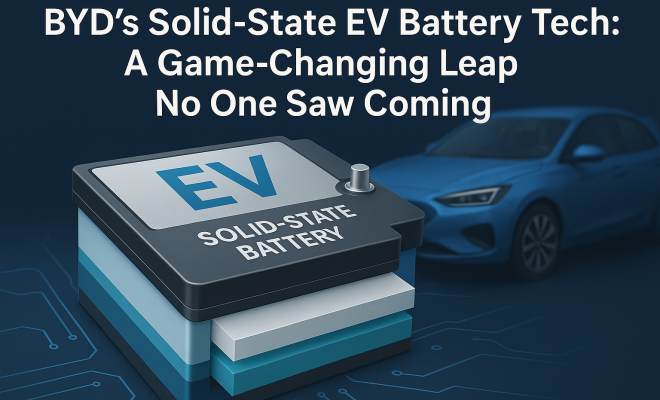
BYD’s Solid-State EV Battery Tech: A Game-Changing Leap No One Saw Coming
“`html
When you talk about the future of electric vehicles, the conversation inevitably turns to batteries. For years, solid-state batteries have been the holy grail – a technology promising longer range, faster charging, and enhanced safety, but always seemingly five to ten years away. It’s a running joke in the industry, isn’t it? Well, it seems BYD, the quiet giant of the EV world, is ready to pull back the curtain on that distant future, and they’re doing it much sooner than many anticipated. The news that BYD plans to launch an EV with solid-state batteries in 2027, with mass production scaling up significantly by 2030, is nothing short of groundbreaking. It suggests a profound shift in the landscape of BYD EV battery technology, potentially leaving competitors scrambling.
This isn’t just about a minor improvement; it’s about a fundamental transformation that addresses the core anxieties holding many consumers back from making the switch to electric. Think about it: range anxiety, long charging times, and even the perceived safety risks associated with current lithium-ion chemistries. BYD’s aggressive timeline for solid-state deployment, coupled with their already impressive ‘Flash Charging’ capabilities, paints a picture of an EV future that feels genuinely practical and accessible. Let’s dig into why this move by BYD isn’t just big news, but a potential seismic event for the automotive industry.
1. The Solid-State Surprise: Why BYD’s 2027 Target is So Significant
For years, the automotive and battery industries have treated solid-state batteries as a long-term goal, a technology for the 2030s, or even later, for widespread adoption. Toyota, a long-time proponent of the technology, has often been cited as a leader, yet even their timelines have been cautious, often speaking of limited deployment around 2027 with mass production further out. Samsung SDI, another major player, has also set a 2027 target, but with similar caveats about the challenges of scaling up manufacturing.
BYD’s announcement, therefore, isn’t just another company stating an ambition; it’s a bold declaration that they believe they’ve cracked the code for commercial viability earlier than their rivals. Bringing a solid-state EV to market by 2027 implies that BYD has overcome significant hurdles in materials science, manufacturing processes, and cost reduction – challenges that have plagued others. This isn’t just about laboratory breakthroughs; it’s about engineering a product that can be reliably produced at scale and integrated into a consumer vehicle within a relatively short timeframe.
2. Beyond Lithium-Ion: The Fundamental Advantages of Solid-State Technology
To truly appreciate the significance of BYD’s solid-state advancements, it helps to understand what makes these batteries so revolutionary. Unlike traditional lithium-ion batteries that use a liquid or gel electrolyte, solid-state batteries employ a solid material to conduct ions between the electrodes. This seemingly simple change unlocks a cascade of benefits that address many of the current limitations of EVs.
Firstly, energy density. Solid-state electrolytes can allow for a much higher packing density of active materials, meaning more energy can be stored in a smaller, lighter package. This translates directly into increased range for the same battery size, or a lighter vehicle for the same range. Secondly, safety. The absence of a flammable liquid electrolyte significantly reduces the risk of thermal runaway, a condition where overheating can lead to fires. This enhanced safety profile could alleviate consumer concerns and potentially simplify battery management systems. Finally, charging speed. Solid-state designs often promise much faster charging rates, as the solid electrolyte can withstand higher current densities without degrading.
3. Flash Charging Today: BYD’s Current Answer to Range Anxiety
While solid-state batteries represent the future, BYD isn’t waiting around to address consumer concerns about EV practicality. They’ve already deployed impressive ‘Flash Charging’ technology in their Denza Z9GT model. This isn’t just incrementally better charging; it’s a genuinely rapid refill that tackles one of the biggest psychological barriers for potential EV buyers: the perceived inconvenience of long charging stops. Imagine pulling into a charging station, grabbing a coffee, and knowing your car is almost full before you’ve even finished checking your emails.
The numbers speak for themselves: the Denza Z9GT can go from 10% to 70% charge in a mere five minutes. That’s essentially adding hundreds of miles of range in the time it takes to grab a snack. Push it a little further, and you’re looking at 10% to 97% in just nine minutes. This kind of performance isn’t just competitive; it’s a direct challenge to the charging speeds of internal combustion engine vehicles. It effectively minimizes the downtime associated with long-distance EV travel, making road trips far more feasible and less stressful. This existing capability showcases BYD’s engineering prowess and their commitment to pushing the boundaries of what’s possible in BYD EV battery technology, even before solid-state enters the mainstream.
4. The Denza Z9GT: A Glimpse into BYD’s High-Performance Future
The Denza Z9GT isn’t just a testbed for fast charging; it’s a statement vehicle, a luxurious grand tourer that signals BYD’s ambitions in the premium segment. This model, developed under BYD’s luxury brand Denza, is designed to compete with high-end European sedans and wagons, blending performance, technology, and sophisticated design. Its role in showcasing the Flash Charging technology is strategic, demonstrating that cutting-edge battery innovation isn’t reserved for entry-level models but is being integrated into vehicles that demand the best. (See: Solid-state battery technology overview.)
The Z9GT’s impressive charging times are a key selling point, but it’s also packed with other advanced features, including a sophisticated suspension system and a powerful electric drivetrain. Its existence proves that BYD is not just a battery manufacturer that happens to make cars; they are a full-fledged automotive powerhouse capable of integrating advanced BYD EV battery technology into compelling, market-ready vehicles. This holistic approach, from battery cell to finished car, gives them a significant advantage in controlling development cycles and costs.
5. BYD’s Vertical Integration: A Competitive Edge in Battery Innovation
One of the core reasons BYD is able to make such aggressive moves in battery technology, including solid-state, is its unparalleled vertical integration. Unlike many automakers who rely heavily on external suppliers for their battery cells, BYD designs and manufactures most of its own batteries in-house. This includes everything from the raw material sourcing and cell chemistry development to pack assembly and battery management systems. This ‘closed-loop’ approach offers several critical advantages.
Firstly, it grants BYD complete control over the research and development pipeline, allowing them to rapidly iterate and implement new discoveries in BYD EV battery technology. They don’t have to wait for a third-party supplier to catch up or prioritize their needs. Secondly, it provides a significant cost advantage. By eliminating layers of external profit margins and optimizing production processes from the ground up, BYD can produce batteries more efficiently. Finally, and perhaps most importantly for groundbreaking tech like solid-state, it allows for seamless integration of battery and vehicle design, ensuring that the battery system is perfectly optimized for the specific vehicle architecture and performance requirements. This tight coupling is crucial for pushing the boundaries of performance and safety.
6. The Blade Battery Legacy: Paving the Way for Solid-State
Before solid-state, BYD made waves with its ‘Blade Battery’ technology, a form of lithium iron phosphate (LFP) battery that offered significant improvements in safety, durability, and space utilization. The Blade Battery isn’t just a clever packaging solution; it’s a testament to BYD’s pragmatic and innovative approach to battery design. By arranging elongated cells directly into the battery pack, it eliminated the need for traditional modules, increasing volumetric efficiency and structural integrity. This also meant fewer components, simplifying manufacturing and reducing cost.
Crucially, the Blade Battery also demonstrated exceptional safety performance, famously passing the nail penetration test without thermal runaway, a critical benchmark for battery safety. This experience in developing, manufacturing, and mass-deploying a fundamentally new battery architecture like the Blade Battery has undoubtedly provided BYD with invaluable lessons and expertise. This foundation in advanced battery engineering and large-scale production gives them a head start in tackling the complexities of solid-state manufacturing. It’s a natural progression of their commitment to advancing BYD EV battery technology.
7. Social Media Buzz and Market Impact: The Industry Reacts
The news of BYD’s solid-state battery plans isn’t just confined to industry reports; it’s generating significant buzz across social media platforms. Enthusiasts, investors, and even competitors are keenly watching BYD’s moves. This kind of social engagement is a strong indicator of the perceived importance and potential impact of this technology. People are recognizing that if BYD delivers on its promise, it could fundamentally alter the competitive landscape.
For consumers, the prospect of an EV with vastly improved range and charging times is incredibly appealing, and the discussion reflects that excitement. For investors, it signals a potential differentiator that could give BYD a significant market advantage, boosting its valuation and cementing its position as a global EV leader. Competitors, on the other hand, are likely feeling the pressure. If BYD truly brings solid-state to market in 2027, it means they need to accelerate their own development or risk falling behind in a crucial technological race. This isn’t just a PR announcement; it’s a signal that the EV market is about to get a lot more interesting, driven by advancements in BYD EV battery technology.
8. The Road Ahead: Challenges and Opportunities for BYD EV Battery Technology
While BYD’s solid-state ambitions are exciting, the path to mass production of any new battery technology is rarely without its challenges. Scaling up manufacturing for solid-state batteries has historically been a major hurdle, requiring new production techniques, specialized materials, and stringent quality control. The cost of these initial solid-state cells could also be higher, at least initially, potentially limiting their deployment to premium vehicles before trickling down to more affordable segments. However, BYD’s history of aggressive cost reduction and vertical integration suggests they are uniquely positioned to tackle these challenges.
If BYD succeeds in its 2027 timeline, the opportunities are immense. They could establish a commanding lead in battery technology, attracting new customers and potentially licensing their technology to other automakers. This would further solidify their position not just as an EV manufacturer, but as a dominant force in the entire EV ecosystem. The implications for global EV adoption, environmental impact, and energy independence are profound. BYD isn’t just building cars; they’re building a more sustainable and efficient future, one battery innovation at a time. The evolution of BYD EV battery technology is truly a story to watch.
9. A New Era of EV Practicality: What This Means for Drivers
Ultimately, all this talk of advanced BYD EV battery technology, solid-state electrolytes, and flash charging boils down to one thing: a better experience for the driver. For years, the criticisms leveled against EVs have been consistent: too expensive, too short-ranged, and too long to charge. While prices are coming down and ranges are improving, the charging time remains a significant point of contention for many. (See: Recent developments in solid-state batteries.)
BYD’s dual approach – delivering immediate relief with Flash Charging and promising a future paradigm shift with solid-state batteries – directly tackles these pain points. Imagine an EV that charges faster than you can fill a gas tank, offers ranges comparable to or exceeding internal combustion vehicles, and boasts an inherent safety advantage. This isn’t just about technological bragging rights; it’s about making electric vehicles so undeniably convenient and practical that the choice becomes a no-brainer for the vast majority of consumers. This is the future BYD is aggressively pursuing, and if they achieve it, they will fundamentally reshape how we think about personal transportation.
10. Comparing Solid-State to Current Lithium-Ion: A Deeper Dive
To really grasp the leap BYD is aiming for, let’s compare solid-state batteries against the current champions: lithium-ion (Li-ion) batteries. Traditional Li-ion batteries, while revolutionary in their time, have some inherent limitations. The liquid electrolyte is flammable, which means robust cooling systems and sophisticated battery management systems are needed to prevent thermal runaway. This adds weight, complexity, and cost. Plus, the liquid can degrade over time, affecting battery life and performance. Imagine a liquid that slowly becomes less efficient at its job; that’s what happens inside a conventional Li-ion cell.
Solid-state batteries, by replacing that liquid with a solid, bypass many of these issues. Think of it like swapping a leaky garden hose for a solid pipe – the potential for issues with the medium itself just drops dramatically. This solid electrolyte often allows for the use of a lithium metal anode, which has a much higher theoretical energy density than the graphite anodes used in most current Li-ion batteries. This means you can pack significantly more energy into the same volume, or achieve the same energy with a much smaller, lighter battery. For a car, that means more range, better handling due to less weight, or more space for passengers and cargo. It’s a fundamental architectural change, not just an incremental tweak.
11. The Global Race for Solid-State Dominance: BYD’s Position
BYD isn’t the only player in the solid-state battery race, and understanding the competitive landscape helps contextualize their announcement. Major automakers like Toyota, Volkswagen, and Hyundai, along with battery giants like Samsung SDI, LG Energy Solution, and CATL, are all pouring billions into solid-state R&D. Startups like QuantumScape, Solid Power, and ProLogium are also making significant progress, often backed by these larger industry players.
Toyota, for instance, has long held a substantial patent portfolio in solid-state technology and has demonstrated prototype vehicles. However, their timelines for mass production have often been more conservative, focusing on small-scale deployment first. What makes BYD’s 2027 target so impactful is its ambition for actual vehicle launches and a clear path to larger-scale production by 2030. This isn’t just a lab demonstration; it’s a commercialization roadmap. BYD’s deep expertise in manufacturing, particularly their vertical integration mentioned earlier, gives them a unique advantage in translating lab breakthroughs into mass-produced products. They control the entire supply chain, which can dramatically speed up development and deployment compared to companies relying on external partners for critical components.
12. Economic and Environmental Implications: Beyond the Vehicle
The shift to advanced BYD EV battery technology, especially solid-state, has ripples far beyond just the automotive sector. Environmentally, a higher energy density means potentially smaller, lighter battery packs, which reduces the amount of raw materials needed per vehicle. Faster charging also makes it easier to integrate EVs into existing grids, potentially reducing strain during peak demand if charging can be more dynamically managed. A longer lifespan for these batteries could also reduce waste, making the entire EV lifecycle more sustainable.
Economically, if BYD can achieve cost-effective mass production of solid-state batteries, it could significantly lower the overall cost of EVs in the long run. This would accelerate adoption, create new jobs in battery manufacturing and related industries, and potentially shift global economic power. For nations, securing a domestic supply chain for these advanced batteries becomes a strategic imperative, reducing reliance on foreign sources and bolstering energy independence. BYD, being a Chinese company with a robust domestic supply chain, is well-positioned to capitalize on these geopolitical considerations.
13. Expert Perspectives: What Analysts Are Saying
Industry analysts are largely optimistic but cautious about BYD’s ambitious solid-state timeline. Many acknowledge BYD’s proven track record with the Blade Battery and their vertical integration as key strengths. For example, some battery experts suggest that while 2027 for initial deployment is aggressive, it’s not impossible given BYD’s resources and focus. They point to the substantial investment BYD has made in R&D and manufacturing capabilities. However, the sheer scale of the challenge – from perfecting new materials to establishing entirely new production lines – means that achieving mass production at competitive costs by 2030 will be a monumental task.
There’s also discussion about the specific type of solid-state electrolyte BYD might be pursuing. Sulfide-based solid electrolytes, for instance, offer high conductivity but come with their own manufacturing complexities and sensitivity to moisture. Oxide-based electrolytes are more stable but often have lower conductivity. The exact chemistry and architecture BYD develops will be crucial to its success. Analysts agree that if BYD pulls this off, it will be a game-changer, not just for BYD, but for the entire EV industry, forcing competitors to rethink their own battery strategies. (See: Research on battery technologies.)
Frequently Asked Questions about BYD EV Battery Technology
Q1: What exactly is a solid-state battery, and how is it different from current EV batteries?
A solid-state battery replaces the liquid or gel electrolyte found in traditional lithium-ion batteries with a solid material. This solid electrolyte offers several key advantages: it’s non-flammable, significantly improving safety; it allows for higher energy density, meaning more range or lighter batteries; and it can often handle faster charging rates without degradation. It’s a fundamental change in the battery’s internal structure.
Q2: Why is BYD’s 2027 target for solid-state batteries so significant?
Many other companies and research institutions have projected solid-state battery commercialization much later, often in the 2030s, with limited initial deployment. BYD’s announcement of an EV launch by 2027, with significant mass production scaling by 2030, signals that they believe they’ve overcome critical manufacturing and cost hurdles sooner than anticipated. This aggressive timeline could give them a substantial lead in the market.
Q3: What is “Flash Charging,” and how does it relate to BYD’s battery strategy?
Flash Charging is BYD’s current ultra-fast charging technology, already deployed in models like the Denza Z9GT. It allows an EV to gain hundreds of miles of range in just a few minutes, drastically reducing charging times. This technology addresses immediate consumer concerns about charging convenience, while solid-state batteries represent the longer-term solution for even faster charging and greater energy density. It shows BYD is tackling battery innovation on multiple fronts.
Q4: How does BYD’s vertical integration help its battery development?
BYD designs and manufactures most of its battery components in-house, from raw materials to finished battery packs. This vertical integration gives them complete control over the R&D process, allowing for faster innovation, rapid iteration, and seamless integration of battery and vehicle design. It also provides significant cost advantages and reduces reliance on external suppliers, which is crucial for developing and scaling complex new technologies like solid-state batteries.
Q5: What role did the Blade Battery play in BYD’s journey towards solid-state technology?
The Blade Battery, BYD’s innovative LFP battery, demonstrated their ability to develop and mass-produce a fundamentally new battery architecture that prioritized safety, durability, and space efficiency. The experience gained in scaling up Blade Battery production and perfecting its safety features has provided BYD with invaluable expertise in advanced battery engineering, which is a strong foundation for tackling the complexities of solid-state manufacturing.
Q6: Will solid-state batteries make current EVs obsolete?
Not necessarily. While solid-state batteries promise significant improvements, the transition will be gradual. Current lithium-ion EVs will continue to be produced and refined, especially as their costs continue to decrease. Solid-state batteries will likely debut in premium segments first due to initial higher costs, gradually trickling down to more affordable vehicles as production scales. It’s more of an evolution than an immediate replacement, offering consumers even better choices over time.
“`
Trending Now
Frequently Asked Questions
What are solid-state batteries and why are they important for EVs?
Solid-state batteries are a type of battery technology that uses solid electrolytes instead of liquid ones. They promise longer range, faster charging, and enhanced safety compared to traditional lithium-ion batteries, making them crucial for the future of electric vehicles.
When will BYD launch its solid-state battery EV?
BYD plans to launch its first electric vehicle equipped with solid-state batteries in 2027, with plans for mass production to significantly ramp up by 2030, marking a significant advancement in EV technology.
How will BYD's solid-state batteries impact the electric vehicle market?
BYD's introduction of solid-state batteries could revolutionize the EV market by addressing key consumer concerns such as range anxiety and long charging times, potentially giving them a competitive edge over other manufacturers.
What challenges do solid-state batteries face in the automotive industry?
Solid-state batteries have faced challenges such as high production costs, scalability issues, and technical hurdles related to material stability and performance, which have delayed their widespread adoption in the automotive sector.
What advantages do BYD's 'Flash Charging' capabilities offer?
BYD's 'Flash Charging' technology allows for significantly faster charging times compared to conventional methods, making electric vehicles more convenient and practical for everyday use, especially when combined with the upcoming solid-state battery technology.
Have you experienced this yourself? We'd love to hear your story in the comments.