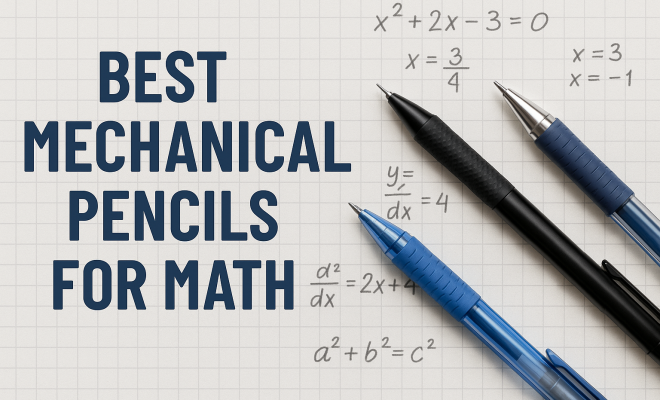
Best Mechanical Pencils for Math
“`html
When it comes to mastering mathematics, having the right tools can make all the difference. For students, engineers, architects, and anyone who frequently works with numbers, mechanical pencils are often the preferred writing instrument. These pencils provide consistency, precision, and a smooth writing experience that can enhance your workflow. In this article, we’ll explore the best mechanical pencils for math, highlighting their features, benefits, and why they stand out among the rest.
1. Pentel Graph Gear 1000: Precision at Its Best
The Pentel Graph Gear 1000 is a favorite among math enthusiasts for good reason. This mechanical pencil is designed with a 0.5 mm lead size, making it ideal for detailed mathematical work, such as writing equations or drafting diagrams. The pencil features a dual-action retractor that protects the lead and the eraser, ensuring they stay intact and ready for use.
Moreover, the Graph Gear 1000’s ergonomic grip allows for prolonged writing sessions without discomfort. Its metal clip and casing provide durability, while the lead hardness indicator lets you keep track of which leads you are using. Overall, this pencil combines functionality with aesthetic appeal, making it a top contender for anyone serious about math.
2. Uni Kuru Toga Roulette: The Innovative Lead Rotation
If you’re looking for something that takes the hassle out of sharpening, the Uni Kuru Toga Roulette is a revolutionary choice. This mechanical pencil features a unique lead rotation mechanism that ensures a consistent sharp point with every turn of the pencil. It’s particularly beneficial for math students who need precise lines for their calculations.
The 0.5 mm lead is perfect for mathematical precision, while the gripping area is designed to prevent slipping, allowing for a steady hand while working on complicated equations. The Kuru Toga is available in various colors and styles, appealing to those who appreciate a bit of flair with their writing instruments.
3. Paper Mate Clearpoint: Comfort Meets Functionality
The Paper Mate Clearpoint is an excellent option for those who value comfort alongside performance. With a 0.7 mm lead, this mechanical pencil strikes a balance between sturdiness and flexibility, making it suitable for both writing and sketching in math. Its soft grip and chunky body are designed to fit comfortably in your hand, allowing for long hours of use without fatigue. (promoting inquiry in math)
Moreover, the Clearpoint features a built-in sharpener in the cap, ensuring you can maintain your lead’s sharpness on the go. For students who frequently work on math assignments and need to switch between writing and drawing, this pencil provides the versatility needed without compromising comfort.
4. Rotring 600: The Classic Choice for Professionals
For those in the field of engineering or architecture, the Rotring 600 is a classic mechanical pencil that delivers professional quality. Its 0.5 mm lead allows for precise and detailed work, essential for technical drawings and complex calculations. The full metal body provides a substantial feel and durability, ensuring it can withstand rigorous use. (See: History and types of pencils.)
The Rotring 600 also boasts a knurled grip that offers exceptional control, making it a favorite among professionals who require accuracy in their work. Its timeless design not only looks sleek but also emphasizes function, making it an essential tool for math-related professions.
5. Staedtler Mars Micro 775: Engineering Excellence
The Staedtler Mars Micro 775 is specifically designed with engineers in mind. This mechanical pencil features a 0.5 mm lead, suitable for high-precision work in technical drawings and mathematical calculations. Its built-in lead sharpener is a game-changer, ensuring that you always have a fine point without the need for extra tools.
One of the standout features of the Mars Micro 775 is its retractable lead sleeve, which protects the lead and prevents breakage. This is particularly useful for students who carry their pencils in bags or pockets. With a comfortable grip and excellent build quality, it’s no wonder that this pencil has a solid reputation in the engineering community.
6. Ticonderoga Woodcase Mechanical Pencil: Classic Meets Modern
While primarily known for their wooden pencils, Ticonderoga also offers a mechanical option that stands out for its simplicity and effectiveness. The Ticonderoga Woodcase Mechanical Pencil features a 0.7 mm lead, making it robust enough for various tasks. Its classic design is reminiscent of the traditional wooden pencil, which many users find comforting and familiar. This builds on math apps for everyone.
Offering a blend of modern convenience and classic flair, this pencil includes an eraser top for quick corrections, making it suitable for math students who often need to revise their work. It’s a reliable choice for those who appreciate straightforward functionality without any of the bells and whistles.
7. Faber-Castell Mechanical Pencil: Precision and Style
Faber-Castell is a respected name in the world of writing instruments, and their mechanical pencils don’t disappoint. The Faber-Castell Mechanical Pencil, with a lead size of 0.5 mm, offers exceptional precision for mathematical tasks. It features a comfortable grip and a click mechanism that allows for easy lead advancement without any hassle.
This pencil is particularly attractive for those who appreciate aesthetics, as it comes in a variety of stylish designs and colors. The quality of the lead used ensures that it resists breakage, an essential factor for students who write with pressure. Whether you’re drafting equations or creating geometric figures, this pencil provides both style and functionality.
8. Muji Mechanical Pencil: Minimalist Design
For fans of minimalist design, the Muji Mechanical Pencil is an ideal addition to your stationery collection. This pencil focuses on simplicity, featuring a clean aesthetic with a 0.5 mm lead that performs well for mathematical writing. The lightweight body makes it comfortable to hold, while the straightforward mechanism is easy to use.
One of the Muji Mechanical Pencil’s best features is its affordability, making it accessible to students on a budget. Despite its low price, it doesn’t compromise on quality, providing a reliable writing experience. For those who prefer a no-fuss, elegant design, this pencil is a worthy contender.
The Importance of Choosing the Right Mechanical Pencil for Math
The right mechanical pencil can significantly affect your math experience. When considering the best mechanical pencils for math, it’s essential to think about factors like lead size, grip comfort, and additional features like retractable tips or built-in sharpeners. Each individual has different preferences, so what works for one person might not work for another. (See: Importance of precision in measurements.)
For example, students who frequently work on assignments may benefit from pencils with comfortable grips and easily replaceable lead, while professionals might require mechanical pencils that offer precision and durability for technical drawings. Understanding your specific needs will help you select the best mechanical pencil that enhances your mathematical endeavors.
Frequently Asked Questions about Mechanical Pencils for Math
1. What lead size is best for math work?
The most commonly recommended lead sizes for math are 0.5 mm and 0.7 mm. The 0.5 mm lead is preferred for detailed work and neat writing, while the 0.7 mm lead provides a sturdier option that’s less prone to breakage. Depending on your writing style and the type of math you’re doing, you may prefer one over the other.
2. Do mechanical pencils work well on graph paper?
Yes, mechanical pencils are particularly effective on graph paper. The fine tip allows you to create precise lines and calculations without the smudging that can occur with traditional wooden pencils or pens. Look for pencils with finer lead sizes for the best results.
3. How do I know when to replace the lead in my mechanical pencil?
Most mechanical pencils will allow you to see how much lead is left through a small opening in the body or by the lead advancement mechanism. If you notice that the lead is breaking frequently or not writing smoothly, it might be time to replace it. Additionally, if you find yourself advancing the lead more often, it’s a sign that your lead supply is running low.
4. Are there mechanical pencils with erasers?
Many mechanical pencils come equipped with erasers, offering a convenient solution for correcting mistakes. However, the quality of erasers can vary. If you frequently need to erase, consider models with larger, high-quality erasers that can handle the pressure of repeated use without wearing down quickly. There’s a fuller look at tools to engage kids in math.
5. Can I use colored lead in mechanical pencils?
Yes, many mechanical pencils can accommodate colored lead, allowing for creativity in note-taking or visualizing mathematical concepts. Check the specifications of your mechanical pencil to confirm the compatibility with colored leads, but most standard models will work just fine.
6. What’s the advantage of a retractable lead sleeve?
A retractable lead sleeve protects the lead from breaking and helps to keep it from getting damaged when the pencil is stored in a bag or pencil case. This feature is particularly beneficial for students who are always on the go, as it ensures that the pencil is ready for use without the worry of lead breakage. (See: The resurgence of mechanical pencils.) For more on this, see benefits of gamifying lessons.
Comparative Overview of Leading Mechanical Pencils
| Pencil Model | Lead Size | Grip Comfort | Durability | Special Features |
|---|---|---|---|---|
| Pentel Graph Gear 1000 | 0.5 mm | Ergonomic | High | Lead hardness indicator |
| Uni Kuru Toga Roulette | 0.5 mm | Adequate | Moderate | Lead rotation mechanism |
| Paper Mate Clearpoint | 0.7 mm | High | Moderate | Built-in sharpener |
| Rotring 600 | 0.5 mm | Excellent | Very High | Knurled grip |
| Staedtler Mars Micro 775 | 0.5 mm | High | High | Retractable lead sleeve |
| Ticonderoga Woodcase | 0.7 mm | Comfortable | Moderate | Classic design |
| Faber-Castell Mechanical Pencil | 0.5 mm | High | High | Stylish designs |
| Muji Mechanical Pencil | 0.5 mm | Moderate | Moderate | Minimalist design |
Tips for Maintaining Your Mechanical Pencil
Proper maintenance can extend the life of your mechanical pencil and ensure that it continues to perform at its best. Here are some simple tips to keep in mind:
- Keep it clean: Dust and debris can accumulate in the lead mechanism. Regularly wipe the pencil’s exterior and use compressed air to clear any particles from the lead chamber.
- Store properly: When not in use, retract the lead to avoid breakage. Store your pencil in a protective case to prevent damage.
- Replace worn parts: If your eraser wears down, don’t hesitate to replace it. Many brands offer replacement erasers compatible with their pencils.
- Use quality lead: Invest in high-quality lead that fits your pencil model. Inferior lead can lead to more breakage and a less satisfying writing experience.
Trends in Mechanical Pencils: What’s New?
The world of mechanical pencils is evolving, with innovations designed to enhance functionality and aesthetics. Here are some of the recent trends you might find interesting:
- Eco-friendly materials: Many brands are now focusing on sustainability, creating pencils from recycled or biodegradable materials. Choosing these options helps reduce plastic waste.
- Customizable designs: Personalization is becoming a trend, with brands offering customizable colors, grips, and even engravings, allowing users to express their individuality through their writing instruments.
- Smart mechanical pencils: Some companies have introduced smart mechanical pencils that can connect to devices via Bluetooth, allowing for seamless transitions between writing and digital formats, ideal for tech-savvy students and professionals.
Expert Perspectives: Choosing the Best Mechanical Pencil for Math
To gain further insights into the best practices for selecting mechanical pencils, we reached out to several educators and professionals in the field of mathematics and engineering. Here’s what they had to say:
Dr. Emily Richards, a mathematics educator: “I always recommend pencils with a 0.5 mm lead for students. It strikes the right balance between precision and ease of use. Comfort is also key; my students often write for extended periods, so a pencil that feels good in hand makes a big difference.”
Mark Johnson, a mechanical engineer: “In my profession, durability is crucial. I lean towards mechanical pencils with metal bodies and retractable leads. You can’t afford to have your tools fail you, especially when you’re working on tight deadlines.”
Conclusion: Finding Your Perfect Writing Companion
Choosing the right mechanical pencil can greatly enhance your math performance, whether you’re a student tackling algebra or a professional working on complex engineering designs. The best mechanical pencils for math listed here provide a range of options suited to various writing styles and needs. Investing in a quality mechanical pencil not only improves your writing experience but also fosters a more enjoyable and efficient approach to math.
“`
Trending Now
Frequently Asked Questions
What is the best mechanical pencil for math?
The best mechanical pencil for math is often considered to be the Pentel Graph Gear 1000 due to its precision 0.5 mm lead, ergonomic grip, and durable design. It’s ideal for detailed work like writing equations and drafting diagrams.
Why are mechanical pencils preferred for math?
Mechanical pencils are preferred for math because they provide consistent lead thickness, precision writing, and a smooth experience. This allows for clear calculations and neat diagrams, which are essential in mathematical work.
What features should I look for in a mechanical pencil for math?
When choosing a mechanical pencil for math, look for features such as lead size (0.5 mm is ideal), ergonomic grips for comfort, durability, and mechanisms that prevent lead breakage, like the dual-action retractor in the Pentel Graph Gear 1000.
How does the Uni Kuru Toga work?
The Uni Kuru Toga features an innovative lead rotation mechanism that sharpens the lead as you write, ensuring a consistent point. This is particularly beneficial for math students who require precision in their calculations and diagrams.
Are there mechanical pencils that help prevent slipping while writing?
Yes, the Uni Kuru Toga Roulette is designed with a gripping area that prevents slipping, allowing for a steady hand while working on complicated equations. This feature enhances control during detailed mathematical tasks.
What did we miss? Let us know in the comments and join the conversation.