Webb Telescope Uncovers Giant Exoplanet Beta Pictoris d in 2026
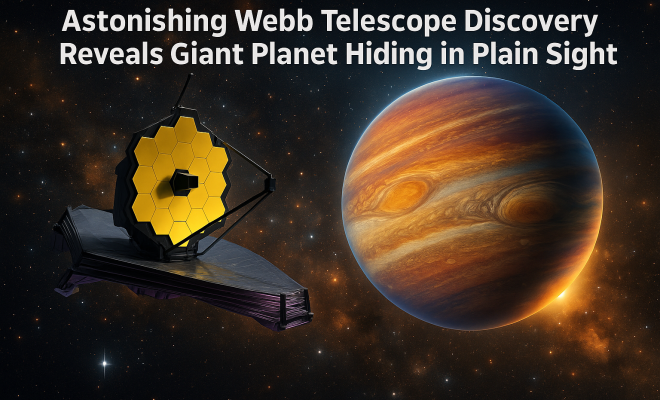
The cosmos, it turns out, still holds plenty of secrets, even in the most familiar cosmic neighborhoods. Just when we thought we had a pretty good handle on some of astronomy’s celebrity star systems, the James Webb Space Telescope swoops in and completely upends our understanding. Its latest triumph, published on July 23, 2026, isn’t just another distant galaxy shot; it’s a groundbreaking discovery right here in our stellar backyard, revealing a massive, previously unseen exoplanet, Beta Pictoris d, tucked away in one of the most intensely scrutinized planetary systems known to science. This isn’t just a fascinating new data point; it’s a game-changer for how we find planets and understand their formation, demonstrating the sheer power of the Webb telescope discovery capabilities.
Think about it: Beta Pictoris isn’t some obscure corner of the universe. It’s a system that astronomers have been poring over for decades, a poster child for planetary formation thanks to its prominent debris disk and two already-known giant planets, Beta Pictoris b and c. To find a third, enormous world lurking there, practically under our noses, feels almost counterintuitive. Yet, that’s precisely what the Webb telescope did, not through traditional direct imaging, but by sniffing out the planet’s atmospheric signature. This innovative spectroscopic approach, spearheaded by Aidan Gibbs and his team, has opened up an entirely new avenue for exoplanet hunting, particularly in those dusty, chaotic environments where direct visual confirmation is nearly impossible. It’s a testament to human ingenuity and the incredible engineering behind the Webb, pushing the boundaries of what we thought was possible in astronomical observation.
1. Beta Pictoris: A Storied System Gets a New Resident
For decades, Beta Pictoris has been a rockstar among star systems. Located a relatively close 63 light-years away, it’s a young star, only about 20 million years old, making it an ideal laboratory for studying how planets form and evolve. Its most famous feature is a vast, asymmetric debris disk, essentially a ring of dust and gas – the leftover building blocks from planet formation – that stretches hundreds of astronomical units from the star. This disk was one of the first ever discovered around another star, and its intricate structure has long hinted at the gravitational influence of unseen planets shaping its dynamics.
Until now, astronomers had confirmed two gas giants within this system: Beta Pictoris b and Beta Pictoris c. Both are massive worlds, significantly larger than Jupiter, and their orbital motions have been meticulously tracked. Beta Pictoris b, in particular, is famous for being one of the first exoplanets ever directly imaged, a monumental achievement that truly solidified our understanding of planets outside our solar system. The system was already a treasure trove for planet hunters, offering a unique glimpse into a planetary system still in its adolescence. But the recent Webb telescope discovery of Beta Pictoris d suggests that even the most well-trodden paths in astronomy can still yield incredible surprises.
2. The Webb Telescope Discovery: Not Your Average Snapshot
What makes the detection of Beta Pictoris d so revolutionary isn’t just the fact of finding a new planet, but how it was found. When most people hear about exoplanet discoveries, they often imagine a telescope capturing a direct image of a distant world. While Webb is certainly capable of direct imaging, that wasn’t the primary method here. Instead, Aidan Gibbs and his team leveraged the telescope’s unparalleled spectroscopic capabilities to detect the planet’s atmospheric fingerprints.
Imagine trying to find a needle in a haystack, except the haystack is also emitting a blinding light. That’s essentially the challenge of finding exoplanets, especially giant ones, close to their parent star. The star’s glare completely overwhelms any light reflected or emitted by the planet. But Webb’s instruments can analyze the light passing through a planet’s atmosphere. As light from the star filters through the planet’s atmosphere, certain wavelengths are absorbed by specific molecules, leaving tell-tale gaps or ‘fingerprints’ in the spectrum. For Beta Pictoris d, the team meticulously identified the spectral signatures of carbon monoxide, water vapor, and methane – clear indicators of a substantial atmosphere, and thus, a substantial planet.
3. Aidan Gibbs and the Spectroscopic Revolution
The lead author of this groundbreaking study, Aidan Gibbs, has spearheaded a truly innovative approach to exoplanet detection. His team’s success with Beta Pictoris d demonstrates that spectroscopy isn’t just a tool for characterizing known exoplanets; it’s a powerful and perhaps even superior method for initial discovery, particularly in challenging environments. This is a significant paradigm shift. Traditionally, astronomers would first try to find a planet using methods like transit photometry (detecting dips in starlight as a planet passes in front) or radial velocity (measuring the wobble of a star caused by a planet’s gravity). Once a candidate was identified, then spectroscopy might be used to study its atmosphere.
Gibbs’s work flips this script, proving that we can go straight to the atmospheric signatures to find planets that might otherwise remain hidden. This is especially crucial for systems like Beta Pictoris, where the pervasive dust disk can obscure direct imaging attempts. The ability to ‘smell’ a planet through its atmospheric gases, rather than needing to ‘see’ it directly, opens up vast new territories in our search for exoplanets, including those that are closer to their stars or embedded within dense stellar nurseries. It’s a testament to the foresight of those who designed Webb’s instruments and the ingenuity of researchers like Gibbs who are pushing the boundaries of their application.
4. The Elusive Nature of Planetary Discovery in Dusty Systems
Finding planets, especially giant ones, isn’t always as straightforward as pointing a telescope and snapping a picture. In systems like Beta Pictoris, which are still actively forming and surrounded by vast amounts of dust and gas, the challenge is amplified. This circumstellar debris, while fascinating for studying planet formation, acts like a cosmic fog, scattering and absorbing light, making it incredibly difficult to directly image faint planets orbiting within. This is precisely why Beta Pictoris d remained hidden for so long, despite the system being so thoroughly investigated. (See: James Webb Space Telescope overview.)
Traditional direct imaging relies on sophisticated coronagraphs to block out the overwhelming light of the central star, allowing the faint light from orbiting planets to be detected. But even with these advanced techniques, thick dust disks can render direct imaging ineffective. The spectroscopic method employed by Webb bypasses this limitation. Instead of relying on the planet to be visually separate and distinct from the star and its surrounding dust, it searches for chemical compounds that are uniquely associated with a planetary atmosphere. It’s like finding a hidden object not by seeing it, but by detecting the unique scent it emits, a truly innovative approach that promises to unlock many more secrets from dusty stellar nurseries.
5. Beta Pictoris d: A New Piece in the Planetary Puzzle
The discovery of Beta Pictoris d adds a crucial third giant planet to an already intriguing system. This now makes Beta Pictoris only the second known planetary system to host at least three directly imaged planets, an incredibly rare and valuable arrangement for astronomers. Why is this so significant? Because multiple-planet systems offer a much richer dataset for understanding how planets interact gravitationally, how they migrate, and how their atmospheres evolve over time. The presence of three massive gas giants within a relatively young system provides a unique opportunity to test our models of planetary formation and dynamics.
We’re talking about a gravitational ballet of immense proportions. The interactions between Beta Pictoris b, c, and now d would have profound effects on each other’s orbits and on the surrounding debris disk. Studying these interactions can help us understand how giant planets clear out their orbital paths, shepherd smaller bodies, and even influence the habitability of any inner, smaller planets that might eventually form. Each new planet in such a system adds another layer of complexity and another opportunity to refine our understanding of how solar systems, including our own, come to be. We covered hidden giant planet discovery in more detail.
6. The Power of Webb’s Infrared Vision
The James Webb Space Telescope’s ability to make this type of Webb telescope discovery stems directly from its incredible infrared capabilities. Unlike its predecessor, Hubble, which primarily observes in visible and ultraviolet light, Webb is optimized for infrared. Why is this so crucial for exoplanet hunting, especially in dusty systems? Because dust and gas, while opaque to visible light, are often transparent to infrared light. Think of it like night-vision goggles for the cosmos.
Furthermore, young, forming planets, especially gas giants, are still relatively warm from their formation process, emitting a significant amount of heat in the infrared spectrum. This makes them ‘glow’ brightly in Webb’s eyes, even when they’re otherwise hidden. The specific spectral features of molecules like carbon monoxide, water, and methane – the very signatures Gibbs’s team detected – are also most prominent in the infrared. So, Webb isn’t just seeing ‘through’ the dust; it’s also perfectly tuned to detect the very emissions that signal the presence of a forming giant planet. It’s an astronomical superpower that is continually reshaping our view of the universe.
7. Implications for Exoplanet Detection Strategies
This Webb telescope discovery has far-reaching implications for future exoplanet detection strategies. Traditionally, methods like transit detection (where a planet passes in front of its star, causing a slight dimming) have been incredibly successful, particularly for finding planets close to their stars. However, these methods are often limited to planets with specific orbital alignments. Radial velocity measurements, while powerful, are also indirect and can be challenging for very young, active stars.
The success with Beta Pictoris d demonstrates that high-resolution spectroscopy, directly targeting atmospheric molecules, can be a primary discovery tool, especially for gas giants that might not transit or whose gravitational tug is hard to isolate from stellar activity. This new strategy is particularly exciting for finding planets in regions previously thought to be too difficult to probe, such as within dense debris disks or closer to their host stars. It offers a complementary approach that broadens our net, ensuring that we’re not missing entire classes of planets simply because our existing detection methods are blind to them. We’re moving beyond just seeing planets to truly ‘sensing’ them.
8. Beta Pictoris: A Rosetta Stone for Planetary Formation
With three directly imaged giant planets and a prominent debris disk, Beta Pictoris is becoming an even more important ‘Rosetta Stone’ for understanding how planetary systems form. Our own solar system, with its distinct asteroid belt and Kuiper belt, is the result of billions of years of gravitational interactions and evolutionary processes. By studying younger systems like Beta Pictoris, still in the throes of formation, we can essentially watch these processes unfold in real-time (on astronomical timescales, anyway).
The interaction between the three giant planets and the massive debris disk is undoubtedly complex. The planets’ gravity would sculpt the disk, creating gaps, rings, and potentially even slingshotting smaller bodies around. Understanding these dynamics can shed light on phenomena observed in our own solar system, such as the Grand Tack hypothesis for Jupiter’s migration or the origins of the Late Heavy Bombardment. Beta Pictoris, now with its expanded planetary family, offers an unparalleled opportunity to refine our models of planetary system architecture and evolution, giving us deeper insights into our cosmic origins.
9. The Future is Bright: More Hidden Worlds Awaiting Discovery
The detection of Beta Pictoris d is more than just an isolated finding; it’s a powerful demonstration of the James Webb Space Telescope’s capabilities and a harbinger of things to come. If a well-studied system like Beta Pictoris can still harbor a massive, hidden planet, what does that say about the countless other stellar systems we’ve only begun to scratch the surface of? It suggests that the universe is likely teeming with even more planets than we currently imagine, many of them cleverly concealed by dust, glare, or simply our limitations. (See: NASA's official Webb Telescope page.)
Aidan Gibbs and his team have shown us a powerful new way to peer through the cosmic veil. This spectroscopic method, honed by Webb’s exquisite instruments, will undoubtedly be applied to many other young, dusty star systems, potentially uncovering a whole new population of giant planets that have evaded detection until now. The era of the Webb telescope discovery is still in its early stages, and with each new revelation, we gain a deeper appreciation for the incredible diversity and sheer abundance of worlds beyond our own. The universe, it seems, is far more crowded and complex than we ever dared to imagine.
10. Comparing Webb’s Spectroscopic Power to Other Observatories
While the Webb telescope discovery of Beta Pictoris d highlights its unique capabilities, it’s worth taking a moment to appreciate how it stands in contrast to, and complements, other powerful observatories. For instance, the Hubble Space Telescope, a venerable workhorse, has primarily focused on visible and ultraviolet light. While Hubble has made incredible contributions to exoplanet characterization, its limitations in infrared light meant it couldn’t penetrate the thick dust around young stars with the same efficacy as Webb.
Ground-based telescopes, even those with adaptive optics like the Very Large Telescope (VLT) in Chile, face the hurdle of Earth’s atmosphere. Our atmosphere absorbs significant portions of the infrared spectrum, distorting incoming light and blurring images. While adaptive optics can correct for some of this atmospheric turbulence, they can’t entirely eliminate the problem, especially for the specific infrared wavelengths crucial for detecting molecular signatures. Webb, operating in the cold vacuum of space, far from Earth’s atmospheric interference, has an unobstructed view of the universe. This allows for cleaner, more precise spectroscopic data, making the detection of faint atmospheric signatures like those of Beta Pictoris d possible where other instruments would struggle. It’s not just a step up; it’s a completely different class of observation.
11. The Chemistry of Exoplanet Atmospheres: What These Signatures Tell Us
The detection of carbon monoxide, water vapor, and methane in Beta Pictoris d’s atmosphere isn’t just a confirmation of its existence; these molecules are like chemical breadcrumbs, offering profound insights into the planet’s composition and formation history. Carbon monoxide (CO) is a common molecule in young, gas-rich environments, often found in protoplanetary disks. Its presence suggests that Beta Pictoris d formed from a reservoir of gas that was relatively rich in carbon, a crucial detail for planetary formation models.
Water vapor (H2O) is, of course, a fundamental ingredient for life as we know it, but in giant gas planets, it tells us about the conditions in the cooler, outer layers of the atmosphere. Its abundance can hint at the temperature profile and the presence of clouds. Methane (CH4) is another key carbon-bearing molecule, often indicating a reducing (hydrogen-rich) atmosphere, typical of gas giants like Jupiter and Saturn. The relative abundances of these molecules, and their distribution through the atmosphere, can help astronomers piece together the temperatures, pressures, and even the internal structure of Beta Pictoris d. It’s like having a remote chemical lab in space, analyzing a planet millions of miles away.
12. Gravitational Dynamics and the Beta Pictoris System’s Evolution
The addition of Beta Pictoris d fundamentally alters our understanding of the system’s gravitational dance. With three massive gas giants, the gravitational interactions become significantly more complex than a two-planet system. These giants likely exerted substantial influence on the surrounding debris disk, possibly clearing out gaps, creating resonances, and even causing smaller planetesimals to collide, generating more dust. We can think of it as a cosmic billiards game played on a grand scale.
Models of planetary migration, which propose that giant planets don’t necessarily form in their final orbits but can move inwards or outwards, will now have a richer testbed. The configuration of Beta Pictoris b, c, and d could provide clues about whether they formed in situ or migrated to their current positions. For example, if Beta Pictoris d is found to be on a slightly inclined or eccentric orbit compared to its siblings, it might suggest past scattering events or interactions with other, perhaps smaller, now-ejected bodies. Understanding these dynamics is crucial not only for Beta Pictoris but for the broader understanding of how our own solar system achieved its current architecture.
13. What’s Next for Beta Pictoris and Webb?
The discovery of Beta Pictoris d is certainly not the end of the story for this intriguing system. Future observations with Webb will undoubtedly focus on even more detailed characterization of Beta Pictoris d’s atmosphere. Astronomers will be looking for a wider array of molecules, trying to build a more complete chemical profile. They’ll also be trying to measure its precise mass and orbital parameters, which will allow for more accurate modeling of its gravitational interactions with Beta Pictoris b and c. This will help confirm if the planet is indeed a gas giant and how it fits into the overall system dynamics. (See: Research on exoplanet detection methods.)
Beyond Beta Pictoris, the success of this spectroscopic detection method means it will be applied to many other protoplanetary disks and young star systems. The scientific community is already identifying new targets where Webb’s infrared capabilities and spectroscopic prowess can be brought to bear. We might expect a surge in discoveries of hidden giant planets, particularly in the inner regions of young stellar systems that are still shrouded in dust. Webb is just beginning to unlock the full potential of its instruments, and the catalog of known exoplanets is surely set to expand in exciting and unexpected ways.
Frequently Asked Questions (FAQ) about the Webb Telescope Discovery of Beta Pictoris d
Q1: What is Beta Pictoris d and why is its discovery significant?
Beta Pictoris d is a massive, previously unseen exoplanet, likely a gas giant, discovered in the Beta Pictoris system. Its discovery is significant because it’s the third giant planet found in this well-studied, young system, making it a rare multi-planet system for direct study. More importantly, it was found using a novel spectroscopic method by the James Webb Space Telescope, detecting its atmospheric chemical signatures rather than direct visual imaging. This opens up a new way to find planets, especially in dusty environments.
Q2: How was Beta Pictoris d discovered if not by direct imaging?
Instead of seeing the planet directly, the James Webb Space Telescope used its advanced spectroscopic instruments to analyze the light passing through Beta Pictoris d’s atmosphere. As light from the parent star filtered through the planet’s atmosphere, specific molecules (like carbon monoxide, water vapor, and methane) absorbed certain wavelengths, leaving behind unique ‘fingerprints’ in the light spectrum. Aidan Gibbs’s team identified these chemical signatures, confirming the planet’s presence.
Q3: What are the key features of the Beta Pictoris system that make it so interesting to astronomers?
The Beta Pictoris system is a young star, only about 20 million years old, located relatively close at 63 light-years away. It’s famous for its prominent, vast, and asymmetric debris disk – a ring of dust and gas that are the leftover building blocks of planet formation. Before Beta Pictoris d, it was already known to host two directly imaged gas giants, Beta Pictoris b and c. Its youth and the presence of a debris disk make it an ideal natural laboratory for studying how planets form and evolve in real-time. exciting updates from the cosmos offers useful background here.
Q4: Why is Webb’s infrared vision so crucial for this type of discovery?
Webb’s infrared capabilities are critical because dust and gas, which often obscure visible light, are transparent to infrared light. This allows Webb to effectively ‘see through’ the debris disk of Beta Pictoris. Furthermore, young, forming gas giants like Beta Pictoris d are still warm from their formation, emitting significant heat in the infrared spectrum. The specific molecular signatures (carbon monoxide, water, methane) that signify a planetary atmosphere are also most prominent and detectable in infrared light, making Webb perfectly tuned for such observations.
Q5: What do the atmospheric molecules detected on Beta Pictoris d tell us about the planet?
The detection of carbon monoxide, water vapor, and methane in Beta Pictoris d’s atmosphere provides clues about its composition and formation. Carbon monoxide suggests a carbon-rich gas environment during its formation. Water vapor indicates atmospheric temperatures and potential cloud layers. Methane, a common molecule in gas giant atmospheres, points to a hydrogen-rich (reducing) atmosphere. The relative amounts of these molecules can help astronomers determine the planet’s atmospheric temperature, pressure, and even its internal structure, giving us insights into its planetary evolution.
Trending Now
Frequently Asked Questions
What did the Webb Telescope discover about Beta Pictoris?
The Webb Telescope discovered a massive, previously unseen exoplanet named Beta Pictoris d in the well-studied Beta Pictoris system. This groundbreaking finding demonstrates the telescope's advanced capabilities in detecting planetary atmospheric signatures, challenging previous assumptions about this system.
Why is Beta Pictoris significant in astronomy?
Beta Pictoris is significant because it is a prime example of a young star system, only about 20 million years old, and has been extensively studied for its prominent debris disk and two known giant planets. The discovery of a third planet enhances our understanding of planetary formation in such environments.
How does the Webb Telescope find exoplanets?
The Webb Telescope finds exoplanets using innovative spectroscopic techniques that analyze atmospheric signatures rather than relying on direct imaging. This method is particularly effective in chaotic environments, allowing astronomers to detect planets that might otherwise remain hidden.
What are the implications of discovering Beta Pictoris d?
The discovery of Beta Pictoris d has significant implications for exoplanet research, as it opens new avenues for understanding planet formation and the dynamics of densely populated planetary systems, potentially altering existing theories in astronomy.
What is the role of Aidan Gibbs in the Webb Telescope discovery?
Aidan Gibbs led the team that utilized the Webb Telescope's advanced spectroscopic capabilities to identify the atmospheric signature of Beta Pictoris d. His work is pivotal in showcasing the telescope's ability to uncover hidden planets in well-explored star systems.
What's your take on this? Share your thoughts in the comments below — we read every one.