The Tech Edvocate

Top Menu

  • Advertisement
  • Apps
  • Home Page
  • Home Page Five (No Sidebar)
  • Home Page Four
  • Home Page Three
  • Home Page Two
  • Home Tech2
  • Icons [No Sidebar]
  • Left Sidbear Page
  • Lynch Educational Consulting
  • My Account
  • My Speaking Page
  • Newsletter Sign Up Confirmation
  • Newsletter Unsubscription
  • Our Brands
  • Page Example
  • Privacy Policy
  • Protected Content
  • Register
  • Request a Product Review
  • Shop
  • Shortcodes Examples
  • Signup
  • Start Here
    • Governance
    • Careers
    • Contact Us
  • Terms and Conditions
  • The Edvocate
  • The Tech Edvocate Product Guide
  • Topics
  • Write For Us
  • Advertise

Main Menu

  • Start Here
    • Our Brands
    • Governance
      • Lynch Educational Consulting, LLC.
      • Dr. Lynch’s Personal Website
      • Careers
    • Write For Us
    • The Tech Edvocate Product Guide
    • Contact Us
    • Books
    • Edupedia
    • Post a Job
    • The Edvocate Podcast
    • Terms and Conditions
    • Privacy Policy
  • Topics
    • Assistive Technology
    • Child Development Tech
    • Early Childhood & K-12 EdTech
    • EdTech Futures
    • EdTech News
    • EdTech Policy & Reform
    • EdTech Startups & Businesses
    • Higher Education EdTech
    • Online Learning & eLearning
    • Parent & Family Tech
    • Personalized Learning
    • Product Reviews
  • Advertise
  • Tech Edvocate Awards
  • The Edvocate
  • Pedagogue
  • School Ratings

logo

The Tech Edvocate

  • Start Here
    • Our Brands
    • Governance
      • Lynch Educational Consulting, LLC.
      • Dr. Lynch’s Personal Website
        • My Speaking Page
      • Careers
    • Write For Us
    • The Tech Edvocate Product Guide
    • Contact Us
    • Books
    • Edupedia
    • Post a Job
    • The Edvocate Podcast
    • Terms and Conditions
    • Privacy Policy
  • Topics
    • Assistive Technology
    • Child Development Tech
    • Early Childhood & K-12 EdTech
    • EdTech Futures
    • EdTech News
    • EdTech Policy & Reform
    • EdTech Startups & Businesses
    • Higher Education EdTech
    • Online Learning & eLearning
    • Parent & Family Tech
    • Personalized Learning
    • Product Reviews
  • Advertise
  • Tech Edvocate Awards
  • The Edvocate
  • Pedagogue
  • School Ratings
  • Urgent Warning: How AI is Fueling Rampant Skincare Scams Right Now

  • Urgent: This Skincare Trend Is Exploiting Children — And It’s Spreading Fast

  • Seattle Times sues Microsoft and OpenAI, alleging they trained their AI on its journalism

  • Astonishing: Anthropic Axed $6 Billion Deal for Decart — Why?

  • Sega cancelled its “risky” Super Game project as it “would have to grow enormously to match the scale of the service” | GamesIndustry.biz

  • Devastating: Don’t Nod’s €8M Cash Crisis Threatens Studio Future

  • OpenAI Accused of Shocking Attempt to Hijack Euler Proof — The Truth Revealed

  • Meta Child Sexual Abuse Ads: A Disturbing Investigation Unveils Shocking Truths

  • Unveiling the Quiet Crisis: Why Two Mega-Districts Just Banned AI in Education

  • Unveiling the Controversial New Texas Curriculum: A Battle Over History and Identity

Digital & Mobile Technology
Home›Digital & Mobile Technology›All the Different RAID Types Explained

All the Different RAID Types Explained
By Matthew Lynch
June 22, 2023
0
Spread the love

RAID, which stands for Redundant Array of Independent Disks, is a technology that’s used to combine multiple hard drives into a single logical unit. The main purpose of RAID is to increase performance and data reliability. RAID achieves these aims through various techniques like striping, mirroring, and parity. Each of these techniques has numerous advantages and disadvantages, making it essential to understand the different RAID types available.

There are many different types of RAID that you can choose from, each with its own set of strengths and weaknesses. The most common RAID types include RAID 0, RAID 1, RAID 5, RAID 6, and RAID 10. Let’s take a close look at each of these RAID types and how they differ.

RAID 0: This type of RAID uses two or more hard drives simultaneously to improve disk performance. In RAID 0, data is divided across multiple disks, resulting in faster read and write speeds. However, there is no redundancy in data with RAID 0. If one drive fails, all the data on the RAID 0 setup could be lost. RAID 0 is ideal for applications that require faster disk processing, but data loss is not a concern.

RAID 1: This type of RAID is also known as disk mirroring, which involves creating an exact copy of data on multiple hard drives. In RAID 1, all data is always duplicated on two disks, providing redundancy in the event of a hard drive failure. RAID 1 increases the read speed as the array can read any data from either drive. Although RAID 1 has excellent redundancy, it’s not suitable for improving write speeds.

RAID 5: This type of RAID stripes data across at least three disks and utilizes a parity bit for data redundancy. In RAID 5, if one drive fails, the parity bit can be used to rebuild the data. This ensures that there is no data loss in a single-disk failure scenario. RAID 5 is ideal for applications that require striping data with redundancy and is the most popular choice for small to medium-sized enterprises.

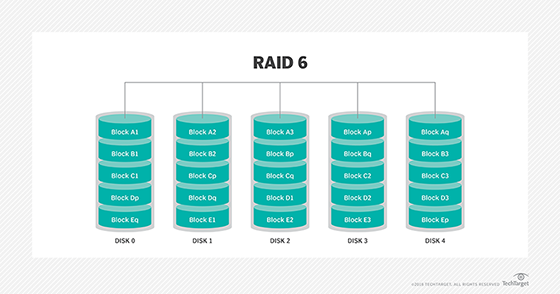
RAID 6: RAID 6 is similar to RAID 5, but instead of the parity bit, RAID 6 uses two parity bits. This means that if two disks fail simultaneously, data can still be rebuilt. The main disadvantage of RAID 6 is that it costs more than other RAID levels.

RAID 10: This is a combination of RAID 0 and RAID 1. It’s sometimes called RAID 1+0. In RAID 10, data is striped across at least four disks and is then mirrored for redundancy. This provides fast read and write speeds with good data redundancy. However, RAID 10 is less efficient for storage capacity as it requires a combination of mirrored and striped disks.


Previous Article

How to Improve Your Laptop’s Wi-Fi Reception

Next Article

How to Recover Lost Safari Bookmarks

Matthew Lynch

Related articles More from author

  • Digital & Mobile Technology

    How to Thoroughly Dry Out Your Wet Electronics

    May 29, 2023
    By Matthew Lynch
  • Digital & Mobile Technology

    How to Recover Deleted Emails in Yahoo Mail

    August 5, 2023
    By Matthew Lynch
  • Digital & Mobile Technology

    Why Is Apple Called “Apple”?

    August 5, 2023
    By Matthew Lynch
  • Digital & Mobile Technology

    What Are AirPods and How Do They Work?

    June 2, 2023
    By Matthew Lynch
  • Digital & Mobile Technology

    4 Skyrim Mods Guaranteed To Breathe New Life Into The Game

    July 31, 2023
    By Matthew Lynch
  • Digital & Mobile Technology

    Is Your Virtual Memory Too Low? Here’s How to Fix

    June 23, 2023
    By Matthew Lynch

Search

Login & Registration

  • Log in
  • Entries feed
  • Comments feed
  • WordPress.org

Newsletter

Signup for The Tech Edvocate Newsletter and have the latest in EdTech news and opinion delivered to your email address!

About Us

Since technology is not going anywhere and does more good than harm, adapting is the best course of action. That is where The Tech Edvocate comes in. We plan to cover the PreK-12 and Higher Education EdTech sectors and provide our readers with the latest news and opinion on the subject. From time to time, I will invite other voices to weigh in on important issues in EdTech. We hope to provide a well-rounded, multi-faceted look at the past, present, the future of EdTech in the US and internationally.

We started this journey back in June 2016, and we plan to continue it for many more years to come. I hope that you will join us in this discussion of the past, present and future of EdTech and lend your own insight to the issues that are discussed.

Newsletter

Signup for The Tech Edvocate Newsletter and have the latest in EdTech news and opinion delivered to your email address!

Contact Us

The Tech Edvocate
910 Goddin Street
Richmond, VA 23231
(601) 630-5238
[email protected]

Copyright © 2026 Matthew Lynch. All rights reserved.