The Tech Edvocate

Top Menu

  • Advertisement
  • Apps
  • Home Page
  • Home Page Five (No Sidebar)
  • Home Page Four
  • Home Page Three
  • Home Page Two
  • Home Tech2
  • Icons [No Sidebar]
  • Left Sidbear Page
  • Lynch Educational Consulting
  • My Account
  • My Speaking Page
  • Newsletter Sign Up Confirmation
  • Newsletter Unsubscription
  • Our Brands
  • Page Example
  • Privacy Policy
  • Protected Content
  • Register
  • Request a Product Review
  • Shop
  • Shortcodes Examples
  • Signup
  • Start Here
    • Governance
    • Careers
    • Contact Us
  • Terms and Conditions
  • The Edvocate
  • The Tech Edvocate Product Guide
  • Topics
  • Write For Us
  • Advertise

Main Menu

  • Start Here
    • Our Brands
    • Governance
      • Lynch Educational Consulting, LLC.
      • Dr. Lynch’s Personal Website
      • Careers
    • Write For Us
    • The Tech Edvocate Product Guide
    • Contact Us
    • Books
    • Edupedia
    • Post a Job
    • The Edvocate Podcast
    • Terms and Conditions
    • Privacy Policy
  • Topics
    • Assistive Technology
    • Child Development Tech
    • Early Childhood & K-12 EdTech
    • EdTech Futures
    • EdTech News
    • EdTech Policy & Reform
    • EdTech Startups & Businesses
    • Higher Education EdTech
    • Online Learning & eLearning
    • Parent & Family Tech
    • Personalized Learning
    • Product Reviews
  • Advertise
  • Tech Edvocate Awards
  • The Edvocate
  • Pedagogue
  • School Ratings

logo

The Tech Edvocate

  • Start Here
    • Our Brands
    • Governance
      • Lynch Educational Consulting, LLC.
      • Dr. Lynch’s Personal Website
        • My Speaking Page
      • Careers
    • Write For Us
    • The Tech Edvocate Product Guide
    • Contact Us
    • Books
    • Edupedia
    • Post a Job
    • The Edvocate Podcast
    • Terms and Conditions
    • Privacy Policy
  • Topics
    • Assistive Technology
    • Child Development Tech
    • Early Childhood & K-12 EdTech
    • EdTech Futures
    • EdTech News
    • EdTech Policy & Reform
    • EdTech Startups & Businesses
    • Higher Education EdTech
    • Online Learning & eLearning
    • Parent & Family Tech
    • Personalized Learning
    • Product Reviews
  • Advertise
  • Tech Edvocate Awards
  • The Edvocate
  • Pedagogue
  • School Ratings
  • US Battery as a Service Market Shifts Toward Fleet-Based Energy

  • The Startling Truth: Why Americans Distrust AI with Their Health

  • This Crucial Deadline for Banks Is Closer Than You Think

  • Baffling: CrowdStrike’s $500 Million AI Bet Reshapes Cybersecurity

  • This Crucial Autonomous Driving Rule Could Cost You Everything

  • Baffling: Microsoft AI CEO Demands Halt to Conscious AI Development

  • O seară în ritmul tău: atmosfera divertismentului de cazinou pe internet

  • Outrageous: AppLovin Hit With Lawsuit Over AI Claims — What Investors Need to Know

  • 9 Critical Ways AI Investment Fraud Is Quietly Draining Your Bank Account

  • Is the AI Bubble Bursting? OpenAI’s Funding Woes Revealed

Digital & Mobile Technology
Home›Digital & Mobile Technology›How to Make a Torn Paper Edge in Photoshop

How to Make a Torn Paper Edge in Photoshop
By Matthew Lynch
June 12, 2023
0
Spread the love

Photoshop offers a vast range of possibilities when it comes to design and editing, and creating a torn paper edge effect is one of the many options you can choose from. This technique can add a unique and creative touch to your projects or photos, and it’s quite easy to achieve. In this article, we’ll take you through the steps required to create a torn paper edge in Photoshop.

Step 1: Open a New Document

start creating your torn paper effect, you will need to open a new document in Photoshop. Click on “File” in the top menu, then select “New”. Choose your preferred document size, resolution, and color mode, and then click “OK”.

Step 2: Create a Background Layer

Create a new layer by clicking on the “New Layer” button situated at the bottom of the Layers Panel. Choose a color to fill the layer with, or opt for a gradient or texture fill. For this tutorial, we’re using a plain white background color.

Step 3: Add a Paper Texture

To make your image look like a piece of paper, you will need to add some texture. There are various ways to achieve this, such as using a texture image or creating one yourself. However, to keep it simple, we’ll use a preset paper texture. Go to the “Layer Styles” menu, click on “Pattern Overlay,” select the pattern you want, then adjust the scale and opacity until it matches your preference.

Step 4: Create a Selection

Next, select the rectangular marquee tool from the toolbar, then drag it around the edges of your document to create a selection. We want to create a torn edge effect, so it’s essential to make sure that the selection is ragged and irregular.

Step 5: Add a Layer Mask

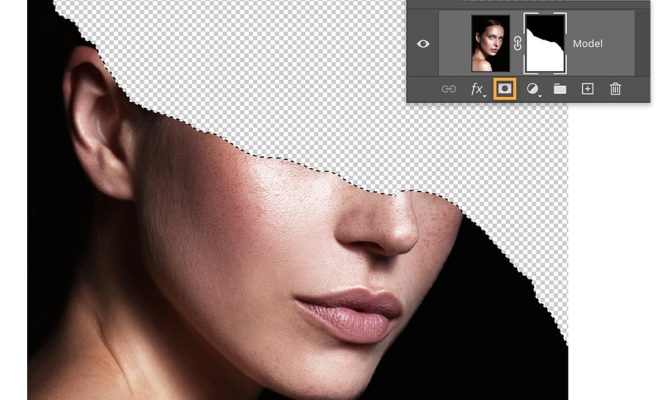
With the selection still active, click on the “Add Layer Mask” button, located at the bottom of the Layers panel, to mask out the unwanted areas outside the selection.

Step 6: Roughen the Edge

achieve the torn paper edge effect, we need to roughen the edge. Select the layer mask by clicking on it, then go to “Filter” in the top menu and select “Noise.” Choose the “Add Noise” option, adjust the amount until you have a rough edge that looks similar to a torn paper. Check the “Monochromatic” checkbox, then select “OK.”

Step 7: Apply a “Grunge” Effect

make the torn paper effect more realistic, we’ll apply a “grunge” effect to the edge. Go to the “Filters” menu, select “Filter Gallery,” and then choose the “Texture” option. Under “Texture,” pick a texture that looks like creases, scratches, or anything that makes the paper look worn. Adjust the settings until you have your desired result, then click “OK.”

Step 8: Add Additional Elements

Suppose you want to enhance your creation’s overall aesthetic, try adding some additional elements such as a drop shadow, torn-off pieces, or even text. The possibilities are endless, so feel free to experiment with different elements and layering techniques.

Voila! You’ve successfully created a torn paper edge effect in Photoshop. As you can see, it’s quite simple to achieve, and with a few further tweaks, you can make it as realistic and unique as you want. Give it a try and take your design game one step further.


Previous Article

How to Add Friends on Epic Games

Next Article

How to Connect Samsung TV to Alexa

Matthew Lynch

Related articles More from author

  • Digital & Mobile Technology

    Your AirPods Aren’t Waterproof, But Here’s What You Can Do

    July 4, 2023
    By Matthew Lynch
  • Digital & Mobile Technology

    Mac Won’t Boot or Start? How to Fix Issues With a Mac Not Turning On

    June 23, 2023
    By Matthew Lynch
  • Digital & Mobile Technology

    Can a Router Get a Virus?

    June 10, 2023
    By Matthew Lynch
  • Digital & Mobile Technology

    How Does My Phone Track My Steps?

    June 23, 2023
    By Matthew Lynch
  • Digital & Mobile Technology

    Reasons Why You Shouldn’t Jailbreak Your PS5

    June 30, 2023
    By Matthew Lynch
  • Digital & Mobile Technology

    How to Set Up Leafnode as an Offline USENET Server

    May 8, 2023
    By Matthew Lynch

Search

Login & Registration

  • Log in
  • Entries feed
  • Comments feed
  • WordPress.org

Newsletter

Signup for The Tech Edvocate Newsletter and have the latest in EdTech news and opinion delivered to your email address!

About Us

Since technology is not going anywhere and does more good than harm, adapting is the best course of action. That is where The Tech Edvocate comes in. We plan to cover the PreK-12 and Higher Education EdTech sectors and provide our readers with the latest news and opinion on the subject. From time to time, I will invite other voices to weigh in on important issues in EdTech. We hope to provide a well-rounded, multi-faceted look at the past, present, the future of EdTech in the US and internationally.

We started this journey back in June 2016, and we plan to continue it for many more years to come. I hope that you will join us in this discussion of the past, present and future of EdTech and lend your own insight to the issues that are discussed.

Newsletter

Signup for The Tech Edvocate Newsletter and have the latest in EdTech news and opinion delivered to your email address!

Contact Us

The Tech Edvocate
910 Goddin Street
Richmond, VA 23231
(601) 630-5238
[email protected]

Copyright © 2026 Matthew Lynch. All rights reserved.