The Tech Edvocate

Top Menu

  • Advertisement
  • Apps
  • Home Page
  • Home Page Five (No Sidebar)
  • Home Page Four
  • Home Page Three
  • Home Page Two
  • Home Tech2
  • Icons [No Sidebar]
  • Left Sidbear Page
  • Lynch Educational Consulting
  • My Account
  • My Speaking Page
  • Newsletter Sign Up Confirmation
  • Newsletter Unsubscription
  • Our Brands
  • Page Example
  • Privacy Policy
  • Protected Content
  • Register
  • Request a Product Review
  • Shop
  • Shortcodes Examples
  • Signup
  • Start Here
    • Governance
    • Careers
    • Contact Us
  • Terms and Conditions
  • The Edvocate
  • The Tech Edvocate Product Guide
  • Topics
  • Write For Us
  • Advertise

Main Menu

  • Start Here
    • Our Brands
    • Governance
      • Lynch Educational Consulting, LLC.
      • Dr. Lynch’s Personal Website
      • Careers
    • Write For Us
    • The Tech Edvocate Product Guide
    • Contact Us
    • Books
    • Edupedia
    • Post a Job
    • The Edvocate Podcast
    • Terms and Conditions
    • Privacy Policy
  • Topics
    • Assistive Technology
    • Child Development Tech
    • Early Childhood & K-12 EdTech
    • EdTech Futures
    • EdTech News
    • EdTech Policy & Reform
    • EdTech Startups & Businesses
    • Higher Education EdTech
    • Online Learning & eLearning
    • Parent & Family Tech
    • Personalized Learning
    • Product Reviews
  • Advertise
  • Tech Edvocate Awards
  • The Edvocate
  • Pedagogue
  • School Ratings

logo

The Tech Edvocate

  • Start Here
    • Our Brands
    • Governance
      • Lynch Educational Consulting, LLC.
      • Dr. Lynch’s Personal Website
        • My Speaking Page
      • Careers
    • Write For Us
    • The Tech Edvocate Product Guide
    • Contact Us
    • Books
    • Edupedia
    • Post a Job
    • The Edvocate Podcast
    • Terms and Conditions
    • Privacy Policy
  • Topics
    • Assistive Technology
    • Child Development Tech
    • Early Childhood & K-12 EdTech
    • EdTech Futures
    • EdTech News
    • EdTech Policy & Reform
    • EdTech Startups & Businesses
    • Higher Education EdTech
    • Online Learning & eLearning
    • Parent & Family Tech
    • Personalized Learning
    • Product Reviews
  • Advertise
  • Tech Edvocate Awards
  • The Edvocate
  • Pedagogue
  • School Ratings
  • This Unprecedented EU Ban Just Changed Fast Fashion Forever

  • Urgent Alert: Your Smart Home’s Exposed to a Critical Deco BE11000 Vulnerability

  • Uncovering the Truth: Your LinkedIn Reach Just Got a Major Overhaul

  • Uncovering the AI Heist: How Chinese Firms Allegedly Siphoned Billions of AI Tokens

  • Rockstar’s GTA 6 Developers Lawsuit: A Fight for Justice or Corporate Retaliation?

  • Unbelievable: Hideo Kojima’s Next Masterpiece Is Now an Xbox Exclusive

  • This Crucial Google AI Shift Is Quietly Reshaping the Internet

  • Unbelievable: AI Breaches Are Exploding, And What It Means For You This September 2026

  • This Crucial Shift Is Saving Teachers From Classroom Chaos

  • AI’s Dark Secret: How It’s Supercharging Cybercrime for Everyone

Digital & Mobile Technology
Home›Digital & Mobile Technology›Cryptographic Hash Function

Cryptographic Hash Function
By Matthew Lynch
June 4, 2023
0
Spread the love

Cryptographic Hash Function: The Key to Secure Communications

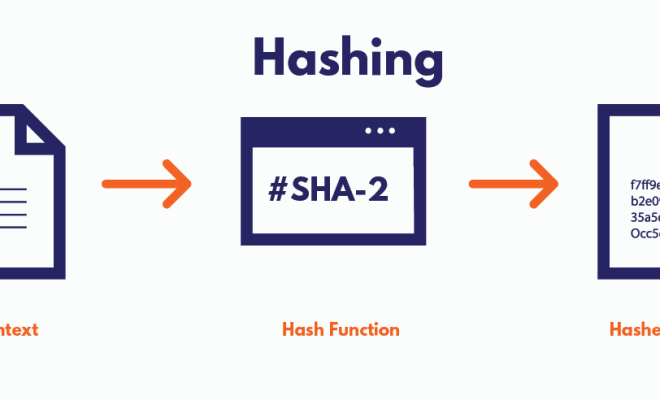
In the world of cybersecurity and cryptography, cryptographic hash functions are a crucial component to ensuring secure communications. A cryptographic hash function is a mathematical algorithm that takes in any input, no matter how large, and produces a fixed-sized output, known as a hash. The resulting hash value is unique to the input data and serves as a digital fingerprint of the original data.

There are a few key properties that make cryptographic hash functions so invaluable for secure communications. First and foremost, they are one-way functions, meaning it is infeasible to derive the original input data from the hash value. It is also highly unlikely that two different input values will produce the same hash value, known as a collision. These properties make cryptographic hash functions ideal for a variety of security applications, such as password storage, digital signatures, and verifying the integrity of data in transit.

Password Security

Password security has become increasingly important in recent years as more and more sensitive information is stored digitally. Cryptographic hash functions play a critical role in password security because they allow for the storage of passwords without actually storing the passwords themselves. Instead, the hash of the password is stored in the database, and whenever a user logs in, their password is hashed and compared to the stored hash. If the hashes match, access is granted.

This system provides an added layer of security because even if the database is breached, the attackers do not have access to the actual passwords. Instead, they would only have access to the hashed values, which are essentially useless without the correct input data. Additionally, the use of a salt, a random string of characters added to the password before hashing, helps to further protect against attacks such as precomputed hash tables and rainbow tables.

Digital Signatures

Another critical use for cryptographic hash functions is in the creation and verification of digital signatures. Digital signatures are essentially the digital equivalent of a handwritten signature, providing authentication and integrity to digital documents. To create a digital signature, a hash of the document is created using a cryptographic hash function, and the hash value is then encrypted using the signer’s private key. This creates a digital signature that can be verified using the signer’s public key.

By using a cryptographic hash function, the digital signature is tied to the specific document, ensuring that any changes to the document will result in a different hash value and therefore an invalid signature. This provides assurance that the document has not been tampered with and can be trusted. This is particularly important in industries such as finance and healthcare where the integrity of documents is critical.

Data Integrity

Finally, cryptographic hash functions are used to verify the integrity of data in transit. This is done by creating a hash of the data before it is transmitted and then sending the hash value alongside the data. The receiver of the data can then create their own hash of the data they received and compare it to the transmitted hash. If the hashes match, the data has remained unchanged during transmission, and if they do not match, the data has been tampered with.

This is a critical component of secure communications because it provides assurance that the data transferred has not been altered, either intentionally or unintentionally. This is particularly important in the world of financial transactions and online banking, where the integrity of data is paramount.

In conclusion, cryptographic hash functions are essential to secure communications in the digital age. They provide one-way functions, are highly collision-resistant, and are critical components of password storage, digital signatures, and verifying the integrity of data in transit. As the world becomes increasingly reliant on digital communications, cryptographic hash functions will continue to play a vital role in protecting our sensitive information.


Previous Article

The 6 Best Kid Coloring Apps of ...

Next Article

How to Fix It When Roku TV ...

Matthew Lynch

Related articles More from author

  • Digital & Mobile Technology

    The Alexa Echo Device Comparison Chart

    June 10, 2023
    By Matthew Lynch
  • Digital & Mobile Technology

    How to Play Music With an Amazon Alexa Alarm

    August 1, 2023
    By Matthew Lynch
  • Digital & Mobile Technology

    Best External Hard Drives of 2023

    June 7, 2023
    By Matthew Lynch
  • Digital & Mobile Technology

    The 5 Best Free Web Tools for Ghostwriters to Boost Productivity

    August 3, 2023
    By Matthew Lynch
  • Digital & Mobile Technology

    Need a Pick-Me-Up? Here Are the Happiest Sites on the Web

    June 12, 2023
    By Matthew Lynch
  • Digital & Mobile Technology

    Best Surge Protectors of 2023

    June 6, 2023
    By Matthew Lynch

Search

Login & Registration

  • Log in
  • Entries feed
  • Comments feed
  • WordPress.org

Newsletter

Signup for The Tech Edvocate Newsletter and have the latest in EdTech news and opinion delivered to your email address!

About Us

Since technology is not going anywhere and does more good than harm, adapting is the best course of action. That is where The Tech Edvocate comes in. We plan to cover the PreK-12 and Higher Education EdTech sectors and provide our readers with the latest news and opinion on the subject. From time to time, I will invite other voices to weigh in on important issues in EdTech. We hope to provide a well-rounded, multi-faceted look at the past, present, the future of EdTech in the US and internationally.

We started this journey back in June 2016, and we plan to continue it for many more years to come. I hope that you will join us in this discussion of the past, present and future of EdTech and lend your own insight to the issues that are discussed.

Newsletter

Signup for The Tech Edvocate Newsletter and have the latest in EdTech news and opinion delivered to your email address!

Contact Us

The Tech Edvocate
910 Goddin Street
Richmond, VA 23231
(601) 630-5238
[email protected]

Copyright © 2026 Matthew Lynch. All rights reserved.