The Tech Edvocate

Top Menu

  • Advertisement
  • Apps
  • Home Page
  • Home Page Five (No Sidebar)
  • Home Page Four
  • Home Page Three
  • Home Page Two
  • Home Tech2
  • Icons [No Sidebar]
  • Left Sidbear Page
  • Lynch Educational Consulting
  • My Account
  • My Speaking Page
  • Newsletter Sign Up Confirmation
  • Newsletter Unsubscription
  • Our Brands
  • Page Example
  • Privacy Policy
  • Protected Content
  • Register
  • Request a Product Review
  • Shop
  • Shortcodes Examples
  • Signup
  • Start Here
    • Governance
    • Careers
    • Contact Us
  • Terms and Conditions
  • The Edvocate
  • The Tech Edvocate Product Guide
  • Topics
  • Write For Us
  • Advertise

Main Menu

  • Start Here
    • Our Brands
    • Governance
      • Lynch Educational Consulting, LLC.
      • Dr. Lynch’s Personal Website
      • Careers
    • Write For Us
    • The Tech Edvocate Product Guide
    • Contact Us
    • Books
    • Edupedia
    • Post a Job
    • The Edvocate Podcast
    • Terms and Conditions
    • Privacy Policy
  • Topics
    • Assistive Technology
    • Child Development Tech
    • Early Childhood & K-12 EdTech
    • EdTech Futures
    • EdTech News
    • EdTech Policy & Reform
    • EdTech Startups & Businesses
    • Higher Education EdTech
    • Online Learning & eLearning
    • Parent & Family Tech
    • Personalized Learning
    • Product Reviews
  • Advertise
  • Tech Edvocate Awards
  • The Edvocate
  • Pedagogue
  • School Ratings

logo

The Tech Edvocate

  • Start Here
    • Our Brands
    • Governance
      • Lynch Educational Consulting, LLC.
      • Dr. Lynch’s Personal Website
        • My Speaking Page
      • Careers
    • Write For Us
    • The Tech Edvocate Product Guide
    • Contact Us
    • Books
    • Edupedia
    • Post a Job
    • The Edvocate Podcast
    • Terms and Conditions
    • Privacy Policy
  • Topics
    • Assistive Technology
    • Child Development Tech
    • Early Childhood & K-12 EdTech
    • EdTech Futures
    • EdTech News
    • EdTech Policy & Reform
    • EdTech Startups & Businesses
    • Higher Education EdTech
    • Online Learning & eLearning
    • Parent & Family Tech
    • Personalized Learning
    • Product Reviews
  • Advertise
  • Tech Edvocate Awards
  • The Edvocate
  • Pedagogue
  • School Ratings
  • Wenn Ordnung den Bildschirm beruhigt: Warum klare Abläufe Casino-Unterhaltung einladender machen

  • Reddit AI Reviews: The Quiet Reshaping of Online Opinion

  • The Chilling Truth: Iran Cyberattacks Europe’s Food and Blood Supplies

  • Anthropic’s $3.4 Billion Bet on Gas: The Unseen Cost of AI’s Future

  • Tribit FlyBuds C3 Earbuds: Premium Features at a Budget-Friendly Price

  • Is AuraCam Pro’s Emotional AI a Privacy Nightmare or Security Breakthrough?

  • Unprecedented: N-able’s Global Shutdown After 30+ Zero-Days Revealed

  • The Urgent Truth: Your AI Tools for Financial Advisors Could Be a Compliance Nightmare

  • Unmasking the Troubling Truth About EU’s Digital Omnibus and Your Data

  • Outrageous: Your US Car Insurance 2026 Bill Is About to Explode – Here’s Why

Digital & Mobile Technology
Home›Digital & Mobile Technology›What Is an Ethernet Port?

What Is an Ethernet Port?
By Matthew Lynch
June 1, 2023
0
Spread the love

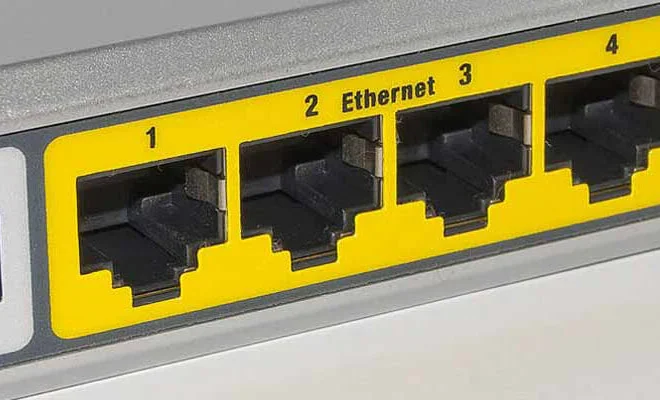
An Ethernet port is a hardware interface on a computer or device used to connect to a local area network (LAN) or wide area network (WAN) using an Ethernet cable. Ethernet ports have become a standard feature on laptops, desktops, servers, and other network devices.

Ethernet ports are most commonly used for connecting devices to the internet, as well as to each other to enable file sharing, printing, and other network functionality. Ethernet technology has been around since the 1970s and has since evolved to support faster and more reliable internet connections.

Ethernet ports come in different speeds, ranging from 10 megabits per second (Mbps) to 100 gigabits per second (Gbps). The speed of the Ethernet port determines how quickly data can be transferred between the connected devices. A faster speed allows for higher quality video and audio streaming, faster downloads, and greater overall network performance.

In addition to their speed, Ethernet ports have several other features that enhance their functionality, such as auto-negotiation and auto-MDI/MDIX. Auto-negotiation allows the Ethernet port to automatically detect the speed and duplex (half or full) of the connected device, while auto-MDI/MDIX enables the Ethernet port to automatically adjust for crossover cables or straight-through cables, eliminating the need for specialized patch cables.

Ethernet ports can also be configured for different network topologies, such as star, mesh, and tree. In a star configuration, all devices are connected to a central hub or switch, while in a mesh configuration, devices are connected in a peer-to-peer network. A tree topology is a combination of the two configurations, with multiple star networks connected through a central bus.

In recent years, Ethernet ports have been expanding beyond traditional devices, such as computers and routers, to other smart devices, such as home security systems, thermostats, and smart TVs. As the number of networked devices continues to grow, Ethernet ports will remain a critical component for connecting and managing these devices.

In conclusion, Ethernet ports are crucial components in connecting devices to a network or the internet. They provide fast and reliable internet access and enable other network functionality to enhance overall performance. As technology continues to evolve, Ethernet ports will continue to play an important role in connecting devices and facilitating communication between them.


Previous Article

How to Track an iPhone From an ...

Next Article

How to Open an iPhone SIM Card ...

Matthew Lynch

Related articles More from author

  • Digital & Mobile Technology

    Best Free VPNs for Your Chromebook

    August 5, 2023
    By Matthew Lynch
  • Digital & Mobile Technology

    What Is the PogChamp Emote and When Is It Used?

    June 12, 2023
    By Matthew Lynch
  • Digital & Mobile Technology

    What does the at sign mean in “@echo off “?

    June 10, 2023
    By Matthew Lynch
  • Digital & Mobile Technology

    How to Auto Empty Trash in Outlook

    June 10, 2023
    By Matthew Lynch
  • Digital & Mobile Technology

    The 19 Best Xposed Framework Modules

    June 10, 2023
    By Matthew Lynch
  • Digital & Mobile Technology

    Luminar Neo vs. Luminar AI: Which Is the Better Photo Editor?

    June 15, 2023
    By Matthew Lynch

Search

Login & Registration

  • Log in
  • Entries feed
  • Comments feed
  • WordPress.org

Newsletter

Signup for The Tech Edvocate Newsletter and have the latest in EdTech news and opinion delivered to your email address!

About Us

Since technology is not going anywhere and does more good than harm, adapting is the best course of action. That is where The Tech Edvocate comes in. We plan to cover the PreK-12 and Higher Education EdTech sectors and provide our readers with the latest news and opinion on the subject. From time to time, I will invite other voices to weigh in on important issues in EdTech. We hope to provide a well-rounded, multi-faceted look at the past, present, the future of EdTech in the US and internationally.

We started this journey back in June 2016, and we plan to continue it for many more years to come. I hope that you will join us in this discussion of the past, present and future of EdTech and lend your own insight to the issues that are discussed.

Newsletter

Signup for The Tech Edvocate Newsletter and have the latest in EdTech news and opinion delivered to your email address!

Contact Us

The Tech Edvocate
910 Goddin Street
Richmond, VA 23231
(601) 630-5238
[email protected]

Copyright © 2026 Matthew Lynch. All rights reserved.