Is the AI Bubble About to Burst? Finance Titans Clash Over Unprecedented Market Risk
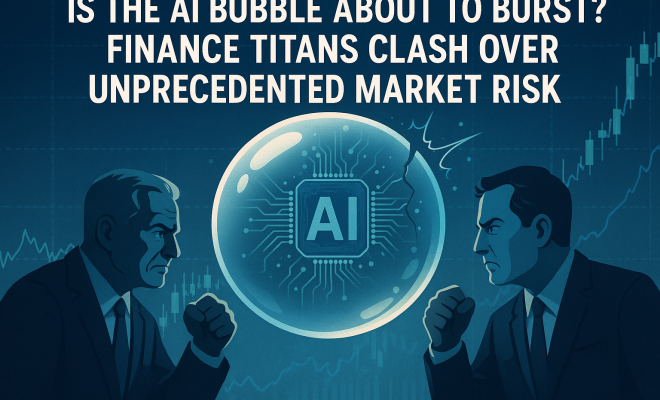
You can almost feel the tension in the air, can’t you? It’s a mix of exhilarating possibility and gnawing apprehension, especially if you’re watching the stock market these days. Artificial intelligence has exploded into our collective consciousness, not just as a technological marvel, but as an investment phenomenon. Companies like Nvidia, once a niche player in graphics cards, are now household names, their valuations soaring to astronomical heights. But underneath all that excitement, a crucial question is brewing, one that could profoundly impact your portfolio, your job, and the global economy: Are we in an AI bubble?
It’s a debate that has ignited a firestorm among some of the most influential figures in finance, with billionaire Ken Griffin, the formidable head of Citadel, throwing down a gauntlet. His stark warning? Investors pouring money into AI are “almost certainly” caught in a speculative bubble, and he believes we should all brace for potential setbacks. This isn’t just a casual observation; it’s a direct challenge to the prevailing optimism, drawing unsettling parallels to historical tech booms and busts. But not everyone agrees, and the pushback from other titans of industry makes this a conversation you absolutely need to pay attention to.
The Ken Griffin Gauntlet: A Dire Warning of an AI Bubble
When Ken Griffin speaks, people listen. As the founder and CEO of Citadel, one of the world’s most successful hedge funds, his insights carry immense weight. Griffin isn’t just talking about a minor market correction; he’s sounding the alarm about a full-blown AI bubble. His reasoning isn’t based on a gut feeling, but on a deep understanding of market cycles and human psychology. He’s seen these patterns before, in the dot-com era, in the housing market, and in countless other periods of rapid technological advancement.
Griffin’s core argument rests on the idea that while AI’s underlying technology is genuinely transformative, the market’s current valuation of AI-related companies has detached from fundamental economics. He suggests that the sheer speed and scale of capital flowing into the sector are creating an unsustainable environment, where future potential is being priced in at an unrealistic premium. It’s a classic bubble scenario: speculative fervor, rapid price appreciation, and a collective belief that ‘this time it’s different.’ But history, as Griffin well knows, often rhymes, and the eventual reckoning can be painful for those caught unprepared.
What makes Griffin’s warning particularly potent is his reference to historical technological transformations. Think back to the railway boom of the 19th century, or the early days of radio and aviation. Each represented a paradigm shift, promising unprecedented growth and societal change. And each, at various points, was accompanied by intense speculative bubbles that eventually burst, wiping out fortunes. Griffin isn’t dismissing AI’s potential; he’s simply reminding us that even genuine innovation can be overshadowed by irrational exuberance, leading to an inevitable correction. For investors, this means a potential for significant losses if they aren’t careful.
Pushback from the Giants: Why Deutsche Bank and BlackRock Disagree
Of course, not everyone in the C-suite of global finance is echoing Griffin’s caution. In fact, some are directly pushing back, arguing that the current AI boom is fundamentally different and far from an imminent burst. Christian Sewing, the CEO of Deutsche Bank, and Larry Fink, the CEO of BlackRock – another titan overseeing trillions in assets – have articulated a much more optimistic perspective. Their arguments hinge on a crucial distinction: the underlying utility and necessity of AI, and the massive investment required to realize its full potential.
Sewing and Fink aren’t blind to market dynamics, but they emphasize the critical need for continued, substantial investment in AI infrastructure. They see AI not as a speculative fad, but as a foundational technology that will reshape nearly every industry. To them, the current valuations, while high, reflect the immense capital expenditure required to build out the computing power, data centers, and advanced algorithms necessary for AI to truly thrive. If anything, they suggest, under-investment could be a greater risk, leading to bottlenecks and stifled innovation, rather than an AI bubble bursting.
Their perspective also touches on a very real economic concern: inflation. If investment in AI infrastructure doesn’t keep pace with demand, the costs associated with AI development and deployment could skyrocket, contributing to broader inflationary pressures. Think about it: limited supply of cutting-edge chips, specialized data centers, and skilled AI talent would inevitably drive up prices. From this viewpoint, the current investment levels, while seemingly large, are actually a necessary step to ensure that AI can deliver its promised productivity gains without creating new economic imbalances. It’s a long-term play, they argue, not a short-term speculative frenzy.
The Productivity Promise: Goldman Sachs’ Optimistic Outlook and Workforce Concerns
Beyond the immediate market debate, there’s a deeper economic current at play: AI’s potential to dramatically boost productivity. Goldman Sachs, another behemoth in the financial world, has offered a compelling forecast that underpins much of the long-term optimism surrounding AI. They project that a significant 15% increase in productivity driven by AI is entirely within reach. Imagine what that could mean for global GDP, for corporate profits, and for our overall standard of living. It’s a tantalizing prospect, painting a picture of a future where AI acts as a powerful engine for economic growth. (See: AI bubble analysis by NY Times.)
However, this rosy productivity outlook comes with a significant asterisk, one that fuels widespread anxiety: job displacement. Goldman Sachs also estimates that this same productivity surge could lead to the temporary displacement of approximately 9% of the workforce. “Temporary” is the operative word here, suggesting that while some jobs will disappear, new ones will likely emerge, or existing roles will transform. But for those 9% — potentially millions of people — “temporary” can feel like a lifetime when you’re suddenly out of work. The transition period is where the real human cost lies. For more context, see Why Millions Are Finally Using AI to Master High-Demand Skills.
What makes this job displacement forecast even more troubling is its sensitivity to economic cycles. Goldman Sachs warns that job losses could accelerate significantly during economic downturns. In a recession, companies are already looking for ways to cut costs, and AI offers a powerful tool for automation and efficiency. This means that if an AI bubble were to burst, triggering a wider economic slump, the job market could face a double whammy: a slowdown in hiring coupled with increased AI-driven automation, exacerbating unemployment and making the recovery even more challenging for displaced workers. We covered Why investors are concerned in more detail.
Drawing Parallels: Historical Bubbles and the AI Era
Ken Griffin’s warning about an AI bubble isn’t just theoretical; it’s steeped in historical precedent. Understanding these past bubbles can offer crucial insights into our current situation. The dot-com bubble of the late 1990s and early 2000s is perhaps the most vivid recent memory. Companies with little more than a catchy website and a vague business plan saw their valuations skyrocket, only to crash spectacularly when investors realized there wasn’t enough substance to back the hype. Many promising technologies got caught in the crossfire, their genuine potential obscured by rampant speculation.
But the history of bubbles goes back much further. Consider “Tulip Mania” in 17th-century Netherlands, where the price of tulip bulbs reached absurd levels, only to collapse dramatically. Or the South Sea Bubble in 18th-century Britain, where a company promising fantastic returns from trade with South America saw its stock surge before a catastrophic collapse. In each case, a new, exciting, or seemingly revolutionary idea captured the public imagination, leading to a frenzy of investment driven more by fear of missing out (FOMO) and speculative greed than by sound financial analysis.
The key parallel Griffin draws is not that AI is a worthless technology – far from it. Instead, it’s about the market’s irrational response to genuine innovation. In a bubble, the distinction between truly transformative companies and those simply riding the wave becomes blurred. Valuations get stretched to breaking point, often pricing in decades of future growth without any guarantee of its realization. The challenge for investors today is to discern which AI companies have sustainable business models and which are merely beneficiaries of the current speculative fever, destined to fall when the AI bubble eventually deflates.
The Inflationary Pressure Argument: A Counter-Narrative
One of the most compelling counter-arguments to the AI bubble thesis comes from the perspective of inflationary pressures. Larry Fink and Christian Sewing highlight this as a critical factor. Their point is that if AI is truly going to deliver on its promise of increased productivity and economic growth, it requires an enormous upfront investment in infrastructure. We’re talking about massive data centers, specialized chips, cooling systems, and the energy grids to power them all. This isn’t cheap, and it requires significant capital expenditure.
If capital markets become too cautious, or if the perceived risk of an AI bubble deters necessary investment, then the supply of AI infrastructure could fall short of demand. What happens then? Basic economics tells us that scarcity drives up prices. The cost of accessing AI capabilities, developing new models, or even simply using AI-powered services could become prohibitively expensive. This wouldn’t just affect tech companies; it would ripple through the entire economy, potentially fueling inflation across various sectors as businesses pass on higher AI-related costs to consumers.
So, from this viewpoint, the current flow of investment, while it might appear speculative, is actually a necessary defense against future inflation. It’s about building out the foundational layers of a new economic era. Think of it like laying down railway tracks or building power grids in earlier industrial revolutions. These were massive, capital-intensive undertakings, and insufficient investment could have severely hampered economic progress. The argument is that the current investment isn’t just about speculation, but about strategically positioning the global economy for an AI-driven future, preventing future inflationary bottlenecks.
Investment Strategies in an AI-Dominated Market: Navigating Volatility
So, what’s an investor to do when finance leaders are sparring over whether we’re in an AI bubble? The conflicting opinions underscore the inherent uncertainty of investing in revolutionary technologies. This isn’t a time for knee-jerk reactions, but for thoughtful, well-researched strategies. For starters, diversification remains your strongest defense. Don’t put all your eggs in the AI basket, no matter how shiny it looks. A balanced portfolio across different sectors and asset classes can cushion the blow if one segment, like AI, experiences a significant downturn. (See: BBC report on AI market risks.) (2023's billion-dollar startups)
For those still eager to participate in the AI boom, a more discerning approach is critical. Rather than chasing every stock with “AI” in its name, focus on companies with strong fundamentals, proven business models, and a clear path to profitability that isn’t solely dependent on speculative hype. Look for those providing essential infrastructure (like chip manufacturers or cloud service providers), those with proprietary data, or those demonstrating real, tangible applications of AI that solve concrete problems and generate revenue. Valuation matters, even in an exciting growth sector. Avoid companies with sky-high price-to-earnings ratios and limited revenue, as these are often the first to fall in a market correction.
Finally, consider dollar-cost averaging. Instead of investing a large lump sum at once, commit to investing a fixed amount regularly over time. This strategy helps mitigate the risk of buying at the peak of an AI bubble, as you’ll naturally buy more shares when prices are low and fewer when they’re high. It’s a disciplined approach that smooths out the inevitable volatility that comes with investing in rapidly evolving sectors, allowing you to participate in the long-term growth of AI without exposing yourself to undue risk from short-term market fluctuations. For more context, see The Gold Rush: Why AI Governance Careers Will Eclipse Traditional Compliance.
The Human Element: AI’s Impact on the Workforce and Career Paths
Beyond the financial markets, the most profound and immediate impact of AI is on people’s jobs and career trajectories. Goldman Sachs’ forecast of 9% workforce displacement is a stark reminder that this isn’t just about algorithms and balance sheets; it’s about livelihoods. This isn’t necessarily a doomsday scenario, but it demands proactive planning from individuals and organizations alike. The nature of work is changing, and those who adapt will be best positioned for the future.
So, what does an “AI-proof” career path look like? It often involves focusing on skills that AI struggles to replicate: creativity, critical thinking, complex problem-solving, emotional intelligence, and interpersonal communication. Roles requiring deep human interaction, strategic judgment, artistic expression, or innovative thinking are likely to be augmented by AI rather than replaced. Think about professions like therapists, strategists, artists, designers, or educators – these often require nuanced human skills that AI can’t yet fully replicate.
For those in roles susceptible to automation, the key is reskilling and upskilling. This means embracing lifelong learning, acquiring new technical skills (like prompt engineering, data analysis, or AI model interpretation), and adapting existing skills to work alongside AI tools. Online education platforms, corporate training programs, and even government initiatives are increasingly focusing on these areas. The goal isn’t to compete with AI, but to collaborate with it, leveraging its capabilities to enhance human productivity and create new value. This proactive approach can turn potential job displacement into an opportunity for career evolution.
Monetization Opportunities: Capitalizing on the AI Trend (Responsibly)
The widespread interest in AI, whether driven by fear or excitement, creates significant monetization opportunities across various sectors. For content creators, educators, and service providers, understanding these opportunities can be highly lucrative, but it also comes with a responsibility to provide accurate, valuable, and actionable information. The high-stakes economic debate and the widespread anxiety around AI’s impact on jobs make this a highly engaged audience.
One clear area is personal finance and investing. With so much talk about an AI bubble, people are hungry for guidance on how to invest safely and smartly in this environment. This opens doors for content on investment strategies specific to AI, risk management, and diversification. Affiliate partnerships with reputable investment platforms, robo-advisors, or financial advisory services can be very effective here. Similarly, online education is booming. Courses on AI literacy, prompt engineering, data science, or even “AI-proof” career development are in high demand. Platforms like Coursera, edX, or even independent course creators can capitalize on this by offering high-quality, relevant content.
Beyond education, career development and reskilling programs are critical. As AI reshapes the job market, people need help understanding how their roles will change and what new skills they need. This can involve career coaching, workshops on adapting to AI tools, or even platforms that connect workers with reskilling opportunities. For businesses, this means identifying where AI can genuinely add value, developing ethical AI policies, and investing in their workforce’s AI capabilities. The key to responsible monetization is to provide genuine value, offering solutions and insights that help people navigate the complex, rapidly evolving world of artificial intelligence. For more context, see The AI Governance Gold Rush: Why This New Role Is Suddenly Exploding. (See: Research on AI investment trends.)
The Ethical Imperative: Beyond the Market Hype
While the financial debate about an AI bubble rightly captures headlines, it’s crucial not to lose sight of the profound ethical considerations that accompany AI’s rapid ascent. The deployment of AI is not a morally neutral act; it carries significant societal implications that extend far beyond stock prices and productivity gains. As AI becomes more integrated into our lives, questions of fairness, bias, accountability, and transparency become paramount. Ignoring these issues in the rush for profit or technological advantage would be a grave mistake, potentially leading to widespread societal harm.
Consider the issue of bias. AI models are trained on vast datasets, and if those datasets reflect existing human biases – whether racial, gender, or socioeconomic – the AI will inevitably perpetuate and even amplify those biases. This can lead to discriminatory outcomes in everything from hiring decisions and loan applications to criminal justice and healthcare. Ensuring fairness in AI means meticulously auditing training data, developing robust bias detection methods, and implementing ethical guidelines for AI development and deployment.
Then there’s the question of accountability. When an AI system makes a mistake, or causes harm, who is responsible? Is it the developer, the deployer, the user, or the AI itself? Establishing clear lines of accountability is essential for building public trust and ensuring that AI is used responsibly. Transparency is another key pillar. Understanding how AI makes decisions, especially in critical applications, is vital. Black-box algorithms that offer no explanation for their outputs can erode trust and make it difficult to identify and correct errors. As we push the boundaries of AI, we must concurrently develop a robust ethical framework that guides its creation and application, ensuring that its benefits are shared widely and its risks are carefully managed. Because ultimately, the true success of AI won’t just be measured in market caps, but in its positive impact on humanity.
Conclusion: A Fork in the Road for AI’s Future
So, where does all this leave us? Is an AI bubble inevitable, or is this simply a necessary, albeit expensive, investment in the future? The truth, as is often the case, probably lies somewhere in the middle, and it depends on who you ask and what timeframe they’re considering. Ken Griffin’s warning is a valuable reminder of market cycles and the dangers of irrational exuberance. History teaches us that even the most revolutionary technologies can be prone to speculative frenzies that end in painful corrections. It’s a call for caution, for due diligence, and for remembering that not every company riding the AI wave will survive the inevitable shakeout.
On the other hand, the arguments from Christian Sewing and Larry Fink highlight AI’s foundational nature and the sheer scale of investment required to unlock its full potential. Their perspective suggests that current valuations, while high, reflect a genuine economic imperative to build out the infrastructure necessary for an AI-driven future, and that under-investment could lead to its own set of problems, including inflationary pressures. They see the AI revolution as a marathon, not a sprint, requiring sustained capital and commitment. Related reading: Potential market correction warning.
For individuals, whether as investors or as workers, the message is clear: AI is here to stay, and its impact will be profound. Navigating this era successfully means staying informed, adapting continually, and making strategic choices based on sound principles rather than hype. The debate among finance leaders isn’t just an academic exercise; it’s a critical conversation shaping the economic landscape for years to come. Your ability to understand these dynamics and act accordingly will largely determine how you fare in this brave new world of artificial intelligence.
Trending Now
Frequently Asked Questions
Is there really an AI bubble right now?
Many experts, including billionaire Ken Griffin, believe we may be in an AI bubble. They argue that the rapid rise in valuations for AI companies, like Nvidia, mirrors past speculative bubbles in technology, suggesting that investors could face significant setbacks if the market corrects.
What did Ken Griffin say about the AI market?
Ken Griffin, the CEO of Citadel, warned that investors pouring money into AI might be caught in a speculative bubble. He emphasized the need for caution, drawing parallels to previous tech booms and stressing that the current excitement could lead to a market correction.
How do historical tech booms relate to AI?
Historical tech booms, such as the dot-com era, provide cautionary tales about rapid market growth followed by significant crashes. Analysts like Ken Griffin argue that the current AI hype could follow a similar trajectory, where overvaluation leads to a market downturn.
What are the risks of investing in AI companies?
Investing in AI companies carries risks, particularly the potential for a market bubble. Experts warn that while AI technology is transformative, the inflated valuations may not be sustainable, leading to possible financial losses for investors if a correction occurs.
Who are the key figures in the AI investment debate?
The AI investment debate features prominent figures like Ken Griffin of Citadel, who warns of a bubble, and other industry leaders who hold contrasting views. Their differing opinions highlight the contentious nature of AI's role in the current financial landscape.
Agree or disagree? Drop a comment and tell us what you think.