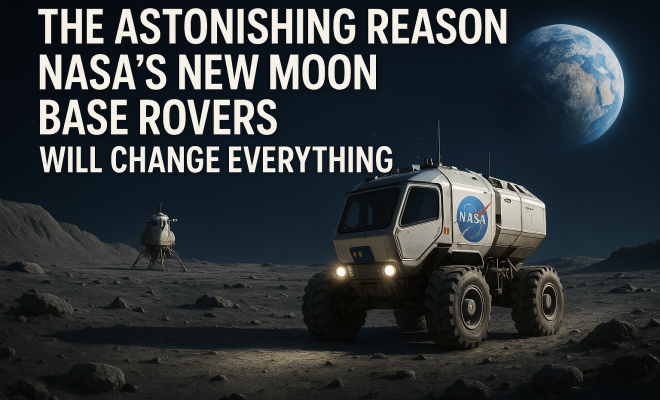
The Astonishing Reason NASA’s New Moon Base Rovers Will Change Everything
“`html
Imagine a future where humanity isn’t just visiting the Moon, but truly living and working there. It sounds like science fiction, doesn’t it? Yet, with every passing month, that vision inches closer to reality. NASA recently offered a tantalizing glimpse into this future, providing a progress update on October 20, 2026, that has space enthusiasts and industry insiders buzzing. The agency showcased its next generation of robotic explorers and innovative crew-carrying lunar terrain vehicles, developed by companies like Astrolab and Lunar Outpost. These aren’t just fancy moon buggies; they’re the vanguard, set to map the Moon’s enigmatic South Pole long before our Artemis astronauts even set foot there.
What makes these particular moon base rovers so pivotal? It boils down to their ambition and capability. Designed to traverse significant distances daily, these vehicles are slated for a myriad of critical tasks: demonstrating cutting-edge technologies, transporting astronauts with unprecedented efficiency, meticulously mapping lunar terrain, conducting vital scientific research, and perhaps most importantly, prospecting for resources. Specifically, they’re hunting for water ice – a resource that could fundamentally alter the economics and sustainability of human endeavors beyond Earth. This isn’t just about cool robots; it’s about laying the groundwork for a permanent, thriving human presence on our nearest celestial neighbor. The implications are truly profound, extending from scientific discovery to the very fabric of future lunar industries and even speculative lunar real estate.
The Strategic Importance of the Lunar South Pole
Why the South Pole, you ask? It’s not just a picturesque locale; it’s a region of immense strategic value, making it the primary target for these new moon base rovers. Unlike other areas of the Moon, the South Pole is home to permanently shadowed regions within craters where sunlight never reaches. These frigid traps are believed to harbor significant quantities of water ice, preserved for billions of years. Imagine, if you will, a natural reservoir waiting to be tapped. This isn’t just about having a refreshing drink on the Moon; water ice can be broken down into hydrogen and oxygen. Hydrogen can be used as rocket fuel, while oxygen is essential for breathing and supporting life.
The ability to ‘live off the land’ – or in this case, off the Moon – is a game-changer. It dramatically reduces the cost and complexity of lunar missions. Instead of launching every drop of water and every tank of fuel from Earth, which is incredibly expensive and logistically challenging, future lunar settlements could become self-sufficient. This prospect transforms the Moon from a distant destination into a potential staging ground for deeper space exploration, perhaps even to Mars. The South Pole, therefore, isn’t just a landing site; it’s a strategic resource hub, and the data gathered by these moon base rovers will be indispensable in planning the first permanent lunar outposts.
Introducing the Next Generation of Lunar Explorers: Astrolab and Lunar Outpost
NASA isn’t going it alone in this ambitious endeavor. The agency has wisely tapped into the innovative spirit of private industry, partnering with companies like Astrolab and Lunar Outpost. These aren’t your grandfather’s space contractors; they’re nimble, forward-thinking enterprises pushing the boundaries of what’s possible in lunar mobility. Astrolab, for instance, is making waves with its FLEX (Flexible Logistics and Exploration) rover, designed to be highly versatile. It can carry substantial payloads, accommodate astronauts, and perform a wide array of tasks from scientific research to construction support. Its modular design is particularly compelling, allowing for quick reconfigurations to suit different mission profiles.
Lunar Outpost, on the other hand, brings its own specialized expertise. While specific details of their contribution to these crew-carrying lunar terrain vehicles weren’t fully enumerated in the update, their track record in developing robust, autonomous robotic systems for extreme environments speaks volumes. Their previous work on smaller, highly capable rovers demonstrates a deep understanding of the challenges of lunar operations. The collaboration between these private entities and NASA exemplifies a new era of space exploration – one where public and private sectors synergize to accelerate progress and achieve goals that would be insurmountable for either party alone. These moon base rovers represent the sharp edge of this new collaborative frontier.
More Than Just Transportation: A Multitude of Mission Objectives
When we talk about moon base rovers, it’s easy to picture a simple vehicle for moving people and things. But these aren’t just lunar Ubers. Their mission objectives are incredibly diverse and critical to establishing a sustainable presence on the Moon. Think of them as multi-tool platforms. First, they’ll be performing vital technology demonstrations. This means testing new systems, sensors, and operational procedures in the harsh lunar environment, gathering data that will inform future designs and missions. Can a specific drill penetrate lunar regolith effectively? How do new communication systems perform under extreme radiation? These are the kinds of questions they’ll answer.
Then there’s the role of astronaut transport. While astronauts are highly trained, they’re still human and have limits on how far they can walk in a bulky spacesuit. These rovers will extend their operational range dramatically, allowing them to explore wider areas, service equipment, and conduct geological surveys far from their habitats. Beyond that, they’re crucial for terrain mapping and science. High-resolution maps of the South Pole, identifying safe routes and potential hazards, are absolutely essential. Scientific instruments on board will analyze lunar soil, rocks, and volatiles, unlocking secrets about the Moon’s formation and evolution. Each of these functions is not just a nice-to-have; they are foundational pillars for human expansion into space.
The Critical Hunt for Water Ice: Fueling Future Lunar Industries
Let’s circle back to what might be the most impactful mission of these moon base rovers: the search for water ice. This isn’t just a scientific curiosity; it’s the lynchpin for nearly every future lunar industry. If significant, accessible deposits of water ice can be confirmed, the Moon transforms from a barren rock into a resource-rich outpost. The process is relatively straightforward, at least in concept: extract the ice, melt it, purify the water, and then electrolyze it into hydrogen and oxygen. As I mentioned earlier, hydrogen is a potent rocket fuel, and oxygen is not only breathable air but also an oxidizer for rockets. (See: NASA Artemis program overview.)
Imagine refueling rockets on the Moon for missions to Mars or beyond, instead of hauling every ounce of propellant from Earth’s deep gravity well. This drastically lowers the cost of deep-space exploration. Furthermore, water is vital for human sustenance, agriculture, and industrial processes in a lunar settlement. The implications for B2B services are enormous – companies specializing in resource extraction, processing, and delivery will emerge. We’re talking about a potential lunar economy built around water, oxygen, and fuel. This isn’t just speculation; it’s a tangible goal driving significant investment and engineering effort, and these moon base rovers are the scouts leading the charge.
Operational Prowess: Covering Significant Distances Daily
One of the quiet but truly impressive technical achievements of these new moon base rovers is their ability to cover significant distances daily. The Moon’s environment is unforgiving: extreme temperatures, abrasive regolith, sharp rocks, and the constant threat of micrometeoroids. Designing a vehicle that can reliably operate day after day, traversing kilometers of treacherous terrain, is no small feat. This speaks to advancements in battery technology, thermal management systems, navigation algorithms, and robust mechanical design. For more context, see the future of technology and innovation in space exploration.
Earlier lunar rovers, while groundbreaking, often had more limited ranges or operational durations. The Apollo Lunar Roving Vehicle (LRV), for example, was an incredible piece of engineering for its time, but its excursions were relatively short and directly controlled by astronauts. These new moon base rovers are designed for sustained, often autonomous, operation. This extended range is crucial for comprehensive mapping, efficient resource prospecting across wide areas, and supporting far-ranging astronaut excursions. The ability to cover more ground translates directly into more science, more data, and ultimately, a faster path towards understanding and utilizing our Moon.
Viral Potential: Fueling Public Fascination with Lunar Exploration
Beyond the technical and scientific merits, there’s a compelling human element to this story that ensures its viral potential. The public’s fascination with lunar exploration is deep-seated and enduring. There’s something inherently captivating about humanity reaching for the stars, and the Moon, being our closest celestial neighbor, holds a special place in our collective imagination. The images and videos of these advanced moon base rovers traversing the lunar surface, especially with the promise of astronauts soon following, tap into a universal sense of wonder and adventure.
This isn’t just abstract science; it’s tangible progress towards establishing a human presence on another world. People can visualize these vehicles, imagine themselves riding in them, and understand the profound implications of finding water on the Moon. This emotional connection, combined with the clear, progressive steps towards a permanent lunar base, makes for incredibly compelling content. It’s not just news; it’s a narrative of human ambition and ingenuity unfolding in real-time, captivating audiences from casual observers to dedicated space enthusiasts. That kind of widespread appeal is invaluable for generating interest, support, and even investment in the future of space exploration.
Monetization Opportunities: Beyond the Scientific Frontier
While the scientific and exploratory aspects are paramount, it’s also worth considering the burgeoning economic landscape these developments are creating. The news about advanced moon base rovers and the hunt for water ice isn’t just for scientists and engineers; it has significant monetization opportunities. For investors, this opens up discussions around investment in space resource extraction companies. Imagine early-stage startups developing technologies for lunar mining, water processing, or even lunar manufacturing. These are the companies that could become the titans of a new space economy.
Then there are B2B services for lunar infrastructure development. As NASA and international partners plan permanent bases, there will be a massive demand for everything from construction robotics to communication networks, energy systems, and waste management solutions tailored for the lunar environment. Think of it as an entirely new frontier for infrastructure contractors and technology providers. And for those with a truly long-term, speculative view, there’s even the intriguing, albeit distant, concept of lunar real estate. While perhaps decades away, the groundwork being laid now with resource prospecting and site selection could one day determine the most valuable plots on the Moon. This kind of discussion appeals to a broad audience interested in ‘space investment’ or ‘lunar resource technology’, extending the impact far beyond traditional aerospace circles.
The Road Ahead: Challenges and Triumphs for Moon Base Rovers
Of course, no grand endeavor is without its challenges. While the progress update is incredibly exciting, the reality of operating these moon base rovers on the Moon is still fraught with difficulties. Radiation, fine abrasive dust that gets everywhere, extreme temperature swings from blistering sunlight to cryogenic shadow, and the inherent risks of mechanical failure in a remote, hostile environment are all formidable obstacles. Engineers are working tirelessly to mitigate these issues, developing radiation-hardened electronics, dust-resistant mechanisms, and robust thermal control systems. The success of these missions hinges on overcoming each of these hurdles.
Despite these challenges, the momentum is palpable. The collaboration between NASA and private companies signals a new, more agile approach to space exploration. The data gathered by these robotic explorers will be invaluable, not just for the Artemis missions, but for shaping the long-term vision of humanity’s expansion beyond Earth. The triumphs of these moon base rovers, in mapping the South Pole, confirming water ice deposits, and demonstrating advanced operational capabilities, will be celebrated as critical milestones on our journey to becoming a truly multi-planetary species. It’s a testament to human ingenuity and our enduring drive to explore and settle new frontiers.
Deeper Dive into Rover Autonomy and AI
The success of these moon base rovers, especially in covering significant distances and executing complex tasks, relies heavily on advanced autonomy and artificial intelligence. Unlike the Apollo-era LRVs, which were entirely human-driven, the next generation will need to operate with a high degree of independence. Why? Because direct human control from Earth is hampered by communication delays. Even at the speed of light, a signal to the Moon takes over a second to arrive, and another second for the response to return. For nuanced terrain navigation or intricate scientific operations, that two-second round trip is simply too long. (See: NASA's lunar rovers and their missions.)
This is where AI steps in. Imagine rovers equipped with sophisticated perception systems – cameras, lidar, radar – that can analyze the terrain in real-time, identify hazards like boulders or steep slopes, and plot safe, efficient routes without constant human intervention. They’ll use machine learning algorithms trained on vast datasets of lunar imagery and simulated environments to make split-second decisions. Furthermore, AI will be critical for optimizing scientific experiments. A rover might autonomously identify an interesting rock formation, adjust its instruments, and begin analysis, all while alerting its human operators to the discovery. This level of autonomy frees up astronauts and mission control teams to focus on higher-level strategic decisions, rather than micromanaging every wheel turn. It’s not just about getting from A to B; it’s about intelligent exploration.
Engineering Marvels: Surviving the Lunar Environment
Let’s talk a bit more about the sheer engineering required to make these moon base rovers function reliably in such a brutal environment. It’s not just about a powerful engine or a sturdy chassis. Every single component must be meticulously designed and tested to withstand conditions unlike anything on Earth. Take temperature extremes, for instance. The lunar day can reach over 100°C (212°F), while the night plunges to -173°C (-280°F). These enormous swings wreak havoc on electronics and materials, causing expansion and contraction that can lead to fatigue and failure. Rovers need advanced thermal control systems, often involving radioisotope heater units (RHUs) or active fluid loops, to maintain operational temperatures. For more context, see breakthroughs in science and technology.
Then there’s the dust – lunar regolith. It’s not like terrestrial dust; it’s incredibly fine, abrasive, and electrically charged due to solar radiation. This dust clings to everything, jams mechanisms, abrades seals, and can even damage sensitive optics. Engineers are developing innovative solutions, from electrostatic dust shields to specialized coatings and brush systems, to keep critical components clean. Radiation is another silent killer. Without Earth’s protective atmosphere and magnetic field, the Moon is exposed to constant solar and cosmic radiation. Rover electronics must be “hardened” against this radiation to prevent data corruption and component failure, a complex and expensive process. It’s a testament to human ingenuity that we can build machines capable of thriving in such a hostile world.
The Artemis Program Context: Why These Rovers Matter Now More Than Ever
These moon base rovers aren’t operating in a vacuum; they are integral to NASA’s broader Artemis program. Artemis aims to return humans to the Moon, establish a sustainable presence, and use it as a stepping stone for future missions to Mars. The rovers are the unsung heroes preceding the human explorers, preparing the ground, literally and figuratively. They’ll be the advance scouts for landing sites, ensuring that when Artemis astronauts arrive, they step onto a thoroughly vetted, understood, and somewhat prepped surface.
Think of it this way: the rovers are laying the initial infrastructure. Their mapping data will pinpoint the safest routes, identify potential hazards, and locate the most promising sites for lunar habitats and resource extraction facilities. The water ice prospecting isn’t just for future industries; it’s critical for sustaining the Artemis astronauts themselves. If they can produce water and oxygen on the Moon, their missions can be longer, more complex, and less reliant on costly resupply from Earth. These rovers are enabling the very possibility of a long-term human presence, transforming the ambition of Artemis into a concrete, achievable reality. They represent the bridge between robotic reconnaissance and human habitation.
Global Collaboration and Competition: A New Space Race?
While NASA leads the Artemis program, the lunar exploration landscape is increasingly international and competitive. Other nations, like China and Russia, have their own ambitious lunar plans, and private companies from around the globe are developing their own lunar landers and rovers. This creates a fascinating dynamic of both collaboration and competition. For example, the data gathered by NASA’s partner rovers could be shared with international partners, fostering a collective understanding of the lunar environment and resources.
However, the strategic importance of the South Pole and its potential water ice resources also sparks a new kind of “space race.” Who will be the first to reliably extract and utilize these resources? The technological advancements demonstrated by companies like Astrolab and Lunar Outpost are not just for NASA; they showcase capabilities that could be offered to other space agencies or private ventures. This competitive drive pushes innovation faster, potentially leading to more robust and efficient moon base rovers, and ultimately, a more rapid expansion of humanity’s footprint beyond Earth. It’s a complex dance between shared scientific goals and national/commercial interests.
Future Applications: Beyond the Moon
While the immediate focus for these advanced rovers is the Moon, the technologies and operational experience gained will have far-reaching implications. The autonomous navigation systems, resource prospecting tools, extreme environment engineering, and remote operation capabilities are directly transferable to other celestial bodies. Imagine these same principles applied to Mars rovers, which could explore much larger areas, drill deeper, and potentially even establish preliminary bases for future human missions.
The ability to “live off the land” on the Moon with water ice extraction is a precursor to similar endeavors on Mars, where subsurface ice is also known to exist. The modular design of rovers like Astrolab’s FLEX could be adapted for asteroid mining missions, allowing for configurable payloads to extract rare minerals or volatiles. Essentially, the Moon is serving as a crucial proving ground. Every challenge overcome, every new technology validated by these moon base rovers, brings us one step closer to human exploration and settlement across the solar system. The Moon isn’t just a destination; it’s a launchpad for humanity’s future in space. For more context, see revolutionary advancements in healthcare technology. (See: Scientific research on lunar resources.)
FAQ: Your Burning Questions About Moon Base Rovers Answered
Q: How big are these new moon base rovers compared to previous ones?
A: While specific dimensions vary between models like Astrolab’s FLEX and Lunar Outpost’s contributions, they are generally larger and more capable than early lunar rovers. The Apollo LRV, for instance, was about 3.1 meters long and could carry two astronauts. The new crew-carrying vehicles are designed for significant payloads and extended duration, implying they will be robust and substantial, likely comparable in scale or even larger to accommodate advanced systems and cargo.
Q: Can these rovers operate autonomously, or do they always need human control?
A: These next-generation moon base rovers are designed for a high degree of autonomy. While human operators on Earth or future lunar bases will provide high-level commands and oversight, the rovers use advanced AI, sensors, and navigation systems to make real-time decisions, identify hazards, and plot routes independently. This is crucial for overcoming communication delays and efficiently covering large distances without constant human intervention.
Q: What kind of scientific instruments will be on board these rovers?
A: The exact instrument suites will depend on the specific mission objectives, but you can expect a range of geological and environmental sensors. This might include spectrometers to analyze mineral composition, drills for subsurface sampling, ground-penetrating radar to detect water ice beneath the surface, cameras for high-resolution imaging, and environmental sensors to monitor radiation and temperature. Each instrument helps unlock secrets about the Moon’s history and resource potential.
Q: How will the rovers withstand the extreme temperatures and radiation on the Moon?
A: Engineers incorporate several strategies. For temperature, rovers use advanced thermal control systems, including insulation, heaters (sometimes radioisotope heater units), and radiators to maintain optimal internal temperatures. To combat radiation, sensitive electronics are “radiation-hardened” through specialized design and shielding, making them resistant to the charged particles and cosmic rays prevalent on the lunar surface.
Q: How long are these moon base rovers expected to operate on the lunar surface?
A: Unlike the Apollo LRVs, which had limited operational lives tied to short human missions, these new rovers are designed for sustained, long-duration operations. While exact mission durations will vary, the goal is for them to operate for months, if not years, performing continuous science, exploration, and support tasks for future lunar outposts. Their robust design and self-maintenance capabilities are key to this extended longevity.
Q: What happens if a rover gets stuck or breaks down far from a base?
A: This is a significant challenge. Rovers are designed with redundancy in critical systems and robust hazard avoidance. If a rover gets stuck, mission control (or autonomous systems) will attempt to free it using various maneuvers. If a breakdown occurs, modular designs might allow for remote repairs or even future repairs by astronauts once a permanent base is established. However, for initial robotic missions, a severe breakdown in a remote location could mean the end of the rover’s operational life. Planning for such contingencies is a crucial part of mission design.
“`
Trending Now
Frequently Asked Questions
What are NASA's new moon base rovers designed for?
NASA's new moon base rovers are designed to traverse significant distances on the lunar surface, conduct scientific research, map terrain, transport astronauts, and prospect for vital resources like water ice, which is essential for sustainable human presence on the Moon.
Why is the lunar South Pole important for exploration?
The lunar South Pole is crucial for exploration due to its permanently shadowed regions that may contain water ice. This resource could support future lunar missions and enable a sustainable human presence by providing water and potentially fuel.
How will the new rovers impact lunar missions?
The new rovers will significantly enhance lunar missions by mapping the terrain, testing new technologies, and efficiently transporting astronauts, which lays the groundwork for a permanent human presence and the development of lunar industries.
What companies are involved in developing the moon base rovers?
NASA's moon base rovers are being developed by companies like Astrolab and Lunar Outpost. These collaborations aim to create advanced robotic explorers and crew-carrying vehicles for future lunar missions.
What role does water ice play in lunar exploration?
Water ice plays a pivotal role in lunar exploration as it could provide essential resources for drinking water, oxygen, and even fuel for future missions, making it a key target for the new moon base rovers.
Agree or disagree? Drop a comment and tell us what you think.