DAP vs. Academic Pressure: The Battle for Early Childhood Learning
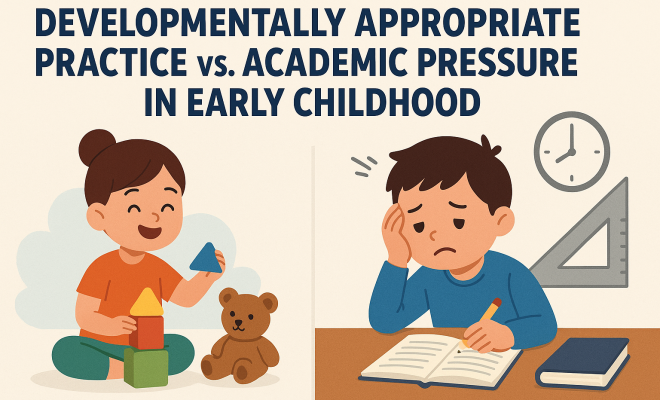
Walk into almost any early childhood classroom today, and you’re likely to see a tension playing out: the natural, messy, curiosity-driven world of young children bumping up against a growing push for early academics. It’s a silent battle, often waged without much public fanfare, but its stakes are incredibly high for our youngest learners. We’re talking about the clash between what we know as developmentally appropriate practice (DAP) and the relentless — and often misguided — academic pressure that’s seeping into preschools and even kindergartens.
For decades, experts in early childhood education have championed the idea that learning in the early years isn’t about rote memorization or worksheet drills. Instead, it’s about play, exploration, social interaction, and hands-on experiences. This is the core of DAP: teaching and caring for children in ways that are suitable for their age, individual traits, and cultural background. But in an increasingly competitive world, where standardized tests loom large and parents often feel the need to give their kids an ‘edge,’ the pendulum has swung. We’re seeing more and more calls for kindergartners to read, for preschoolers to do complex math, and for every moment to be ‘academic.’
This article isn’t just about theory; it’s about what’s actually happening on the ground and why it matters. We’ll dive into the fundamental principles of DAP, explore the roots and manifestations of academic pressure, and look at the real, tangible consequences this push has on children’s well-being, their love of learning, and even their long-term success. It’s a conversation that every parent, educator, and policymaker needs to be part of, because the future of our children’s education depends on it.
The Bedrock of Learning: What Is Developmentally Appropriate Practice?
At its heart, developmentally appropriate practice is about meeting children where they are. It’s a framework, primarily guided by the National Association for the Education of Young Children (NAEYC), that recognizes that children learn and develop in predictable sequences but at their own unique pace. Think of it like this: you wouldn’t expect a toddler to write a research paper, right? That’s an extreme example, but the principle holds true for more subtle expectations placed on young children.
DAP encourages educators to design learning experiences that are respectful of children’s age-related capabilities, their individual personalities and interests, and the cultural context they come from. It’s a holistic approach, meaning it considers all aspects of a child’s development: cognitive, social, emotional, and physical. When we talk about DAP, we’re talking about active learning, hands-on exploration, meaningful interactions, and plenty of opportunities for play – not just as a break from ‘real’ learning, but as the primary vehicle for it.
So, what does this look like in practice? Imagine a preschool classroom where children are building a magnificent castle out of large blocks, negotiating roles, discussing engineering challenges (without realizing they are), and using their imaginations. Or a kindergarten where children are learning about measurement by baking cookies, reading a recipe, and collaborating to share the ingredients. These aren’t just ‘fun activities’; they are deeply intentional learning experiences that build foundational skills in literacy, math, social-emotional development, and critical thinking, all within a context that makes sense to a young child.
The Rise of Academic Pressure: Where Did It Come From?
If DAP is so well-established and research-backed, why are we seeing such a strong counter-movement towards early academic pressure? The roots are complex, a tangled web of societal shifts, policy changes, and parental anxieties. One significant factor was the No Child Left Behind Act of 2002 in the United States, which, while focusing primarily on K-12, inadvertently trickled down to early childhood. The emphasis on standardized testing and accountability meant that even early grades felt the squeeze to demonstrate measurable academic gains, often through direct instruction and rote learning.
Another powerful driver is globalization and the increasing competitiveness of the job market. Parents, understandably, want their children to succeed. They hear stories of countries like Finland or Singapore excelling in international comparisons and sometimes misinterpret this to mean earlier formal instruction is the key. This leads to a demand for ‘academic’ preschools or kindergartens that promise a head start, often without fully understanding what a truly effective ‘head start’ looks like for a young child.
Then there’s the ‘kindergarten readiness’ movement, which, while well-intentioned, has often been misinterpreted. Instead of focusing on a child’s social-emotional maturity, self-regulation, and curiosity – the true indicators of readiness for formal schooling – it’s often narrowed to pre-reading skills, number recognition, and the ability to sit still and follow directions. This puts immense pressure on preschools to ‘get kids ready’ for a kindergarten that itself has become more academically rigorous, creating a downward spiral of inappropriate expectations.
8 Ways Academic Pressure Undermines Developmentally Appropriate Practice
1. Erosion of Play-Based Learning: The Cornerstone Crumbles
The most immediate and visible casualty of academic pressure is the reduction, or even elimination, of play-based learning. For young children, play isn’t frivolous; it’s their primary mode of learning. Through play, children develop executive function skills like planning, problem-solving, and self-regulation. They learn to negotiate, share, empathize, and resolve conflicts. They explore scientific concepts by building and experimenting, develop mathematical understanding by counting and sorting, and enhance literacy by creating stories and engaging in dramatic play. (See: ED.gov on Early Learning Practices.)
When academic pressure pushes for more worksheets, direct instruction, and structured lessons, the time for free, imaginative, child-led play shrinks. Classrooms become less about exploration and more about compliance. This doesn’t just make learning less enjoyable; it fundamentally deprives children of the very experiences that build the neural pathways and foundational skills necessary for later, more formal learning. It’s like trying to build a skyscraper without a solid foundation – it might look impressive for a moment, but it’s inherently unstable.
2. Increased Stress and Anxiety in Young Children: The Hidden Cost
Imagine being constantly pushed to perform tasks that are beyond your current developmental capacity. For a young child, that’s what excessive academic pressure feels like. When preschoolers are expected to sit still for long periods, complete abstract tasks, or master concepts before their brains are ready, it doesn’t foster a love of learning; it fosters frustration, anxiety, and a feeling of inadequacy. We’re seeing children as young as four and five exhibiting stress behaviors, developing negative self-concepts, and even experiencing burnout.
This isn’t just anecdotal. Research shows that high-stakes environments can trigger a stress response in children, affecting their ability to focus, retain information, and engage positively with their peers and teachers. Instead of building resilience and a growth mindset, we risk instilling a fear of failure and a perception that learning is a chore rather than an exciting journey of discovery. The emotional toll of this pressure is a significant, yet often overlooked, consequence.
3. Narrowing of Curriculum and Skills Development: A Limited Horizon
When the focus shifts heavily to early literacy and numeracy – often in a decontextualized, drill-and-practice manner – other vital areas of child development get neglected. Developmentally appropriate practice emphasizes a holistic curriculum that includes physical development (fine and gross motor skills), social-emotional competence, creativity, critical thinking, and problem-solving. These are not ‘soft skills’; they are fundamental to success in school and life.
Academic pressure often leads to a ‘teaching to the test’ mentality, even in early childhood. If a skill isn’t easily measurable on a standardized assessment, it tends to be marginalized. This means less time for art, music, movement, outdoor exploration, and complex social interactions – all crucial components of a well-rounded early education. Children might learn to recognize letters, but miss out on the rich language development that comes from storytelling or dramatic play. They might count to 100 but struggle with the conceptual understanding of quantity that comes from manipulating objects.
4. Inappropriate Assessment Methods: Measuring the Wrong Things
The drive for early academic benchmarks often necessitates formal assessment methods that are completely inappropriate for young children. Standardized tests, timed tasks, and paper-and-pencil assessments are designed for older children with fully developed attention spans and the ability to understand abstract instructions. For a four-year-old, these methods can be intimidating, inaccurate, and completely unreflective of their true knowledge or capabilities.
A child might know their letters and sounds perfectly well but perform poorly on a worksheet due to shyness, a bad day, or simply not understanding the test format. DAP advocates for authentic assessment, which means observing children during play, collecting work samples, documenting conversations, and using portfolios to show progress over time. This approach respects the variability of young children’s performance and provides a far more accurate and nuanced picture of their learning journey than any single test score ever could.
5. Decreased Motivation and Love of Learning: Extinguishing the Spark
Children are born curious. They have an innate drive to explore, understand, and master their environment. This intrinsic motivation is the most powerful engine for learning. When learning becomes a series of externally imposed tasks, rewards, and punishments – often associated with academic pressure – that intrinsic spark can dim, or even be extinguished entirely.
Think about it: who enjoys being forced to do something they don’t understand or find interesting? Young children are no different. When learning is divorced from their interests and presented in a dry, didactic manner, it transforms from an exciting adventure into a dreaded chore. This can lead to a long-term aversion to school and a reluctance to engage in challenging tasks, precisely the opposite outcome we want for our students.
6. Exacerbation of Achievement Gaps: Widening the Divide
While academic pressure is often justified as a way to ‘catch up’ disadvantaged children, it often has the opposite effect, widening existing achievement gaps. Children from lower socioeconomic backgrounds, or those who are English language learners, may not have the same prior experiences or home supports that align with the increasingly academic expectations of early childhood programs.
When classrooms prioritize formal academic skills over foundational social-emotional development, language acquisition through play, and culturally responsive teaching, these children are at a significant disadvantage. They might be labelled as ‘behind’ or ‘not ready’ before they’ve even had a fair chance to learn in a way that makes sense to them. Developmentally appropriate practice, with its emphasis on individualization, hands-on learning, and a broad range of experiences, is actually far more equitable and effective in supporting all children, regardless of their background.
7. Reduced Opportunities for Social-Emotional Development: Missing the Foundation
Many educators and psychologists now agree that social-emotional skills – empathy, self-regulation, cooperation, conflict resolution – are not just ‘nice to have’ but are absolutely foundational for academic success and life happiness. A child who can manage their emotions, persist through challenges, and work effectively with others is far more likely to thrive in a classroom environment than one who struggles in these areas, regardless of their pre-reading skills.
Academic pressure, with its focus on individual performance and quiet compliance, often leaves little room for the messy, complex, and vital work of social-emotional learning. When children spend more time at desks completing worksheets and less time in collaborative play or guided group activities, they miss out on crucial opportunities to practice these essential skills. This is a profound miscalculation, as strong social-emotional foundations are what allow children to fully access and benefit from academic instruction later on.
8. Teacher Burnout and De-professionalization: A System Under Strain
The impact of academic pressure isn’t just on children; it’s also profoundly felt by early childhood educators. Teachers who are deeply committed to developmentally appropriate practice often find themselves caught between their professional knowledge and the demands of administrators or parents for more ‘academic’ outcomes. This can lead to significant moral distress, job dissatisfaction, and ultimately, burnout.
When teachers are forced to implement curricula that go against their training and best judgment, it undermines their professionalism and autonomy. They become less facilitators of learning and more deliverers of prescribed content, often feeling like they are doing a disservice to the children in their care. This de-professionalization can drive talented educators out of the field, further exacerbating the challenges in providing high-quality early childhood education.
The Long-Term Ripple Effect: Beyond Early Childhood
It’s easy to think of these issues as confined to the early years, but the effects of inappropriate academic pressure can echo for years, impacting a child’s entire educational journey. Children who experience burnout or anxiety in preschool often carry that negative association with school into elementary grades. They might develop an aversion to reading or math, not because they lack capability, but because their initial experiences were stressful and unengaging. This foundational stress can hinder their ability to engage with more complex subjects later on.
Moreover, the executive function skills, like self-regulation, working memory, and flexible thinking, that are best developed through child-led play in the early years, are absolutely crucial for success in upper elementary, middle, and high school. A child who hasn’t had ample opportunities to practice these skills might struggle with organization, planning long-term projects, or adapting to new learning strategies. So, while the immediate push for early academics might seem to yield short-term gains in certain areas, it can inadvertently weaken the very cognitive and emotional scaffolding needed for sustained academic success.
Global Perspectives: Learning from Other Nations
It’s worth looking at how other high-achieving nations approach early childhood education. Countries like Finland, often lauded for its excellent educational outcomes, prioritize play and social-emotional development in their early years. Formal academic instruction, like reading and writing, typically doesn’t begin until age seven. Before that, the focus is on developing a strong foundation of social skills, curiosity, and a love for learning through rich, play-based experiences.
Germany, too, emphasizes a “kindergarten” (children’s garden) approach where play, outdoor exploration, and social development are paramount. Academic instruction is reserved for primary school. These examples challenge the notion that earlier formal academics lead to better outcomes. In fact, they suggest the opposite: a strong, play-based foundation might be the secret ingredient to long-term academic excellence and overall well-being. This isn’t about ignoring academics, but about understanding the optimal timing and method for introducing them.
Reclaiming Childhood: The Path Forward
So, what can we do to counteract this pervasive academic pressure and champion developmentally appropriate practice? It requires a multi-pronged approach involving parents, educators, and policymakers.
Educating Parents and Communities
A huge part of the problem stems from a lack of understanding about how young children truly learn. Parents often equate ‘school’ with desks, worksheets, and direct instruction because that’s what they experienced. We need to actively educate parents and the wider community about the profound benefits of play, the importance of social-emotional development, and what high-quality early childhood education really looks like. Workshops, informational sessions, and transparent communication from schools can help shift perceptions. When parents see the depth of learning happening during a block building session or a dramatic play scenario, they often become powerful advocates for DAP.
Empowering Educators and Providing Support
Early childhood educators are on the front lines, and they need support. This means providing ongoing professional development that reinforces DAP principles, offering resources for creating rich, play-based environments, and, crucially, trusting their professional judgment. When teachers feel empowered to advocate for their students’ developmental needs, and when they are protected from undue external pressures, they can create the optimal learning environments that children deserve. Reducing class sizes and ensuring adequate staffing also plays a critical role, allowing teachers to individualize instruction and truly meet children where they are.
Advocacy for Policy Changes
Ultimately, some of the pressure comes from policies that prioritize standardized testing and narrow academic benchmarks. We need to advocate for policies that reflect a deep understanding of early childhood development. This includes pushing back against high-stakes testing in early grades, advocating for play-based curriculum frameworks, and investing in comprehensive early childhood systems that value all aspects of child development. Policymakers need to hear from experts, parents, and educators about the long-term damage that inappropriate academic pressure can inflict.
Redefining ‘Readiness’ for School
It’s time to broaden our definition of ‘kindergarten readiness.’ Instead of focusing solely on whether a child knows their letters or can count to 20, we should emphasize their social-emotional skills, their ability to self-regulate, their curiosity, their persistence, and their enthusiasm for learning. A child who is resilient, can communicate their needs, and is excited to explore is far more ‘ready’ for the challenges of school than one who can recite the alphabet but melts down when faced with a new task or a social conflict. Schools can work with feeder preschools to align on these broader readiness indicators, fostering a more seamless and supportive transition.
The tension between developmentally appropriate practice and academic pressure in early childhood is a critical issue that demands our attention. While the desire for children to succeed is understandable, pushing academics too early and too intensely is not only ineffective but potentially harmful. By embracing what we know about how young children truly learn – through play, exploration, and meaningful interaction – we can create learning environments that foster joy, curiosity, and a lifelong love of learning, setting children up for genuine success, not just in school, but in life.
Frequently Asked Questions About Developmentally Appropriate Practice
Q1: What’s the biggest misconception about DAP?
Many people mistakenly think DAP means “anything goes” or that it’s just about letting kids play without any structure. That’s not it at all. DAP is highly intentional. Educators carefully design environments and activities to facilitate specific learning goals across all developmental domains, but they do it in ways that are engaging, meaningful, and appropriate for the child’s stage of development. It’s structured play with purpose, not just free-for-all playtime.
Q2: Does DAP mean children won’t learn to read or do math?
Absolutely not! DAP helps children build a stronger foundation for reading, writing, and math. Instead of rote memorization, it focuses on the underlying concepts. For example, a child building with blocks isn’t just “playing”; they’re learning about spatial reasoning, measurement, balance, and problem-solving – all crucial pre-math skills. Storytelling and dramatic play build vocabulary, narrative skills, and phonological awareness, which are essential for literacy. Children in DAP settings often develop a deeper conceptual understanding, which serves them better in the long run than simply memorizing facts.
Q3: How can parents recognize a DAP classroom?
Look for active, engaged children. You’ll see children moving, talking, collaborating, and making choices. The classroom will likely have various learning centers (blocks, art, dramatic play, sensory table, reading nook) where children can explore. Teachers will be facilitators, asking open-ended questions, observing, and scaffolding learning, rather than just delivering information from the front of the room. There will be evidence of children’s work, not just identical worksheets. And crucially, there’s a palpable sense of joy and curiosity in the air.
Q4: Is DAP just for preschool, or does it apply to older children too?
While DAP is most commonly discussed in early childhood (birth through age 8), its core principles are relevant for all ages. The idea of meeting learners where they are, considering their individual needs, cultural context, and developmental stage, and using active, engaging methods can be applied throughout education. The specific “appropriate” practices will change as children grow, but the underlying philosophy remains powerful.
Trending Now
Frequently Asked Questions
What is developmentally appropriate practice in early childhood education?
Developmentally appropriate practice (DAP) refers to teaching strategies that are tailored to the age, individual traits, and cultural background of children. It emphasizes play, exploration, and social interaction over rote memorization, aiming to foster a love of learning and support holistic development in young learners.
How does academic pressure affect early childhood education?
Academic pressure in early childhood education can lead to a focus on standardized testing and early academics, which may undermine children's natural curiosity and love for learning. This pressure can result in stress and disengagement, potentially hindering their long-term educational success and well-being.
What are the principles of developmentally appropriate practice?
The principles of developmentally appropriate practice include understanding child development, creating learning experiences based on children's interests, promoting active learning through play, and fostering social interactions. These principles guide educators to provide enriching environments that support children's growth and learning.
Why is play important in early childhood education?
Play is crucial in early childhood education as it promotes exploration, creativity, and problem-solving skills. Through play, children develop social skills, emotional regulation, and cognitive abilities, making it an essential component of developmentally appropriate practice that fosters a lifelong love of learning.
What are the consequences of pushing academics in preschool?
Pushing academics in preschool can lead to negative consequences such as increased anxiety, reduced motivation, and a diminished love for learning. Children may become overwhelmed and disengaged, which can affect their overall development and long-term academic success, highlighting the importance of a balanced approach.
Have you experienced this yourself? We’d love to hear your story in the comments.