The Tech Edvocate

Top Menu

  • Advertisement
  • Apps
  • Home Page
  • Home Page Five (No Sidebar)
  • Home Page Four
  • Home Page Three
  • Home Page Two
  • Home Tech2
  • Icons [No Sidebar]
  • Left Sidbear Page
  • Lynch Educational Consulting
  • My Account
  • My Speaking Page
  • Newsletter Sign Up Confirmation
  • Newsletter Unsubscription
  • Our Brands
  • Page Example
  • Privacy Policy
  • Protected Content
  • Register
  • Request a Product Review
  • Shop
  • Shortcodes Examples
  • Signup
  • Start Here
    • Governance
    • Careers
    • Contact Us
  • Terms and Conditions
  • The Edvocate
  • The Tech Edvocate Product Guide
  • Topics
  • Write For Us
  • Advertise

Main Menu

  • Start Here
    • Our Brands
    • Governance
      • Lynch Educational Consulting, LLC.
      • Dr. Lynch’s Personal Website
      • Careers
    • Write For Us
    • The Tech Edvocate Product Guide
    • Contact Us
    • Books
    • Edupedia
    • Post a Job
    • The Edvocate Podcast
    • Terms and Conditions
    • Privacy Policy
  • Topics
    • Assistive Technology
    • Child Development Tech
    • Early Childhood & K-12 EdTech
    • EdTech Futures
    • EdTech News
    • EdTech Policy & Reform
    • EdTech Startups & Businesses
    • Higher Education EdTech
    • Online Learning & eLearning
    • Parent & Family Tech
    • Personalized Learning
    • Product Reviews
  • Advertise
  • Tech Edvocate Awards
  • The Edvocate
  • Pedagogue
  • School Ratings

logo

The Tech Edvocate

  • Start Here
    • Our Brands
    • Governance
      • Lynch Educational Consulting, LLC.
      • Dr. Lynch’s Personal Website
        • My Speaking Page
      • Careers
    • Write For Us
    • The Tech Edvocate Product Guide
    • Contact Us
    • Books
    • Edupedia
    • Post a Job
    • The Edvocate Podcast
    • Terms and Conditions
    • Privacy Policy
  • Topics
    • Assistive Technology
    • Child Development Tech
    • Early Childhood & K-12 EdTech
    • EdTech Futures
    • EdTech News
    • EdTech Policy & Reform
    • EdTech Startups & Businesses
    • Higher Education EdTech
    • Online Learning & eLearning
    • Parent & Family Tech
    • Personalized Learning
    • Product Reviews
  • Advertise
  • Tech Edvocate Awards
  • The Edvocate
  • Pedagogue
  • School Ratings
  • The Brutal Truth: Why 75% of Fintech Startups Collapse in 5 Years

  • This AI Company’s Staggering 14 Million Record Data Leak Is Just The Beginning

  • New York Rep Introduces Bill That Could Keep Games Playable for Longer – PCMag

  • Mind-Blowing: These AI Investment Funds Are Crushing the Market — Here’s How

  • The AI Detector Deception: Why Universities Are Pulling the Plug

  • Stunning: New Student Loan Repayment Rules Could Hike Payments for Millions

  • Shocking: California’s Billion-Dollar Clean Transit Initiative Drove Nowhere

  • Why EV Charging Reliability Soared Despite Cratering Sales

  • A new lithium-ion battery breakthrough could lead to cells that deliver more power for longer — they might be useful for everything from EVs to gaming laptops to robots to drones | TechRadar

  • One Breakthrough: How AI is Reshaping Medicine Faster Than Anyone Imagined

Tech News
Home›Tech News›Phonon Laser 2026: Revolutionizing Gravity Measurement

Phonon Laser 2026: Revolutionizing Gravity Measurement
By Matthew Lynch
March 31, 2026
0
Spread the love

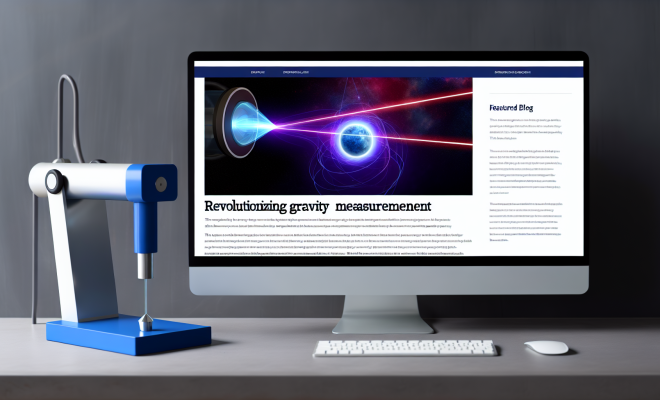
In a groundbreaking development, researchers at the University of Rochester have unveiled a novel technology known as the phonon laser, or sound laser, which promises to revolutionize the measurement of gravity with unprecedented precision. Published on March 31, 2026, this innovation could potentially replace existing GPS systems by providing highly accurate gravitational measurements that are essential for various scientific and practical applications.

Understanding the Phonon Laser

The phonon laser operates on principles similar to those of traditional lasers, which emit light through the stimulated emission of photons. However, instead of light, this device generates and amplifies sound waves, or phonons, allowing it to measure gravitational forces with remarkable sensitivity.

Phonons are quantized sound waves that carry energy through solids, liquids, and gases. The researchers have developed a method to create a coherent stream of these phonons, thus enabling a new way to investigate gravitational interactions. The phonon laser’s ability to amplify sound waves dramatically enhances the measurement capabilities, making it a powerful tool in the field of precision measurement.

Implications for Gravity Measurement

The ability to measure gravity with extreme accuracy has significant implications across various domains:

  • Geophysical Studies: Understanding Earth’s gravitational field can reveal insights into geological structures, tectonic movements, and the distribution of mass within the planet.
  • Navigation Systems: The phonon laser could potentially provide an alternative to GPS, offering a more reliable and accurate means of determining location through gravitational measurements.
  • Scientific Research: This technology may enable more precise experiments in fundamental physics, including those exploring gravitational waves and quantum mechanics.

Advantages Over Conventional Methods

Current methods of measuring gravity often rely on satellite systems and other indirect techniques, which can be limited by various factors such as atmospheric conditions and the Earth’s rotation. The phonon laser, in contrast, offers several advantages:

  • High Precision: The phonon laser can measure tiny variations in gravitational forces, allowing scientists to detect changes that were previously undetectable.
  • Reduced Environmental Impact: Unlike traditional systems that may require extensive infrastructure, the phonon laser can be more compact and less intrusive.
  • Cost-Effective: Over time, the implementation of phonon lasers could reduce the costs associated with gravitational measurement and navigation.

Future Applications and Research Directions

The potential applications of the phonon laser extend beyond navigation and geophysical studies. Researchers are exploring various avenues for its utilization:

  • Space Exploration: Enhanced gravitational measurements could assist in mapping the gravitational fields of other celestial bodies, aiding future missions to planets and moons.
  • Climate Monitoring: By tracking changes in gravity over time, scientists can gain insights into sea-level rise, ice melt, and other critical climate factors.
  • Engineering and Construction: Accurate gravitational data can inform the construction of buildings and infrastructure, ensuring stability and safety.

Conclusion

The development of the phonon laser marks a significant leap forward in the field of precision measurement technology. As researchers at the University of Rochester continue to refine this innovative tool, the potential for improved gravitational measurements could reshape our understanding of the planet and beyond.

This advancement stands to impact not just scientific research, but also everyday applications that rely on accurate navigation and environmental monitoring. As the world becomes increasingly dependent on precise data, the phonon laser could emerge as a vital instrument in our quest to explore and understand the natural world.


Previous Article

NASA Alerts: Triple Asteroid Flyby Set for ...

Next Article

Light-Responsive Perovskite Crystals Revolutionize Optics

Matthew Lynch

Related articles More from author

  • Tech News

    Outrageous: Amex Fined $350M for Letting $13 Billion in Dirty Money Flow for a Decade

    October 10, 2026
    By Matthew Lynch
  • Tech News

    Proton VPN’s Free Tier Is the Best You’ll Find

    March 11, 2024
    By Matthew Lynch
  • Tech News

    Processed Meat & Colon Cancer: A 2026 Wake-Up Call for Americans

    April 11, 2026
    By Matthew Lynch
  • Tech News

    Permanently Delete Your Spotify Account: A Complete Guide

    June 18, 2026
    By Matthew Lynch
  • Tech News

    How to bundle flights and hotels Travelocity

    September 1, 2026
    By Matthew Lynch
  • Tech News

    Gmail keyboard shortcuts list

    August 7, 2026
    By Matthew Lynch

Search

Login & Registration

  • Log in
  • Entries feed
  • Comments feed
  • WordPress.org

Newsletter

Signup for The Tech Edvocate Newsletter and have the latest in EdTech news and opinion delivered to your email address!

About Us

Since technology is not going anywhere and does more good than harm, adapting is the best course of action. That is where The Tech Edvocate comes in. We plan to cover the PreK-12 and Higher Education EdTech sectors and provide our readers with the latest news and opinion on the subject. From time to time, I will invite other voices to weigh in on important issues in EdTech. We hope to provide a well-rounded, multi-faceted look at the past, present, the future of EdTech in the US and internationally.

We started this journey back in June 2016, and we plan to continue it for many more years to come. I hope that you will join us in this discussion of the past, present and future of EdTech and lend your own insight to the issues that are discussed.

Newsletter

Signup for The Tech Edvocate Newsletter and have the latest in EdTech news and opinion delivered to your email address!

Contact Us

The Tech Edvocate
910 Goddin Street
Richmond, VA 23231
(601) 630-5238
[email protected]

Copyright © 2026 Matthew Lynch. All rights reserved.