NASA’s Dragonfly Mission: Pioneering Titan Exploration
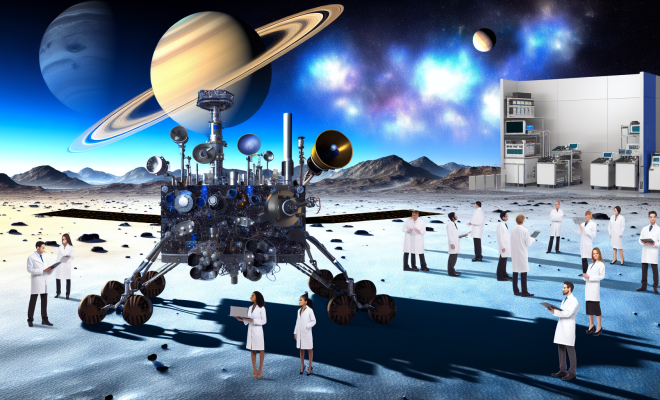
NASA’s Dragonfly mission is making significant strides as it prepares for its groundbreaking journey to Saturn’s largest moon, Titan. This innovative rotorcraft-lander is designed to conduct a comprehensive exploration of Titan’s unique surface and atmosphere, providing unprecedented insights into this distant celestial body. As the mission advances, key components of Dragonfly are undergoing meticulous testing that simulates the harsh conditions of space, ensuring the craft’s reliability and functionality.
Understanding Titan: A Unique Target for Exploration
Titan is the second-largest moon in the solar system and stands out due to its dense atmosphere and liquid hydrocarbon lakes. It is the only moon known to have a significant atmosphere, primarily composed of nitrogen, with clouds and rain similar to Earth, albeit consisting of methane and ethane. The exploration of Titan is crucial for understanding not only its own environment but also the broader processes that govern planetary atmospheres.
Moreover, Titan’s intriguing chemistry may offer clues about prebiotic conditions and the potential for life beyond Earth. The Dragonfly mission aims to investigate these aspects by conducting aerial and surface exploration, making it a pioneering endeavor in planetary science.
The Dragonfly Rotorcraft-Lander: A New Era of Space Exploration
The Dragonfly mission represents a significant leap in aerospace technology, combining the capabilities of a rotorcraft with the robustness of a lander. This dual-functionality allows Dragonfly to traverse Titan’s diverse terrain, which includes vast dunes, icy plains, and potentially cryovolcanoes. Unlike traditional landers that are limited to one location, Dragonfly can fly to multiple sites, significantly expanding its scientific reach.
Pioneering Nuclear Power for Space Missions
A key feature of Dragonfly is its use of a radioisotope thermoelectric generator (RTG) for power. This nuclear-powered design allows the spacecraft to operate continuously throughout Titan’s 16-day-long day-night cycle, providing a reliable energy source even in the cold and dark conditions of the moon’s surface. The decision to utilize nuclear power is a testament to the innovative approaches NASA is taking to ensure long-term, sustainable exploration of distant celestial bodies.
Testing the Dragonfly: Simulating Harsh Environments
As the components of Dragonfly come together, they are subjected to rigorous testing that mimics the extreme conditions of space and Titan’s environment. Engineers at NASA’s Goddard Space Flight Center are conducting these tests to validate the spacecraft’s design and functionality.
Environmental Simulations
The environmental testing includes thermal vacuum tests, vibration tests, and simulations of Titan’s atmospheric conditions. These simulations are crucial for identifying any potential issues before launch, ensuring that Dragonfly can withstand the challenges of space travel and the harsh surface conditions on Titan.
- Thermal Vacuum Testing: In this phase, components are placed in a vacuum chamber where temperatures can be lowered to the extreme cold of Titan, allowing engineers to assess how well the materials and technology hold up in such conditions.
- Vibration Testing: The spacecraft must endure the intense vibrations experienced during launch. This testing ensures that all components remain intact and functional when subjected to the forces of a rocket launch.
- Atmospheric Simulation: Engineers replicate Titan’s thick atmosphere in controlled environments to understand how the craft will perform during its descent and landing.
Key Players in the Dragonfly Mission
Leading the development of the Dragonfly mission are a team of dedicated scientists and engineers at NASA’s Goddard Space Flight Center. Their expertise and commitment to innovation are driving the project forward, ensuring that every aspect of Dragonfly meets the high standards required for deep-space exploration.
Collaboration with Other NASA Centers
The Dragonfly mission is a collaborative effort, involving various NASA centers that contribute specialized knowledge and technology. For instance, the Jet Propulsion Laboratory (JPL) plays a crucial role in the mission’s navigation and flight dynamics, while the Marshall Space Flight Center focuses on propulsion systems.
Looking Ahead: The Planned Launch and Future Exploration
The planned launch window for Dragonfly is set for the mid-2030s, with the spacecraft expected to arrive at Titan several years later. Once there, Dragonfly will embark on a series of flights and landings, gathering data and conducting experiments that could reshape our understanding of the moon and its potential for hosting life.
Scientific Objectives of the Mission
Dragonfly’s mission objectives are ambitious and far-reaching. Among them are:
- Conducting in-depth analysis of Titan’s surface and atmosphere.
- Investigating the prebiotic chemistry that may resemble the early Earth.
- Examining the moon’s potential for harboring life.
- Studying the geology and meteorology of Titan to enhance our understanding of planetary processes.
Conclusion: A New Frontier in Space Exploration
As NASA’s Dragonfly mission moves closer to its launch, the rigorous testing and development processes underscore the commitment to ensuring a successful exploration of Titan. This innovative rotorcraft-lander stands at the forefront of a new era in space exploration, promising to unravel the mysteries of one of the solar system’s most intriguing moons. By leveraging advanced technology and a collaborative approach, NASA is not only pushing the boundaries of what is possible in space exploration but also expanding our understanding of the potential for life beyond Earth.
As we await the launch of Dragonfly, the excitement surrounding this mission reflects our enduring curiosity about the universe and our place within it. Titan, with its unique characteristics and enigmatic environment, represents a compelling destination for scientific inquiry, and Dragonfly is poised to lead the way.