NASA Confirms Two Airplane-Sized Asteroids to Pass Earth in 2026
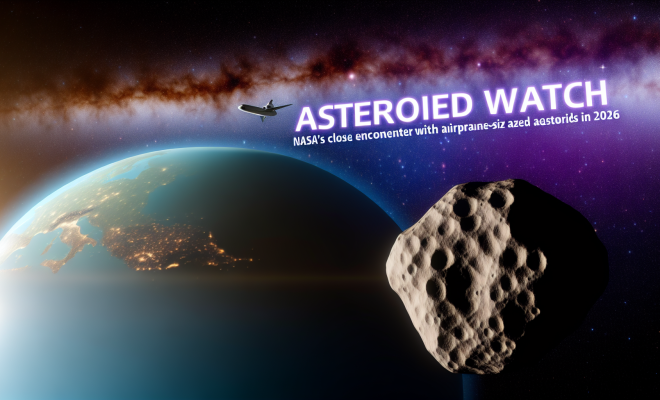
In a fascinating development for astronomers and space enthusiasts alike, NASA has confirmed that two sizable asteroids will make a close approach to Earth on April 27, 2026. Designated as 2026 HJ3 and 2026 HR, these celestial bodies are comparable in size to commercial airplanes and will pass millions of miles away from our planet, posing no threat of collision. This event serves as a reminder of the ongoing efforts in planetary defense and the importance of monitoring near-Earth objects (NEOs).
Understanding the Asteroids
Asteroids are remnants from the early solar system, formed over 4.6 billion years ago. They vary in size and composition, and their orbits can bring them into close proximity to Earth. The two asteroids in question, 2026 HJ3 and 2026 HR, have been classified as NEOs due to their orbits that bring them within 1.3 astronomical units (AU) of the Sun.
Characteristics of 2026 HJ3 and 2026 HR
- 2026 HJ3: This asteroid measures approximately 80 feet (24 meters) in diameter, similar to the size of a large jetliner. Its composition is likely rocky or metallic, typical of many asteroids.
- 2026 HR: Slightly smaller than HJ3, this asteroid is estimated to be around 70 feet (21 meters) across. Like HJ3, it is expected to be made up of similar materials.
The Path of the Asteroids
Both asteroids will be making their closest approach to Earth on April 27, 2026. NASA’s Jet Propulsion Laboratory (JPL) is closely monitoring their trajectories to ensure accurate predictions of their paths. During this close encounter, the asteroids will be traveling at significant speeds, which is typical for objects in space. While they will be millions of miles away, this event provides a valuable opportunity for scientists to study the asteroids more closely.
Safety Measures and Planetary Defense
NASA has established a comprehensive framework for tracking and characterizing NEOs to mitigate any potential threats that they may pose to Earth. The agency’s Planetary Defense Coordination Office (PDCO) is responsible for identifying, tracking, and characterizing these objects. The confirmation of 2026 HJ3 and 2026 HR’s safe passage is a testament to the advancements in monitoring capabilities.
The Importance of Monitoring Near-Earth Objects
Asteroids and comets have been the subject of scientific study for decades. As our understanding of these celestial bodies grows, so does the importance of tracking their movements. NASA’s continuous monitoring efforts allow scientists to refine orbital data, which is crucial for predicting future encounters. The close approach of asteroids such as 2026 HJ3 and 2026 HR is an excellent opportunity for scientific observation and public engagement in space exploration.
Technological Advancements in Tracking
The monitoring of NEOs has become increasingly sophisticated, thanks to advancements in technology. Ground-based telescopes and space-based observatories provide detailed information about an asteroid’s size, shape, rotation, and surface composition. This data is vital for assessing potential risks and planning future missions.
Future Implications of Asteroid Monitoring
NASA’s efforts extend beyond mere observation. The agency is also developing strategies for planetary defense, which could include methods for deflecting or altering the trajectory of hazardous asteroids. As the technology and methods evolve, scientists will be better equipped to address any potential threats.
Global Collaboration in Planetary Defense
Planetary defense is a global effort, with international collaborations playing a key role. Organizations worldwide are joining forces to share data and resources in the fight against potential asteroid impacts. Initiatives like the Asteroid Impact & Deflection Assessment (AIDA) mission aim to test techniques for deflecting asteroids and understanding their physical characteristics.
Public Engagement and Education
Events like the close approach of 2026 HJ3 and 2026 HR create opportunities for public engagement and education about space. NASA and various space agencies encourage schools and communities to participate in discussions about asteroids, their significance, and the importance of monitoring them for planetary safety.
How to Get Involved
- Follow NASA’s updates and announcements regarding asteroids and space missions.
- Participate in local astronomy clubs or events to learn more about NEOs.
- Engage with educational resources provided by NASA and other space organizations.
- Attend public lectures or webinars focused on planetary defense and astronomy.
Conclusion
The upcoming close approach of asteroids 2026 HJ3 and 2026 HR on April 27, 2026, represents a significant event in the realm of space exploration. While these objects will pass safely at a distance of millions of miles, they serve as a reminder of the importance of monitoring near-Earth objects and enhancing our planetary defense strategies. As technology continues to improve, our understanding of these celestial bodies will deepen, paving the way for future missions and potential asteroid deflection techniques. The engagement of the public in these discussions fosters a collective awareness of our place in the universe and the ongoing efforts to protect our planet.