Oil Prices Drop 4.6% as Trump Announces Iran Peace Talks
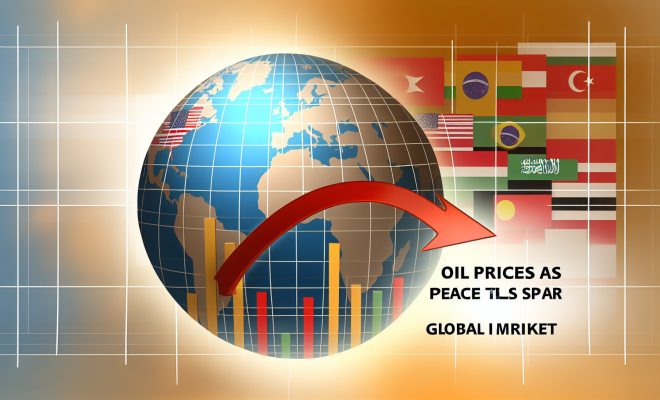
In a significant development in the global economy, oil prices experienced a notable drop of 4.6%, with Brent crude settling at $94.79 per barrel. This decline comes in the wake of U.S. President Donald Trump’s announcement regarding potential peace talks with Iran, indicating that the ongoing conflict may soon reach a resolution. The discussions are set to take place in Islamabad over the next two days, igniting hopes that the war is ‘very close to over.’
Market Reactions to Peace Prospects
The news of potential peace negotiations has not only affected oil prices but has also resulted in a robust rally in global stock markets. Wall Street showed a particularly strong performance, with the S&P 500 index rising by 81.14 points to close at 6,967.38. Similarly, the Dow Jones Industrial Average gained 317.74 points, reaching 48,535.99, while the Nasdaq composite surged by 455.35 points, ending at 23,639.08.
Across the Pacific, Japan’s Nikkei 225 index saw an increase of 0.5%, reflecting positive sentiment among investors. Meanwhile, South Korea’s Kospi index jumped by an impressive 3.0%. In Europe, stock indices remained mostly steady, indicating a cautious optimism as the situation continues to unfold.
Impact on Global Economic Forecasts
Amidst these developments, the International Monetary Fund (IMF) has released updated projections for global economic growth. The IMF downgraded its forecast to 3.1%, a reflection of ongoing uncertainties in various markets. Additionally, the organization raised its inflation forecast to 4.4%, driven in part by fluctuations in oil prices and their broader economic implications.
This change comes at a time when 10-year U.S. Treasury yields have eased to 4.25%. The decline in yields is attributed to reduced inflationary pressures resulting from falling oil prices, which have historically played a significant role in influencing overall inflation rates.
Factors Contributing to Oil Price Fluctuations
The fluctuations in oil prices can be traced to a variety of factors, including geopolitical tensions, supply and demand dynamics, and economic forecasts. The recent announcement of peace talks with Iran is particularly impactful, as it may lead to a stabilization of oil supply in the market. Iran has been a significant player in the global oil industry, and any easing of sanctions or resolution of conflicts could enhance its production capabilities, further influencing global oil prices.
Moreover, the uncertainty surrounding oil supply has been a critical driver of prices in recent months. Factors such as OPEC’s production decisions, U.S. shale oil output, and economic conditions in major importing countries all contribute to the volatility in oil markets.
Investor Sentiment and Future Outlook
The renewed optimism in the stock market reflects a broader investor sentiment that hinges on geopolitical stability. Many investors are closely monitoring the developments in the Middle East, particularly the potential outcomes of the upcoming peace talks. A successful resolution could not only stabilize oil prices but also bolster economic growth prospects in regions heavily dependent on oil exports.
However, analysts caution that while the current sentiment is positive, the geopolitical landscape remains complex. Any missteps in negotiations or escalations in conflict could lead to renewed volatility in both oil and equity markets. Therefore, investors are advised to remain vigilant and consider the potential implications of ongoing developments.
Conclusion
The recent drop in oil prices, coupled with a robust rally in global stock markets, underscores the interconnectedness of geopolitical events and economic performance. As President Trump’s administration seeks to explore peace talks with Iran, market participants remain hopeful for a resolution that could pave the way for greater economic stability.
With the IMF’s revised growth and inflation forecasts, it is evident that the global economy is navigating through a period of uncertainty. Nonetheless, the optimistic market response to potential peace talks illustrates the critical role that diplomacy plays in shaping economic outcomes. As the situation unfolds, stakeholders across markets will be watching closely, anticipating both the risks and opportunities that lie ahead.