The Tech Edvocate

Top Menu

  • Advertisement
  • Apps
  • Home Page
  • Home Page Five (No Sidebar)
  • Home Page Four
  • Home Page Three
  • Home Page Two
  • Home Tech2
  • Icons [No Sidebar]
  • Left Sidbear Page
  • Lynch Educational Consulting
  • My Account
  • My Speaking Page
  • Newsletter Sign Up Confirmation
  • Newsletter Unsubscription
  • Our Brands
  • Page Example
  • Privacy Policy
  • Protected Content
  • Register
  • Request a Product Review
  • Shop
  • Shortcodes Examples
  • Signup
  • Start Here
    • Governance
    • Careers
    • Contact Us
  • Terms and Conditions
  • The Edvocate
  • The Tech Edvocate Product Guide
  • Topics
  • Write For Us
  • Advertise

Main Menu

  • Start Here
    • Our Brands
    • Governance
      • Lynch Educational Consulting, LLC.
      • Dr. Lynch’s Personal Website
      • Careers
    • Write For Us
    • The Tech Edvocate Product Guide
    • Contact Us
    • Books
    • Edupedia
    • Post a Job
    • The Edvocate Podcast
    • Terms and Conditions
    • Privacy Policy
  • Topics
    • Assistive Technology
    • Child Development Tech
    • Early Childhood & K-12 EdTech
    • EdTech Futures
    • EdTech News
    • EdTech Policy & Reform
    • EdTech Startups & Businesses
    • Higher Education EdTech
    • Online Learning & eLearning
    • Parent & Family Tech
    • Personalized Learning
    • Product Reviews
  • Advertise
  • Tech Edvocate Awards
  • The Edvocate
  • Pedagogue
  • School Ratings

logo

The Tech Edvocate

  • Start Here
    • Our Brands
    • Governance
      • Lynch Educational Consulting, LLC.
      • Dr. Lynch’s Personal Website
        • My Speaking Page
      • Careers
    • Write For Us
    • The Tech Edvocate Product Guide
    • Contact Us
    • Books
    • Edupedia
    • Post a Job
    • The Edvocate Podcast
    • Terms and Conditions
    • Privacy Policy
  • Topics
    • Assistive Technology
    • Child Development Tech
    • Early Childhood & K-12 EdTech
    • EdTech Futures
    • EdTech News
    • EdTech Policy & Reform
    • EdTech Startups & Businesses
    • Higher Education EdTech
    • Online Learning & eLearning
    • Parent & Family Tech
    • Personalized Learning
    • Product Reviews
  • Advertise
  • Tech Edvocate Awards
  • The Edvocate
  • Pedagogue
  • School Ratings
  • This Unprecedented EU Ban Just Changed Fast Fashion Forever

  • Urgent Alert: Your Smart Home’s Exposed to a Critical Deco BE11000 Vulnerability

  • Uncovering the Truth: Your LinkedIn Reach Just Got a Major Overhaul

  • Uncovering the AI Heist: How Chinese Firms Allegedly Siphoned Billions of AI Tokens

  • Rockstar’s GTA 6 Developers Lawsuit: A Fight for Justice or Corporate Retaliation?

  • Unbelievable: Hideo Kojima’s Next Masterpiece Is Now an Xbox Exclusive

  • This Crucial Google AI Shift Is Quietly Reshaping the Internet

  • Unbelievable: AI Breaches Are Exploding, And What It Means For You This September 2026

  • This Crucial Shift Is Saving Teachers From Classroom Chaos

  • AI’s Dark Secret: How It’s Supercharging Cybercrime for Everyone

Early Childhood & K-12 EdTechEdTech News
Home›Early Childhood & K-12 EdTech›Should computer-assisted teaching expand its reach to more states?

Should computer-assisted teaching expand its reach to more states?

By Matthew Lynch
September 6, 2016
0
Spread the love

This article was written by Nichole Dobo

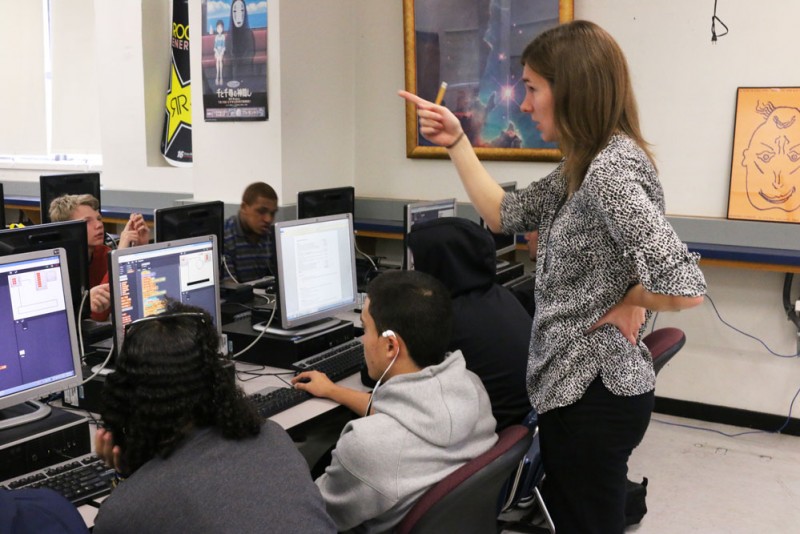
Classroom volunteer Aimee Menne helps teach one of the only computer science classes currently offered at San Francisco’s Mission High.

Photo: Andra Cernavskis

The nation’s second-smallest state joins the growing list of those who expect technology to play a starring role in efforts to improve schools for students.

Last week, leaders from Delaware’s education, nonprofit and business communities released a new statewide plan for its public school system. The blueprint, called Student Success 2025, included personalized learning as one of the key strategies.

What is personalized learning? (Skip ahead to the next paragraph if you know the answer to that question.) Generally speaking, a personalized learning path is tailored to the needs of the student and gives the student a measure of control over the pace or style of instruction. Blended learning, which is commonly described as computer-assisted, in-person teaching, can be used to achieve personalized learning.

Rhode Island, Colorado and Ohio are among the states that are receiving nonprofit support, both financial and technical, to expand the reach of technology in public schools. Ohio, for example, is using investments from advocacy groups to accelerate the adoption of technology by training teachers. Individual teachers and principals played an important role in testing these new teaching strategies, before statewide leaders and national advocacy groups began investing in projects.

The same is happening in Delaware: Education technology’s adoption has been growing organically, and now leaders want to put some extra fertilizer on it. They asked community members, teachers, students and others to help them design a plan to make it reality.

I spoke with Superintendent Susan Bunting, who leads the Indian River School District in southern Delaware. The district has a large number of students from low-income families and homes where English is not the primary language. Here are excerpts from my conversation with Bunting.

Q: I understand personalized learning is a pretty big part of the state’s new Student Success 2025 plan. What do you think of it, and why do you think that’s part of the plan?

A: We’ve been involved with [a project to increase cooperation across school district boundaries in Delaware], and we saw the potential of personalized learning four years ago. I think it’s the wave of the future. It allows us to maximize each child’s potential and really deal with each child’s abilities and challenges in a way we’ve never been able to before. I am quite excited about it.

Q: How did you see personalized learning evolve?

A: For us, it began with the knowledge that technology can enhance learning. And we had the opportunity to begin to explore using it on many systems and platforms. We began training our teachers on the use of Schoology, which was selected by the state as a platform. The teachers were taught how to use it and how to design lessons that could make such a difference. The blended learning piece has been really enthusiastically embraced.

Q: How does personalized learning fit into the broader plan for improving the state’s schools?

A: This is the wave of the future. This is the way it has to be. In 10 years we are going to see – particularly high schools – look very different from what we know them as today. You might have two students, for example, who want to learn Japanese, and you can do that through technology. It just broadens the all the opportunities for our students.

Q: What do you think are some of the challenges to bringing personalized learning to more students?

A: Money – paying for it. And changing the way people think about school. There are traditionalists who haven’t yet embraced that idea that the world is going to be very different. For example, for so many years we’ve judged education on “you’ve completed a semester of this” or “you spent a marking period studying a subject.” The idea that you might be able to demonstrate

mastery on a certain subject, get credit for that, and then move on to something else, it’s just going to require people to rethink everything we’ve done. It’s just not the mental framework we have for schools.

This interview was conducted for our free Blended Learning newsletter. Subscribe today to receive the week’s news about educational technology and blended learning delivered to your inbox every Tuesday. Sign up for a free subscription, and invite a friend to subscribe.

The original article was published on The HechingerReport

Nichole Dobo is a reporter and the blended learning fellow. Her work has been published in the Los Angeles Times, The Atlantic’s online edition, Mind/Shift, WHYY NewsWorks, Slate and in McClatchy newspapers.


TagsEdtechedtechchatelearningSTEAMSTEM
Previous Article

More schools have modern Internet and computers. ...

Next Article

Ving – The Content Management System Educators ...

Matthew Lynch

Related articles More from author

  • Early Childhood & K-12 EdTech

    What Does a Future Ready School Look Like?

    January 23, 2018
    By Matthew Lynch
  • Uncategorized

    Trailblazers in Edtech: Salman Khan

    July 12, 2017
    By Matthew Lynch
  • Uncategorized

    Fostering Responsible Digital Citizenship

    November 7, 2016
    By Matthew Lynch
  • EdTech Policy & Reform

    What fewer women in STEM means for their mental health

    June 18, 2016
    By Matthew Lynch
  • EdTech News

    Study finds taking intro statistics class online does no harm

    October 26, 2016
    By Matthew Lynch
  • Higher Education EdTech

    How technology can help connect off-campus students

    August 26, 2017
    By Matthew Lynch

Search

Login & Registration

  • Log in
  • Entries feed
  • Comments feed
  • WordPress.org

Newsletter

Signup for The Tech Edvocate Newsletter and have the latest in EdTech news and opinion delivered to your email address!

About Us

Since technology is not going anywhere and does more good than harm, adapting is the best course of action. That is where The Tech Edvocate comes in. We plan to cover the PreK-12 and Higher Education EdTech sectors and provide our readers with the latest news and opinion on the subject. From time to time, I will invite other voices to weigh in on important issues in EdTech. We hope to provide a well-rounded, multi-faceted look at the past, present, the future of EdTech in the US and internationally.

We started this journey back in June 2016, and we plan to continue it for many more years to come. I hope that you will join us in this discussion of the past, present and future of EdTech and lend your own insight to the issues that are discussed.

Newsletter

Signup for The Tech Edvocate Newsletter and have the latest in EdTech news and opinion delivered to your email address!

Contact Us

The Tech Edvocate
910 Goddin Street
Richmond, VA 23231
(601) 630-5238
[email protected]

Copyright © 2026 Matthew Lynch. All rights reserved.