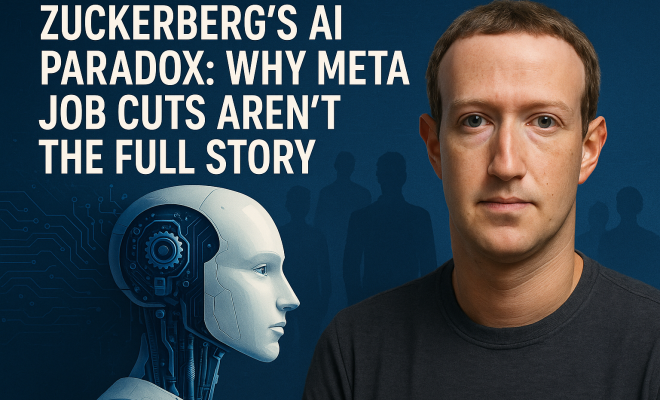
Zuckerberg’s AI Paradox: Why Meta Job Cuts Aren’t the Full Story
Artificial intelligence. Just hearing those two words can trigger a spectrum of emotions, from wide-eyed wonder to existential dread. It’s a topic that dominates headlines, fuels water cooler conversations, and keeps countless individuals up at night, pondering its impact on their livelihoods. Will AI be the ultimate job creator, ushering in an era of unprecedented productivity and new opportunities? Or will it be the silent, relentless job destroyer, leaving a trail of displaced workers in its wake? The truth, as often happens with such seismic shifts, is far more nuanced than either extreme suggests.
Take Meta, for instance. The company, under the stewardship of CEO Mark Zuckerberg, has been a significant player in the tech world’s AI arms race. Yet, even as Meta invests heavily in AI research and development, it recently undertook a painful round of layoffs, letting go of some 8,000 employees. This move, coming amidst the AI hype cycle, naturally raises questions. How can a company so deeply committed to AI also be shedding jobs? Zuckerberg himself acknowledges a fascinating paradox: AI is creating more work, but, crucially, not necessarily inside Meta itself. This isn’t just a corporate talking point; it’s a window into the complex, often contradictory economic impacts of AI, and it provides crucial context to the recent Meta job cuts.
This situation at Meta isn’t an isolated incident; it’s a microcosm of a much larger, emotionally charged debate playing out across the global economy. People are desperate for answers, for clarity, for a glimpse into their professional future. The narratives are often conflicting, the data points seemingly at odds, and the stakes couldn’t be higher. Understanding this dynamic is key to navigating the turbulent waters of AI’s integration into our working lives.
The Discrepancy: AI’s Job Creation Outside Big Tech
It’s easy to look at the Meta job cuts and conclude that AI is a net negative for employment. After all, if a tech giant like Meta, which is at the forefront of AI innovation, is laying people off, what hope is there for the rest of us? But that’s a superficial reading, one that misses a crucial part of the story. The narrative of AI’s job-creating potential isn’t entirely a myth; it’s just manifesting in unexpected places.
Consider the findings of a recent Intuit QuickBooks report. This study highlighted a compelling trend: small businesses that actively embrace and utilize AI are four times more likely to expand their workforce than to reduce it. Think about that for a moment. Four times more likely to hire! This isn’t some minor statistical blip; it’s a significant indicator that AI is fueling growth, not just efficiency, in the small and medium-sized enterprise (SME) sector. These are the businesses that form the backbone of many economies, often more agile and quicker to adapt new technologies than their larger counterparts. They’re using AI to automate mundane tasks, personalize customer interactions, analyze market trends more effectively, and ultimately, to expand their reach and services. This expansion, in turn, necessitates more human input – often in new roles that focus on strategy, creativity, and complex problem-solving that AI can’t yet replicate.
So, while Zuckerberg points out that the job creation spurred by AI isn’t happening within Meta’s walls, it’s clearly happening elsewhere. It suggests a redistribution of labor, a shift in where economic value is generated and where new jobs emerge. This divergence between large tech and the broader business landscape is critical for anyone trying to make sense of AI’s impact on employment. Meta's risky AI ventures offers useful background here.
Why Small Businesses Are Different
Why this difference between a behemoth like Meta and your local bakery or consulting firm embracing AI? Larger companies, particularly established tech giants, often have deeply entrenched structures and legacy systems. When AI is introduced, it’s frequently aimed at optimizing existing processes, which can, in some cases, lead to redundancy for certain roles. Their scale allows for widespread automation to achieve significant cost savings, which can sometimes come at the expense of headcount. The Meta job cuts could be seen through this lens – a strategic restructuring to become a ‘leaner’ company, leveraging AI for internal efficiencies rather than direct job creation.
Small businesses, on the other hand, often adopt AI as an accelerant for growth they couldn’t achieve otherwise. For a small marketing agency, an AI tool might allow them to take on more clients without hiring an entirely new data analyst. This increased capacity leads to more revenue, which then allows them to hire a new creative director or project manager – roles that AI enhances but doesn’t replace. For a local e-commerce store, AI-powered inventory management or customer service chatbots free up the owner’s time, enabling them to focus on product development or market expansion, eventually necessitating more staff for fulfillment or specialized customer engagement. It’s a growth multiplier, not just a cost-cutter, for these smaller entities. (See: CDC on AI and workforce impact.)
The Human Element: Widespread Anxiety About AI
Despite the promising data from the SME sector, there’s an undeniable undercurrent of anxiety running through the global workforce. An Ipsos survey paints a rather stark picture: two-thirds of US workers anticipate that AI will actually worsen their job experience. This isn’t just a vague fear; it’s a concrete concern about job elimination or, failing that, increased pressure and demands in their existing roles. These are not mutually exclusive outcomes, of course, and both contribute significantly to the widespread unease.
This anxiety is deeply personal and emotionally charged. For many, a job isn’t just a paycheck; it’s a source of identity, purpose, and community. The thought of an algorithm taking over tasks they’ve honed for years, or rendering their skills obsolete, is genuinely frightening. It’s not just about losing income; it’s about losing a sense of value and contribution. This fear is a powerful driver of engagement in the AI debate, as individuals desperately seek to understand how this technological revolution will reshape their careers, their lives, and their fundamental place in the economy. The Meta job cuts, despite their specific context, feed into this broader narrative of uncertainty.
The Nature of the Fear
It’s worth dissecting this fear a bit. Is it rational? Partially, yes. History shows us that technological revolutions do displace workers. The agricultural revolution, the industrial revolution, the rise of personal computing – each fundamentally changed the nature of work and made certain jobs redundant. But each also created new industries and new job categories that were unimaginable before. The difference with AI, many argue, is its potential universality. Unlike a specific machine replacing a specific manual task, AI’s ability to learn, reason, and even create touches upon cognitive work, which has traditionally been seen as a safe haven for human employment.
Workers worry about being forced into a ‘race to the bottom’ where they compete with increasingly sophisticated algorithms, driving down wages and increasing performance demands. They envision a future where their skills are devalued, and their contributions are minimized. This isn’t just a theoretical concern; it’s a very real, very human response to a paradigm shift that feels both inevitable and unpredictable. The media often amplifies these fears, sometimes responsibly, sometimes sensationalistically, but always reflecting a genuine societal concern.
Zuckerberg’s Perspective: AI Infrastructure & Efficiencies
Mark Zuckerberg’s candid assessment that AI is creating more work, but not necessarily within Meta, offers a critical insight into the strategic thinking at the top echelons of big tech. When a company like Meta talks about AI, they’re often thinking at a different scale than a small business. For Meta, AI isn’t just a tool to enhance existing products; it’s a fundamental shift in their technological foundation.
The ‘work’ AI is creating, from Zuckerberg’s vantage point, is largely in the realm of AI infrastructure. Think about the massive data centers, the specialized chips (like Meta’s own custom silicon), the complex software frameworks, the armies of engineers and researchers designing, building, and maintaining these foundational systems. This is incredibly high-skill, specialized work, often requiring advanced degrees in fields like machine learning, data science, and AI ethics. These roles are critical, well-compensated, and in high demand. But they are also relatively few compared to the broader workforce, and they require a very specific, advanced skillset.
Simultaneously, Meta, like many large corporations, is using AI to drive internal efficiencies. This means automating tasks, streamlining operations, and optimizing resource allocation across its vast global enterprise. When these efficiencies are achieved, it can, unfortunately, lead to a reduction in headcount in areas where human effort can now be augmented or replaced by AI. The 8,000 Meta job cuts, while painful, can be interpreted as part of this strategic realignment: becoming more efficient and focused on core AI development, even if it means fewer employees overall.
The Monetization Opportunity: Addressing Fear and Opportunity
The intense debate surrounding AI’s impact on jobs, fueled by conflicting narratives and widespread anxiety, isn’t just a societal challenge; it’s a massive economic opportunity. Where there is significant fear and uncertainty, coupled with genuine potential, there’s a market for solutions. This emotionally charged environment is driving massive engagement, creating fertile ground for businesses that can effectively address both the fears and the opportunities presented by AI.
We’re already seeing several key areas where this monetization is taking shape:
- Online Education for AI Upskilling: Millions of workers recognize the need to adapt. They’re asking, “How do I stay relevant? What new skills do I need?” This has created an explosion in demand for online courses, certifications, and bootcamps focused on AI literacy, prompt engineering, data analysis, machine learning fundamentals, and AI-powered tools. Platforms offering accessible, practical, and job-oriented AI education are thriving.
- B2B SaaS Tools for AI Integration: Businesses, particularly SMEs, are eager to leverage AI but often lack the in-house expertise or resources to build custom solutions. This drives demand for user-friendly, plug-and-play Software-as-a-Service (SaaS) tools that integrate AI functionalities into existing workflows – think AI-powered CRM, marketing automation, content generation, or customer support platforms. These tools bridge the gap between AI’s potential and practical application for everyday businesses.
- Career Counseling and Coaching: The career landscape is shifting rapidly, leaving many professionals feeling lost or unsure of their next steps. AI-focused career counselors and coaches are emerging to help individuals identify transferable skills, pinpoint emerging job roles, craft AI-optimized resumes, and navigate the transition to an AI-augmented workplace. This personalized guidance is invaluable for those grappling with significant career uncertainty.
- Affiliate Partnerships for AI Software and Training Programs: As the market for AI tools and education expands, so too does the opportunity for affiliate marketing. Influencers, educators, and content creators who can provide unbiased reviews, tutorials, and recommendations for AI software, platforms, and training programs can generate significant revenue through affiliate partnerships. They act as trusted guides in a complex and rapidly evolving ecosystem.
These aren’t just niche markets; they represent significant growth sectors built directly on the back of the AI employment debate. Businesses that can effectively position themselves as solutions providers, addressing both the defensive need to avoid displacement and the offensive desire to seize new opportunities, stand to gain immensely. (See: NY Times on AI and job market.)
The ‘Leaner’ Meta: A Strategic Repositioning
When we talk about the Meta job cuts, it’s crucial to understand them not as a failure of AI, but perhaps as a consequence of Meta’s own ambitious AI strategy. Mark Zuckerberg has been very clear about Meta’s long-term vision, particularly its focus on the metaverse and, more recently, a renewed emphasis on AI. These are capital-intensive endeavors that require significant investment in research, infrastructure, and top-tier talent.
The layoffs, therefore, can be viewed as part of a broader strategic repositioning. By shedding what might be considered non-core or redundant roles, Meta aims to become a ‘leaner, more efficient’ organization. This often means consolidating teams, streamlining workflows, and focusing resources on the most critical strategic priorities – in this case, AI development and its integration across their product suite. It’s a tough decision, undoubtedly painful for those affected, but from a corporate strategy perspective, it’s about optimizing the company for a future where AI plays an even more central role.
Long-Term Vision vs. Short-Term Reality
This strategy also reflects a common challenge for large tech companies: balancing ambitious long-term visions with short-term economic realities. The metaverse, while still a distant goal, required massive investment. Now, AI is commanding similar levels of capital and human resources. In an environment of increased investor scrutiny and pressure to deliver profitability, companies often resort to cost-cutting measures, including layoffs, to free up capital for these strategic bets. The Meta job cuts, therefore, aren’t just about AI’s impact on jobs; they’re also about corporate strategy, market pressures, and the intense competition to lead the next technological frontier.
The AI Skill Gap: A Defining Challenge
One of the most significant takeaways from this complex picture of AI and employment is the looming, and frankly, widening, skill gap. On one side, you have companies like Meta investing billions in AI infrastructure, desperate for specialized talent. On the other, you have a vast workforce anxious about their job security but often lacking the skills to transition into these new, AI-driven roles. This isn’t just a minor inconvenience; it’s a defining challenge of the current economic era.
The skills needed for the AI economy are shifting. While traditional roles might be augmented or even replaced, new roles are emerging that require a blend of technical proficiency, critical thinking, creativity, and adaptability. We’re talking about prompt engineers, AI ethicists, data curators, machine learning operations (MLOps) engineers, and human-AI interaction specialists. These aren’t just fancy titles; they represent entirely new domains of work that are essential for developing, deploying, and managing AI responsibly and effectively.
The problem is that the education system, both traditional and vocational, often struggles to keep pace with such rapid technological evolution. There’s a lag between the emergence of new technologies and the development of curricula and training programs designed to equip the workforce with the necessary skills. This lag creates a bottleneck, hindering both individual career progression and broader economic adaptation. Bridging this skill gap will require concerted efforts from governments, educational institutions, and private industry, focusing on continuous learning and reskilling initiatives.
Beyond Automation: Augmentation and New Roles
It’s too simplistic to frame the AI debate purely in terms of job elimination. While some tasks, and even entire roles, will undoubtedly be automated, a more prevalent and often overlooked aspect is augmentation. AI isn’t just taking over; it’s enhancing human capabilities, allowing us to do more, do it faster, and do it better. (See: ScienceDirect on AI economic impacts.)
Think of a doctor using AI to analyze medical images more accurately, an architect leveraging AI to generate hundreds of design iterations, or a lawyer using AI to sift through vast legal documents. In these scenarios, AI acts as a powerful co-pilot, not a replacement. It frees up human professionals from mundane, repetitive, or data-intensive tasks, allowing them to focus on higher-level reasoning, creativity, empathy, and complex problem-solving – precisely the uniquely human attributes that AI struggles to replicate.
This augmentation also leads to the creation of entirely new roles. Someone needs to train the AI, manage its biases, interpret its outputs, and design the interfaces through which humans interact with it. These are not jobs that existed a decade ago, but they are becoming increasingly critical. The challenge, of course, is ensuring that the workforce is adequately prepared to step into these augmented and novel roles. The Meta job cuts, while seemingly a step backward, are part of a larger industry-wide movement towards this augmented future, even if the transition is bumpy. For more on this, see AI ethics MOOC insights.
The Shifting Definition of Productivity
The rise of AI is also fundamentally altering our understanding of productivity. Traditionally, productivity often meant doing more with less, primarily through increased efficiency. With AI, it’s not just about doing tasks faster; it’s about doing entirely new things, achieving capabilities that were previously impossible. For small businesses, this might mean reaching new customer segments or offering personalized services at scale. For large tech companies, it means developing new AI-powered products and experiences that redefine user interaction.
Zuckerberg’s observation that AI creates more work, even if not within Meta, underscores this shift. It’s creating new economic activity, new markets, and new demands for goods and services that support the AI ecosystem. This isn’t just about existing jobs changing; it’s about the very economic fabric evolving. This evolution, while promising, also means significant disruption. Industries that fail to adapt, companies that resist AI integration, and individuals who don’t upskill risk being left behind. The Meta job cuts can be seen as a harsh lesson in this new definition of productivity and the imperative to adapt to it.
Looking Ahead: Navigating the AI-Driven Future
So, where does all this leave us? The economic impact of AI on employment is undeniably complex, a tapestry woven with threads of both promise and peril. The Meta job cuts, while a stark reality for those affected, don’t tell the whole story. They highlight the internal restructuring and efficiency drives within large tech, while the broader economy, particularly the SME sector, shows signs of AI-driven job creation.
The widespread anxiety among workers is real and understandable, underscoring the need for proactive measures to support reskilling and career transitions. The monetization opportunities, from AI education to B2B SaaS tools, demonstrate the economic vibrancy emerging from this paradigm shift. Ultimately, successfully navigating this AI-driven future won’t be about resisting the tide, but about understanding its currents and learning to sail with them. It will demand adaptability, continuous learning, and a willingness to embrace new ways of working, ensuring that the benefits of AI are broadly shared, rather than concentrated in the hands of a few.
Trending Now
Frequently Asked Questions
How is AI affecting jobs at Meta?
AI is creating new job opportunities but not necessarily within Meta itself. Despite the company's significant investment in AI, recent layoffs of around 8,000 employees highlight a paradox where AI's growth leads to job displacement in large tech firms.
What are the implications of AI on employment?
The implications of AI on employment are complex. While AI can enhance productivity and create new roles in various sectors, it also poses a risk of job losses, particularly in established companies like Meta, where automation can streamline operations.
Why did Meta lay off 8,000 employees?
Meta laid off 8,000 employees as part of restructuring efforts despite its commitment to AI development. This reflects a broader trend where companies are optimizing their workforce amidst evolving technologies, even as they invest in AI.
Is AI a job creator or destroyer?
AI can be seen as both a job creator and destroyer. It generates new opportunities in emerging fields but can also lead to job losses in traditional roles, creating a paradox where some sectors thrive while others decline.
What does Zuckerberg say about AI's impact on jobs?
Zuckerberg acknowledges that while AI is generating more work, it does not necessarily mean job creation within Meta. This highlights the nuanced relationship between AI advancements and employment trends in the tech industry.
What's your take on this? Share your thoughts in the comments below — we read every one.