The Tech Edvocate

Top Menu

  • Advertisement
  • Apps
  • Home Page
  • Home Page Five (No Sidebar)
  • Home Page Four
  • Home Page Three
  • Home Page Two
  • Home Tech2
  • Icons [No Sidebar]
  • Left Sidbear Page
  • Lynch Educational Consulting
  • My Account
  • My Speaking Page
  • Newsletter Sign Up Confirmation
  • Newsletter Unsubscription
  • Our Brands
  • Page Example
  • Privacy Policy
  • Protected Content
  • Register
  • Request a Product Review
  • Shop
  • Shortcodes Examples
  • Signup
  • Start Here
    • Governance
    • Careers
    • Contact Us
  • Terms and Conditions
  • The Edvocate
  • The Tech Edvocate Product Guide
  • Topics
  • Write For Us
  • Advertise

Main Menu

  • Start Here
    • Our Brands
    • Governance
      • Lynch Educational Consulting, LLC.
      • Dr. Lynch’s Personal Website
      • Careers
    • Write For Us
    • The Tech Edvocate Product Guide
    • Contact Us
    • Books
    • Edupedia
    • Post a Job
    • The Edvocate Podcast
    • Terms and Conditions
    • Privacy Policy
  • Topics
    • Assistive Technology
    • Child Development Tech
    • Early Childhood & K-12 EdTech
    • EdTech Futures
    • EdTech News
    • EdTech Policy & Reform
    • EdTech Startups & Businesses
    • Higher Education EdTech
    • Online Learning & eLearning
    • Parent & Family Tech
    • Personalized Learning
    • Product Reviews
  • Advertise
  • Tech Edvocate Awards
  • The Edvocate
  • Pedagogue
  • School Ratings

logo

The Tech Edvocate

  • Start Here
    • Our Brands
    • Governance
      • Lynch Educational Consulting, LLC.
      • Dr. Lynch’s Personal Website
        • My Speaking Page
      • Careers
    • Write For Us
    • The Tech Edvocate Product Guide
    • Contact Us
    • Books
    • Edupedia
    • Post a Job
    • The Edvocate Podcast
    • Terms and Conditions
    • Privacy Policy
  • Topics
    • Assistive Technology
    • Child Development Tech
    • Early Childhood & K-12 EdTech
    • EdTech Futures
    • EdTech News
    • EdTech Policy & Reform
    • EdTech Startups & Businesses
    • Higher Education EdTech
    • Online Learning & eLearning
    • Parent & Family Tech
    • Personalized Learning
    • Product Reviews
  • Advertise
  • Tech Edvocate Awards
  • The Edvocate
  • Pedagogue
  • School Ratings
  • The Shocking Truth: ESG Training Programs Are Quietly Reshaping Your Career Path

  • Why Millions of People Are Switching to These Green Energy Certifications Right Now

  • The green skills gap in 2026: How to address this growing problem

  • The Shocking Truth: Your Degree Won’t Land You the Best IT Jobs in 2026

  • The Brutal Truth About Degrees: Why Micro-Credentials Are Quietly Dominating Careers by 2026

  • Why 96% of Employers Now Prefer Skills Over Degrees: The Micro-Credential Revolution

  • This Crucial Mistake With AI Is Stunting Student Minds: Here’s How to Fix It

  • The AI ‘Cognitive Surrender’ Crisis: 7 Tools Every Educator Needs NOW

  • This Crucial Mistake Is Quietly Killing Students’ Brains, Says MIT

  • The Sneaky Truth About RTO: How to Negotiate Flexible Work Without Losing Your Job

Artificial Intelligence
Home›Artificial Intelligence›What Teachers Can Expect from Machine Learning

What Teachers Can Expect from Machine Learning

By Matthew Lynch
November 19, 2019
0
Spread the love

Using technology to digitize textbooks or create worksheet PDFs is uninspiring. It also doesn’t make the best use of technology’s potential in our classrooms. 

The real power of technology lies in machine learning. This concept of teaching a computer to think and act on its own volition is part of the push to create artificial intelligence. For some people, the thought of AI in the classroom is scary. Others, however, see the potential of AI to transform education. 

Artificial intelligence mimics human actions and decision-making. Ever adjusting its responses to stimuli, dynamic machine learning adapts itself to circumstances. 

The process of creating artificial intelligence is an involved one. AI relies on machine learning (optimized algorithms), which in turn, encapsulates deep learning (layers of mathematical formulas). The process – deep learning, machine learning, and artificial intelligence – is like a series of Russian nesting dolls. As thinking capacity increases, so does the size of the doll.

Machine learning is still a newbie in the education industry, but it’s growing up fast. This form of artificial intelligence brings benefits in several areas.  

Experiential learning 

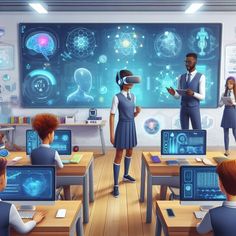
Artificial intelligence simulates learning in ways that a textbook never can. Reading requires the use of one sense (visual), but experiential learning, in the form of virtual reality, requires the use of multiple senses. 

Students enrolled in the Mandarin Project, for example, engage in immersive learning to practice their Mandarin skills. Available scenarios include a restaurant and a tai chi class where students communicate with a machine-learned Mandarin-speaking chatbot. At the simulated restaurant, students stand in a virtual room where a chatbot offers to seat them at a table. It takes their food order, assisting with Mandarin tone and delivery. Students can practice pronunciation and grammar without the fear of harsh judgment from native speakers.

Real-time data analytics

Classrooms are already devoting resources to machine learning adoption. Teachers use this form of artificial intelligence to predict students’ performance, evaluate progress objectively, improve learning and retention, and more.

Many schools have allocated resources for learning management systems and tutorial programs that identify student strengths and weaknesses. This effort helps learners improve their understanding of concepts.

Mental health predictions 

Machine learning enables researchers to accurately predict the likelihood of developing mental illness, especially post-traumatic-stress-disorder (PTSD). 

In recent years, educators have seen an increase in the number of students experiencing mental illness. More than half of school-age children experience at least one traumatic episode before they are sixteen years old. Early identification of diseases like PTSD may allow for prevention of the diagnosis.

Final thoughts

You are witnessing the beginning of an educational revolution in how we teach, learn, and respond to student needs. 

As much as we have begun to rely on machine learning for instructional decision-making, AI is still developing and growing. It brings with it significant challenges, like the potential for bias, but we can work on that. 

Education has long been in need of total transformation. Artificial intelligence and machine learning may be the catalyst needed for this metamorphosis.

Previous Article

How Teachers Use Machine Learning to Add ...

Next Article

Tips for Selling to Districts, Schools, and ...

Matthew Lynch

Related articles More from author

  • Artificial Intelligence

    11 Of The Best AI Story Generators – Educators Technology

    March 18, 2024
    By Matthew Lynch
  • Artificial Intelligence

    20 Top Free AI Courses on edX

    March 4, 2024
    By Matthew Lynch
  • Artificial Intelligence

    I Tried Out Dall-E 3. The AI Images Are Bolder, More Detailed and More Fun

    February 1, 2024
    By Matthew Lynch
  • Artificial Intelligence

    6 Amazon Alexa Settings to Change for a Personalized Smart Home Experience

    January 30, 2024
    By Matthew Lynch
  • Artificial Intelligence

    What is a Learning Algorithm?

    April 18, 2023
    By Matthew Lynch
  • Artificial Intelligence

    Canva’s New AI Design Tools Aim to Help You Create and Edit Like a Pro

    February 1, 2024
    By Matthew Lynch

Search

Login & Registration

  • Log in
  • Entries feed
  • Comments feed
  • WordPress.org

Newsletter

Signup for The Tech Edvocate Newsletter and have the latest in EdTech news and opinion delivered to your email address!

About Us

Since technology is not going anywhere and does more good than harm, adapting is the best course of action. That is where The Tech Edvocate comes in. We plan to cover the PreK-12 and Higher Education EdTech sectors and provide our readers with the latest news and opinion on the subject. From time to time, I will invite other voices to weigh in on important issues in EdTech. We hope to provide a well-rounded, multi-faceted look at the past, present, the future of EdTech in the US and internationally.

We started this journey back in June 2016, and we plan to continue it for many more years to come. I hope that you will join us in this discussion of the past, present and future of EdTech and lend your own insight to the issues that are discussed.

Newsletter

Signup for The Tech Edvocate Newsletter and have the latest in EdTech news and opinion delivered to your email address!

Contact Us

The Tech Edvocate
910 Goddin Street
Richmond, VA 23231
(601) 630-5238
[email protected]

Copyright © 2026 Matthew Lynch. All rights reserved.