The Tech Edvocate

Top Menu

  • Advertisement
  • Apps
  • Home Page
  • Home Page Five (No Sidebar)
  • Home Page Four
  • Home Page Three
  • Home Page Two
  • Home Tech2
  • Icons [No Sidebar]
  • Left Sidbear Page
  • Lynch Educational Consulting
  • My Account
  • My Speaking Page
  • Newsletter Sign Up Confirmation
  • Newsletter Unsubscription
  • Our Brands
  • Page Example
  • Privacy Policy
  • Protected Content
  • Register
  • Request a Product Review
  • Shop
  • Shortcodes Examples
  • Signup
  • Start Here
    • Governance
    • Careers
    • Contact Us
  • Terms and Conditions
  • The Edvocate
  • The Tech Edvocate Product Guide
  • Topics
  • Write For Us
  • Advertise

Main Menu

  • Start Here
    • Our Brands
    • Governance
      • Lynch Educational Consulting, LLC.
      • Dr. Lynch’s Personal Website
      • Careers
    • Write For Us
    • The Tech Edvocate Product Guide
    • Contact Us
    • Books
    • Edupedia
    • Post a Job
    • The Edvocate Podcast
    • Terms and Conditions
    • Privacy Policy
  • Topics
    • Assistive Technology
    • Child Development Tech
    • Early Childhood & K-12 EdTech
    • EdTech Futures
    • EdTech News
    • EdTech Policy & Reform
    • EdTech Startups & Businesses
    • Higher Education EdTech
    • Online Learning & eLearning
    • Parent & Family Tech
    • Personalized Learning
    • Product Reviews
  • Advertise
  • Tech Edvocate Awards
  • The Edvocate
  • Pedagogue
  • School Ratings

logo

The Tech Edvocate

  • Start Here
    • Our Brands
    • Governance
      • Lynch Educational Consulting, LLC.
      • Dr. Lynch’s Personal Website
        • My Speaking Page
      • Careers
    • Write For Us
    • The Tech Edvocate Product Guide
    • Contact Us
    • Books
    • Edupedia
    • Post a Job
    • The Edvocate Podcast
    • Terms and Conditions
    • Privacy Policy
  • Topics
    • Assistive Technology
    • Child Development Tech
    • Early Childhood & K-12 EdTech
    • EdTech Futures
    • EdTech News
    • EdTech Policy & Reform
    • EdTech Startups & Businesses
    • Higher Education EdTech
    • Online Learning & eLearning
    • Parent & Family Tech
    • Personalized Learning
    • Product Reviews
  • Advertise
  • Tech Edvocate Awards
  • The Edvocate
  • Pedagogue
  • School Ratings
  • Viaim Opennote Review: The AI Note-Taker That Disappears Into Your Daily Routine

  • A Visitors Guide to Long Beach (CA), United States

  • A Visitor’s Guide to Fresno (CA), United States

  • A Visitors Guide to New Orleans (LA), United States

  • A Visitors Guide to Sacramento (CA), United States

  • A Visitors Guide to Lyon, France

  • JisuLife Ultra2 Portable Fan: A Powerful Multi-Function Cooling Solution

  • A Visitors Guide to Viña del Mar, Chile

  • A Visitors Guide to Århus, Denmark

  • A Visitors Guide to Bakersfield (CA), United States

Digital & Mobile Technology
Home›Digital & Mobile Technology›What is Pulse Width Modulation (PWM)?

What is Pulse Width Modulation (PWM)?
By Matthew Lynch
May 10, 2023
0
Spread the love

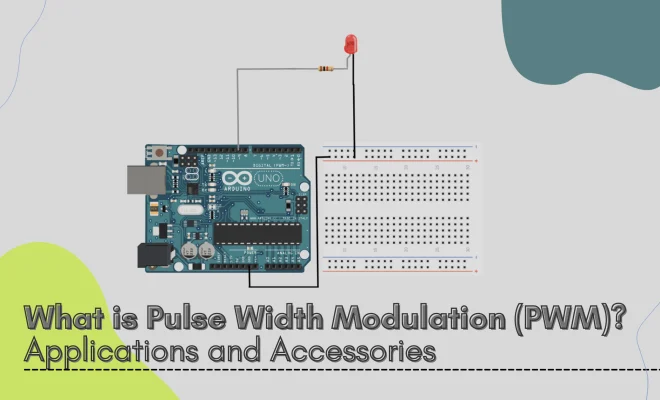
Pulse Width Modulation (PWM) is a technique used to control the intensity of a signal or digital output through the manipulation of its duty cycle. Initially developed for use in audio equipment, PWM has since found applications in a wide range of digital circuits, including motor speed regulation, power supply control, and LED lighting.

A PWM signal is generated by varying the relative time duration of two states of a digital signal – on and off. For example, if the signal is high for 50% of the time and low for the other 50%, the duty cycle is 50%. By controlling the duty cycle of a signal, a system can precisely control the average voltage, current, or power delivered to a load.

The speed control of DC motors is a common example of PWM application. By adjusting the duty cycle of the PWM signal sent to a motor, the speed of the motor can be controlled. A 50% duty cycle signal will result in the motor running at half of its maximum speed, while a 25% duty cycle signal will reduce it to a quarter of its maximum speed.

In LED lighting applications, PWM is often used to control the brightness of LEDs. Because LEDs have a nonlinear relationship between current and brightness, it is not possible to control LED brightness by a current regulation technique alone. By pulsing the current with a rapid rate, PWM can keep the brightness of LEDs at a constant level while saving energy.

PWM is not without its limitations, however. One of the main concerns with PWM is the possibility of unwanted electromagnetic interference (EMI) generated during the switching process. To minimize EMI, designers must carefully select the switching frequency, conduct extensive filtering, and employ proper grounding and shielding techniques.

Previous Article

What is Project Management Software?

Next Article

What is push technology (Webcasting)?

Matthew Lynch

Related articles More from author

  • Digital & Mobile Technology

    The Best Free Online Music Streaming Services with No Limitations

    June 5, 2023
    By Matthew Lynch
  • Digital & Mobile Technology

    How to Open the Exchange Management Console

    May 1, 2023
    By Matthew Lynch
  • Digital & Mobile Technology

    Samsung Galaxy A51 5G Review

    August 5, 2023
    By Matthew Lynch
  • Digital & Mobile Technology

    Fixes If Your Mouse Lags and Stutters in Games

    June 12, 2023
    By Matthew Lynch
  • Digital & Mobile Technology

    How to Subtract Two or More Numbers in Excel

    June 3, 2023
    By Matthew Lynch
  • Digital & Mobile Technology

    How to Use Basic Math Formulas Like Addition and Subtraction in Excel

    June 10, 2023
    By Matthew Lynch

Search

Login & Registration

  • Register
  • Log in
  • Entries feed
  • Comments feed
  • WordPress.org

Newsletter

Signup for The Tech Edvocate Newsletter and have the latest in EdTech news and opinion delivered to your email address!

About Us

Since technology is not going anywhere and does more good than harm, adapting is the best course of action. That is where The Tech Edvocate comes in. We plan to cover the PreK-12 and Higher Education EdTech sectors and provide our readers with the latest news and opinion on the subject. From time to time, I will invite other voices to weigh in on important issues in EdTech. We hope to provide a well-rounded, multi-faceted look at the past, present, the future of EdTech in the US and internationally.

We started this journey back in June 2016, and we plan to continue it for many more years to come. I hope that you will join us in this discussion of the past, present and future of EdTech and lend your own insight to the issues that are discussed.

Newsletter

Signup for The Tech Edvocate Newsletter and have the latest in EdTech news and opinion delivered to your email address!

Contact Us

The Tech Edvocate
910 Goddin Street
Richmond, VA 23231
(601) 630-5238
[email protected]

Copyright © 2025 Matthew Lynch. All rights reserved.