The Tech Edvocate

Top Menu

  • Advertisement
  • Apps
  • Home Page
  • Home Page Five (No Sidebar)
  • Home Page Four
  • Home Page Three
  • Home Page Two
  • Home Tech2
  • Icons [No Sidebar]
  • Left Sidbear Page
  • Lynch Educational Consulting
  • My Account
  • My Speaking Page
  • Newsletter Sign Up Confirmation
  • Newsletter Unsubscription
  • Our Brands
  • Page Example
  • Privacy Policy
  • Protected Content
  • Register
  • Request a Product Review
  • Shop
  • Shortcodes Examples
  • Signup
  • Start Here
    • Governance
    • Careers
    • Contact Us
  • Terms and Conditions
  • The Edvocate
  • The Tech Edvocate Product Guide
  • Topics
  • Write For Us
  • Advertise

Main Menu

  • Start Here
    • Our Brands
    • Governance
      • Lynch Educational Consulting, LLC.
      • Dr. Lynch’s Personal Website
      • Careers
    • Write For Us
    • The Tech Edvocate Product Guide
    • Contact Us
    • Books
    • Edupedia
    • Post a Job
    • The Edvocate Podcast
    • Terms and Conditions
    • Privacy Policy
  • Topics
    • Assistive Technology
    • Child Development Tech
    • Early Childhood & K-12 EdTech
    • EdTech Futures
    • EdTech News
    • EdTech Policy & Reform
    • EdTech Startups & Businesses
    • Higher Education EdTech
    • Online Learning & eLearning
    • Parent & Family Tech
    • Personalized Learning
    • Product Reviews
  • Advertise
  • Tech Edvocate Awards
  • The Edvocate
  • Pedagogue
  • School Ratings

logo

The Tech Edvocate

  • Start Here
    • Our Brands
    • Governance
      • Lynch Educational Consulting, LLC.
      • Dr. Lynch’s Personal Website
        • My Speaking Page
      • Careers
    • Write For Us
    • The Tech Edvocate Product Guide
    • Contact Us
    • Books
    • Edupedia
    • Post a Job
    • The Edvocate Podcast
    • Terms and Conditions
    • Privacy Policy
  • Topics
    • Assistive Technology
    • Child Development Tech
    • Early Childhood & K-12 EdTech
    • EdTech Futures
    • EdTech News
    • EdTech Policy & Reform
    • EdTech Startups & Businesses
    • Higher Education EdTech
    • Online Learning & eLearning
    • Parent & Family Tech
    • Personalized Learning
    • Product Reviews
  • Advertise
  • Tech Edvocate Awards
  • The Edvocate
  • Pedagogue
  • School Ratings
  • A Visitors Guide to Viña del Mar, Chile

  • A Visitors Guide to Århus, Denmark

  • A Visitors Guide to Bakersfield (CA), United States

  • A Visitors Guide to Aurora (CO), United States

  • A Visitor’s Guide to Toledo (OH), United States

  • A Visitors Guide to Cincinnati (OH), United States

  • The MagicEagle Cam 5: Revolutionizing Wildlife Monitoring with Smart 4G Technology

  • A Visitors Guide to Pittsburgh (PA), United States

  • A Visitors Guide to Colorado Springs (CO), United States

  • 5 Pairs of Shoes That Will Instantly Step Your Shoe Game Up

Digital & Mobile Technology
Home›Digital & Mobile Technology›What Is File Allocation Table (FAT)?

What Is File Allocation Table (FAT)?
By Matthew Lynch
July 28, 2023
0
Spread the love

File Allocation Table (FAT) is an important aspect of computer file systems that manages files and directories on a storage medium such as a hard disk, floppy disk, or USB drive. It is a common file system format used by various operating systems, including Microsoft Windows and the older versions of Mac OS X.

FAT was first introduced by Microsoft in 1977 as part of the MS-DOS operating system. Since then, it has undergone several revisions and improvements, such as FAT16, FAT32, and exFAT.

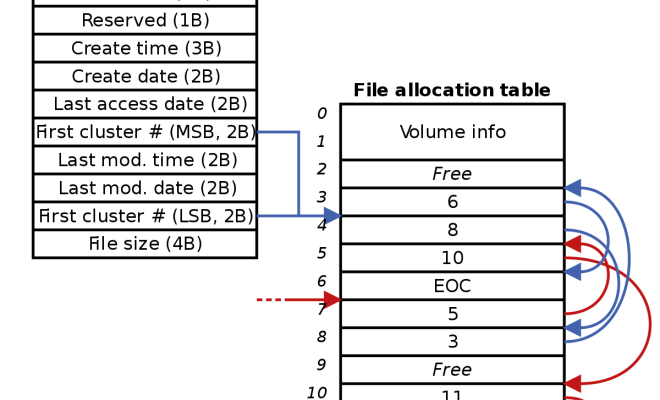
FAT stores information about files and folders in a table called the ‘File Allocation Table’, which is a data structure that keeps track of the clusters (also known as ‘blocks’) of data on the storage medium. Each cluster is a fixed-size unit of data storage, and the FAT table links each file to the clusters that it occupies on the disk.

When a file is saved on a FAT-based file system, it is divided into clusters that are scattered across the disk, with each cluster linked to the next cluster in the file’s allocation chain. The FAT table stores the information about these links, enabling the operating system to locate and retrieve the file’s data later on.

One of the key advantages of the FAT file system is its simplicity and ease of use. It has low overhead and can operate on a wide range of storage devices, making it a versatile choice for many applications. FAT is also compatible with various operating systems, making it a popular choice for data interchange between computers with different operating systems. FAT is more commonly used in removable storage devices, PDA’s and mobile phones.

However, FAT also has some limitations. One of the most significant drawbacks of the FAT file system is that it has a limited maximum file size. The maximum file size that can be saved on a FAT32 file system is 4GB, which is a lot smaller compared with newer file systems like NTFS. Another drawback is that FAT does not support features like file permissions, encryption, and journaling that newer file systems have to provide.

In conclusion, the File Allocation Table (FAT) remains an important component of computer file systems even after over 40 years since its introduction. It has been widely used for a wide range of storage media devices, thanks to its simplicity and versatility. Although it has limitations regarding file size and lack of advanced features that are present in newer file systems, it still serves a purpose as a reliable and straightforward file management system.


Previous Article

How to Copy a Link in iOS ...

Next Article

13 Windows 10 Tips and Tricks

Matthew Lynch

Related articles More from author

  • Digital & Mobile Technology

    What is Wearable Technology? Definition, Uses and Examples

    May 14, 2023
    By Matthew Lynch
  • Digital & Mobile Technology

    How to Use Battery Saver Mode on Android

    June 1, 2023
    By Matthew Lynch
  • Digital & Mobile Technology

    Adobe Launches Cloud Spaces and Cloud Canvas Apps

    July 26, 2023
    By Matthew Lynch
  • Digital & Mobile Technology

    Can I Keep Unlimited Data with iPhone Personal Hotspot?

    July 6, 2023
    By Matthew Lynch
  • Digital & Mobile Technology

    How to Translate WhatsApp Messages on Android and iPhone

    May 29, 2023
    By Matthew Lynch
  • Digital & Mobile Technology

    How to Create a Custom To-Do List in Google Sheets

    July 31, 2023
    By Matthew Lynch

Search

Login & Registration

  • Register
  • Log in
  • Entries feed
  • Comments feed
  • WordPress.org

Newsletter

Signup for The Tech Edvocate Newsletter and have the latest in EdTech news and opinion delivered to your email address!

About Us

Since technology is not going anywhere and does more good than harm, adapting is the best course of action. That is where The Tech Edvocate comes in. We plan to cover the PreK-12 and Higher Education EdTech sectors and provide our readers with the latest news and opinion on the subject. From time to time, I will invite other voices to weigh in on important issues in EdTech. We hope to provide a well-rounded, multi-faceted look at the past, present, the future of EdTech in the US and internationally.

We started this journey back in June 2016, and we plan to continue it for many more years to come. I hope that you will join us in this discussion of the past, present and future of EdTech and lend your own insight to the issues that are discussed.

Newsletter

Signup for The Tech Edvocate Newsletter and have the latest in EdTech news and opinion delivered to your email address!

Contact Us

The Tech Edvocate
910 Goddin Street
Richmond, VA 23231
(601) 630-5238
[email protected]

Copyright © 2025 Matthew Lynch. All rights reserved.