The Tech Edvocate

Top Menu

  • Advertisement
  • Apps
  • Home Page
  • Home Page Five (No Sidebar)
  • Home Page Four
  • Home Page Three
  • Home Page Two
  • Home Tech2
  • Icons [No Sidebar]
  • Left Sidbear Page
  • Lynch Educational Consulting
  • My Account
  • My Speaking Page
  • Newsletter Sign Up Confirmation
  • Newsletter Unsubscription
  • Our Brands
  • Page Example
  • Privacy Policy
  • Protected Content
  • Register
  • Request a Product Review
  • Shop
  • Shortcodes Examples
  • Signup
  • Start Here
    • Governance
    • Careers
    • Contact Us
  • Terms and Conditions
  • The Edvocate
  • The Tech Edvocate Product Guide
  • Topics
  • Write For Us
  • Advertise

Main Menu

  • Start Here
    • Our Brands
    • Governance
      • Lynch Educational Consulting, LLC.
      • Dr. Lynch’s Personal Website
      • Careers
    • Write For Us
    • The Tech Edvocate Product Guide
    • Contact Us
    • Books
    • Edupedia
    • Post a Job
    • The Edvocate Podcast
    • Terms and Conditions
    • Privacy Policy
  • Topics
    • Assistive Technology
    • Child Development Tech
    • Early Childhood & K-12 EdTech
    • EdTech Futures
    • EdTech News
    • EdTech Policy & Reform
    • EdTech Startups & Businesses
    • Higher Education EdTech
    • Online Learning & eLearning
    • Parent & Family Tech
    • Personalized Learning
    • Product Reviews
  • Advertise
  • Tech Edvocate Awards
  • The Edvocate
  • Pedagogue
  • School Ratings

logo

The Tech Edvocate

  • Start Here
    • Our Brands
    • Governance
      • Lynch Educational Consulting, LLC.
      • Dr. Lynch’s Personal Website
        • My Speaking Page
      • Careers
    • Write For Us
    • The Tech Edvocate Product Guide
    • Contact Us
    • Books
    • Edupedia
    • Post a Job
    • The Edvocate Podcast
    • Terms and Conditions
    • Privacy Policy
  • Topics
    • Assistive Technology
    • Child Development Tech
    • Early Childhood & K-12 EdTech
    • EdTech Futures
    • EdTech News
    • EdTech Policy & Reform
    • EdTech Startups & Businesses
    • Higher Education EdTech
    • Online Learning & eLearning
    • Parent & Family Tech
    • Personalized Learning
    • Product Reviews
  • Advertise
  • Tech Edvocate Awards
  • The Edvocate
  • Pedagogue
  • School Ratings
  • 77% of Employees Believe They Can Outperform AI in Their Jobs

  • Rethinking Recruitment Strategies in Higher Education

  • 1 in 4 Gen Z Are Considering Ditching Corporate for Content Creation

  • This One Flaw Just Blew Up the Guardian Smart Baby Monitor

  • The AI Race: Why Doomsday Warnings Can’t Stop the Train

  • XBOX: Activision takes over Halo, Obsidian joins Bethesda, and Ninja Theory is going

  • White House Arcade: 2nd Japan Protest, Nintendo Feud [2026]

  • One-Fifth of White-Collar Jobs Could Vanish by 2030, New Report Claims

  • Is a ‘Pacing’ AI Slowdown Really Possible? This Week’s AI News Roundup Reveals the Truth

  • California’s Bold Move: AB 1709 Social Media Restrictions Could Banish Teen Addiction

Digital & Mobile Technology
Home›Digital & Mobile Technology›Ways to Create a Windows 11 Bootable USB Drive

Ways to Create a Windows 11 Bootable USB Drive
By Matthew Lynch
July 6, 2023
0
Spread the love

Windows 11 is the latest operating system introduced by Microsoft, and it means that you may have to install it on your computer. To do this effectively, there are specific procedures that you need to follow, and one of them is to create a Windows 11 bootable USB drive. This will ensure that you can quickly boot the Windows 11 setup and install the operating system with ease. In this article, we will discuss the ways to create a Windows 11 bootable USB drive.

Method 1: Using the Media Creation Tool

The media creation tool is a utility provided by Microsoft to simplify the process of creating a bootable USB drive. It makes the process straightforward, and you can create the bootable drive within a few clicks. Here are the steps to follow:

Step 1: First, you need to download the Media Creation Tool from the official Microsoft website.

Step 2: Once downloaded, launch the Media Creation Tool and accept the license terms and conditions.

Step 3: Choose the ‘Create installation media’ option and select Windows 11 as the operating system.

Step 4: Click the ‘Next’ button and choose the USB flash drive option.

Step 5: Insert the USB drive into your computer and choose it from the list.

Step 6: Click the ‘Next’ button to start the process, and wait for it to complete.

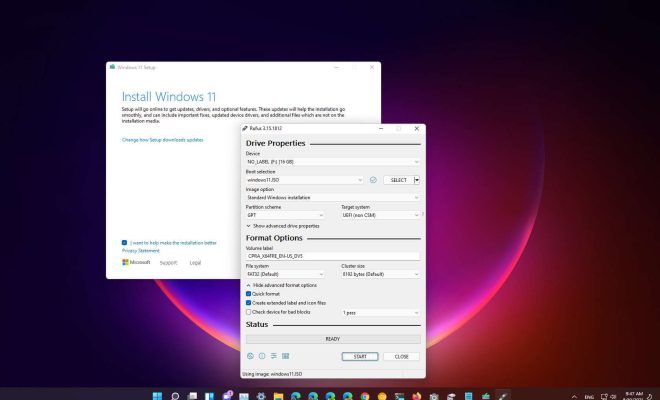
Method 2: Using Rufus software

Rufus is another popular utility software used to create a bootable USB drive. It is widely used for creating bootable drives for different operating systems, including Windows and Linux. Here are the steps to follow:

Step 1: First, download the Rufus software from the official website and install it on your computer.

Step 2: Once installed, launch the Rufus application.

Step 3: Choose your USB flash drive from the list of available devices.

Step 4: Change the bootable drive properties as follows:

Partition scheme: GPT for UEFI
File System: FAT32
Cluster Size: Default

Step 5: Select the Windows 11 ISO image that you downloaded earlier.

Step 6: Click the ‘Start’ button to proceed with the process, and wait for it to complete.

Method 3: Using the Command Prompt

This method is a manual process that involves running commands on the Command Prompt. It requires some technical skills, but it is a simple process. Here are the steps to follow:

Step 1: First, insert your USB flash drive into your computer.

Step 2: Launch the Command Prompt with administrator privileges.

Step 3: Run the ‘diskpart’ command and select the USB drive with the ‘list disk’ and ‘select disk’ commands.

Step 4: Clean the USB drive with the ‘clean’ command.

Step 5: Create a new partition with the ‘create partition primary’ command and select it using the ‘select partition 1’ command.

Step 6: Format the partition with the ‘format fs=ntfs quick’ command.

Step 7: Assign a drive letter to the USB drive with the ‘assign’ command.

Step 8: Use the ‘exit’ command to close the Diskpart utility.

Step 9: Mount the Windows 11 ISO image onto your computer and copy its contents to the USB drive.

Conclusion

Creating a Windows 11 bootable USB drive is essential when installing the operating system on your computer. You can use any of the methods mentioned above to create the bootable drive, depending on your preference and technical skills. It is recommended that you follow the steps carefully to ensure that the process is successful. Once you have created the bootable drive, you can now install Windows 11 on your computer.


Previous Article

Can You Get Instagram on an Apple ...

Next Article

How to Add Channels to Roku

Matthew Lynch

Related articles More from author

  • Digital & Mobile Technology

    What Is the ChatGPT “Error in Body Stream” Issue? Ways You Can Fix It

    June 8, 2023
    By Matthew Lynch
  • Digital & Mobile Technology

    How to Get a Google Phone Number

    May 30, 2023
    By Matthew Lynch
  • Digital & Mobile Technology

    Apps You Can Use to Make Your Mac Look Like Windows

    June 13, 2023
    By Matthew Lynch
  • Digital & Mobile Technology

    How to Change the IP Address on iPhone

    May 20, 2023
    By Matthew Lynch
  • Digital & Mobile Technology

    How to Fix “User Profile Service Failed the Sign-in” Error for Windows

    May 28, 2023
    By Matthew Lynch
  • Digital & Mobile Technology

    21:9 Ultrawide Monitors: How Wide Is Too Wide?

    June 23, 2023
    By Matthew Lynch

Search

Login & Registration

  • Log in
  • Entries feed
  • Comments feed
  • WordPress.org

Newsletter

Signup for The Tech Edvocate Newsletter and have the latest in EdTech news and opinion delivered to your email address!

About Us

Since technology is not going anywhere and does more good than harm, adapting is the best course of action. That is where The Tech Edvocate comes in. We plan to cover the PreK-12 and Higher Education EdTech sectors and provide our readers with the latest news and opinion on the subject. From time to time, I will invite other voices to weigh in on important issues in EdTech. We hope to provide a well-rounded, multi-faceted look at the past, present, the future of EdTech in the US and internationally.

We started this journey back in June 2016, and we plan to continue it for many more years to come. I hope that you will join us in this discussion of the past, present and future of EdTech and lend your own insight to the issues that are discussed.

Newsletter

Signup for The Tech Edvocate Newsletter and have the latest in EdTech news and opinion delivered to your email address!

Contact Us

The Tech Edvocate
910 Goddin Street
Richmond, VA 23231
(601) 630-5238
[email protected]

Copyright © 2026 Matthew Lynch. All rights reserved.