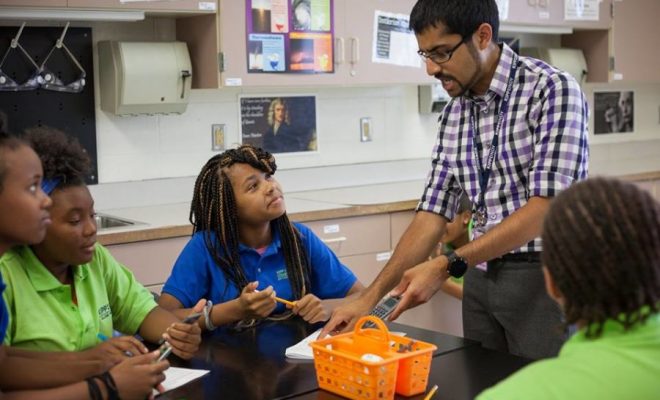
Using EdTech to assess small group instruction

A panel discussion with the teachers of Richardson ISD in Richardson, Texas
PANELISTS:
Caroline Canessa, Merriman Park Elementary, 5th Grade Reading-Language Arts
Leah Janoe, Dover Elementary, 5th Grade Math
Ashley Scott, White Rock Elementary, 3rd Grade
Jennifer Looney, Wallace Elementary, 3rd Grade
Alyson Hollon, Dover Elementary, 6th Grade Science
For those who may not know, can you elaborate on what your state standards ask teachers to assess in terms of small group discussions?
Jennifer Looney: According to our third grade standards, students should be involved in teacher-led and student-led discussions.
Leah Janoe: Students should participate in small-group discussions by asking questions and answering questions appropriately, which includes answering the question thoroughly, giving enough detail, and most importantly helping the conversation build and continue through their input.
Ashley Scott: We’re also asked to determine if students can use proper verb tense and grammar through discussions with peers.
Why is it challenging for teachers to monitor small group discussions?
Alyson Hollon: The biggest challenge with small group discussions or team collaborations is being able to monitor each group’s discussions at once, so that any misconceptions are addressed.
Caroline Canessa: This area of teaching can be very challenging! Often times it is hard to know whether or not student conversations or focus on the task at hand, or completely off the mark. Also, students may pretend to be on task while the teacher is near, but then return to being off task as soon as the teacher leaves the area.
Jennifer Looney: Small groups are often spread out all over the class, so it is hard for a teacher to have the time to engage with all groups. It is also a challenge to talk to one group while also monitoring behavior in a group across the room.
RISD has found and is trying out a tool that allows teachers to monitor several discussions all at once. Can you tell us about it?
Ashley Scott: The Flexcat system comes with two teacher microphones and remotes, one large speaker, and six individual speaker pods. The microphones can be used to project your voice out of the large speaker or out of individual pods. The remote controls the volume of your voice. You can use your normal talking voice and it does a wonderful job making it louder for all students to hear. With the pods I can control which group I would like to speak to directly. The microphone comes with an earpiece, which allows for you to listen through the pod to that group. You can turn on the pod without the students knowing and listen. Students can also use the call button on their pod and speak to the teacher through their pod.
Jennifer Looney: The speaker pods allow you to have ears all over the classroom. From working with a small group at my teacher table, I can tell what a group in the hallway is discussing and talk to them directly to refocus them without interrupting precious teaching time.
How has the Flexcat changed the way you run your classroom?
Leah Janoe: The Flexcat allows me to hear students’ natural conversations with each other, especially when I can listen in and hear how students are explaining a concept to each other. As a math teacher, I can listen in and see what steps students are verbalizing during group work and help clear up misconceptions in that manner. With the ability to project my voice using the main speaker, I’ve noticed that my students can actually hear my from any point in the room without me having to yell while teaching.
Ashley Scott: My kids are highly motivated to share their thinking and “be the teacher” up at the front of the class wearing the microphone. I can also send a student into a breakout room with a pod to finish work or make up a test. I can pop in on the pod and make sure everything is going OK or they can call me if they have a question. There is also a place for headphones so you could send a child with a pod and headphones to another class to work and still be able to talk directly to the student. It provides so much freedom and flexibility.
How have students reacted to the Flexcat?
Caroline Canessa: The students think the Flexcat is a lot of fun! They always ask to use the microphone and love to push the call button.
Alyson Hollon: The students were shocked at first when they realize that I could listen to their conversations even when I wasn’t near them. This has really pushed them to remain on topic and have higher-level group discussions. It has also given students who normally don’t ask questions the opportunity to ask me direct questions, reducing their feeling of apprehension.
Leah Janoe: My students have loved using the Flexcat system because they can discreetly call me to ask for help on a problem. Students who normally would not ask for help feel more comfortable asking for help if they can do so without me having to walk over to address them.
Could you share an example of a time when the Flexcat allowed you to catch a student really shining that you would have otherwise missed?
Ashley Scott: This year I had a few students new to our school. Most of my class has gone to school with their peers since kindergarten, and it can be an intimidating situation to walk into. It took this student until the third week to raise her hand to share with the class. One day I called on this particular child to “be the teacher” and share her thinking with the class during math. I gave her the microphone and once she heard her voice from the back of the room, she immediately smiled and stood up straight. You could see how excited and proud she was. Without the microphone, there is no way anyone would have been able to hear her because she was so nervous about sharing with her new peers.
Jennifer Looney: I have a very intelligent student who prefers to only share a few words at a time whole group because she is so shy. When she is with her tablemates, however, she is very talkative. I am able to listen in on her responses in a more laidback situation. I know several students have anxiety about whole class answers and responding directly to a teacher. As this student was working through a table problem in math, she guided her peers to solve a multiplication problem. It was really great to witness her come out of her shell and collaborate!
Alyson Hollon: I have this one student who really struggles working with teammates. One day I was listening to his group as they were finishing up a lab and he explained to another teammate why the chemical reaction occurred and he explained it so well. At this time I was working with my small group students and if I didn’t have the Flexcat I would never have heard his wonderful explanation.
What are your thoughts on education these days?
Caroline Canessa: The world of education is just as challenging and rigorous as it has always been.
Alyson Hollon: Today’s education is changing from teacher lead to student lead. Our students need “21st century skills” to be successful today which changes the role of teacher in a 21st century classroom. Students are more motivated and want to be in charge in their own learning.
Leah Janoe: In these times, I am amazed at what students are learning and how they are being taught. The methods and topics that students are using are amazing and I cannot imagine having learned with so many technology tools when I was in school.
What are your thoughts on technology in education? Why?
Jennifer Looney: Technology is used, in some way, for every career out there. Students must graduate knowing how to use this technology. To exclude technology from the classroom would be a great disservice to our students.
Leah Janoe: I am so excited for (and slightly jealous of) the technology opportunities my students have to integrate into their classes and learning. I’m amazed at all the tools students can use to encourage their learning.
Caroline Canessa: Technology in education is critical. It allows students access to information that they may not otherwise be able to access at home. It also readies all students for the future – which is increasingly more and more digital world.
Any other comments or experiences to share?
Alyson Hollon: I honestly believe with all the technology that I have in my classroom, the Flexcat is essential and necessary. A Flexcat should be in every classroom.
Ashley Scott: I would not want to go back to teaching without the Flexcat!