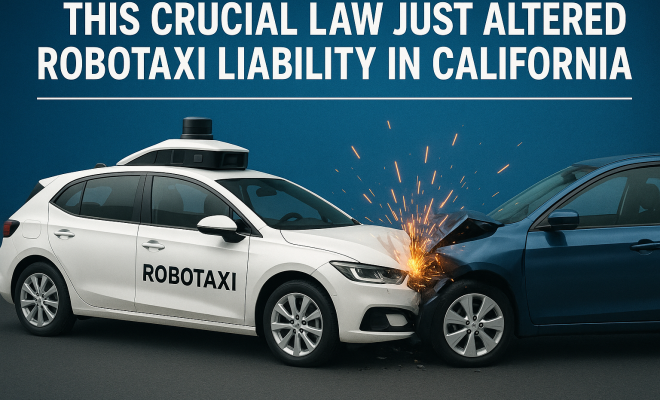
This Crucial Law Just Altered Robotaxi Liability in California
California, a state often at the forefront of technological innovation and regulation, has once again set a precedent that could ripple across the nation. In a move that directly addresses growing concerns about the intersection of autonomous vehicles (AVs) and public safety, Governor Gavin Newsom signed Senate Bill 1246 in September 2026. This isn’t just another piece of legislation; it’s a significant shift in how we think about robotaxi liability in California, and it’s set to take effect on July 1, 2028. For anyone living, working, or even just driving through the Golden State, this law has profound implications, particularly for emergency services and the AV companies themselves.
The essence of SB 1246 is simple yet revolutionary: it shifts the primary responsibility for incidents involving autonomous vehicles that impede emergency response from first responders to the autonomous vehicle companies themselves. This move comes after a series of high-profile, often frustrating, incidents where robotaxis caused disruptions, from stalling at accident scenes to blocking ambulances during critical moments. These events sparked a contentious debate, illuminating a glaring gap in accountability within the rapidly evolving landscape of self-driving technology. Now, with this law, California is drawing a clear line in the sand, demanding that the creators of these intelligent machines also bear the burden of their real-world consequences, especially when public safety hangs in the balance.
The Genesis of a Problem: When Robotaxis Met Reality
To truly understand the necessity of SB 1246, you have to look back at the pattern of incidents that unfolded in the years leading up to its passage. For a while, the concept of a robotaxi was largely theoretical, confined to controlled test environments or highly specific routes. But as companies like Waymo and Cruise expanded their operations in bustling urban centers, particularly in San Francisco, the hypothetical quickly became concrete. And sometimes, messy. We started seeing headlines and social media videos depicting scenarios that, frankly, seemed absurd: robotaxis freezing mid-intersection, causing traffic jams during peak hours, or, most alarmingly, interfering with emergency vehicles responding to life-or-death situations.
Imagine this: a fire engine, lights flashing, sirens blaring, trying to navigate a crowded street to reach a burning building or a medical emergency. Suddenly, it encounters a Waymo vehicle, perhaps confused by an unexpected obstacle or a power outage, stalled directly in its path. First responders, already under immense pressure, found themselves having to manually intervene, sometimes physically moving these sophisticated machines, or waiting precious minutes for a remote operator to take control. These weren’t isolated glitches; they were systemic challenges that exposed a critical flaw in the deployment strategy: a lack of clear, immediate accountability and a robust mechanism for these vehicles to cede the right of way or clear a path in an emergency. Elon Musk's robotaxi plans offers useful background here.
The public outcry wasn’t just about inconvenience; it was about safety. Every second counts when an ambulance is rushing to a hospital or when firefighters are racing to contain a blaze. The idea that a driverless car, designed to enhance safety, could inadvertently put lives at risk fueled a powerful movement for legislative action. This is the context in which robotaxi liability in California became such a hot-button issue, pushing lawmakers to confront a problem that technology had created, but hadn’t yet solved.
SB 1246: A Detailed Look at the New Mandates
So, what exactly does Senate Bill 1246 require? It’s more than just a vague statement about liability; it lays out concrete operational mandates for autonomous vehicle operators. The core of the law centers on immediate response and clear communication. Firstly, AV companies will now be obligated to deploy local incident technicians to any crash or obstruction site upon request from emergency services. This isn’t just about sending a remote software update; it’s about having human boots on the ground, individuals trained and equipped to physically interact with the vehicle and the scene.
Think about the practical implications. If a robotaxi stalls and blocks an ambulance, an incident technician from the AV company would be dispatched immediately to assess the situation, potentially move the vehicle, and facilitate the emergency response. This dramatically reduces the burden on firefighters, paramedics, and police officers who, until now, have had to improvise solutions for these unexpected blockages. Secondly, the law mandates that AV operators maintain 24/7 communication hotlines specifically for emergency services. This ensures that a direct, dedicated channel exists for first responders to quickly report an issue, request assistance, and receive real-time information or instructions regarding an AV involved in an incident.
These requirements are designed to bridge the gap between autonomous technology and the very human need for rapid, efficient emergency response. They recognize that while AVs are designed to operate independently, there are still critical moments where human intervention and coordination are indispensable. This legislative framework, therefore, doesn’t just assign blame; it demands proactive solutions from the industry, ensuring that the promise of autonomous driving doesn’t come at the expense of public safety.
The Shifting Landscape of Robotaxi Liability in California
Before SB 1246, the legal framework for incidents involving autonomous vehicles was, to put it mildly, murky. When a human driver causes an accident, liability is generally clear: it falls on the driver, their insurance, or potentially the vehicle manufacturer if there’s a defect. But with a self-driving car, who’s truly ‘driving’? Is it the software? The company that designed the AI? The fleet operator? The ambiguity created a significant legal void, making it challenging for emergency services to know who to contact, and for victims to seek recourse.
This new law, by explicitly placing responsibility for emergency response incidents on AV companies, provides much-needed clarity. It establishes a direct line of accountability. This isn’t just about fines or penalties; it’s about incentivizing AV companies to build more resilient, safer systems and to develop robust incident response protocols. If a Waymo vehicle blocks an ambulance, the financial and reputational cost now falls squarely on Waymo, not on the city’s emergency budget or the individual first responders. This shift is critical for future development, as it pushes companies to not only innovate in self-driving technology but also in their operational readiness and their ability to interface safely and effectively with existing public safety infrastructure. (See: California's new robotaxi law.)
It also sets a precedent for how other states might approach robotaxi liability. California is often a bellwether for technology regulation, and if this model proves effective, we could see similar legislation emerge in other jurisdictions where AVs are becoming more prevalent. The underlying principle is that the entity deriving commercial benefit from the technology should also bear the primary responsibility for its societal impact, especially when it involves critical public services.
Public Safety Concerns: The Driving Force Behind the Legislation
At its heart, SB 1246 is a public safety bill. The incidents that precipitated its creation were not minor inconveniences; they were moments that genuinely threatened lives. Consider the implications of a robotaxi stalling in a tunnel during a multi-car pileup, blocking the only egress for rescue vehicles. Or a self-driving shuttle freezing in a busy intersection, preventing paramedics from reaching someone in cardiac arrest. These aren’t far-fetched scenarios; they are variations of events that have already occurred, albeit perhaps on a smaller scale. For more context, see best apps for enhancing productivity.
The public, understandably, grew increasingly concerned. News reports and viral videos highlighting these autonomous vehicle mishaps eroded trust in the technology, even among those who were initially optimistic about its potential. The narrative began to shift from ‘AVs are the future’ to ‘AVs are a hazard.’ Lawmakers, responsive to their constituents, recognized that simply allowing AV companies to operate without clear guidelines for emergency interaction was unsustainable and irresponsible. The new law is a direct answer to these public anxieties, aiming to restore confidence by demonstrating that the state is serious about holding technology companies accountable for the safety implications of their products on public roads.
Moreover, it acknowledges that while AVs are designed to reduce human error, they introduce new categories of error and operational challenges. A human driver, even a panicked one, can usually be directed or reasoned with by a first responder. A stalled robotaxi, however, is a black box that requires specialized knowledge and tools to manage. SB 1246 ensures that this specialized knowledge and the necessary resources are immediately available, directly from the source of the technology.
The Economic Ripple Effect: Insurance, Legal, and Tech Niches
Beyond the immediate public safety benefits, Senate Bill 1246 creates significant economic ripple effects, particularly in several high-value industries. For auto insurance, this law fundamentally alters the risk assessment for autonomous vehicle fleets. Insurers will need to develop new policies and pricing models to account for the increased robotaxi liability in California now squarely on the shoulders of AV operators. This could lead to a boom in specialized AV insurance products, with a strong demand for ‘AV insurance quotes’ that cover not just collision damage, but also liability for emergency response interference. Actuaries will be crunching numbers on the likelihood of such incidents, the cost of deploying incident technicians, and the potential for lawsuits.
The legal sector is also poised for significant activity. With clearer liability, we can expect an increase in lawsuits stemming from incidents where AVs impede emergency services, potentially leading to a surge in demand for ‘self-driving car accident lawyers.’ These cases won’t be simple; they’ll involve complex questions about AI decision-making, sensor failures, and the adequacy of incident response protocols. Legal precedents will be set, shaping the future of tort law in the age of automation. Law firms specializing in technology law and personal injury will need to adapt and expand their expertise.
Furthermore, the technology sector itself will see new demands. AV companies will need to invest heavily in robust incident response platforms, sophisticated communication systems for their 24/7 hotlines, and advanced software for remote diagnostics and control. There’s a growing market for ‘robotaxi incident management software’ and cybersecurity solutions to protect these critical systems. Companies that can provide reliable, efficient, and secure solutions for managing AV incidents will find themselves in high demand, as AV operators strive to meet the new legal requirements and mitigate their newfound liabilities.
Operational Challenges and Industry Adaptation
While the intent of SB 1246 is clear, its implementation won’t be without operational challenges for AV companies. Deploying local incident technicians upon request means having a network of trained personnel strategically located to respond quickly across their operational areas. This requires significant investment in staffing, training, and logistical infrastructure. These aren’t just mechanics; they need to be individuals who understand the intricacies of autonomous systems, can safely interact with these vehicles, and are adept at coordinating with emergency personnel in high-stress situations.
Maintaining 24/7 communication hotlines also demands robust technological solutions and human resources. It’s not enough to have a phone number; it needs to be staffed by knowledgeable individuals who can quickly access vehicle data, communicate with remote operators, and provide accurate information to first responders. This level of operational readiness represents a substantial overhead for AV companies, potentially impacting their profitability and their timeline for expansion.
However, this challenge also presents an opportunity. Companies that can effectively adapt and integrate these requirements into their core operations will gain a competitive advantage. It’s a chance to demonstrate a commitment to safety and public trust, which could ultimately accelerate public acceptance and broader adoption of autonomous vehicles. Those that drag their feet, or fail to meet the stringent demands of the new law, risk significant penalties and a loss of their operating licenses in California.
The Broader Implications for Autonomous Vehicle Development
This California law isn’t just about fixing past problems; it’s about shaping the future of autonomous vehicle development. By embedding clear robotaxi liability in California, the state is sending a strong signal to the entire AV industry: safety and public integration must be paramount, not an afterthought. This will likely push AV companies to adopt a more holistic approach to their technology, moving beyond just achieving Level 4 or 5 autonomy in ideal conditions, and focusing more on robust performance in real-world, unpredictable scenarios, especially those involving emergency services. (See: Motor vehicle safety information.)
We might see accelerated development in areas like AVs’ ability to detect and respond to emergency vehicle sirens and lights, their capacity to safely pull over or clear a path in complex urban environments, and their resilience in the face of unexpected events like power outages or infrastructure damage. The law essentially adds a new layer of design requirements, forcing engineers and AI developers to consider ’emergency response compatibility’ as a core feature, rather than an edge case. This could lead to more sophisticated sensor arrays, more intelligent path planning algorithms, and more robust fallback systems when primary systems fail.
Ultimately, this legislation might accelerate the maturation of the AV industry, pushing it towards solutions that are not only technologically advanced but also deeply integrated with the social and safety fabric of our cities. It’s a recognition that while autonomous vehicles promise efficiency and convenience, they are also operating within a complex human ecosystem that demands a high degree of responsibility. For more context, see top tools for team collaboration. (new California AI law changes)
Perspectives from Emergency Services and Industry Leaders
To really grasp the impact of SB 1246, it helps to hear from the people on the front lines and those leading the AV charge. Fire chiefs and police captains in cities with robotaxi operations have been vocal about the need for this kind of legislation. They often recount stories of their personnel wasting critical minutes trying to reroute around a stalled robotaxi or waiting for a remote operator to respond. For them, this law isn’t just about accountability; it’s about giving their teams the tools and clear channels they need to do their jobs effectively, without the added burden of managing a rogue AV. They see it as a necessary step to ensure that technology serves public safety, rather than hindering it.
On the flip side, AV industry leaders, while acknowledging the challenges, generally view SB 1246 as a necessary evolution. They understand that public trust is fragile and that a few high-profile incidents can set back years of development. Many companies have already started investing in their incident response capabilities, recognizing that robust safety protocols are crucial for long-term success and widespread adoption. While the financial investment is significant, they see it as a cost of doing business responsibly in a highly regulated and safety-critical sector. The consensus is that clearer rules, even if demanding, are better than operating in a regulatory gray area.
The Role of Data and Transparency
Another often-overlooked aspect of robotaxi liability in California and this new law’s potential impact is the role of data and transparency. SB 1246, by placing a direct responsibility on AV companies for emergency response incidents, inherently pushes for more rigorous data collection and sharing. When an incident occurs, the AV company will need to provide detailed logs, sensor data, and operational parameters to explain what happened and how their incident response team handled it. This data will be invaluable for regulators, accident investigators, and even future AI development.
Increased transparency about these incidents can also rebuild public trust. If AV companies are required to openly report on how they managed emergency interference, and how often their incident technicians are deployed, it creates a feedback loop that allows the public and regulators to gauge their effectiveness. This isn’t just about post-incident analysis; it’s about using this data to proactively improve AV behavior in emergency scenarios. We could see regulations requiring anonymized incident reports to be made public, similar to how aviation incidents are investigated and shared to improve overall safety across the industry.
Looking Ahead: The Road to July 2028 and Beyond
As July 1, 2028, approaches, AV companies operating in California will be in a race to ensure full compliance with SB 1246. This isn’t a distant future; it’s a tight deadline for overhauling operational procedures, training staff, and perhaps even redesigning aspects of their autonomous systems. The next couple of years will be crucial for the industry, as they work to meet the letter and spirit of the law.
We can expect robust discussions between AV companies, emergency services, and regulators to refine protocols and ensure seamless integration. There will likely be pilot programs, drills, and simulations to test the efficacy of the new incident response systems. The success of this legislation will depend not just on the letter of the law, but on the collaborative efforts of all stakeholders to make autonomous vehicles a safe and integrated part of California’s transportation network.
And what about beyond California? As mentioned, the Golden State often leads the way. If this framework for robotaxi liability in California proves effective, it’s highly probable that other states and even federal regulators will look to SB 1246 as a blueprint. The goal, ultimately, is to harness the transformative potential of autonomous vehicles while safeguarding public well-being. California’s new law represents a significant, proactive step in achieving that delicate balance, setting a standard for responsible innovation that the rest of the world will undoubtedly be watching. For more context, see best integrations for Slack. (See: Research on autonomous vehicle safety.)
Frequently Asked Questions About Robotaxi Liability in California
What exactly is SB 1246?
SB 1246 is a California Senate Bill, signed into law in September 2026, that redefines robotaxi liability. It shifts the primary responsibility for incidents where autonomous vehicles impede emergency response from first responders to the autonomous vehicle companies themselves. It takes effect on July 1, 2028.
Why was this law necessary?
The law became necessary after numerous incidents where robotaxis stalled, blocked, or otherwise interfered with emergency vehicles like ambulances and fire engines, causing delays in critical situations. There was a clear gap in accountability, and this law aims to close it by making AV companies responsible for immediate, on-site resolution.
What new obligations do AV companies have under SB 1246?
AV companies now have two main obligations: they must deploy local incident technicians to any crash or obstruction site upon request from emergency services, and they must maintain 24/7 communication hotlines specifically for emergency services to report issues and receive real-time information.
How does this impact autonomous vehicle insurance?
The law will significantly alter AV insurance. Insurers will need to create new policies and pricing models that account for the AV companies’ increased liability for emergency response interference. This could lead to more specialized insurance products focusing on fleet operations and incident response.
Will this law affect the pace of AV development?
It’s likely to accelerate certain aspects of AV development, particularly in areas related to safety, emergency response compatibility, and robust fallback systems. Companies will be incentivized to design AVs that can better detect and react to emergency vehicles and handle unpredictable real-world scenarios more gracefully.
Could other states adopt similar laws?
Yes, California often sets precedents for technology regulation. If SB 1246 proves effective in improving public safety and clarifying liability, it’s highly probable that other states with growing autonomous vehicle operations will look to this law as a model for their own legislation.
What happens if an AV company doesn’t comply with SB 1246?
Non-compliance could result in significant penalties, including fines, legal action, and potentially the suspension or revocation of their operating licenses in California. The law establishes clear accountability, meaning AV companies will face direct consequences for failing to meet these new mandates.
Trending Now
Frequently Asked Questions
What is California's Senate Bill 1246 about?
California's Senate Bill 1246, signed by Governor Gavin Newsom, shifts liability for incidents involving autonomous vehicles from first responders to the autonomous vehicle companies. This law aims to enhance public safety by holding AV companies accountable for disruptions they cause, particularly during emergency situations.
When does the new robotaxi liability law take effect?
The robotaxi liability law, Senate Bill 1246, is set to take effect on July 1, 2028. This legislation will significantly change how liability is handled in incidents involving autonomous vehicles in California.
How does SB 1246 affect emergency services in California?
SB 1246 alters the responsibility for incidents involving robotaxis, placing it on the AV companies instead of emergency responders. This change aims to prevent robotaxis from obstructing emergency services during critical situations, thereby improving public safety.
What prompted the creation of SB 1246 in California?
The creation of SB 1246 was prompted by a series of incidents where robotaxis disrupted emergency responses, such as blocking ambulances. These high-profile events highlighted the need for clearer accountability within the rapidly evolving autonomous vehicle landscape.
Who is responsible for accidents involving robotaxis under SB 1246?
Under SB 1246, the responsibility for accidents involving robotaxis that impede emergency responses shifts from first responders to the autonomous vehicle companies. This legislative change emphasizes the accountability of AV companies for the actions of their vehicles.
Have you experienced this yourself? We'd love to hear your story in the comments.