This Astonishing Discovery Around a Dead Star Just Blew Up Astrobiology
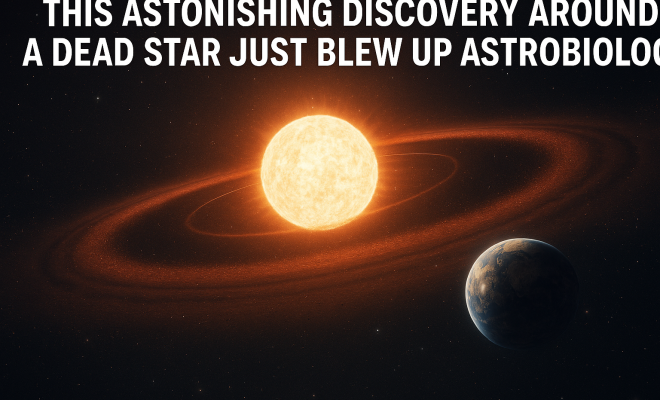
Imagine a planet, not born in the fiery embrace of a young star, but forged from the ashes of a star’s violent death. Sounds like science fiction, right? Well, astronomers have just given us a glimpse into that very reality, and it’s shaking up everything we thought we knew about where life might thrive in the cosmos. The recent discovery of HS 0209+0832b, a ‘second-generation’ planet orbiting a white dwarf star roughly 270 light-years away, is a truly groundbreaking find. This Jupiter-like world appears to have coalesced from the very debris ejected when its parent star, once a sun-like star, died. This challenges long-held theories about planetary formation and, frankly, throws open a whole new cosmic door for astrobiology.
For decades, we’ve focused our search for extraterrestrial life on planets orbiting active, main-sequence stars, much like our own Sun. The idea of a planet forming and then maintaining a stable, potentially habitable environment around a dead star – a white dwarf – was, until now, largely confined to theoretical discussions. Yet, researchers from the University of Warwick, poring over archival data from NASA’s Hubble Space Telescope, suggest HS 0209+0832b could indeed maintain conditions suitable for life for millions, even billions, of years as its white dwarf host slowly cools. This revelation isn’t just a scientific curiosity; it’s a profound philosophical shift, forcing us to reconsider life’s resilience and its potential to persist far beyond the perceived lifespan of its original star system. This kind of discovery invigorates the entire field, making the pursuit of knowledge through the best astrobiology programs more exciting than ever.
If you’re an aspiring space scientist, this is precisely the kind of moment that defines a generation. The implications for the prevalence of life in the universe are staggering, and the questions it raises about life’s ability to adapt and endure are endless. It’s a clear signal that the frontiers of astrobiology are expanding rapidly, and there’s never been a more opportune time to dive into this fascinating field. For those looking to be at the forefront of these discoveries, choosing the right educational path is crucial. Let’s explore some of the best astrobiology programs available today that are equipping future scientists to tackle these monumental questions.
1. The University of Edinburgh, UK: MSc in Astrobiology and Planetary Sciences
When you’re looking for a program that truly embodies the interdisciplinary spirit of astrobiology, the University of Edinburgh’s MSc in Astrobiology and Planetary Sciences often comes up at the top. This program is designed to give students a comprehensive understanding of the origin, evolution, and distribution of life in the universe, a mission that feels even more urgent and relevant with the discovery of HS 0209+0832b. What really sets Edinburgh apart is its strong foundation in both the biological and geological sciences, combined with a deep dive into planetary science. You’re not just studying biology; you’re exploring how biology interacts with alien environments, from the icy moons of Jupiter to the newly discovered worlds orbiting dead stars.
The curriculum is robust, covering everything from the chemistry of life’s origins and astrobiological detection techniques to planetary environments and the search for extraterrestrial intelligence (SETI). Students benefit from direct access to faculty actively involved in cutting-edge research, including projects related to Mars exploration and exoplanet characterization. The program culminates in a significant research project, often allowing students to contribute to ongoing scientific investigations. This hands-on experience, combined with a rigorous theoretical framework, makes it one of the best astrobiology programs for those serious about a research-oriented career.
2. Florida Institute of Technology (FIT), USA: Master of Science in Astrobiology
For a program with a uniquely American flavor, and one that benefits from proximity to the space coast, Florida Tech’s Master of Science in Astrobiology is a standout. FIT has a long-standing reputation for excellence in space-related fields, and its astrobiology program leverages this expertise beautifully. The curriculum is broad, encompassing astrophysics, planetary geology, organic chemistry, and microbiology, ensuring graduates have a versatile skill set. What’s particularly appealing about FIT’s program is its emphasis on practical, applied research, often utilizing instruments and methodologies relevant to current and future space missions.
The faculty here are often involved in NASA-funded projects, offering students unparalleled opportunities for mentorship and collaboration. You might find yourself working on projects simulating extreme environments on other planets, analyzing extraterrestrial materials, or developing instrumentation for future probes. The interdepartmental nature of the program means you’ll be learning from experts across various scientific disciplines, fostering a truly holistic understanding of astrobiology. If you’re looking for a program that combines academic rigor with real-world space industry connections, FIT offers one of the best astrobiology programs out there. (See: White dwarf star explanation.)
3. The University of Arizona, USA: Interdisciplinary Minor in Astrobiology
While not a full master’s degree, the University of Arizona’s Interdisciplinary Minor in Astrobiology deserves a mention because of its foundational strength and the institution’s overall reputation in planetary science. For undergraduates, or graduate students in related fields who want to build a strong astrobiological framework, this minor is incredibly valuable. Arizona is home to the Lunar and Planetary Laboratory (LPL), a world-renowned center for space exploration, and its faculty are deeply involved in missions like OSIRIS-REx and the James Webb Space Telescope. This means even at the minor level, students are exposed to cutting-edge research and thought leaders in the field. For more context, see the implications of rogue AI.
The minor provides a robust introduction to the field, covering topics from the origins of life on Earth to the search for life elsewhere. It’s an excellent pathway for students who might pursue a Ph.D. in a related scientific discipline (like geology, astronomy, or biology) but want a strong astrobiology specialization. The breadth of expertise at the University of Arizona, especially in areas like exoplanet characterization and planetary habitability, makes this minor a fantastic springboard for anyone serious about a career in astrobiology. It offers a taste of what makes the best astrobiology programs so compelling.
4. University College London (UCL), UK: MSc in Planetary Science
UCL’s MSc in Planetary Science, while not exclusively branded as ‘astrobiology,’ has a very strong astrobiological component and is widely regarded as one of Europe’s premier programs for studying other worlds. Given the profound implications of the HS 0209+0832b discovery, a program like UCL’s, with its deep focus on planetary formation, evolution, and environments, becomes even more critical. Understanding how planets form around dead stars requires a sophisticated grasp of planetary dynamics and geological processes, areas where UCL excels.
Students delve into topics such as planetary atmospheres, surface processes, interior structures, and the very processes that lead to planet formation. Many faculty members are actively involved in space missions, providing invaluable insights and potential research opportunities. The interdisciplinary nature of the program draws from astrophysics, geophysics, and chemistry departments, offering a comprehensive view of planetary science. If your interest in astrobiology leans heavily towards understanding the physical conditions necessary for life on other planets, UCL’s program offers an exceptionally strong foundation and could easily be considered among the best astrobiology programs in terms of its scientific rigor and breadth.
5. Open University, UK: MSc in Space Science and Technology (Planetary Environments and Life)
For those who need flexibility, the Open University in the UK offers an outstanding online option with its MSc in Space Science and Technology, featuring a specialization in ‘Planetary Environments and Life.’ This program is a game-changer for working professionals or individuals who can’t relocate for their studies, proving that distance learning can still deliver world-class education. The Open University has a long history of excellence in distance education, and its space science programs are no exception. The curriculum is meticulously designed to be engaging and rigorous, despite the online format.
The ‘Planetary Environments and Life’ pathway specifically addresses key astrobiological questions, covering topics such as planetary habitability, exoplanetary detection, and the search for biosignatures. You’ll gain a deep understanding of the conditions that allow life to emerge and persist, which is more relevant than ever with discoveries like HS 0209+0832b. The program draws on the Open University’s strong research base in planetary science and astrobiology, with faculty often involved in major space missions. If you’re seeking one of the best astrobiology programs that offers both flexibility and academic depth, this online MSc is a fantastic choice.
6. University of Washington, USA: Certificate in Astrobiology
Similar to Arizona’s minor, the University of Washington’s Certificate in Astrobiology offers a focused pathway for individuals looking to gain specialized knowledge without committing to a full master’s degree, or to complement an existing degree. Washington has a powerful Astrobiology Program that brings together faculty from diverse departments, including Earth and Space Sciences, Astronomy, Oceanography, and Atmospheric Sciences. This collaborative environment fosters a truly interdisciplinary approach to the field, which is essential for tackling complex questions about life beyond Earth.
The certificate program provides a strong grounding in the core concepts of astrobiology, from the origins of life to the detection of exoplanets and the philosophical implications of discovering extraterrestrial intelligence. It’s an excellent option for those already holding a science degree who want to pivot towards astrobiology, or for professionals seeking to enhance their skill set. The program leverages the university’s significant research infrastructure and active participation in various astrobiology research consortia. For a focused, high-quality introduction or specialization, this certificate is undoubtedly one of the best astrobiology programs available. (See: NASA Hubble Space Telescope discoveries.)
7. University of St Andrews, UK: MRes in Astrophysics (with Astrobiology Focus)
The University of St Andrews, with its rich academic history, offers an MRes in Astrophysics that can be tailored with a strong astrobiology focus, making it a powerful choice for students whose interests lie at the intersection of astronomy and the search for life. While primarily an astrophysics degree, the research-intensive nature of the MRes allows students to pursue projects directly related to astrobiology, such as exoplanet characterization, the study of protoplanetary disks, or the habitability of specific stellar environments. This flexibility is key, especially as new discoveries redefine what constitutes a potentially habitable zone. For more context, see breakthroughs in scientific research.
The MRes program is designed to prepare students for doctoral research, providing a deep dive into advanced astrophysical concepts and research methodologies. St Andrews has a strong astronomy group, with expertise in areas crucial to astrobiology, including exoplanet detection and atmospheric modeling. If you’re passionate about the astronomical aspects of astrobiology – understanding the environments where life might arise and how to detect it from afar – and want a strong research foundation, this program offers an exceptional path and can be considered among the best astrobiology programs for its specific niche.
The Impact of HS 0209+0832b: Reshaping Our Search for Life
The discovery of HS 0209+0832b isn’t just another exoplanet finding; it’s a paradigm shift. For so long, our models for habitability have been tethered to the life cycle of a main-sequence star like our Sun. We imagined planets forming in a relatively orderly fashion from a protoplanetary disk, then settling into a long, stable existence around their parent star. But now, we have compelling evidence of a world that literally rose from the ashes – a ‘second-generation’ planet. This suggests that the universe might be far more dynamic and forgiving when it comes to planetary formation than we ever dared to imagine.
This finding, made by University of Warwick researchers using archival Hubble data, means we need to expand our search parameters significantly. White dwarfs, once seen as cosmic graveyards, might actually harbor worlds that reformed after their star’s violent death throes. And crucially, these white dwarfs cool very slowly, meaning a planet in the right orbital sweet spot could remain habitable for billions of years, potentially even longer than Earth’s remaining habitable lifespan around our aging Sun. Think about that for a moment: life could potentially thrive on planets orbiting dead stars, long after their stellar nurseries have faded.
Why Interdisciplinary Skills Are More Crucial Than Ever
This discovery underscores a fundamental truth about astrobiology: it’s inherently interdisciplinary. To understand HS 0209+0832b, you need astronomers who can detect it, planetary scientists who can model its formation and evolution, geologists who can speculate on its internal structure, and biologists who can ponder what kind of life might survive such a cataclysmic origin story. This isn’t a field for specialists working in isolation; it’s a field for synthesizers, for thinkers who can bridge the gaps between seemingly disparate scientific domains.
The best astrobiology programs understand this, which is why they emphasize curriculum that spans multiple traditional sciences. You’ll find yourself delving into everything from microbiology and biochemistry to astrophysics and planetary geology. The ability to speak the language of different scientific fields, to connect concepts across disciplines, is what will drive the next generation of breakthroughs. The more we learn about the universe, the more complex and interconnected it becomes, and our scientific approaches must evolve to match that complexity. For more context, see troubling signs for technology. (See: New York Times on white dwarf planets.)
The Future of Astrobiology: Beyond the Main Sequence
The implications of this ‘dead star planet’ extend far beyond just HS 0209+0832b. It opens up a whole new class of potential targets for future exoplanet surveys and missions. Imagine dedicated telescopes designed to search for planets around white dwarfs, looking for subtle changes in light that could indicate atmospheric biosignatures. This shifts our focus, reminding us that life is tenacious and adaptable, and its potential abodes might be far more diverse than our Earth-centric biases have led us to believe.
This also reignites the philosophical debate about the ubiquity of life. If planets can form and remain habitable around dead stars, then the universe’s habitable window, and the sheer number of potentially life-bearing worlds, just got a lot bigger. It challenges us to think more creatively about what life might look like, how it might evolve in such unique circumstances, and what biosignatures we should be looking for. The next few decades in astrobiology are going to be nothing short of revolutionary, and choosing one of the best astrobiology programs now means you’ll be right at the heart of it.
Choosing Your Path: What to Look For in an Astrobiology Program
When you’re sifting through the options for the best astrobiology programs, keep a few key factors in mind. First, consider the faculty’s research interests. Do they align with what excites you most about astrobiology? Are they actively involved in current missions or groundbreaking theoretical work? Second, look at the interdisciplinary nature of the curriculum. Does it genuinely integrate biology, chemistry, geology, and astronomy, or does it feel like a collection of separate courses? The stronger the integration, the better prepared you’ll be.
Finally, think about the practical experience offered. Does the program include opportunities for lab work, fieldwork, computational modeling, or participation in research projects? Direct involvement in scientific inquiry is invaluable. Whether you opt for a comprehensive master’s degree, a focused certificate, or an undergraduate minor, the goal is to equip yourself with the tools and knowledge to contribute to this thrilling quest. The universe is calling, and with discoveries like HS 0209+0832b, the call is louder and more intriguing than ever.
The discovery of a planet like HS 0209+0832b orbiting a white dwarf star is more than just a scientific headline; it’s a powerful reminder that our universe is far stranger and more wonderful than we can often conceive. It challenges our assumptions, expands our horizons, and provides a fresh impetus for the study of astrobiology. For those with a burning curiosity about life beyond Earth, there’s never been a more exciting time to pursue a career in this field. The best astrobiology programs are ready to arm you with the knowledge to write the next chapter in this incredible cosmic story.
Trending Now
Frequently Asked Questions
What is HS 0209+0832b and why is it significant?
HS 0209+0832b is a 'second-generation' planet orbiting a white dwarf star about 270 light-years away. Its discovery challenges traditional theories of planetary formation and suggests that planets can maintain habitable conditions around dead stars, reshaping our understanding of where life might thrive in the universe.
How do planets form around white dwarf stars?
Planets like HS 0209+0832b can form from the debris ejected during the violent death of a parent star, such as a sun-like star that has transitioned into a white dwarf. This process allows for the coalescence of materials into new planetary bodies, even after the original star has died.
Can life exist on planets orbiting dead stars?
Yes, recent findings suggest that planets orbiting dead stars, like HS 0209+0832b, could maintain stable environments suitable for life for millions to billions of years. This challenges previous assumptions that life can only exist around active stars and opens new avenues for astrobiological research.
What impact does HS 0209+0832b have on astrobiology?
The discovery of HS 0209+0832b significantly impacts astrobiology by prompting scientists to reconsider the conditions under which life can survive. It suggests that life may persist in environments previously thought inhospitable, invigorating the search for extraterrestrial life across different star systems.
Why is the discovery of HS 0209+0832b a philosophical shift in science?
This discovery represents a philosophical shift by challenging our understanding of life's resilience and adaptability. It suggests that life can endure beyond the expected lifespan of its original star system, inviting deeper questions about the nature of life in the universe and its potential to thrive in diverse environments.
Agree or disagree? Drop a comment and tell us what you think.