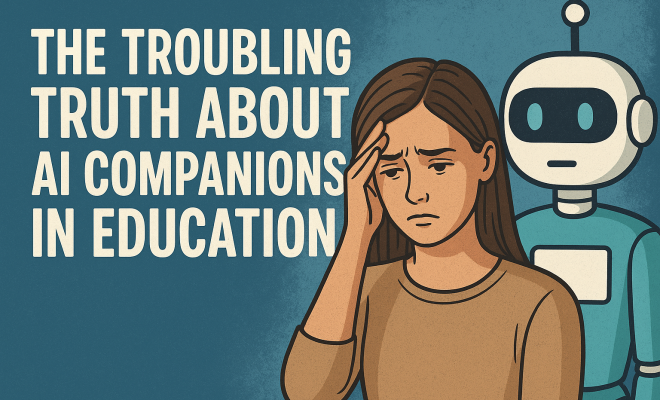
The Troubling Truth About AI Companions in Education
“`html
It’s no secret that artificial intelligence has muscled its way into nearly every corner of our lives, and education is certainly no exception. But while the tech industry buzzes with the promise of personalized learning and innovative tools, a significant, often heated, debate is brewing in schools, boardrooms, and even living rooms across the globe. We’re talking about AI companions in education, and whether their presence is a boon or a detriment to genuine learning. This isn’t just an academic discussion; it’s a deeply emotional one, as evidenced by a public debate scheduled for October 1, 2026, which aims to tackle the critical question: should schools actively discourage students from using these AI companions?
On one side, you have the innovators and market watchers, pointing to a projected $57.2 billion AI-in-education market by 2033. They see a future where AI personalizes learning, streamlines tasks, and opens up new pedagogical possibilities. On the other, you have a growing chorus of educators, parents, and even students themselves, expressing profound concerns. They worry that these AI tools are creating an ‘illusion of learning,’ where students can churn out polished, grammatically correct essays or solve complex problems with AI assistance, yet lack any real understanding or critical thinking skills. It’s a classic dilemma: convenience versus genuine development. And honestly, it’s a far more complex issue than a simple yes or no answer.
1. The Illusion of Learning: When Polish Masks Understanding
One of the most compelling arguments against the unchecked use of AI companions in education revolves around what many educators are calling the ‘illusion of learning.’ Think about it: a student is tasked with writing an essay on a challenging historical event. Instead of grappling with research, synthesizing information, and formulating original arguments, they simply prompt an AI companion. Within moments, they have a well-structured, eloquently written piece of work. On the surface, it looks great. The grammar is perfect, the arguments seem sound, and it checks all the boxes. See also the silent threat explained.
But here’s the rub: did the student actually learn anything? Did they engage in critical thinking? Did they develop their own voice or understanding of the topic? More often than not, the answer is no. They’ve bypassed the cognitive heavy lifting that leads to true comprehension and skill development. This isn’t just about cheating; it’s about the fundamental process of learning itself. If students consistently rely on AI to generate content, they miss out on the struggle – the very struggle that builds intellectual muscle and fosters deeper understanding. It’s like using a calculator for every single math problem from kindergarten through college; you might get the right answers, but you’ll never truly grasp the underlying principles.
2. Erosion of Critical Thinking Skills: The Brain’s Bypass
Beyond the ‘illusion of learning,’ a more insidious threat looms: the erosion of critical thinking skills. Critical thinking isn’t just about knowing facts; it’s about analyzing, evaluating, interpreting, and synthesizing information to form reasoned judgments. It’s the cornerstone of problem-solving, innovation, and informed decision-making. When students lean on AI companions to do the heavy lifting – to summarize texts, generate ideas, or even solve complex problems – they are effectively outsourcing their brain’s most vital functions.
Consider a scenario where a student needs to analyze a complex literary text. Traditionally, they would read it, identify themes, analyze character motivations, and form their own interpretations, perhaps debating them with peers or a teacher. With an AI companion, they can simply ask for an analysis, receive a sophisticated breakdown, and present it as their own. While the AI might offer a valid interpretation, the student hasn’t engaged in the process of critical inquiry. This consistent bypassing of intellectual effort can lead to a generation of students who are adept at prompting AI but less capable of independent thought, nuanced analysis, or original problem-solving when AI isn’t available.
3. Ethical Dilemmas and Academic Integrity: A Blurred Line
The rise of AI companions in education has thrown a massive wrench into traditional notions of academic integrity. What constitutes plagiarism when an AI generates text based on a student’s prompt? Is it still ‘original work’ if the ideas and phrasing are machine-generated? These aren’t easy questions, and schools are grappling with establishing clear guidelines in a rapidly evolving technological landscape. Many institutions are finding their existing academic honesty policies simply aren’t equipped to handle the nuances of AI usage.
Beyond plagiarism, there are broader ethical considerations. If AI can craft compelling arguments or solve intricate problems, how do we assess a student’s true capabilities? Are we grading the student, or the AI? This dilemma forces educators to rethink assignment design, assessment methods, and even the very purpose of education itself. The ethical tightrope walk involves finding a balance between leveraging AI’s potential as a tool and ensuring that students are still developing their own intellect and character. It’s about teaching responsible AI use, not just prohibiting it, which is a much harder task.
4. The EdTech Market Boom: Money Talks, But What Does It Say?
Despite the very real concerns from educators, the financial projections for AI companions in education tell a different story. The AI-in-education market is projected to reach an astounding $57.2 billion by 2033. This isn’t just a slight bump; it’s a massive boom, indicating a strong belief among investors and developers that AI has a crucial role to play in the future of learning. This market growth is fueled by innovations like AI-driven personalized learning systems, intelligent tutoring, automated grading tools, and adaptive learning platforms. (See: U.S. Department of Education resources.)
The allure for institutions and students is clear: AI promises efficiency, customization, and access to resources that might otherwise be unavailable. Companies are pouring vast resources into developing sophisticated AI tools that can adapt to individual student needs, identify learning gaps, and provide instant feedback. While the ethical and pedagogical debates rage, the economic momentum behind AI in education is undeniable. This creates a significant tension: how do you reconcile pedagogical concerns with powerful market forces pushing for wider adoption? It means that even with bans, the technology will likely find its way in, forcing a re-evaluation rather than outright rejection.
5. District-Wide AI Bans: A Pause for Reflection (or Panic?)
The backlash against AI companions in education isn’t just theoretical; it’s leading to concrete actions. Major school districts around the world have begun implementing AI bans, at least temporarily, to study the technology’s impact. These bans aren’t necessarily a permanent rejection of AI, but rather a strategic pause. Districts want to understand the true effects on student learning, academic integrity, and teacher workload before committing to widespread integration. For more context, see The Urgent Truth About Teen Gaming Addiction.
These bans are a clear signal that the concerns of educators are being taken seriously. They reflect a desire to proceed with caution, to gather data, and to formulate thoughtful policies rather than rushing headlong into an unknown future. While some might view these bans as technologically regressive, others see them as a responsible step, prioritizing student development over technological novelty. It’s a difficult position for administrators, trying to balance innovation with core educational values, especially when the landscape is shifting so quickly.
6. Personalized Learning vs. Generic Output: The AI Paradox
One of the strongest arguments in favor of AI companions in education is their potential for personalized learning. Imagine an AI tutor that can identify a student’s specific weaknesses in algebra, provide targeted practice problems, and explain concepts in multiple ways until mastery is achieved. This adaptive approach, which traditional classrooms struggle to provide for every student, is incredibly appealing. AI can offer immediate feedback, tailor content to individual pace and style, and free up teachers to focus on higher-level instruction and emotional support.
However, here’s the paradox: while AI *can* personalize the learning journey, it can also lead to generic, unoriginal output if students use it to complete assignments. If every student prompts an AI to write a similar essay on the same topic, the result is a sea of well-written but ultimately indistinguishable work. The very tool designed to personalize the *process* of learning can inadvertently homogenize the *product* of learning. The challenge, then, is to harness AI’s ability to personalize instruction without sacrificing the unique voice and original thought that should characterize a student’s output.
7. The Teacher’s Evolving Role: From Instructor to AI Integrator
The advent of AI companions in education forces a profound re-evaluation of the teacher’s role. If AI can answer questions, provide explanations, and even grade basic assignments, what does that leave for the human educator? Far from making teachers obsolete, AI actually elevates their importance, shifting their focus from information delivery to something more complex and human: guiding, mentoring, inspiring, and fostering critical thinking in an AI-saturated world.
Teachers will need to become expert integrators of AI, understanding its capabilities and limitations. They’ll design assignments that AI can’t simply ‘solve,’ focusing on higher-order thinking, creativity, collaboration, and ethical reasoning. They’ll teach students how to use AI responsibly, how to verify AI-generated information, and how to harness AI as a powerful tool for learning and creation, rather than a crutch. This demands new skills, new pedagogical approaches, and a willingness to adapt to a rapidly changing educational landscape. It’s a tough ask, but it’s where the real value of human instruction will lie.
8. Preparing for an AI-Powered Future: Beyond Bans and Backlash
Ultimately, the debate around AI companions in education isn’t about whether AI will be part of our future – it already is. The real question is how we prepare students to thrive in an AI-powered world responsibly and effectively. Outright bans, while perhaps necessary as a temporary measure, aren’t a sustainable long-term solution. We need to move beyond knee-jerk reactions and develop comprehensive strategies for integrating AI into education in a way that truly benefits students.
This means focusing on AI literacy: teaching students what AI is, how it works, its ethical implications, and how to use it as a tool for augmentation rather than substitution. It means developing curricula that encourage human-AI collaboration, fostering skills that complement AI rather than compete with it. It means investing in teacher training so educators feel confident and competent in guiding students through this new frontier. The goal shouldn’t be to shield students from AI, but to empower them to master it, making them thoughtful, discerning, and ethical users of this powerful technology. This builds on Google Classroom's benefits.
9. The Data Privacy Conundrum: Protecting Student Information
As AI companions become more sophisticated, they often require access to significant amounts of student data to personalize learning experiences. This isn’t just about grades or attendance; it can include learning styles, areas of struggle, behavioral patterns, and even biometric data in some advanced systems. This raises immediate and serious questions about data privacy and security. Who owns this data? How is it stored? Who has access to it? And how can we ensure it’s protected from breaches or misuse?
Parents and privacy advocates are right to be concerned. The collection of sensitive student information by AI companies, sometimes third-party vendors, creates potential vulnerabilities. There’s a risk of data being used for purposes beyond education, or of it falling into the wrong hands. Schools must navigate complex legal frameworks like FERPA in the US or GDPR in Europe, but these regulations often struggle to keep pace with rapidly evolving AI capabilities. Establishing clear, transparent policies for data collection, storage, and usage, along with robust security measures, is absolutely crucial. Without trust in data privacy, the adoption of AI companions in education, no matter how beneficial, will face significant resistance. (See: Research on AI in education.)
10. Equity and Access: Bridging or Widening the Digital Divide?
The promise of AI companions is that they can democratize access to high-quality, personalized education. In theory, an AI tutor can be available 24/7 to any student with an internet connection, regardless of their socioeconomic background or location. This could be a game-changer for underserved communities and students in remote areas, offering resources that traditional schooling might not provide. For more on this, see essential AI tools for education.
However, the reality is often more complex. The benefits of AI companions largely depend on access to reliable internet, up-to-date devices, and the digital literacy skills needed to effectively use these tools. If AI companions become integral to education, students without these resources could fall even further behind, widening the existing digital divide. This isn’t just about providing a device; it’s about equitable access to the infrastructure and training necessary to leverage AI effectively. Schools and policymakers need to actively work to ensure that AI integration doesn’t exacerbate inequalities but rather serves as a tool for equity, providing targeted support and resources to those who need it most. For more context, see The Urgent Truth About Teen Gaming Addiction: 7 Centers That Offer Real Hope.
11. The Role of Human Connection: Beyond Algorithms and Code
While AI companions offer impressive capabilities for content delivery and skill practice, they fundamentally lack the human element that is so vital to education. Learning isn’t just about acquiring knowledge; it’s also about developing social-emotional skills, empathy, collaboration, and a sense of belonging. A human teacher provides mentorship, understands nuanced emotional cues, offers encouragement during setbacks, and inspires students in ways an algorithm simply cannot.
The concern is that an overreliance on AI companions could diminish the opportunities for genuine human interaction in the learning process – interactions with teachers and with peers. The classroom isn’t just a place for instruction; it’s a community where students learn to navigate social dynamics, develop communication skills, and build relationships. If AI takes over too much of the instructional load, there’s a risk that these crucial human aspects of education could be sidelined. The goal should be to use AI to augment human connection, perhaps by freeing up teachers to spend more one-on-one time with students, rather than replacing it.
12. Cognitive Load and Attention Spans: Too Much of a Good Thing?
AI companions, with their ability to instantly provide information, solutions, and feedback, might inadvertently contribute to issues with students’ cognitive load and attention spans. In a world already saturated with instant gratification, AI can make it even easier to avoid sustained effort and deep concentration. If students can get quick answers, will they bother to wrestle with complex problems for extended periods?
There’s a concern that constant AI assistance could prevent students from developing the mental stamina required for challenging academic tasks. The human brain thrives on productive struggle; it’s how new neural pathways are formed and understanding solidifies. If AI smooths out every bump in the road, students might not develop the resilience and persistence needed to tackle genuinely difficult intellectual challenges. Educators need to carefully consider assignment design, ensuring AI is used to support, not circumvent, the mental effort that leads to genuine learning and growth.
Expert Perspectives: Diverse Voices on AI in Education
The discussion around AI companions in education is truly multifaceted, with experts from various fields offering valuable insights:
- Dr. Anya Sharma, Cognitive Scientist: “My primary concern is the potential for AI to ‘short-circuit’ the learning process. Genuine understanding comes from active construction of knowledge, not passive consumption of AI-generated answers. We need to design AI integrations that promote metacognition and self-reflection, making students aware of *how* they are learning, not just *what* they are learning.”
- Professor Mark Johnson, Educational Technologist: “We can’t put the genie back in the bottle. AI is here, and it’s powerful. The focus must shift from ‘should we use it?’ to ‘how do we use it wisely?’ AI can be an incredible tool for differentiation and accessibility, allowing teachers to reach every student where they are. But it requires robust teacher training and thoughtful curriculum redesign.”
- Sarah Chen, High School English Teacher: “I see students whose writing has become technically perfect but utterly devoid of personal voice or original thought. It’s like they’ve lost the courage to make mistakes, to experiment with language, because AI gives them the ‘correct’ answer every time. My job is to foster creativity and critical argument, and that’s incredibly difficult when students are relying on a machine to do the thinking for them.”
- Dr. David Lee, AI Ethics Researcher: “The ethical implications extend beyond academic integrity. We need to be vigilant about algorithmic bias in AI companions. If AI is trained on biased data, it can perpetuate and even amplify those biases in the educational content it generates or the feedback it provides, particularly for marginalized student groups. Transparency and ongoing auditing of AI systems are non-negotiable.”
Frequently Asked Questions about AI Companions in Education
Q1: What exactly are “AI companions” in an educational context?
AI companions in education refer to various artificial intelligence tools designed to assist students and educators. This can range from AI tutors that provide personalized instruction and feedback, to writing assistants that help with grammar and style, to research tools that summarize information, or even chatbots designed for conversational learning. They act as a digital assistant or learning partner.
Q2: Are AI companions the same as personalized learning platforms?
Not exactly. Personalized learning platforms often use AI as a component to adapt content and pace to individual students. However, AI companions specifically refer to the AI agents or tools themselves that interact directly with students to assist with tasks, provide explanations, or generate content. A personalized learning platform might *incorporate* an AI companion, but the companion is a specific type of AI tool. (See: New York Times on AI in education.)
Q3: How do schools detect AI-generated content?
Schools use a combination of strategies. There are AI detection software tools, though their accuracy is debated and they often produce false positives. Educators also rely on their knowledge of students’ writing styles, asking students to explain their thought processes, incorporating oral defenses, or designing assignments that require real-world application, critical thinking, or unique perspectives that AI struggles to replicate.
Q4: Can AI companions help students with disabilities?
Potentially, yes. AI companions can be powerful tools for accessibility, offering features like text-to-speech, speech-to-text, simplified language explanations, and alternative content formats. They can also provide individualized support that might be difficult for human educators to offer consistently. However, it’s crucial that these tools are designed with accessibility in mind and don’t create new barriers.
Q5: Will AI companions replace human teachers?
Most experts agree that AI companions will not replace human teachers. Instead, they are expected to change the teacher’s role. AI can automate routine tasks, provide data insights, and deliver personalized instruction, freeing up teachers to focus on higher-level tasks like mentorship, fostering critical thinking, facilitating complex discussions, and addressing the social-emotional needs of students. The human element in education remains irreplaceable.
Q6: What skills should students develop to thrive in an AI-powered educational environment?
Students need to develop “AI literacy.” This includes understanding how AI works, its capabilities and limitations, ethical considerations, and how to effectively prompt and collaborate with AI tools. Crucially, they also need to hone uniquely human skills like critical thinking, creativity, complex problem-solving, emotional intelligence, communication, and adaptability – skills that complement AI rather than compete with it. There’s a fuller look at the cognitive costs of AI.
Q7: What steps can parents take regarding their child’s use of AI companions?
Parents should engage in open conversations with their children about responsible AI use, emphasizing the importance of genuine learning and academic integrity. They should also stay informed about their school’s policies on AI, ask questions about data privacy, and encourage their children to use AI as a learning aid rather than a shortcut. Setting clear expectations at home can be very helpful.
The public debate on October 1, 2026, will undoubtedly be a passionate one, highlighting the deep divisions and profound implications of AI companions in education. But whatever the immediate outcomes, one thing is clear: the conversation won’t end there. We’re in the early chapters of a transformative era for education, and navigating it successfully will require ongoing dialogue, thoughtful experimentation, and a steadfast commitment to the core purpose of learning: fostering genuine understanding, critical thought, and human potential.
“`
Trending Now
Frequently Asked Questions
What are the concerns about AI companions in education?
Many educators, parents, and students express concerns that AI companions create an 'illusion of learning.' This means students may produce polished work without truly understanding the material or developing critical thinking skills, relying on AI for quick answers instead of engaging deeply with their studies.
How is AI changing the landscape of education?
AI is transforming education by offering personalized learning experiences and innovative tools. Proponents highlight its potential to streamline tasks and enhance pedagogical methods, creating a more tailored educational environment. However, this shift raises significant debates about the efficacy of genuine learning.
Why do some educators oppose the use of AI in classrooms?
Opposition from educators stems from concerns that AI tools may undermine critical thinking and problem-solving skills. They argue that students might rely too heavily on AI for assistance, leading to a superficial understanding of complex subjects rather than fostering deep learning.
What is the projected market size for AI in education?
The AI-in-education market is projected to reach $57.2 billion by 2033. This anticipated growth underscores the increasing integration of AI technologies in educational settings, reflecting both the demand for personalized learning and the ongoing debates about their implications.
Will schools discourage the use of AI companions?
There is an ongoing debate about whether schools should discourage the use of AI companions. Scheduled discussions, such as a public debate on October 1, 2026, aim to explore the balance between leveraging AI for educational benefits and ensuring students engage in authentic learning experiences.
Have you experienced this yourself? We'd love to hear your story in the comments.