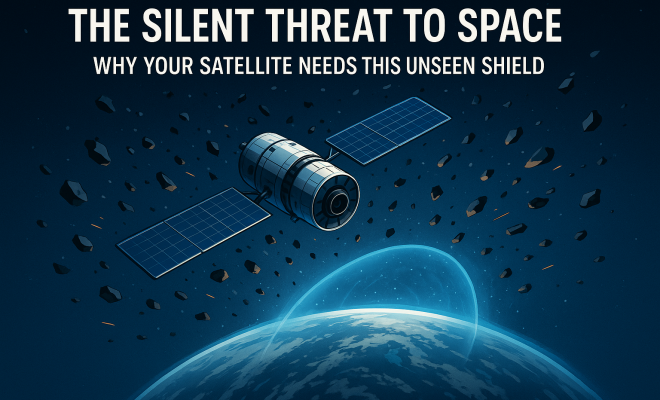
The Silent Threat to Space: Why Your Satellite Needs This Unseen Shield
“`html
You might think of space as the ultimate frontier, a vast, empty canvas where only physics and engineering matter. But look a little closer, and you’ll see it’s becoming a crowded neighborhood, bustling with more activity than ever before. By September 2026, the active orbital fleet has exploded to over 18,000 satellites. Think about that for a moment: eighteen thousand objects, each a sophisticated piece of technology, whizzing above us, doing everything from connecting remote villages to guiding autonomous vehicles. This surge, fueled by cheaper launch costs and the rapid deployment of low Earth orbit (LEO) constellations like SpaceX’s Starlink, is undeniably bridging communication gaps and powering global progress. But it also introduces a terrifying, often overlooked vulnerability: cybersecurity.
It’s not just about a rocket failing or a satellite breaking down anymore. We’re talking about malicious actors – nation-states, terrorist groups, even sophisticated criminals – targeting the very digital backbone of our space infrastructure. A single, well-executed cyberattack could cripple critical global communications, disrupt essential services, and even pose a direct threat to national security. Imagine a world where GPS suddenly goes dark, or vital weather forecasting systems are compromised. The implications are staggering, and they’re precisely why understanding the nuances of a satellite cybersecurity insurance policy comparison isn’t just smart business; it’s a matter of global resilience. This isn’t theoretical; it’s a present and growing danger that demands our immediate attention.
1. Defining Your Risk Profile: It All Starts with Understanding Your Vulnerabilities
Before you even begin to think about insurance, you need to conduct an honest, brutal assessment of your satellite operations. What are your most critical assets? Is it the satellites themselves, your ground control stations, the communication links between them, or the third-party software that underpins everything? Each component represents a potential entry point for an attacker, and each has a different level of criticality.
For instance, a LEO constellation operator might have hundreds or thousands of satellites, making a single satellite loss less catastrophic than for a geostationary satellite operator with one or two high-value assets. However, the LEO operator faces a distributed risk, where a successful attack on a common software vulnerability across their fleet could be devastating. Consider the potential impact of a data breach, a denial-of-service attack, or even the physical damage to ground infrastructure resulting from a cyber incident. A robust satellite cybersecurity insurance policy comparison will always begin with this foundational understanding of your unique risk landscape.
2. Ground Control and Communication Links: The Often-Underestimated Weak Points
When people think about space, they often picture satellites floating gracefully in orbit. What they often forget are the extensive, complex ground control stations and the invisible communication links that bind them to their orbital counterparts. These are not just data centers; they’re the nerve centers, responsible for everything from trajectory adjustments to payload operations. And guess what? They’re connected to the internet, just like your office network, making them prime targets for cyberattacks.
Think of it this way: a satellite might be incredibly secure in its isolated vacuum, but if the command sent to it from Earth is compromised, the satellite itself becomes a weapon or a liability. Communication links, too, are vulnerable to interception, jamming, or spoofing. Your insurance policy needs to explicitly cover these terrestrial and near-Earth vulnerabilities. Many traditional cyber policies might overlook the unique aspects of space-to-ground communications, so a specific satellite cybersecurity insurance policy comparison is crucial to ensure these critical links are adequately protected.
3. Third-Party Software and Supply Chain Risks: The Invisible Hand of Vulnerability
No space operation exists in a vacuum – especially not digitally. Every modern satellite system relies on a sprawling ecosystem of third-party software, components, and services. From the operating systems running your ground control systems to the specialized software controlling your satellite’s payload, you’re inheriting the security posture (or lack thereof) of dozens, if not hundreds, of external vendors. This creates an incredibly complex supply chain risk that’s notoriously difficult to manage.
A recent, high-profile example, though not space-specific, was the SolarWinds attack, which demonstrated how a single vulnerability in widely used software could compromise countless organizations. In the space sector, this risk is amplified. What if a critical piece of navigation software, developed by a third party, has a hidden backdoor? Or what if a firmware update for a satellite component carries malware? Your satellite cybersecurity insurance policy comparison must deeply scrutinize how potential policies address these supply chain vulnerabilities, covering not just your direct losses but also the reputational damage and operational disruption caused by a third-party compromise.
4. Coverage for Data Breach and Exfiltration: When Information Becomes the Target
While disrupting satellite operations is a primary concern, the theft of sensitive data is an equally potent threat. Satellites gather vast amounts of information, from geospatial intelligence and meteorological data to proprietary operational data and even personal communications. A successful cyberattack could lead to the exfiltration of this data, resulting in severe financial penalties (think GDPR fines), loss of competitive advantage, and irreparable reputational damage. (See: cybersecurity threats to satellites.)
Consider the potential impact of a breach involving classified government contracts, or even the personal data of users relying on satellite internet services. The costs associated with forensic investigations, legal fees, notification expenses, and credit monitoring can be astronomical. When you’re undertaking a satellite cybersecurity insurance policy comparison, pay close attention to the specific sub-limits and exclusions related to data breaches. Does the policy cover the cost of regulatory fines? What about public relations and crisis management to mitigate reputational harm? These are not minor details; they are often the most expensive consequences of a cyber incident. For more context, see The Startling Truth About AI's Impact on Your Coding Job by 2026.
5. Business Interruption and Loss of Revenue: The Financial Fallout of a Cyber Incident
Beyond the immediate costs of a cyberattack, there’s the long-term financial impact of operational disruption. If your satellite constellation is compromised or taken offline, even temporarily, the loss of revenue can be crippling. This isn’t just about the cost of repairs; it’s about the services you can’t provide, the contracts you can’t fulfill, and the customers you might lose permanently. For many space companies, particularly those in the burgeoning commercial space sector, this could be an existential threat.
A good satellite cybersecurity insurance policy comparison will highlight policies that offer robust business interruption coverage. This should extend beyond direct physical damage to include losses stemming from cyber-induced outages, even if no physical damage occurs. You’ll want to understand the waiting periods, the maximum period of indemnity, and how ‘loss of revenue’ is calculated. Some policies might offer specific coverage for extra expenses incurred to minimize the interruption, such as renting temporary ground stations or accelerating recovery efforts. Don’t underestimate this aspect; prolonged downtime can quickly dwarf the immediate costs of a cyber incident.
6. Cyber Extortion and Ransomware Coverage: The Hostage Situation in Orbit
Ransomware isn’t just for laptops and corporate networks anymore. As space systems become more interconnected and reliant on software, they become attractive targets for cyber extortionists. Imagine a scenario where a malicious actor gains control of a critical satellite’s operating system and demands a hefty ransom to restore control, or threatens to de-orbit it. The implications for national security, infrastructure, and even human life could be profound.
While thankfully no such high-profile incident has occurred yet in orbit, the risk is very real, and the potential for massive financial demands is clear. A comprehensive satellite cybersecurity insurance policy comparison should explicitly detail coverage for cyber extortion and ransomware attacks. This might include the cost of the ransom itself (though many policies have strict conditions and ethical considerations around this), as well as the expenses for expert negotiation, decryption, and system restoration. It’s a grim reality, but preparing for such a scenario is a critical part of modern space operations.
7. Regulatory Fines and Legal Expenses: The Cost of Non-Compliance
Operating in space isn’t just about engineering; it’s also about navigating a complex web of international regulations, national laws, and industry standards. From data privacy laws like GDPR to export controls and licensing requirements, a cyberattack can quickly expose your company to significant regulatory scrutiny and hefty fines if you’re found to be non-compliant or negligent in your security practices. Legal battles, too, can become a financial black hole.
When evaluating a satellite cybersecurity insurance policy comparison, look for policies that explicitly cover regulatory fines and penalties, as well as legal defense costs. These costs can quickly escalate, especially in cross-border incidents involving multiple jurisdictions. Some policies might also offer coverage for civil litigation expenses arising from third-party claims related to a cyber incident, such as a class-action lawsuit from users whose data was compromised. Don’t assume your general liability policy will cover these; cyber-specific coverage is almost always required to protect against these unique and substantial financial exposures.
8. The Human Element: Insider Threats and Social Engineering
While we often focus on external hackers, a significant portion of cyber risks comes from within. Insider threats, whether malicious or accidental, can be just as devastating. This could be a disgruntled employee intentionally sabotaging systems, or simply an employee falling victim to a sophisticated phishing attack that grants attackers access. Social engineering, where attackers manipulate individuals into divulging confidential information or performing actions, remains one of the most effective attack vectors.
For satellite operations, this means securing not just the technology but also the people operating it. An employee with access to ground control systems or sensitive data could inadvertently open a door for attackers. Your satellite cybersecurity insurance policy comparison needs to address how it handles losses stemming from insider threats. Some policies might have specific exclusions or higher deductibles for incidents linked to gross negligence or malicious insider activity. Look for coverage that assists with forensic investigations to determine the root cause, regardless of whether it’s an external breach or an internal lapse. Training and robust internal controls are your first line of defense here, but insurance provides a critical backstop. (See: NASA's satellite cybersecurity initiatives.)
9. Geopolitical Risks and State-Sponsored Attacks: A Unique Space Challenge
Unlike terrestrial cyberattacks, satellite systems operate in a domain that is inherently intertwined with national security and international relations. State-sponsored actors, with vast resources and sophisticated capabilities, pose a distinct and elevated threat. These aren’t just about financial gain; they often aim for disruption, espionage, or even incapacitation for strategic advantage. The war in Ukraine, for example, highlighted how crucial satellite communications are in modern conflicts and how quickly they can become targets.
When you’re doing a satellite cybersecurity insurance policy comparison, pay extremely close attention to exclusions related to “war,” “terrorism,” or “state-sponsored attacks.” Many traditional cyber policies might have broad exclusions that could leave you uncovered in the event of a significant geopolitical incident. Specialized space cyber policies are beginning to offer more tailored language to address these complex scenarios, but it’s a rapidly evolving area. You need to understand the nuances of what constitutes a covered event when a nation-state is involved, as the lines can be blurry and the stakes incredibly high. For more context, see The Shocking Truth About Your Code: AI Is Already Rewriting Your Future.
Navigating the Evolving Threat Landscape
The sheer scale of today’s orbital fleet – 18,000 satellites and counting – is a double-edged sword. While it’s a testament to human ingenuity and our relentless drive to connect the world, it also presents an unprecedented attack surface for cyber adversaries. The World Economic Forum’s emphasis on enhanced cybersecurity in satellite communications isn’t just a recommendation; it’s a stark warning. The systemic risks are real, and a single cyberattack could indeed create a ‘viral concern around national security and infrastructure stability.’ We’ve already seen how terrestrial cyberattacks can ripple through global economies; imagine that impact amplified by the critical services provided by space assets.
The demand for advanced satellite cybersecurity solutions and specialized space insurance policies is skyrocketing, and for good reason. Companies operating in space, from established players to innovative startups, are recognizing that traditional insurance policies simply don’t cut it. The unique confluence of high-value assets, remote operations, and critical national infrastructure makes this sector particularly vulnerable and deserving of bespoke risk management strategies. This isn’t just about protecting your own assets; it’s about contributing to the overall resilience of global space infrastructure.
The Importance of an Integrated Approach: Beyond Just Insurance
While a robust satellite cybersecurity insurance policy comparison is essential, it’s crucial to remember that insurance is just one piece of the puzzle. It’s a safety net, not a substitute for proactive, rigorous cybersecurity measures. Any reputable insurer will expect you to have strong security protocols in place, including:
- Regular Vulnerability Assessments and Penetration Testing: Actively seeking out weaknesses before attackers do.
- Robust Access Controls: Ensuring only authorized personnel can access critical systems, both on the ground and potentially in orbit.
- Threat Intelligence Sharing: Staying informed about the latest threats and attack vectors relevant to the space sector.
- Incident Response Planning: Having a clear, well-rehearsed plan for what to do when an attack occurs.
- Employee Training: Your people are often the weakest link; ensure they understand cybersecurity best practices.
The best insurance policy in the world won’t prevent an attack, but it will help you recover from one. However, integrating your insurance strategy with a comprehensive cybersecurity framework is the only way to truly build resilience against the silent threat looming over our orbital infrastructure.
Comparing Providers: What to Ask Your Broker
When you’re ready to dive into the specifics of a satellite cybersecurity insurance policy comparison, don’t just look at the premiums. Engage with specialist insurance brokers who understand the unique complexities of space and cyber risks. Here are some key questions to ask:
- What is the insurer’s experience with space-specific cyber incidents?
- Are there specific exclusions related to state-sponsored attacks or acts of war in cyberspace? (This is a huge one for space.)
- How are sub-limits applied for different types of losses (e.g., data breach vs. business interruption)?
- What are the policy’s requirements for your own cybersecurity posture? Are there specific certifications or controls they demand?
- Does the policy include access to a panel of expert incident response providers, forensic investigators, or legal counsel?
- How quickly can a claim be processed, especially for time-sensitive operational disruptions?
- Can the policy be tailored to cover specific, unique risks associated with your particular satellite mission or payload?
Frequently Asked Questions About Satellite Cybersecurity Insurance
Q: Is a standard cyber insurance policy enough for satellite operations?
A: Generally, no. Standard cyber insurance policies are designed primarily for terrestrial IT networks and data centers. They often lack specific clauses and definitions to cover the unique risks of space assets, such as orbital debris, communication link jamming, or the physical loss of a satellite due to a cyber command. A specialized satellite cybersecurity insurance policy is tailored to these specific threats, covering both ground infrastructure and in-orbit assets, as well as the unique regulatory and geopolitical landscape of space. (See: importance of cybersecurity in technology.)
Q: What’s the biggest difference between LEO and GEO satellite cyber insurance needs?
A: The main difference lies in the “single point of failure” risk versus “distributed risk.” Geostationary (GEO) satellites are fewer in number, often very large and expensive, and critical to specific, long-term services. A cyberattack on a GEO satellite could mean a catastrophic loss of a single, irreplaceable asset. Low Earth Orbit (LEO) constellations, conversely, consist of hundreds or thousands of smaller, cheaper satellites. While the loss of one LEO satellite might not be critical, a successful cyberattack exploiting a common vulnerability across the entire constellation could bring down a vast network, leading to widespread business interruption. Policies for LEO typically focus more on fleet-wide disruption and common software vulnerabilities, while GEO policies might prioritize individual asset protection and high-value data exfiltration.
Q: How do insurers assess the cybersecurity posture of a space company?
A: Insurers will conduct a thorough underwriting process. This usually involves detailed questionnaires about your cybersecurity frameworks, incident response plans, access controls, third-party vendor management, and employee training. They might request security audits, penetration test results, and compliance certifications (like NIST or ISO 27001). They’ll also evaluate the maturity of your security team, your threat intelligence capabilities, and your ability to segment critical operational technology (OT) from general IT networks. The stronger your security posture, the more favorable your policy terms and premiums are likely to be.
Q: What if a cyberattack causes physical damage to a satellite or ground station?
A: This is where specialized policies shine. Traditional cyber policies typically cover intangible losses like data breaches or business interruption but often exclude physical damage. A comprehensive satellite cybersecurity insurance policy should explicitly cover physical damage to both in-orbit assets and ground infrastructure if that damage is a direct result of a cyber incident (e.g., a malicious command causing a satellite to malfunction and de-orbit, or a cyberattack leading to an explosion at a ground control facility). It’s crucial to confirm this specific coverage with your broker.
Q: Are “acts of war” or “state-sponsored attacks” typically excluded?
A: Historically, many insurance policies, including cyber, have broad exclusions for “acts of war.” However, as state-sponsored cyberattacks become more common, especially in the space sector, the insurance market is slowly adapting. Some specialized policies might offer carve-backs or specific endorsements to provide coverage for certain state-sponsored cyber incidents, particularly if they fall below the threshold of declared warfare. This is a complex area of law and insurance, so it’s paramount to discuss this specific exclusion and any potential workarounds with your broker.
The Future of Space Security: A Collective Responsibility
The space industry is at a pivotal moment. The rapid expansion of LEO constellations and the increasing reliance on satellite communications for everything from precision agriculture to global internet access means that the security of space assets is no longer a niche concern; it’s a global imperative. The economic opportunities are immense, but so are the risks. As we continue to push the boundaries of what’s possible in orbit, we must equally prioritize the robust protection of these vital systems.
Ultimately, a thorough satellite cybersecurity insurance policy comparison is more than just a financial transaction. It’s an acknowledgment of the harsh realities of the digital age, an investment in resilience, and a commitment to safeguarding the critical infrastructure that increasingly underpins our modern world. Don’t wait until a headline screams about a satellite attack; secure your peace of mind and your operations now.
“`
Trending Now
- This One Skill Is Quietly Reshaping…
- The Silent Threat: How AI Is Reshaping Recent College Graduates’ Job Prospects
- this guide on this crucial shift in ai will devastate millions of college grads
- our breakdown of the brutal truth: zero-day exploit analysis vs. traditional cybersecurity careers — which path pays $300,000?
- The Urgent Truth: Why These Certifications Are Your Only Defense Against Zero-Day Attacks
Frequently Asked Questions
What is the main threat to satellites in space?
The main threat to satellites in space is cybersecurity vulnerabilities. With the increasing number of satellites, malicious actors, including nation-states and criminals, can target the digital infrastructure, potentially crippling global communications and essential services.
Why is satellite cybersecurity important?
Satellite cybersecurity is crucial because a successful cyberattack could disrupt vital services such as GPS and weather forecasting. As more satellites are launched, the risk of these attacks increases, making robust cybersecurity measures essential for national security and global resilience.
How many satellites are expected to be in orbit by 2026?
By September 2026, the number of active satellites in orbit is expected to exceed 18,000. This dramatic increase is largely due to cheaper launch costs and the deployment of low Earth orbit constellations like SpaceX's Starlink.
What should satellite operators do to assess risks?
Satellite operators should conduct a thorough assessment of their operations to identify vulnerabilities. This includes evaluating critical assets like satellites, ground control stations, and communication links to understand their risk profile before considering insurance.
What are the implications of a satellite cyberattack?
The implications of a satellite cyberattack can be severe, leading to disrupted communications, compromised services, and even threats to national security. A well-executed attack could have widespread effects on daily life and global operations.
Agree or disagree? Drop a comment and tell us what you think.