GPU Shortage 2026: AI Makes Gaming Rigs a Luxury
“`html
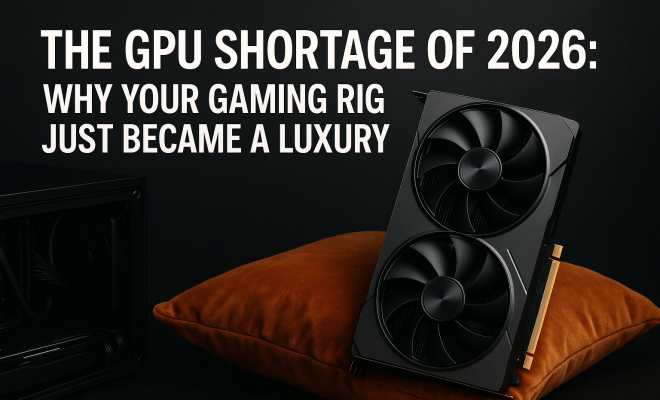
Alright, let’s talk about something that’s probably making your blood boil if you’re a PC gamer right now: the absolute nightmare that is trying to buy a new graphics card. We’re smack dab in the middle of a massive GPU shortage in 2026, and honestly, it feels like the entire industry has gone completely off the rails. Prices are through the roof, availability is non-existent, and even things like RAM, which used to be a commodity, are becoming ridiculously expensive. If you’ve been eyeing an upgrade or trying to build a new rig, you’ve undoubtedly felt this pain. But what’s really going on? Why is it so hard to get your hands on a decent GPU, and is there any light at the end of this very expensive tunnel?
It’s not just about silicon manufacturing hiccups anymore, though those certainly played a role in past shortages. This time, the culprit is far more fundamental, and it’s got less to do with gamers and more to do with the insatiable appetite of another, much larger industry: artificial intelligence. AI data centers are sucking up memory and processing power at an unprecedented rate, creating a ripple effect that’s devastating the consumer hardware market. This isn’t just a temporary blip; it’s a seismic shift that’s reshaping the entire landscape of PC components, and it’s making the prospect of affordable gaming hardware seem like a distant dream. Let’s dig into the nitty-gritty of why your next GPU might cost more than your first car.
1. The AI Data Center Black Hole: The Primary Driver of the GPU Shortage 2026
If you’re wondering what’s truly behind the crippling GPU shortage in 2026, look no further than the colossal, ever-expanding world of artificial intelligence. AI isn’t just a buzzword anymore; it’s a hungry beast, constantly demanding more and more computational power. And guess what’s at the heart of that power? Graphics Processing Units, or GPUs, which are incredibly efficient at parallel processing – precisely what AI training and inference models need.
Think about it: every time you interact with a new AI model, whether it’s for generating images, drafting text, or crunching vast datasets, it’s all running on a server somewhere, packed with high-end GPUs. These aren’t your typical gaming cards, mind you. They’re specialized, enterprise-grade units, but they still draw from the same fundamental manufacturing pipelines for silicon wafers and memory chips. The sheer scale of demand from companies building and expanding these AI data centers is staggering, dwarfing the needs of the entire gaming community. When a massive corporation needs to outfit a new data center with thousands of specialized AI accelerators, that order takes absolute priority over individual gamers or even smaller PC manufacturers. It’s a simple matter of economics and production capacity.
2. Nvidia’s Strategic Pivot: Prioritizing Profits Over Players
Nvidia has always been the undisputed king of gaming GPUs, but their business model is clearly shifting. While gamers have long been their bread and butter, the margins on consumer graphics cards simply don’t compare to the astronomical profits they can rake in from AI accelerators. We’re seeing concrete evidence of this strategic pivot right now. Reports indicate that Nvidia has drastically cut production of its highly anticipated GeForce RTX 50 series – the next generation of gaming GPUs – by an estimated 30-40% for the first half of 2026 alone.
Why would they do this? It’s a calculated business decision. By reducing the supply of gaming cards, they can reallocate those precious manufacturing resources – the chips, the memory, the assembly lines – to produce more of their higher-margin AI products. This move allows them to maximize profitability in a market that’s experiencing exponential growth. For Nvidia, it’s a smart financial play, but for gamers, it’s a gut punch. It means fewer cards available, even higher prices when they do appear, and a much longer wait for any semblance of normalcy in the gaming hardware market. The company is effectively telling the gaming community, ‘Our future isn’t primarily with you anymore; it’s in the data center.’
3. The RAM Rip-Off: Memory Prices Skyrocket
It’s not just GPUs feeling the pinch; RAM, or Random Access Memory, has become an unexpected casualty of the AI boom. Historically, RAM prices have been fairly stable, with occasional fluctuations, but nothing like what we’re witnessing in the GPU shortage 2026. The issue here is fundamentally similar to GPUs: AI models require enormous amounts of high-bandwidth memory to operate efficiently. These aren’t just a few gigabytes; we’re talking about hundreds of gigabytes, even terabytes, of specialized HBM (High Bandwidth Memory) for enterprise AI cards, and even standard DDR5 modules are being snapped up for supporting infrastructure.
The demand for these memory chips from AI data centers is diverting supply away from consumer-grade RAM modules used in gaming PCs. Manufacturers are prioritizing the more lucrative, bulk orders from AI companies, leaving less for the consumer market. This scarcity, naturally, drives up prices across the board. So, even if you manage to snag a GPU, you might find yourself paying an exorbitant amount for what used to be a relatively inexpensive component. It illustrates just how interconnected the entire hardware ecosystem is, and how a surge in one sector can completely disrupt others.
4. The Steam Deck’s Struggle: A Console Caught in the Crossfire
The impact of this GPU shortage in 2026 isn’t confined to desktop PC components; it’s bleeding into other segments of the gaming market, including consoles. Take the Steam Deck, for instance. Valve’s handheld PC gaming device was a game-changer when it launched, offering portable PC gaming at an incredibly attractive price point. But it’s now facing significant headwinds due to the exact same supply chain issues. (See: AI demand impacting GPU availability.)
Reports suggest that Steam Deck sales have plummeted by an estimated 80% recently. Why? Because its price has surged by approximately $300, pushing it into an unaffordable range of $789–$949 for many consumers. This isn’t Valve being greedy; it’s a direct reflection of the increased cost of the internal components, particularly the custom AMD APU which contains both CPU and GPU elements, and the associated memory. Valve engineers have even hinted that current retail prices are still lagging behind their bulk supply costs, suggesting further price increases could be on the horizon. This situation is heartbreaking for a device that was supposed to make PC gaming more accessible, showing just how pervasive this hardware crisis truly is.
5. Lagging Retail Prices and Future Increases: The Uncomfortable Truth
Here’s a bitter pill to swallow: the prices you’re seeing for GPUs and other components right now, as astronomical as they seem, might actually be the *lower* end of what’s coming. Industry insiders and even engineers at companies like Valve are indicating that current retail prices for consumer hardware are lagging behind the true bulk supply costs. What does this mean?
It means that component manufacturers, faced with significantly higher costs to secure chips, memory, and other materials from their suppliers (who are prioritizing AI orders), haven’t fully passed those costs onto consumers yet. They’re likely absorbing some of the hit or working through older, cheaper inventory. As that inventory depletes and new, more expensive stock comes in, those increased costs *will* be reflected in retail prices. So, the $1,000 GPU today could easily be a $1,300 GPU tomorrow, even if its performance hasn’t changed. This creates an urgent, almost panic-inducing situation for anyone contemplating a purchase, fueling the frustration and anger that’s palpable across the gaming community.
6. The Emotional Fallout: Gamers on the Brink
Let’s be real: this GPU shortage in 2026 isn’t just about numbers and market trends; it’s deeply personal for millions of gamers. Gaming isn’t just a hobby for many; it’s a passion, a social outlet, a form of escapism, and a way to connect with friends. When the core components required to participate in that hobby become prohibitively expensive, it creates immense frustration, anger, and a sense of being left behind.
Imagine saving up for months, maybe even years, for that dream build, only to find that the price of a single component has skyrocketed beyond your reach. Or worse, you finally get the money together, only to find the card you wanted is completely out of stock, with no clear indication of when it might return. This constant cycle of hope and disappointment is exhausting. It’s leading to widespread discussions online, often filled with outrage, as gamers feel increasingly marginalized by an industry that once catered directly to them. This emotional angle is precisely why this topic has gone viral – it taps into a shared experience of economic exclusion from a beloved pastime.
7. What I’d Buy Right Now (If You Absolutely Must): Navigating the Minefield
Given this utterly brutal landscape, what’s a gamer to do? If you absolutely *must* upgrade or build a new PC in the midst of this GPU shortage in 2026, you need to be strategic, pragmatic, and perhaps a little bit lucky. My advice leans heavily towards value and availability, rather than chasing the bleeding edge, which is currently a fool’s errand.
First, consider the used market, but proceed with extreme caution. Sites like eBay or local marketplaces can sometimes yield decent deals on slightly older generation cards, but you run the risk of buying a card that’s been abused, used for mining, or is simply faulty. Always ask for video proof of functionality, benchmarks, and original purchase receipts if possible. Secondly, if buying new, look for cards that offer the best performance-per-dollar in the mid-range. While the RTX 50 series is getting cut, previous generations like some RTX 40 series cards (if you can find them at MSRP, which is a huge ‘if’) or even AMD’s RX 7000 series might be your best bet. Don’t chase the absolute top-tier unless you have money to burn; the diminishing returns for the exorbitant price increases are simply not worth it.
Thirdly, don’t overlook pre-built systems. Sometimes, system integrators (SIs) have better access to GPUs at closer-to-MSRP prices than individual consumers. While you might pay a premium for the assembly and other components, it could still be a more cost-effective way to get a powerful gaming PC than trying to buy individual parts. Lastly, seriously consider cloud gaming services like GeForce NOW or Xbox Cloud Gaming. They don’t give you ownership of the hardware, but they offer a way to play high-end games without needing to buy an expensive GPU, effectively bypassing the entire shortage issue altogether. It’s not a perfect solution for everyone, but it’s a viable alternative in these trying times.
8. The Broader Economic Implications: Beyond Gaming
This GPU shortage isn’t just about whether you can play your favorite games at 4K resolution. It has far wider economic implications. The skyrocketing cost of memory and processing power affects every industry that relies on advanced computing. Think about scientific research, medical imaging, financial modeling, autonomous vehicles, and even basic data analysis. When the fundamental building blocks of these technologies become scarce and expensive, it can slow innovation and increase operational costs across the board.
For individuals, the financial strain is significant. Budgeting for an expensive PC upgrade has become a personal finance challenge, often requiring consumers to make difficult choices about discretionary spending. This situation also presents interesting, albeit risky, opportunities for investors looking at tech stocks that are either benefiting from the AI boom (like Nvidia, despite the gamer backlash) or those that might be struggling due to component scarcity. And for anyone looking for commercial or transactional opportunities, the market is ripe for affiliate links for ‘best gaming PC’ alternatives, ‘GPU price comparison’ tools, and ‘affordable gaming hardware’ guides, as people desperately search for solutions. (See: Impact of AI on hardware supply chains.)
9. Is There a Resolution in Sight? The Long Road Ahead
So, will this GPU shortage in 2026 ever end? Honestly, it’s hard to say with any certainty, but most indicators point to a long road ahead. The underlying cause – the insatiable demand from AI data centers – isn’t going away. In fact, it’s only expected to accelerate. While semiconductor manufacturers are investing heavily in expanding production capacity, building new fabs takes years, not months. These massive investments need to come online, and even then, there’s no guarantee that the new capacity will prioritize consumer-grade GPUs over the more profitable AI accelerators.
We might see some relief if the AI boom experiences a slight slowdown or if new, more efficient chip designs emerge that reduce the raw hardware requirements. However, that’s speculative. For now, gamers need to brace themselves for continued high prices and limited availability. It’s a frustrating reality, but understanding the forces at play – primarily the immense pull of AI – is crucial to setting realistic expectations. Don’t expect a sudden return to the ‘good old days’ of readily available, affordable graphics cards anytime soon. This shift feels more permanent, a new normal where gaming hardware competes directly with the foundational technology of the future, and often loses.
10. The Rise of Integrated Graphics and APUs: A Temporary Respite?
In the face of this GPU shortage in 2026, some gamers are finding a temporary, if imperfect, solution in integrated graphics and APUs (Accelerated Processing Units). Processors from both Intel and AMD often come with built-in graphics capabilities, which, while not competing with dedicated high-end GPUs, have become surprisingly capable for less demanding titles or at lower resolutions. For many casual gamers, or those simply trying to tide themselves over, a modern CPU with integrated graphics can handle esports titles like League of Legends, CS:GO, or Valorant at decent frame rates, and even some older AAA games. AMD’s Ryzen APUs, in particular, have seen a surge in interest because their integrated Radeon graphics cores are significantly more powerful than Intel’s offerings.
This isn’t a long-term fix, of course. You won’t be playing Cyberpunk 2077 at max settings on an iGPU. But it does offer a way to get *some* gaming done without needing a discrete graphics card, which can be a huge relief for those building a new system from scratch. It also highlights a potential shift in the entry-level gaming market, where integrated solutions might become the norm for budget-conscious builders, further separating them from the increasingly premium dedicated GPU market. It’s a compromise, for sure, but a functional one for many right now.
11. The Role of Foundries and Geopolitical Factors: A Complex Web
It’s worth remembering that the components for all these chips – gaming GPUs, AI accelerators, memory – don’t just magically appear. They’re fabricated by a handful of highly specialized semiconductor foundries, with TSMC (Taiwan Semiconductor Manufacturing Company) being the undisputed leader. The geopolitical landscape, particularly surrounding Taiwan, adds another layer of complexity and risk to the GPU shortage in 2026. Any significant disruption to TSMC’s operations, whether from natural disaster or political tension, would send shockwaves across the entire tech industry, making the current situation look mild by comparison.
Furthermore, the race for technological supremacy between nations means governments are actively subsidizing and encouraging the development of domestic chip manufacturing capabilities. While this diversification is a good thing in the long run for supply chain resilience, building new fabs is incredibly expensive, takes years, and still relies on a global network of specialized equipment and materials. These efforts won’t yield significant capacity increases for several years, meaning the current reliance on existing foundries, and the intense competition for their production slots, will continue to fuel scarcity and high prices for the foreseeable future.
12. Expert Perspectives and Industry Forecasts: What the Pros Are Saying
When you talk to analysts and industry veterans, a consistent theme emerges: this isn’t just a cyclical downturn. Dr. Lisa Su, CEO of AMD, has often spoken about the “mega-trends” driving demand for high-performance computing, with AI being at the forefront. Jensen Huang, Nvidia’s CEO, has been even more direct, repeatedly emphasizing Nvidia’s transformation into an “AI company,” with gaming becoming a secondary, albeit important, market. These aren’t just corporate talking points; they reflect strategic decisions about resource allocation and future investments.
Investment banks like Morgan Stanley and Goldman Sachs have published reports forecasting continued strong growth in the AI hardware market, with demand for specialized AI chips projected to grow by 30-40% annually for the next few years. This kind of exponential growth simply outstrips the current rate of manufacturing expansion. Many experts predict that while overall GPU supply might increase, the *proportion* of that supply dedicated to consumer gaming will likely shrink or remain stagnant relative to AI, ensuring that the GPU shortage in 2026 persists and possibly worsens for gamers.
Frequently Asked Questions (FAQ) about the GPU Shortage 2026
Q1: What is the main reason for the GPU shortage in 2026?
The primary driver is the massive, increasing demand for Graphics Processing Units (GPUs) from the artificial intelligence (AI) industry, particularly for data centers. AI training and inference models require immense parallel processing power, which GPUs excel at, leading to enterprise demand far outstripping consumer gaming demand and manufacturing capacity. (See: The technology behind GPU shortages.)
Q2: Is this just like the previous GPU shortages caused by crypto mining?
While past shortages were heavily influenced by cryptocurrency mining, this 2026 shortage is fundamentally different and potentially more permanent. Crypto mining demand was volatile and often driven by speculative bubbles. AI demand, however, is driven by long-term technological advancement and widespread industry adoption, making it a more stable and consistently growing factor.
Q3: Why is Nvidia prioritizing AI over gaming GPUs?
Nvidia is a business, and the margins on specialized AI accelerators are significantly higher than on consumer gaming GPUs. By pivoting resources towards AI, they can maximize profitability in a rapidly expanding market. It’s a strategic business decision to capitalize on the most lucrative segment of the market.
Q4: How does the GPU shortage affect RAM prices?
AI models also require vast amounts of high-bandwidth memory (HBM) to function efficiently. This high demand from AI data centers for memory chips diverts supply away from standard consumer-grade RAM modules, leading to scarcity and increased prices for DDR5 and other memory types used in gaming PCs.
Q5: When can gamers expect the GPU shortage to end?
Most industry experts believe this shortage will be a long-term issue. While semiconductor manufacturers are investing in new fabs and increased capacity, these projects take years to come online. The underlying AI demand isn’t expected to slow down significantly, meaning gamers should prepare for continued high prices and limited availability for the foreseeable future, likely extending well beyond 2026.
Q6: Are there any alternatives for gamers who can’t afford a new GPU?
Yes, there are several strategies. Consider the used market with caution, look for mid-range GPUs from previous generations that offer better value, or explore pre-built systems which sometimes have better GPU access. Cloud gaming services like GeForce NOW or Xbox Cloud Gaming offer a way to play high-end games without owning the hardware. Also, modern CPUs with integrated graphics (APUs) can handle less demanding games surprisingly well.
Q7: How do geopolitical factors play a role in this shortage?
The global semiconductor supply chain is highly concentrated, with a few major foundries like TSMC in Taiwan producing the vast majority of advanced chips. Geopolitical tensions or disruptions in these key manufacturing regions pose significant risks, further complicating supply and potentially exacerbating the shortage.
“`
Trending Now
Frequently Asked Questions
Why is there a GPU shortage in 2026?
The GPU shortage in 2026 is primarily driven by the increasing demand from artificial intelligence data centers, which require vast amounts of computational power. This surge in demand has led to significant price hikes and a scarcity of available graphics cards for consumers.
How does AI impact the GPU market?
Artificial intelligence has created an insatiable demand for GPUs, as they are essential for parallel processing tasks in AI training. This high demand from the AI sector is diverting resources away from the consumer hardware market, exacerbating the GPU shortage.
Are GPU prices expected to drop soon?
Given the current demand from AI industries and the ongoing supply chain issues, it's unlikely that GPU prices will drop significantly in the near future. Consumers may have to wait for the market to stabilize before seeing more affordable options.
What other components are affected by the GPU shortage?
The GPU shortage has also impacted other components, such as RAM, which has become increasingly expensive and harder to find. The ripple effects of the GPU scarcity are felt across the entire PC hardware market.
When will the GPU shortage end?
While it's difficult to predict an exact timeline, many experts believe that the GPU shortage may last until the AI industry's demand stabilizes and production capacities increase. It could take time for the consumer market to recover.
What did we miss? Let us know in the comments and join the conversation.