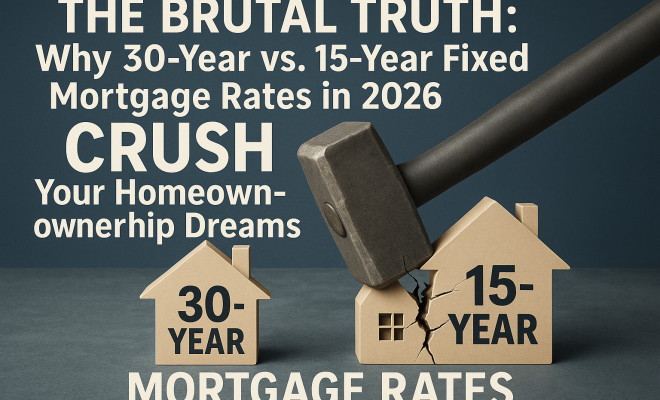
The Brutal Truth: Why 30-Year vs. 15-Year Fixed Mortgage Rates in 2026 Could CRUSH Your Homeownership Dreams
Alright, let’s talk about something that’s keeping a lot of you up at night: mortgage rates. Specifically, we’re going to dive deep into the showdown between 30-year fixed mortgage rates vs 15-year fixed rates in 2026. Why now? Because the housing market is, frankly, a bit of a pressure cooker right now. We’ve seen rates jump to new highs in 2026, pushing homeownership further out of reach for many. This isn’t just about numbers on a screen; it’s about your dreams, your financial stability, and whether you can actually afford that place you’ve been eyeing. So, let’s break down what’s happening, what the experts are saying, and what this all means for your wallet.
The latest data is pretty sobering. Freddie Mac reported the average 30-year fixed rate hit 6.71% in early September, while Mortgage News Daily pegged it even higher at 6.89%. That’s the steepest climb since July 2025, and it’s flirting dangerously close with that ‘psychologically daunting 7 percent threshold’ everyone’s dreading. Think about it: the median monthly mortgage payment now eats up a staggering 40% of the median household income. Just a few years ago, in 2019, that figure was 28%. That’s a massive shift, and it’s why understanding the nuances of a 30-year versus a 15-year mortgage is more critical now than ever before.
1. The 30-Year Fixed Mortgage: Your Monthly Payment Lifeline
Let’s start with the old reliable: the 30-year fixed mortgage. For decades, this has been the go-to choice for most homebuyers, and for good reason. Its primary appeal lies in its lower monthly payments. By stretching out the repayment period over three decades, lenders can offer smaller installments, making homeownership seem more attainable, especially when rates are high. This is particularly relevant in the current climate of escalating rates in 2026. A 30-year term can act as a financial shock absorber, giving you breathing room in your monthly budget.
However, that longer repayment period comes with a trade-off: you’ll pay significantly more in interest over the life of the loan. While your monthly payment might feel manageable today, the cumulative cost can be eye-watering. For example, if you take out a $400,000 mortgage at 6.89% over 30 years, your total interest paid could easily exceed the principal amount. It’s a classic case of paying for convenience, and in a high-rate environment, that convenience gets even more expensive. Still, for many first-time buyers or those with other significant financial commitments, the lower monthly obligation of a 30-year fixed loan simply makes it the only viable path to homeownership.
2. The 15-Year Fixed Mortgage: The Path to Accelerated Equity
Now, let’s turn our attention to the 15-year fixed mortgage. This option is often championed by financial advisors and homeowners who prioritize building equity quickly and minimizing interest paid. The most significant advantage here is the massive savings on interest. Because you’re paying off the principal much faster, you’re exposing yourself to interest charges for half the time, dramatically reducing the overall cost of the loan. In an era where 30-year fixed mortgage rates vs 15-year fixed rates in 2026 are a hot topic due to rising costs, the 15-year option becomes an even more attractive proposition for those who can swing the higher payments.
The flip side, of course, is those higher monthly payments. A 15-year mortgage will always have a substantially larger installment than a 30-year mortgage for the same loan amount. This requires a much stronger financial position and a comfortable buffer in your monthly budget. While the long-term savings are undeniable, you need to be absolutely sure you can consistently meet those higher payments without straining your finances or compromising other essential needs. Missing payments on a 15-year loan can quickly erase any potential savings and put your home at risk, so it’s not a decision to take lightly.
3. Current Rate Trends in 2026: A Sobering Reality Check
Let’s get down to the nitty-gritty of what’s happening with rates right now in 2026. As mentioned, we’ve seen a significant uptick. Freddie Mac reported the average 30-year fixed rate hitting 6.71% in early September, and Mortgage News Daily showed it at 6.89%. These aren’t just abstract numbers; they represent real money out of your pocket. To put it in perspective, these are the highest levels we’ve seen since July 2025. This upward trajectory is pushing the limits of affordability, especially when combined with already high home prices.
What’s driving this surge? A few key factors are at play. First, there’s been a global bond market sell-off, which often translates to higher mortgage rates. Secondly, escalating oil prices, largely due to the U.S. conflict with Iran, are fueling inflation concerns and prompting investors to demand higher returns. And let’s not forget the nation’s ballooning debt, which also puts upward pressure on interest rates. These aren’t temporary blips; these are significant economic forces that are reshaping the mortgage landscape and making the comparison between 30-year fixed mortgage rates vs 15-year fixed rates in 2026 even more stark.
4. The Affordability Crisis: When 40% of Income Isn’t Enough
The impact of these rising rates on affordability is nothing short of brutal. The median monthly mortgage payment now consumes 40% of the median household income. Let that sink in. Just imagine dedicating nearly half of your earnings to your mortgage payment alone. This isn’t sustainable for many families, especially when you factor in other rising costs like groceries, gas, and utilities. Back in 2019, that same payment accounted for 28% of income. We’ve seen a 12-percentage-point jump in just a few years, which is an alarming trend. (See: U.S. Census Bureau Housing Data.)
This escalating cost is creating a serious barrier to entry for prospective homebuyers, especially those looking to buy their first home. It’s not just about the down payment anymore; it’s about the ongoing monthly burden. This affordability crisis is forcing many to either scale back their homeownership dreams, move to less desirable areas, or postpone buying altogether. The ‘psychologically daunting 7 percent threshold’ isn’t just a number; it represents a breaking point for many, making the choice between a 30-year and 15-year mortgage a deeply personal and often agonizing one.
5. The Interest Rate Gap: Why It Matters for Your Choice
Historically, 15-year fixed mortgage rates have always been lower than 30-year rates. This is because lenders perceive less risk when you pay back the loan faster. You’re less likely to default, and the loan is on their books for a shorter period. This rate gap is a crucial factor when comparing 30-year fixed mortgage rates vs 15-year fixed rates in 2026. Even a seemingly small difference, say 0.25% or 0.50%, can translate into tens of thousands of dollars in savings over the life of the loan.
For instance, if the 30-year rate is 6.89% and the 15-year rate is 6.49%, that 0.40% difference, combined with the shorter amortization period, makes a colossal impact. While the higher monthly payment of a 15-year loan might initially sting, the lower interest rate sweetens the deal significantly for those who can manage it. It’s imperative to get quotes for both loan terms to see the actual rate difference at any given time, as this gap can fluctuate based on market conditions and lender specifics. Never assume; always compare.
6. Expert Opinions: Navigating the 2026 Mortgage Maze
So, what are the experts saying about navigating the current mortgage maze, especially when considering 30-year fixed mortgage rates vs 15-year fixed rates in 2026? Many financial professionals are emphasizing caution and a deep dive into personal finances. Greg McBride, chief financial analyst for Bankrate, often advises that while a 15-year mortgage is financially superior in terms of total cost, it’s only a good fit if the monthly payments don’t stretch your budget to the breaking point. “You don’t want to be house rich and cash poor,” he often says, and that sentiment holds even more weight with today’s high rates.
Other experts, like Melissa Cohn, a mortgage banker with William Raveis Mortgage, highlight the flexibility of the 30-year loan. “If rates eventually drop, you can always refinance a 30-year mortgage into a 15-year or simply make extra principal payments,” she suggests. This strategy allows homeowners to secure a lower monthly payment now, giving them a safety net, while retaining the option to accelerate repayment if their financial situation improves or if rates decrease. The key takeaway from most experts is clear: prioritize affordability and financial flexibility, especially in an unpredictable market like the one we’re seeing in 2026.
7. The Refinance Conundrum: A Strategic Consideration
This brings us to the strategic consideration of refinancing. If you opt for a 30-year fixed mortgage now, especially with rates hovering near 7%, the hope for many is that rates will eventually drop, allowing them to refinance into a lower rate or a shorter term. This strategy can be quite effective, essentially giving you the best of both worlds: lower initial payments and the potential for long-term savings. However, it’s not without its risks. There’s no guarantee that rates will fall significantly, or that they will fall quickly enough to make a refinance worthwhile.
Refinancing also comes with closing costs, which can range from 2% to 5% of the loan amount. You need to factor these costs into your calculations to determine if a refinance truly makes financial sense. It’s a gamble, albeit a calculated one, on future market conditions. For those who choose a 15-year mortgage, refinancing might be less of a concern, as their primary goal is typically to pay off the loan as quickly as possible. But for anyone considering a 30-year term today, having a clear understanding of the refinance potential and its associated costs is absolutely vital for your long-term financial planning.
8. Personal Financial Assessment: Are You 15-Year Ready?
Before you even look at a single rate, you need to do a brutally honest assessment of your personal finances. Can you truly afford the higher monthly payments of a 15-year mortgage without sacrificing your emergency fund, retirement savings, or other important financial goals? Think about your job security, future income potential, and any upcoming major expenses. A common rule of thumb suggests that your total housing costs (mortgage, taxes, insurance) shouldn’t exceed 28% of your gross monthly income, though in the current climate, many are exceeding this.
If committing to a higher 15-year payment means you’ll be living paycheck to paycheck, then it’s probably not the right choice for you. The stress of constant financial strain isn’t worth the interest savings. However, if you have a stable income, a robust emergency fund (typically 3-6 months of living expenses), and minimal other high-interest debt, then a 15-year mortgage could be a powerful tool for building wealth and achieving financial freedom sooner. It’s all about finding that sweet spot between ambition and practicality, especially when considering the implications of 30-year fixed mortgage rates vs 15-year fixed rates in 2026.
9. The Emotional Toll: Beyond Just Numbers
Let’s be real: this isn’t just an academic exercise in comparing interest rates. This is deeply personal and emotionally charged. The dream of homeownership, for many, represents stability, security, and a place to raise a family. When mortgage rates surge to near 7%, as they have in 2026, it impacts those dreams directly. It can feel like the goalposts are constantly moving, pushing an already difficult aspiration further out of reach. The stress of high monthly payments can weigh heavily on individuals and families, affecting everything from daily decisions to long-term planning.
The decision between a 30-year and a 15-year fixed mortgage isn’t just about optimizing numbers; it’s about optimizing your peace of mind. For some, the lower monthly payment of a 30-year loan provides essential breathing room, even if it costs more in the long run. For others, the satisfaction of paying off their home faster and saving on interest with a 15-year loan outweighs the higher short-term burden. Ultimately, the ‘better’ choice is the one that aligns with your financial comfort level, your long-term goals, and your emotional capacity to handle the financial commitments. Don’t let the market dictate your decision entirely; let your personal circumstances guide you first.
10. The Impact of Inflation and Federal Reserve Policy
It’s impossible to discuss mortgage rates in 2026 without talking about inflation and the Federal Reserve. The Fed’s primary tool to combat inflation is raising the federal funds rate, which, while not directly setting mortgage rates, strongly influences them. When the Fed signals a hawkish stance to cool down an overheating economy, the bond market reacts, and mortgage rates typically follow suit. We’ve seen this play out over the past year, with persistent inflation figures pushing the Fed to maintain a tighter monetary policy than many initially expected.
For homebuyers, this means that even if economic growth slows, a stubbornly high inflation rate could keep mortgage rates elevated. The market is constantly trying to guess the Fed’s next move, and any unexpected economic data—whether it’s a hotter-than-expected jobs report or a surprisingly high Consumer Price Index (CPI) reading—can send rates swinging. This unpredictability makes long-term planning tricky, and it’s why understanding the broader economic context, beyond just the current rate numbers, is key when you’re weighing 30-year fixed mortgage rates vs 15-year fixed rates in 2026. A 30-year term might offer more stability in a volatile rate environment, but the higher interest cost becomes a direct reflection of inflation concerns.
11. Exploring Alternative Mortgage Products: ARMs and Hybrids
While we’re focusing on fixed-rate mortgages, it’s worth a quick mention that other products exist, especially in a high-rate environment. Adjustable-Rate Mortgages (ARMs) and hybrid ARMs (like a 5/1 ARM or 7/1 ARM) might offer lower initial rates than fixed-rate options. With an ARM, your interest rate is fixed for an initial period (e.g., 5 or 7 years), and then it adjusts periodically based on a market index. This can make monthly payments more affordable upfront, which can be tempting when fixed rates are high.
However, ARMs come with inherent risk. Once that initial fixed period ends, your rate could go up, potentially significantly, leading to much higher monthly payments. This risk is amplified if rates continue to rise or remain elevated. They can be a good option for someone who plans to sell or refinance before the fixed period ends, or for those with highly stable and increasing incomes. But for most homebuyers seeking long-term stability, especially with the uncertainty surrounding 30-year fixed mortgage rates vs 15-year fixed rates in 2026, the predictability of a fixed rate often outweighs the allure of a lower initial ARM payment. Always understand the caps and adjustment periods if you even consider this route.
12. The Wealth-Building Perspective: Beyond Just Mortgage Payments
Choosing between a 30-year and 15-year mortgage isn’t just about the monthly payment or total interest paid; it’s also about your overall wealth-building strategy. For some, the lower payments of a 30-year mortgage free up capital that can be invested elsewhere, potentially earning a higher rate of return than the mortgage interest rate. This is often referred to as “arbitrage” – borrowing money at one rate and investing it at a higher rate. If you’re disciplined and can consistently invest the difference, this strategy can lead to greater net wealth over time.
On the other hand, a 15-year mortgage forces you to pay down principal faster, building equity at an accelerated pace. This guaranteed return (the interest you save) can be very appealing, especially for those who are less comfortable with market volatility or who prioritize being debt-free sooner. Being mortgage-free offers incredible financial flexibility and peace of mind, freeing up significant cash flow for retirement, education, or other goals. When comparing 30-year fixed mortgage rates vs 15-year fixed rates in 2026, consider how each option fits into your broader financial plan and risk tolerance, not just the immediate housing cost.
Frequently Asked Questions About 30-Year vs. 15-Year Fixed Mortgage Rates in 2026
Q1: Will mortgage rates go down in 2026?
Predicting future mortgage rates is tough, but many economists believe rates might stabilize or even slightly decline later in 2026, assuming inflation cools and the Federal Reserve begins to ease its monetary policy. However, significant drops are not guaranteed, and rates are unlikely to return to the historically low levels seen a few years ago. Factors like global economic stability, oil prices, and the Fed’s actions will heavily influence the trajectory.
Q2: How much more do I pay in interest with a 30-year mortgage compared to a 15-year?
The difference can be substantial. For a $400,000 loan, if a 30-year rate is 6.89% and a 15-year rate is 6.49%, you could pay over $200,000 more in interest over the life of the 30-year loan. This is due to both the longer repayment period and the slightly higher interest rate typically associated with 30-year terms. Use a mortgage calculator to see specific examples based on current rates.
Q3: Is it always better to choose a 15-year mortgage if I can afford it?
Financially, a 15-year mortgage saves you a significant amount of interest and builds equity faster. If you can comfortably afford the higher monthly payments without sacrificing your emergency fund, retirement savings, or other important financial goals, it’s often the superior choice for long-term wealth building. However, “comfortably afford” is the key. Overstretching your budget can lead to financial stress and risk.
Q4: What if I take a 30-year mortgage but make extra payments to pay it off faster?
This is a smart hybrid strategy. By making additional principal payments on a 30-year mortgage, you can effectively shorten your loan term and save on interest, similar to a 15-year mortgage. This gives you the flexibility of a lower required payment if finances get tight, while still allowing you to accelerate repayment when you have extra cash. Ensure your lender doesn’t have prepayment penalties, which are rare on fixed-rate mortgages but always worth checking.
Q5: How does the affordability crisis affect my choice between these two mortgage types?
The current affordability crisis, marked by high home prices and rising rates, makes the 30-year mortgage a more accessible option for many. Its lower monthly payments provide essential breathing room for household budgets already strained by other costs. While a 15-year mortgage is financially attractive, the significantly higher monthly payment might simply be out of reach for a larger segment of the population in 2026, making the 30-year term the only viable path to homeownership.
So, where does that leave us when comparing 30-year fixed mortgage rates vs 15-year fixed rates in 2026? There’s no universal answer, no magic bullet. The rising rate environment makes both options more expensive than they were just a few years ago. If you can comfortably afford the higher payments, a 15-year fixed mortgage offers substantial long-term savings and faster equity build-up. But if those payments would stretch you thin, the 30-year fixed mortgage provides crucial affordability and flexibility, with the potential to refinance later if rates drop. The most important thing is to understand your own financial situation intimately, get personalized quotes, and make a decision that ensures your homeownership dream doesn’t turn into a financial nightmare.
Trending Now
Frequently Asked Questions
What are the advantages of a 30-year fixed mortgage?
The primary advantage of a 30-year fixed mortgage is its lower monthly payments, making homeownership more accessible. By spreading payments over three decades, borrowers can better manage their budgets, especially during times of high interest rates, like in 2026. This option provides financial flexibility and a cushion against rising living costs.
How do 15-year and 30-year fixed mortgages compare?
While a 15-year fixed mortgage typically has higher monthly payments, it offers the benefit of paying off your home faster and accruing less interest over time. In contrast, a 30-year fixed mortgage allows for lower monthly payments, which can be more manageable for buyers in a challenging housing market like 2026.
What impact do current mortgage rates have on homeownership?
In 2026, rising mortgage rates have significantly increased the cost of homeownership, with median monthly payments consuming around 40% of household income. This financial strain makes it crucial for potential buyers to carefully consider their mortgage options and the long-term implications of their choices.
Why are mortgage rates rising in 2026?
Mortgage rates are rising in 2026 due to a combination of economic factors, including inflation and changes in monetary policy. This increase has made homeownership less attainable for many, pushing buyers to reassess the types of mortgages available to them and their overall financial strategies.
What is the psychological impact of mortgage rates above 7%?
Mortgage rates nearing or exceeding 7% can create a psychological barrier for potential homebuyers. This threshold is often associated with increased financial anxiety, leading many to feel discouraged about entering the housing market, as higher rates translate to significantly larger monthly payments and long-term financial commitments.
What's your take on this? Share your thoughts in the comments below — we read every one.