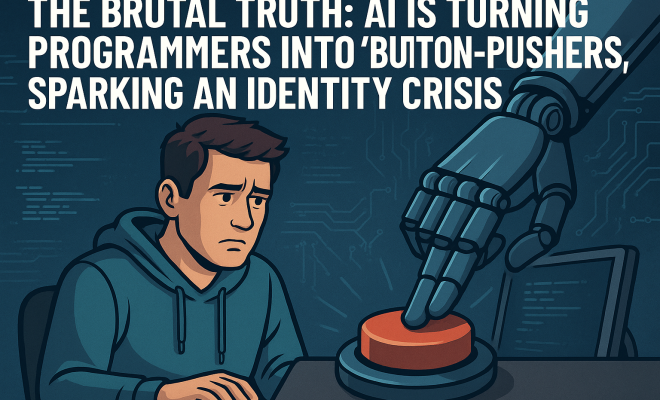
The Brutal Truth: AI Is Turning Programmers Into ‘Button-Pushers,’ Sparking an Identity Crisis
“`html
Imagine spending years honing a craft, dedicating countless hours to mastering complex logic, algorithms, and architectures, only to find yourself in a role where your primary function is to click a button and review AI-generated code. This isn’t a dystopian novel; it’s the lived reality for some software engineers right now, and it’s sparking a deeply unsettling conversation across the tech world. A recent viral post from an engineer on X, known as ‘v0xium,’ brought this brewing frustration to a head, describing his new job as ‘soul-sucking’ due to the overwhelming presence of AI in every phase of the development cycle. His candid reflection, which quickly amassed nearly 5 million views, painted a vivid picture of a future where human ingenuity is relegated to the sidelines, overshadowed by increasingly sophisticated artificial intelligence tools.
This isn’t just about job displacement, though that’s a significant concern. What v0xium’s post, and the ensuing discussion, really highlights is a more existential threat: the erosion of job satisfaction, the stifling of skill development, and the fundamental shift in what it means to be a ‘developer’ in the age of AI. We’re talking about an identity crisis bordering on depression for many experienced professionals. The core appeal of software engineering has always been its intellectual challenge, the thrill of problem-solving, and the satisfaction of building something from the ground up. If AI takes over the heavy lifting, what’s left for us?
The Viral Outcry: When AI Coding Challenges Human Spirit
The post from ‘v0xium’ struck a raw nerve precisely because it articulated a fear many in the tech industry have been quietly grappling with. He detailed a scenario where AI, specifically tools like Claude Code, wasn’t just assisting; it was dictating. From crafting initial product specifications to generating intricate code, and even churning out comprehensive reports, AI was the primary engine. The human engineer, in this model, became a glorified editor, a mere ‘button-pusher’ tasked with reviewing, tweaking, and sometimes debugging what the machine had produced. This wasn’t the collaborative partnership many envisioned; it was a subservient role that stripped away the creative, problem-solving essence of engineering.
His description of long hours spent in this ‘soul-sucking’ cycle resonated deeply. It’s one thing to use AI to automate repetitive, low-value tasks, freeing up engineers for more complex work. It’s an entirely different thing when AI automates the very tasks that define the engineer’s value proposition and intellectual engagement. The sheer volume of engagement with his post – millions of views and thousands of comments – underscores that this isn’t an isolated incident or a singular complaint. It’s a widespread sentiment, a collective sigh of despair from a generation of tech professionals grappling with the evolving nature of their careers and the profound AI coding challenges that come with it.
High-Profile Reactions: Echoes from Tech’s Elite
The discussion didn’t stay confined to the trenches of individual engineers. High-profile figures within the tech ecosystem quickly weighed in, lending significant credence to the concerns raised. Elon Musk, never one to shy away from a bold statement, reacted to the post, though his specific commentary wasn’t detailed in the immediate aftermath. However, it was venture capitalist Chamath Palihapitiya whose words truly amplified the underlying anxiety. Palihapitiya issued a stark warning: companies risk turning an entire generation of technical experts into individuals simply ‘pushing a button in front of casino slot machines.’
This analogy is particularly potent. A casino slot machine offers the illusion of engagement, the momentary thrill of a potential win, but ultimately requires no skill, no deep understanding, and offers no genuine intellectual reward. It’s a passive activity. If software engineering, once a bastion of intellectual rigor and creative problem-solving, becomes akin to pulling a lever on a slot machine, the implications for innovation, skill development, and the mental well-being of the workforce are dire. These aren’t just abstract philosophical musings; they are concrete concerns about the future of a critical global industry and the people who power it. The AI coding challenges are not just technical, but profoundly human.
The Erosion of Skill and the Problem-Solving Paradox
One of the most insidious effects of pervasive AI coding is the potential for skill erosion. When AI generates the bulk of the code, engineers may find their own coding muscles atrophying. The journey from a high-level requirement to a functional, efficient, and robust piece of software involves countless micro-decisions, architectural considerations, performance optimizations, and debugging expeditions. Each of these steps is a learning opportunity, a chance to deepen one’s understanding of systems, languages, and problem domains.
If AI takes over these steps, what does the human engineer actually learn? How do they develop the intuition and deep understanding that only comes from wrestling with complex problems? This creates a paradox: AI is supposed to augment human capabilities, but in this scenario, it risks diminishing them. Junior engineers, in particular, face a formidable challenge. How do they gain the foundational experience necessary to become truly proficient if they’re primarily reviewing AI output rather than creating it? This long-term impact on the talent pipeline and the overall quality of engineering expertise is a significant concern that companies need to address head-on, or they’ll face even greater AI coding challenges down the line. (See: AI's impact on programming jobs.)
The Psychological Toll: Identity Crisis and Depression
Beyond the practical concerns about skill, there’s a profound psychological toll. For many engineers, their identity is deeply intertwined with their ability to build, create, and solve complex problems. The satisfaction derived from seeing a piece of code you designed and implemented come to life is immense. It’s a sense of craftsmanship, of intellectual mastery. When that fundamental aspect of the job is outsourced to a machine, it can lead to a profound sense of disillusionment and a loss of purpose.
The phrase ‘identity crisis bordering on depression’ is not hyperbole in this context. Imagine training for years, investing heavily in your education and career, only to feel redundant or reduced to a mere appendage of a machine. This isn’t just about feeling bored; it’s about a loss of meaning, a questioning of one’s professional worth. Companies need to be acutely aware of this human element. A highly productive but deeply unhappy workforce is not sustainable, and it will inevitably lead to burnout, high turnover, and a decline in overall innovation. Addressing these AI coding challenges requires more than just technical solutions; it demands empathy and a re-evaluation of human-AI collaboration models.
Beyond Mundane Tasks: The Threat to Intellectual Challenge
Proponents of AI in coding often argue that it frees humans from ‘mundane’ or ‘repetitive’ tasks, allowing them to focus on ‘higher-level’ thinking. While there’s certainly truth to the idea that AI can automate boilerplate code generation, configuration management, or simple data transformations, v0xium’s experience suggests AI is reaching far beyond these ‘mundane’ tasks. When AI is generating product specifications and architectural designs, it’s encroaching on the very intellectual core of engineering.
The ‘intellectual challenge’ isn’t just a nice-to-have; it’s the engine of innovation. It’s through grappling with difficult problems, exploring novel solutions, and deeply understanding system interactions that true breakthroughs occur. If AI handles these complex design phases, what new paradigms will human engineers be inspired to create? Will the next generation of groundbreaking software emerge from individuals who spend their days reviewing AI output? This is a critical question for the future of technological advancement. The AI coding challenges aren’t just about efficiency; they’re about the future of creativity itself.
The Nuance of Augmentation vs. Automation
The distinction between augmentation and automation is crucial here. Augmentation implies that AI enhances human capabilities, making us more efficient, more accurate, or able to tackle problems previously out of reach. Think of it like a powerful co-pilot. Automation, on the other hand, implies that AI takes over tasks entirely, replacing the human element. The concern raised by v0xium and others is that many AI tools are trending more towards full automation in critical areas of software development rather than true augmentation.
For AI to be a genuine benefit, it needs to be integrated in a way that elevates human skills, fosters deeper understanding, and empowers engineers to achieve more, not less. This means designing AI tools that act as intelligent assistants, offering suggestions, identifying patterns, and handling drudgery, but always leaving the ultimate decision-making, creative problem-solving, and deep architectural design to the human engineer. The current trend, as described, seems to be flipping this dynamic, placing AI in the driver’s seat and humans in the passenger’s seat, or worse, just in the back observing. Overcoming these AI coding challenges means finding the right balance.
Reimagining the Engineer’s Role in an AI-Dominated Landscape
If the traditional role of a software engineer is indeed being reshaped by AI, what does the future hold? It’s not necessarily a bleak outlook, but it demands a proactive re-imagining of roles and responsibilities. Engineers may need to shift their focus from pure code generation to areas where human intuition, creativity, and empathy remain paramount.
This could mean a greater emphasis on system architecture and design, where understanding complex interdependencies and anticipating future needs is critical. It might involve specializing in AI model training, fine-tuning, and ethical oversight – essentially, becoming the ‘engineers of the AI engine.’ User experience design, complex problem domain modeling, strategic technical leadership, and even the art of asking the right questions to prompt AI effectively will become increasingly valuable skills. The human element of understanding user needs, translating vague requirements into concrete specifications, and navigating the social and ethical implications of technology will remain uniquely human. The AI coding challenges are not going away, but the nature of the challenge is shifting. (See: AI in software development.)
The Path Forward: Human-Centric AI Development
To avoid a future where engineers feel like cogs in an AI-powered machine, companies and AI developers need to adopt a human-centric approach. This means involving engineers in the design and integration of AI tools, ensuring that these tools serve to empower rather than diminish their capabilities. It requires a conscious effort to preserve the intellectual challenge and skill development opportunities within engineering roles.
Practical steps might include creating explicit pathways for engineers to work on truly novel problems that AI can’t yet solve, fostering mentorship programs that emphasize deep understanding over superficial output, and encouraging continuous learning in areas that complement AI capabilities. Furthermore, companies need to articulate clear philosophies on how AI is meant to interact with their human workforce, moving beyond vague promises of ‘efficiency gains’ to concrete strategies for skill enhancement and job enrichment. The AI coding challenges are a shared responsibility, and overcoming them requires a collaborative effort between humans and machines, with humans firmly in the lead.
The Economic Impact: More Than Just Job Loss
While job displacement is a stark and obvious concern, the economic impact of AI in coding extends beyond simply counting how many engineers might lose their jobs. There’s a subtle but significant shift in the value proposition of human labor. If AI can produce code at a fraction of the cost and time, the market rate for human-generated code could plummet. This isn’t just about individual salaries; it impacts the overall economic health of the tech sector, potentially leading to downward pressure on wages across the board for entry-level and even mid-career engineers. Companies might opt for smaller teams of highly specialized ‘AI whisperers’ and reviewers, rather than larger teams of traditional developers. This could create a more stratified workforce, where a few highly skilled individuals command premium rates for overseeing AI, while a larger pool of less specialized engineers struggles to find meaningful, well-paying work. The AI coding challenges here are about economic equity and the distribution of wealth within the industry.
Legal and Ethical Quagmires of AI-Generated Code
The rise of AI-generated code also introduces a complex web of legal and ethical issues that we’re only beginning to unravel. Who owns the copyright to code generated by an AI? If an AI, trained on open-source code, produces a proprietary solution, does it carry any inherent licensing obligations? What happens if AI-generated code contains bugs that lead to catastrophic failures, security vulnerabilities, or even data breaches? Who is liable – the AI developer, the company using the AI, or the human engineer who reviewed and approved it? These aren’t hypothetical questions; they are real AI coding challenges that legal frameworks are ill-equipped to handle currently. The ethical implications are equally thorny: can AI perpetuate biases present in its training data, leading to discriminatory software? The human engineer’s role might increasingly involve navigating these murky waters, becoming a guardian of ethical compliance and legal prudence.
The Evolution of Education and Training
Our current computer science curricula are largely designed to teach humans how to code from scratch, how to design algorithms, and how to build systems. If AI is increasingly taking over these fundamental tasks, then the very foundation of tech education needs a radical overhaul. Future engineers won’t just need to know how to code; they’ll need to know how to effectively prompt AI, how to critically evaluate AI-generated solutions, how to debug and refine them, and how to understand the underlying principles of the AI models themselves. This means a shift from rote coding exercises to more conceptual, critical thinking, and system-level design challenges. Universities and bootcamps face the AI coding challenge of adapting quickly, ensuring that the next generation of talent is equipped for a world where AI is a ubiquitous partner, not just a tool.
The Role of Domain Expertise: A Human Stronghold
While AI can generate syntactically correct and even functionally sound code, it often lacks true domain expertise or a deep understanding of the nuances of a specific business context. AI doesn’t inherently understand market trends, customer psychology, or the subtle political dynamics within an organization. This is where human engineers, particularly those with years of experience in a specific industry, will continue to shine. Their ability to translate vague business requirements into concrete technical specifications, to anticipate user needs, and to design systems that align with long-term strategic goals remains a distinctly human advantage. The AI coding challenges for humans will shift from simply ‘how to build it’ to ‘what should be built, and why,’ and ‘how does this fit into the bigger picture?’
FAQs: Navigating the Future of AI Coding Challenges
Q1: Is AI going to completely replace software engineers?
Probably not entirely. While AI can automate many coding tasks, the consensus among experts is that it will transform, rather than eliminate, the role of a software engineer. The shift will be towards more high-level design, critical review, ethical oversight, and problem-solving that requires human intuition and domain expertise. It’s less about ‘replacement’ and more about ‘redefinition,’ though some entry-level roles might be significantly impacted.
Q2: What skills should engineers focus on developing to stay relevant?
To thrive in an AI-augmented world, engineers should hone skills like critical thinking, complex problem-solving, system design and architecture, effective prompting of AI models, understanding AI capabilities and limitations, debugging AI-generated code, and strong communication. Soft skills like creativity, empathy, and ethical reasoning will also become increasingly valuable. (See: The future of work in tech.)
Q3: How can companies ensure AI tools empower engineers instead of disempowering them?
Companies should adopt a human-centric approach to AI integration. This means involving engineers in the design of AI tools, focusing on augmentation rather than full automation, providing opportunities for engineers to work on novel and challenging problems, investing in continuous learning and reskilling programs, and fostering a culture that values human ingenuity and critical thinking above mere output volume.
Q4: What are the biggest ethical concerns with AI-generated code?
Major ethical concerns include potential biases embedded in AI-generated code (reflecting biases in training data), intellectual property rights and copyright ownership, accountability for errors or security vulnerabilities in AI-generated code, and the risk of reducing human oversight to a rubber-stamping exercise, potentially missing critical flaws.
Q5: Will AI make it harder for junior engineers to get experience?
Potentially, yes. If AI handles much of the boilerplate and foundational coding, junior engineers might struggle to gain hands-on experience in these areas. Companies need to be mindful of this and create structured mentorship programs and specific projects that allow junior engineers to develop core coding and problem-solving skills, even with AI tools present.
Q6: How does AI affect the pace of software development?
AI is expected to significantly accelerate the pace of development by automating repetitive tasks, generating code quickly, and assisting with debugging. However, this increased speed also brings challenges, such as ensuring code quality, managing the complexity of rapidly developed systems, and preventing burnout among engineers who are pressured to keep up with the machine’s output.
The viral conversation sparked by v0xium’s post isn’t just a lament; it’s a vital call to action. It forces us to confront the profound implications of AI on human work, particularly in a field as critical and intellectually demanding as software engineering. If we allow AI to strip away the very essence of what makes engineering meaningful, we risk not only a disengaged workforce but also a future where innovation itself becomes a product of algorithms rather than human brilliance. The challenge now is to harness AI’s power without sacrificing the human spirit and ingenuity that truly drive progress.
“`
Trending Now
Frequently Asked Questions
Is AI taking over programming jobs?
Yes, AI is increasingly automating various aspects of programming, leading to concerns about job displacement. Many programmers find themselves performing repetitive tasks, such as reviewing AI-generated code, which diminishes their traditional roles and skills.
How is AI affecting software engineers' job satisfaction?
AI's dominance in coding tasks is causing a decline in job satisfaction among software engineers. Many feel their roles have become less intellectually stimulating, leading to an identity crisis and concerns about the future of their profession.
What did the engineer 'v0xium' say about AI in programming?
The engineer 'v0xium' expressed frustration over AI's overwhelming role in software development, describing his job as 'soul-sucking.' He highlighted the existential threat posed by AI, which reduces human involvement in creative and problem-solving aspects of programming.
Are AI tools like Claude Code replacing human programmers?
While AI tools such as Claude Code assist in coding, they are also seen as taking over significant responsibilities traditionally held by human programmers. This shift raises concerns about the future role of developers in the tech industry.
What are the long-term implications of AI on the developer identity?
The rise of AI in programming could lead to a fundamental shift in the identity of developers. As AI takes over more tasks, developers may struggle with decreased job satisfaction and a loss of the intellectual challenge that has traditionally defined their work.
What did we miss? Let us know in the comments and join the conversation.