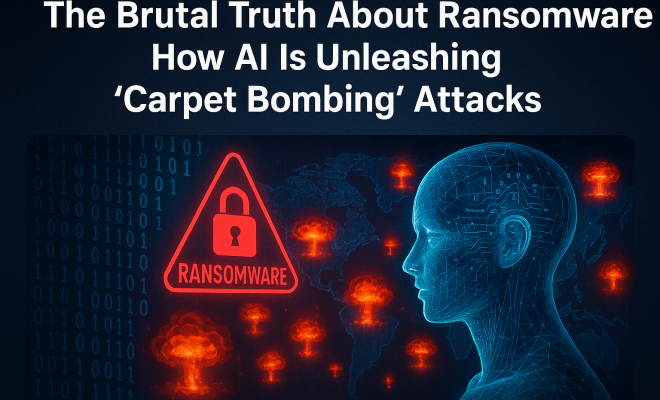
The Brutal Truth About Ransomware: How AI Is Unleashing ‘Carpet Bombing’ Attacks
Imagine waking up to find your entire business — every file, every customer record, every operational system — locked down, held hostage by an invisible enemy. This isn’t a scene from a dystopian movie; it’s the terrifying reality for thousands of organizations worldwide, a reality made even more chilling by the advent of AI-accelerated ransomware. Japan recently declared a cyberspace emergency after an unprecedented wave of these attacks compromised the personal information of over 14 million citizens and cascaded through nearly 500 businesses via a single cloud provider. Security experts are calling this new pattern ‘carpet bombing,’ a stark departure from the more targeted strikes of yesteryear.
The scale and speed are truly alarming. AI isn’t just making ransomware smarter; it’s making it indiscriminate, automating the saturation of targets to a degree we’ve never seen before. This development follows a record-breaking third quarter of 2026 for ransomware globally, with an astonishing 2,627 claimed attacks. When critical infrastructure, essential services, and your fundamental business operations are under siege, knowing exactly how to respond to a ransomware attack isn’t just good practice—it’s absolutely vital for survival. Let’s break down the essential steps your organization needs to take when the unthinkable happens.
1. Isolate and Contain the Breach Immediately: The First Line of Defense
When a ransomware attack hits, your absolute first priority is to stop the bleeding. Think of it like a fire: you need to contain it before it engulfs the entire building. The moment you detect suspicious activity – unusual file encryption, ransom notes appearing, or systems becoming inaccessible – you must isolate the affected systems. This means disconnecting them from your network, both physically and logically. Unplug Ethernet cables, disable Wi-Fi, and segment networks. This isn’t about saving data at this stage; it’s about preventing further propagation.
It’s a race against the clock, especially with AI-driven attacks that can spread with terrifying speed. Japan’s recent emergency, where attacks cascaded through 495 businesses from a single cloud provider, highlights this brutal efficiency. Every second counts. Your incident response plan should have clear, pre-defined procedures for immediate isolation, outlining who does what and the exact steps to take. Don’t wait for perfect clarity; act decisively to minimize the attack surface. This might mean temporarily taking down critical systems, which is a hard decision, but it’s often far less damaging than letting the ransomware spread unchecked.
2. Activate Your Incident Response Team and Plan: Don’t Go It Alone
You wouldn’t tackle a major medical emergency without a team of doctors, right? A ransomware attack is no different. As soon as you’ve isolated the threat, activate your pre-defined incident response plan and assemble your team. This team should include key stakeholders from IT, legal, communications, human resources, and senior management. Each member needs to understand their role, responsibilities, and the communication protocols.
Your incident response plan isn’t just a document; it’s your playbook for chaos. It should detail communication strategies – both internal and external – legal obligations, and escalation paths. Who will notify law enforcement? Who will handle media inquiries? Who will assess the damage and lead recovery efforts? Having these answers ready before an attack happens will save precious hours, and potentially millions of dollars, in the heat of the moment. The sheer scale of recent attacks, like the Warlock group exploiting old Microsoft SharePoint flaws to breach critical sectors, underscores how crucial a coordinated response is.
3. Notify Relevant Authorities and Legal Counsel: The Essential Outreach
Once the immediate containment is underway and your team is activated, your next critical step is to engage with legal counsel and notify relevant authorities. This isn’t just a suggestion; depending on your industry and geographic location, it’s often a legal requirement. Data breach notification laws like GDPR, CCPA, and countless others dictate strict timelines and reporting obligations. Failing to comply can result in hefty fines and severe reputational damage, compounding the misery of the attack itself.
Your legal team will guide you through these complex waters, ensuring you meet all regulatory requirements and advising on potential liabilities. Simultaneously, consider notifying law enforcement agencies like the FBI (in the US) or Europol (in Europe). While they might not be able to recover your data immediately, they can offer forensic assistance, track the perpetrators, and potentially prevent future attacks against others. They also serve as an official record of the incident, which can be crucial for insurance claims or future legal proceedings. Remember, transparency, guided by legal advice, can build trust even in a crisis.
4. Perform a Thorough Forensic Analysis: Understanding the Enemy
You can’t effectively eradicate a threat if you don’t understand how it got in. Forensic analysis is the painstaking process of investigating the attack to determine its root cause, the extent of the compromise, and the specific vulnerabilities exploited. This involves collecting logs, analyzing network traffic, examining compromised systems, and identifying the initial point of entry.
This step is crucial for several reasons. First, it helps you identify and patch the security gaps that allowed the ransomware in, preventing a recurrence. Second, it provides vital intelligence for law enforcement. Third, it informs your recovery strategy. Did the attackers exfiltrate data before encrypting it? Knowing this is critical for understanding your legal notification obligations and the potential impact on your customers. The recent attacks in France on supermarket refrigeration systems, causing widespread food spoilage and even fires, show how understanding the attack vector is paramount to mitigating cascading physical damage. (See: CDC Cybersecurity Resources.)
5. Assess the Damage and Data Exfiltration: What Have We Lost?
Ransomware isn’t just about encrypting files anymore. A significant and growing trend, known as double extortion, involves attackers not only encrypting your data but also stealing it before encryption. They then threaten to publish this sensitive information if the ransom isn’t paid. This makes assessing data exfiltration just as important as evaluating encryption. For more context, see Bizarre AI Threats: Your Digital Security Is Under Attack – Here’s How to Fight Back.
Your forensic analysis will feed into this assessment. You need to identify precisely what data was accessed, copied, or destroyed. This includes personal identifiable information (PII), protected health information (PHI), intellectual property, and financial records. The scale of Japan’s incident, where over 14 million citizens’ personal information was compromised, underscores the catastrophic impact of data exfiltration. This assessment directly influences your legal reporting obligations, public communication strategy, and the potential need for credit monitoring services for affected individuals. It’s a grim task, but absolutely necessary to understand the full scope of the disaster.
6. Evaluate Ransom Payment Considerations: A Difficult Dilemma
This is arguably the most agonizing decision an organization faces when figuring out how to respond to a ransomware attack: to pay or not to pay the ransom. There’s no easy answer, and the FBI, for example, generally advises against paying, as it funds criminal enterprises and offers no guarantee of data recovery. However, in some extreme cases, particularly when data backups are nonexistent or severely compromised, and the business faces existential threat, organizations do consider payment.
If you even contemplate paying, engage with specialized incident response firms and legal counsel. They can help you navigate the complexities, including potential sanctions risks (it’s illegal to pay ransoms to sanctioned entities). They can also facilitate negotiations with the attackers, often acting as intermediaries. The decision to pay should never be taken lightly and must involve a thorough cost-benefit analysis, weighing the financial cost of the ransom against the potential losses from downtime, reputational damage, regulatory fines, and the complete loss of data. The ultimate goal should always be to recover your data and restore operations without resorting to payment, but the reality can be far more complicated.
7. Restore Systems from Secure Backups: The Path to Recovery
Your robust, isolated, and regularly tested backups are your ultimate lifeline in a ransomware attack. This is where the long-term planning truly pays off. Once you’ve contained the threat, understood its scope, and ensured your network is clean, you can begin the painstaking process of restoring your systems and data from your secure backups. It’s absolutely critical that these backups were created *before* the attack and are stored offline or in an immutable fashion, inaccessible to the ransomware itself. If your backups are compromised, your recovery options become severely limited.
The restoration process needs to be methodical. Start with critical systems and data, working your way through less urgent assets. Test restored data rigorously to ensure its integrity and functionality. This isn’t a quick flip of a switch; it’s a careful, phased approach to bring your operations back online safely. Many organizations find themselves relying on cloud-based backups or immutable storage solutions to ensure data survivability against these increasingly aggressive attacks.
8. Harden Your Defenses and Remediate Vulnerabilities: Learning from the Pain
An attack, while devastating, is also a brutal learning experience. Once you’ve recovered, the work isn’t over; it’s time to learn from the incident and significantly harden your defenses. This involves implementing all the lessons learned from the forensic analysis. Patch the vulnerabilities that were exploited, enhance your endpoint detection and response (EDR) capabilities, strengthen your email filtering and web security, and consider multi-factor authentication (MFA) across the board.
This remediation phase should also include a comprehensive review of your security policies and employee training. Human error remains a significant vector for ransomware, so ongoing security awareness training is non-negotiable. Simulate future attacks with penetration testing and red team exercises to find new weaknesses before criminals do. The ‘carpet bombing’ nature of AI-driven ransomware means attackers will hit you again if you don’t close those doors. This is an ongoing battle, not a one-time fix.
9. Review and Update Your Incident Response Plan: The Continuous Cycle of Preparedness
Finally, your incident response plan should be a living document, not something you create once and forget. After every incident, especially one as severe as a ransomware attack, you must conduct a thorough post-mortem review. What worked well? What didn’t? Were there gaps in communication, technology, or personnel training? Document all lessons learned and use them to refine and update your plan.
Regularly test your updated plan through tabletop exercises and live simulations. The threat landscape, particularly with the rapid evolution of AI in cyberattacks, is constantly changing. Your preparedness must evolve with it. The unprecedented scale and speed of recent attacks, like Japan’s cyberspace emergency, demonstrate that complacency is no longer an option. A well-rehearsed, up-to-date plan is your best defense against the next wave of sophisticated, automated threats. Stay vigilant, stay prepared, and never underestimate the ingenuity of those who would seek to hold your data hostage. (See: New York Times on Ransomware Attacks.)
Responding to a ransomware attack is a marathon, not a sprint, demanding swift action, meticulous analysis, and unwavering resilience. The stakes have never been higher, but with a robust plan and a prepared team, your organization can navigate even the most brutal digital assaults.
10. The Psychological Toll: Managing Stakeholder and Public Perception
Beyond the technical and legal challenges, a ransomware attack carries a heavy psychological burden. For employees, it can be a deeply unsettling experience, fostering distrust and anxiety about job security and the company’s future. For executives, the pressure to make rapid, high-stakes decisions under duress is immense. And for the public, especially customers whose data might be compromised, trust can erode quickly. For more context, see How Artificial Intelligence Could Trigger a Nuclear Catastrophe by 2100.
Effective communication is paramount here. Internally, leaders need to be visible, empathetic, and provide regular, honest updates to employees. Transparency about the situation, without revealing sensitive investigative details, helps manage fear and maintain morale. For external communication, your communications team, guided by legal counsel, needs to craft clear, concise messages that acknowledge the incident, explain the steps being taken, and express regret for any inconvenience or harm caused. Avoid speculation or making promises you can’t keep. The goal is to project competence and commitment to resolving the issue and protecting affected parties. Silence or evasiveness can be far more damaging to your reputation than an honest admission of a difficult situation. Remember, how you communicate during a crisis often shapes public perception more than the crisis itself.
11. Cybersecurity Insurance: A Critical Safety Net
In today’s threat landscape, cybersecurity insurance isn’t a luxury; it’s a strategic necessity. Many organizations still underestimate its value until they’re staring down a multi-million dollar recovery bill. Cybersecurity insurance policies are specifically designed to cover a range of costs associated with cyber incidents, including ransomware attacks.
Typical coverage can include:
- Ransom Payment: Some policies may cover the actual ransom amount, though this is often a contentious point and requires careful policy review.
- Incident Response Costs: This covers the fees for forensic investigators, legal counsel, public relations firms, and crisis management experts.
- Business Interruption: Compensation for lost revenue and operational expenses during the downtime caused by the attack.
- Data Restoration: Costs associated with recovering and restoring lost or corrupted data.
- Legal Fees and Fines: Coverage for legal defense, regulatory fines, and class-action lawsuits stemming from data breaches.
- Notification Costs: Expenses for notifying affected individuals, including credit monitoring services.
It’s crucial to understand your policy’s specifics *before* an attack. What are the deductibles? What are the coverage limits? Are there specific requirements for incident response that you must follow to maintain coverage? Many insurers now mandate certain security controls (like MFA or regular backups) as a condition of coverage. Working with an experienced insurance broker specializing in cyber coverage can help you tailor a policy that truly protects your organization against the financial fallout of a ransomware attack.
12. The Evolving Threat Landscape: AI vs. AI
The “AI-accelerated ransomware” mentioned at the beginning of this article isn’t just a buzzword; it represents a significant shift. Attackers are using AI to:
- Automate Reconnaissance: AI can rapidly scan vast networks for vulnerabilities, identify high-value targets, and even learn network configurations faster than human operators.
- Generate Phishing Lures: AI can craft highly personalized and grammatically perfect phishing emails, making them much harder to detect.
- Evade Detection: AI-powered malware can adapt its behavior to bypass traditional security tools, making it stealthier.
- Speed Up Encryption: AI can optimize encryption processes, making the lockout faster and more efficient.
This means your defense strategy must also incorporate AI. Organizations are increasingly deploying AI-driven security tools for:
- Anomaly Detection: AI can identify unusual patterns in network traffic or user behavior that indicate an attack in progress, often before it fully escalates.
- Threat Intelligence: AI can analyze vast amounts of global threat data to predict emerging attack vectors and proactively adjust defenses.
- Automated Response: Security Orchestration, Automation, and Response (SOAR) platforms, often AI-enhanced, can automatically isolate infected systems or block malicious IPs, significantly reducing response times.
- Predictive Analytics: AI can help prioritize patching efforts by predicting which vulnerabilities are most likely to be exploited next.
The battle against ransomware is increasingly becoming an AI vs. AI arms race. Staying competitive means not just understanding the latest threats but also leveraging advanced technology to defend against them. (See: Nature article on AI and Cybersecurity.)
Frequently Asked Questions About Responding to a Ransomware Attack
Q1: How quickly do we need to respond to a ransomware attack?
A: Immediately. The first few minutes and hours are critical. Ransomware, especially AI-accelerated variants, can spread incredibly fast. The sooner you isolate affected systems and activate your response team, the better your chances of containing the damage and reducing recovery time. Every minute of delay can mean more encrypted files or exfiltrated data.
Q2: Should we ever pay the ransom?
A: This is a complex and often agonizing decision. Law enforcement agencies like the FBI generally advise against paying because it funds criminal organizations and doesn’t guarantee data recovery. However, in extreme cases where backups are unusable and the business faces an existential threat, some organizations do consider it. If contemplating payment, engage specialized incident response firms and legal counsel to navigate the risks, including potential sanctions compliance issues. The goal should always be recovery without payment, if possible.
Q3: What’s the most common way ransomware gets into an organization?
A: Phishing emails remain a primary vector. Employees clicking on malicious links or opening infected attachments can provide the initial foothold. Other common entry points include exploiting unpatched software vulnerabilities, weak remote desktop protocol (RDP) configurations, and compromised credentials. Human error and unaddressed security gaps are consistently exploited.
Q4: What should be in our incident response plan specifically for ransomware?
A: A robust ransomware-specific plan should include: clear roles and responsibilities for your IR team, detailed steps for immediate system isolation, communication protocols (internal and external), contact information for legal counsel and law enforcement, procedures for forensic analysis, a strategy for assessing damage and data exfiltration, guidelines for backup restoration, and a process for post-incident review and remediation. Crucially, it should also include decision matrices for potential ransom payment scenarios.
Q5: How can we prevent a ransomware attack in the first place?
A: Prevention is multi-layered:
- Regular Backups: Implement the “3-2-1 rule” – three copies of data, on two different media, with one copy offsite/offline.
- Patch Management: Keep all operating systems, software, and firmware updated to patch known vulnerabilities.
- Multi-Factor Authentication (MFA): Implement MFA everywhere possible, especially for remote access, cloud services, and privileged accounts.
- Employee Training: Conduct regular security awareness training to educate employees about phishing, suspicious links, and social engineering tactics.
- Endpoint Detection and Response (EDR): Deploy advanced EDR solutions to monitor and detect malicious activity on endpoints.
- Network Segmentation: Segment your network to limit lateral movement of ransomware if an initial breach occurs.
- Email and Web Security: Use robust email filtering and web security gateways to block malicious content.
- Privileged Access Management (PAM): Restrict administrative privileges to only those who absolutely need them.
Q6: What role does cybersecurity insurance play in a ransomware attack?
A: Cybersecurity insurance acts as a financial safety net. It can cover various costs associated with an attack, including incident response services (forensics, legal, PR), business interruption losses, data restoration expenses, notification costs for affected individuals, and potentially even the ransom payment itself (depending on the policy and legal restrictions). It’s crucial to understand your policy’s coverage and requirements beforehand.
Q7: What’s the difference between ransomware and a regular data breach?
A: While both are cyber incidents, ransomware specifically involves encrypting your data and demanding payment for its release, often with the added threat of data exfiltration (double extortion). A regular data breach, while also potentially involving data exfiltration, primarily focuses on unauthorized access to and theft of sensitive information, without necessarily encrypting your systems or holding them hostage. Many modern ransomware attacks now incorporate data exfiltration, blurring these lines.
Trending Now
Frequently Asked Questions
What is AI-accelerated ransomware?
AI-accelerated ransomware refers to malicious software that uses artificial intelligence to enhance its attack capabilities. This type of ransomware can automate the process of targeting multiple systems, making attacks faster and more indiscriminate, often compromising vast amounts of data and systems in a short period.
What are the signs of a ransomware attack?
Signs of a ransomware attack include unusual file encryption, ransom notes appearing on your systems, and the sudden inaccessibility of files or operational systems. If you notice any of these indicators, it is crucial to act quickly to isolate the affected systems.
How can businesses respond to a ransomware attack?
Businesses should respond to a ransomware attack by immediately isolating and containing the breach. This involves disconnecting affected systems from the network to prevent further spread. Following this, organizations should assess the damage and engage with cybersecurity professionals for recovery and future prevention.
What does 'carpet bombing' mean in cybersecurity?
'Carpet bombing' in cybersecurity refers to a strategy where ransomware indiscriminately targets a wide range of systems and networks. Unlike previous targeted attacks, this approach aims to saturate as many potential victims as possible, significantly increasing the scale and impact of the attack.
Why is it important to act quickly during a ransomware attack?
Acting quickly during a ransomware attack is crucial to prevent further data loss and minimize damage. Immediate isolation of affected systems can stop the spread of ransomware, protecting critical infrastructure and essential business operations from complete compromise.
Have you experienced this yourself? We'd love to hear your story in the comments.