The Astonishing Truth: Why Tech Jobs Are Surging Despite AI Layoffs
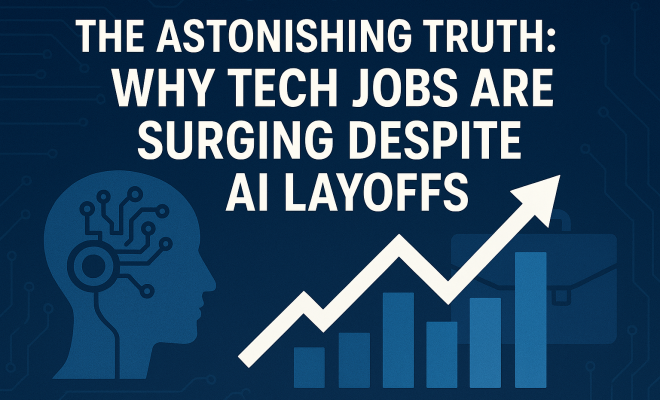
Remember all those dire warnings? The ones that painted a grim picture of AI sweeping through the tech industry, leaving a trail of unemployed engineers and coders in its wake? Well, it seems the narrative might be a little more complex, and dare I say, a lot more hopeful than many initially feared. In fact, when we look at the actual data, the AI impact on tech job opportunities 2026 is shaping up to be quite different from the doomsday scenarios.
For months, headlines screamed about mass layoffs, and while those cuts were undeniably painful for the individuals affected, a quieter, more profound shift has been taking place. We’re not just seeing job destruction; we’re witnessing a significant reshaping and, in many areas, a surprising surge in demand. It’s a nuanced story, and one that every tech professional, aspiring or established, needs to understand right now.
The Counter-Intuitive Surge in Tech Openings
Let’s cut right to the chase with some eye-opening figures. Despite the constant chatter about AI’s job-killing potential, data from TrueUp, a hiring platform that keeps a close eye on over 9,000 tech companies, paints a remarkably different picture. As of October 2026, the platform registered over 280,000 job openings. Think about that for a moment – nearly three hundred thousand positions waiting to be filled. What’s even more striking is that this figure represents a significant increase since the beginning of the year. This isn’t a minor fluctuation; it’s a robust upward trend that challenges the prevailing anxieties about AI’s effect on employment.
This surge isn’t just a statistical blip; it reflects a deep underlying transformation in how companies operate and what skills they value. While some roles are indeed becoming redundant, new ones are emerging at an incredible pace, and existing roles are evolving. It’s a testament to the dynamic nature of technology itself – every major innovation, from the internet to mobile computing, has reshaped the job market, not simply eradicated it. AI, it turns out, is no different, but its speed and scale are certainly unprecedented.
Understanding the Layoff Paradox: AI’s Dual Role
Now, let’s not sugarcoat the challenges. It would be disingenuous to ignore the fact that layoffs have occurred. Approximately 190,000 tech workers have faced job cuts in 2026. While this number is thankfully well below the peak we saw in 2023, it still represents a substantial number of individuals navigating career transitions. What makes this particularly poignant, and frankly, a bit controversial, is AI’s explicit role in these decisions. A staggering 41% of these layoff events, impacting nearly 180,000 workers, cited AI as a driving factor.
This creates a fascinating paradox. On one hand, companies are heavily investing in AI infrastructure, pouring billions into developing new models, hardware, and applications. On the other, they’re simultaneously reducing headcount in roles that AI can automate. It’s a classic case of creative destruction, but the speed at which it’s happening feels different this time. We’re witnessing a rapid reallocation of human capital, driven by the perceived efficiencies and capabilities of artificial intelligence. It’s a tough pill to swallow for those directly impacted, but it’s an unavoidable aspect of this technological revolution.
The Shifting Sands of Tech Roles: Who’s Thriving, Who’s Struggling?
So, which roles are feeling the pinch, and which are seeing unprecedented demand? The patterns are becoming increasingly clear. Roles that involve repetitive tasks, data entry, basic customer support, and even some forms of rudimentary coding are prime candidates for automation. Think about the basic Tier 1 customer service queries that AI chatbots can now handle with remarkable accuracy, or the initial code scaffolding that large language models can generate in seconds. These are areas where the AI impact on tech job opportunities 2026 is most acutely felt in terms of displacement.
However, the flip side is far more encouraging. The demand for highly specialized skills, particularly in areas directly related to AI development and deployment, is skyrocketing. We’re talking about roles like AI/ML Engineers, Data Scientists, Prompt Engineers, and, crucially, Hardware Engineers who are building the very infrastructure that powers these AI systems. These aren’t just minor upticks; these are exponential growth areas. It’s a clear signal that while AI might be taking over some tasks, it’s also creating entirely new categories of work, often requiring a deeper level of expertise and problem-solving capabilities.
Hardware Engineers: The Unsung Heroes of the AI Boom
When most people think about AI, their minds often jump to algorithms, software, and data. But let’s be honest, none of that magic happens without powerful physical infrastructure. This is where hardware engineers step into the spotlight, and their demand has surged dramatically. These are the individuals designing and building the specialized chips, servers, and data centers that are the backbone of every AI operation. From NVIDIA’s GPUs to custom ASICs, the physical components that enable machine learning at scale are more critical than ever.
Consider the sheer computational power required to train a massive AI model like GPT-4 or to run real-time inference for countless users. That power doesn’t come from thin air. It’s the result of relentless innovation in hardware design, thermal management, and energy efficiency. Companies are in a race to build bigger, faster, and more efficient AI infrastructure, and that race is driven by the brilliant minds of hardware engineers. Their work is foundational, and as long as AI continues its exponential growth, so too will the demand for these crucial specialists. The AI impact on tech job opportunities 2026 in this sector is overwhelmingly positive, creating a lucrative niche for those with the right skills. (See: BBC on technology job trends.)
The Resilient Software Engineer: Evolving, Not Eradicating
Perhaps one of the most reassuring takeaways for many is the resilience of software engineering roles. Despite early fears that AI coding assistants would make human programmers obsolete, the data suggests otherwise. While AI can certainly assist with boilerplate code, debugging, and even generating initial drafts, the core essence of software engineering – problem-solving, architectural design, complex system integration, and understanding nuanced user needs – remains firmly in human hands. In fact, many software engineers are now leveraging AI tools to enhance their productivity, allowing them to tackle more complex challenges and deliver solutions faster.
The shift isn’t about elimination; it’s about evolution. Software engineers are increasingly expected to work alongside AI, utilizing it as a powerful co-pilot rather than fearing it as a replacement. This means adapting skill sets, understanding how to prompt effectively, how to validate AI-generated code, and how to integrate AI components into larger systems. The demand for skilled software engineers who can navigate this new paradigm continues to be strong, underscoring that the AI impact on tech job opportunities 2026 is more about transformation than destruction for this vital profession. For more context, see China's AI Education.
The New Skillset: What Employers Really Want in the AI Era
So, if roles are evolving, what specific skills are now in high demand? It’s no longer enough to just be proficient in a programming language or a specific framework. The AI era demands a more holistic and adaptable skill set. Here’s a breakdown:
- AI/ML Proficiency: This one seems obvious, but it’s critical. Understanding machine learning principles, popular frameworks (TensorFlow, PyTorch), and deployment strategies is paramount.
- Data Literacy and Engineering: AI thrives on data. The ability to collect, clean, process, and manage vast datasets is incredibly valuable. Data engineers are the unsung heroes making AI possible.
- Prompt Engineering: This emerging skill involves crafting effective queries and instructions for large language models to elicit the desired outputs. It bridges the gap between human intent and AI capability.
- Critical Thinking & Problem Solving: As AI automates routine tasks, the premium on human creativity, abstract reasoning, and complex problem-solving only increases. AI can provide answers, but humans still need to ask the right questions.
- Ethical AI & Governance: With AI’s growing power comes immense responsibility. Understanding bias, fairness, transparency, and regulatory compliance is becoming a non-negotiable skill for many roles.
- Adaptability & Continuous Learning: The pace of change is accelerating. The ability to quickly learn new tools, embrace new methodologies, and pivot with technological advancements is perhaps the most important skill of all.
These skills aren’t just for AI specialists; they’re becoming increasingly relevant for almost every role in tech, from product management to cybersecurity. The AI impact on tech job opportunities 2026 isn’t just about new job titles, but a fundamental shift in baseline expectations across the board.
California’s Proactive Stance: Protecting Workers in the AI Age
The rapid integration of AI into the workplace hasn’t gone unnoticed by lawmakers. California, often at the forefront of tech regulation, has already taken significant steps to address worker concerns. New laws have been enacted to provide crucial protections against potential abuses of AI in employment. For instance, employers are now prohibited from solely relying on AI for firing decisions. This is a critical safeguard against algorithmic bias or errors that could unfairly impact an individual’s livelihood.
Furthermore, the Golden State has banned the use of AI to predict emotional states of employees – a troubling prospect that raises serious privacy and ethical concerns. The collection of neural data, another potential overreach, has also been restricted. Perhaps most importantly for transparency, companies are now required to notify employees if layoffs are caused by AI. These measures reflect a growing recognition that while AI offers immense potential, it also necessitates careful oversight to ensure it serves humanity, rather than dominating it. These regulations are setting a precedent, and we can expect other states and nations to follow suit, shaping the ethical framework for the AI impact on tech job opportunities 2026 and beyond.
The Economic Engine of AI Investment
It’s easy to focus on the immediate impacts on individual jobs, but we must also consider the broader economic picture. The sheer scale of investment in AI infrastructure is staggering. Major tech giants, venture capitalists, and even governments are pouring billions into research, development, and deployment of AI technologies. This isn’t just about building new software; it’s about creating entirely new industries, products, and services.
Think about the downstream effects: the demand for specialized cloud computing resources, the need for new data centers, the growth of AI-powered analytics platforms, and the explosion of AI-driven applications across every sector, from healthcare to finance. Each of these areas represents an economic engine, generating revenue, fostering innovation, and, yes, creating jobs. While some jobs might be automated away, the economic expansion driven by AI investment often creates a net positive in terms of overall employment, albeit with a significant shift in the types of roles available. This economic momentum is a key driver of the overall AI impact on tech job opportunities 2026, ensuring continued demand for new talent.
Preparing for the Future: Actionable Advice for Tech Professionals
So, what does all this mean for you, the tech professional trying to make sense of this rapidly changing landscape? It means opportunity, but it also means responsibility – the responsibility to adapt and evolve. Here’s some actionable advice:
- Embrace Lifelong Learning: This isn’t a cliché; it’s a survival strategy. Dedicate time each week to learning new AI tools, concepts, and best practices. Online courses, certifications, and even self-study through open-source projects are invaluable.
- Focus on Uniquely Human Skills: Double down on creativity, critical thinking, emotional intelligence, complex problem-solving, and communication. These are the areas where humans will continue to have an undeniable edge over AI.
- Become a ‘Prompt Whisperer’: Learn how to effectively communicate with AI models. Understanding how to structure prompts, provide context, and refine outputs will be a highly sought-after skill.
- Network Strategically: Connect with professionals who are at the forefront of AI adoption. Attend industry events, join online communities, and seek out mentors who can guide you through this transition.
- Consider AI Governance and Ethics: As AI becomes more pervasive, the need for professionals who understand its ethical implications and can help build responsible AI systems will only grow. This is a burgeoning field with significant potential.
- Don’t Panic, Pivot: If your current role seems vulnerable to automation, don’t despair. Instead, identify adjacent areas where your skills can be leveraged in an AI-enhanced environment. Can you transition from basic coding to AI-assisted development, or from traditional data analysis to AI model interpretation?
The AI impact on tech job opportunities 2026 is not about a sudden cliff edge but a gradual, albeit swift, incline towards new horizons. Those who prepare and adapt will not only survive but thrive.
The Broader Implications: Beyond Just Tech Jobs
While this discussion has largely centered on the tech industry, it’s crucial to remember that the AI revolution isn’t confined to Silicon Valley. Its tendrils are reaching into every sector imaginable, from manufacturing and logistics to healthcare and education. What we’re observing in tech is often a precursor to what will unfold across the broader economy. The lessons learned here – about skill evolution, the emergence of new roles, and the necessity of ethical governance – are universal. (See: New York Times on AI and jobs.)
The shift isn’t just about specific job titles, but about the very nature of work itself. We’re moving towards a future where human ingenuity, collaboration, and critical judgment are augmented by powerful AI tools, not replaced by them. This requires a fundamental rethinking of education, corporate training, and even our societal safety nets. The AI impact on tech job opportunities 2026, and far beyond, is a grand experiment in human-machine collaboration, and understanding its nuances is key to navigating the future successfully.
So, the next time you hear someone declare that AI is going to kill all tech jobs, you’ll have the data and the context to challenge that overly simplistic narrative. The truth, as always, is far more interesting and, for those willing to adapt, incredibly promising. For more context, see Executive Order's 'Super Intelligence' Rebrand.
The Rise of the AI Product Manager and UX Designer
When we talk about new roles, it’s not just about the engineers building the AI. There’s a rapidly growing demand for professionals who can bridge the gap between complex AI capabilities and real-world user needs. This is where AI Product Managers and AI-focused UX Designers become invaluable. An AI Product Manager isn’t just defining features; they’re understanding the limitations and possibilities of AI models, strategizing how AI can solve specific user problems, and guiding the development lifecycle of AI-powered products. They need a keen eye for both technical feasibility and market opportunity, translating AI breakthroughs into tangible user value.
Similarly, AI UX Designers face unique challenges. Designing an interface for a traditional application is one thing; designing one for an intelligent agent that might interpret user intent, generate content, or even make autonomous decisions, is another entirely. These designers are grappling with questions of trust, transparency, error handling, and how to make AI feel intuitive and helpful, not opaque or intimidating. They’re defining interaction patterns for conversational AI, designing feedback loops for machine learning systems, and ensuring that AI outputs are presented in an understandable, actionable way. Their role is critical in making AI user-friendly and adoptable, cementing their place as key players in shaping the AI impact on tech job opportunities 2026.
Cybersecurity in the Age of AI: A Double-Edged Sword
The AI revolution brings with it a complex dynamic for cybersecurity professionals. On one hand, AI offers powerful new tools for defense. Machine learning algorithms can detect anomalies in network traffic much faster and more accurately than human analysts, identifying novel threats and zero-day attacks. AI-powered security systems can automate threat intelligence gathering, analyze vast datasets of vulnerabilities, and even predict potential attack vectors. This means a surge in demand for cybersecurity experts who can implement, manage, and fine-tune these advanced AI defense mechanisms.
However, AI is also a formidable weapon in the hands of malicious actors. Generative AI can craft highly convincing phishing emails, deepfakes can be used for sophisticated social engineering, and AI-driven bots can launch highly coordinated and adaptive attacks. This creates a perpetual arms race. Cybersecurity professionals are now tasked with not only defending against traditional threats but also anticipating and countering AI-powered cyber warfare. This necessitates a deep understanding of AI principles, machine learning security, and adversarial AI techniques. The AI impact on tech job opportunities 2026 for cybersecurity isn’t just growth; it’s a dramatic evolution of the required expertise, making it a challenging yet incredibly vital field.
The Role of Education and Government Initiatives
The speed of AI’s integration means that traditional educational pathways often struggle to keep up. Universities and vocational schools are working hard to redesign curricula, but there’s a significant lag. This is where government initiatives and public-private partnerships become crucial. We’re seeing more funding directed towards AI research and development centers, often co-located with universities, to accelerate knowledge transfer. There are also growing efforts to launch national upskilling and reskilling programs, specifically targeting workers whose jobs are most vulnerable to automation.
For example, some governments are exploring tax incentives for companies that invest in employee training for AI-related skills, or offering subsidies for individuals pursuing AI certifications. The goal is to smooth the transition for the workforce, ensuring that fewer people are left behind. These initiatives aren’t just about job creation; they’re about fostering a future-proof workforce capable of adapting to continuous technological disruption. The success of these programs will play a significant role in determining the long-term societal AI impact on tech job opportunities 2026 and beyond, influencing how equitably the benefits of AI are distributed.
Expert Perspectives: Diverse Views on the Future
It’s worth noting that while the data points to a hopeful trend, there are still diverse opinions among experts about the long-term AI impact on tech job opportunities. Some, like Andrew Ng, a prominent figure in AI, emphasize the “augmentation” aspect, believing AI will mostly enhance human capabilities rather than replace them entirely. He often highlights that many tasks require human judgment, creativity, and social intelligence that AI simply can’t replicate.
On the other hand, figures like Kai-Fu Lee, a venture capitalist and AI expert, predict a more significant displacement in routine cognitive and manual labor, even while acknowledging the creation of new, higher-level jobs. His view suggests a greater need for societal safety nets and universal basic income as the workforce transforms. Then there are those who focus on the “superintelligence” aspect, like Nick Bostrom, who warn about the existential risks of unchecked AI development, a perspective that touches less on job numbers and more on the fundamental nature of humanity’s relationship with advanced AI. These varied perspectives underscore the complexity of forecasting technology’s true impact and highlight the importance of continuous monitoring and thoughtful policy development. For more context, see AI Token Costs Your Business Isn't Ready For. (See: CDC on occupational health and trends.)
Frequently Asked Questions (FAQ)
Q1: Is AI going to eliminate all tech jobs by 2026?
No, the data doesn’t support this fear. While AI will automate certain tasks and displace some roles, it’s also creating a significant number of new job opportunities, particularly in areas like AI/ML engineering, data science, prompt engineering, and hardware development. The overall trend shows a reshaping and growth in tech employment, not an eradication.
Q2: Which tech jobs are most at risk from AI automation?
Roles involving highly repetitive tasks, basic data entry, rudimentary coding, and Tier 1 customer support are most susceptible to automation. AI chatbots and coding assistants can handle these functions efficiently, leading to a shift in demand away from these specific, lower-level tasks.
Q3: What new tech jobs are emerging because of AI?
We’re seeing strong demand for AI/ML Engineers, Data Scientists, Prompt Engineers, AI Product Managers, AI UX Designers, and Hardware Engineers specializing in AI infrastructure. Cybersecurity roles are also evolving rapidly to manage AI-driven threats and defenses.
Q4: What skills should I learn to stay relevant in the AI era?
Focus on AI/ML proficiency, strong data literacy and engineering skills, prompt engineering, critical thinking, complex problem-solving, ethical AI understanding, and, most importantly, adaptability and continuous learning. Human-centric skills like creativity and emotional intelligence are also becoming more valuable.
Q5: How are governments responding to the AI impact on jobs?
Governments, like California’s, are starting to enact regulations to protect workers, such as prohibiting AI from being the sole basis for firing decisions and restricting AI’s use in monitoring employee emotional states. There’s also a growing emphasis on funding education and reskilling programs to help the workforce adapt.
Q6: Will AI make software engineers obsolete?
Not at all. Software engineering is evolving. AI coding assistants can handle boilerplate code, but human software engineers remain crucial for architectural design, complex problem-solving, system integration, and understanding nuanced user needs. Engineers who can effectively leverage AI tools will be highly sought after.
Q7: Is the AI job boom only happening in Silicon Valley?
While Silicon Valley is a major hub, the AI impact is global. Investment in AI infrastructure and talent is happening across major tech centers worldwide, and as AI integrates into every industry, demand for AI-savvy professionals will grow in all sectors, not just tech.
Trending Now
- Urgent Warning: GitLab AI Gateway Flaw…
- Aignosis’ Rs 4 Crore Seed Funding:…
- The Billionaire’s Bombshell: Why Startup Funding 2024 Could Be a Minefield
- A Hacker’s Betrayal? Inside the ‘Rey’ Detention That Rocked ShinyHunters
- this guide on the astonishing reason why china’s ai education will leave the west behind
Frequently Asked Questions
Are tech jobs really increasing despite AI layoffs?
Yes, despite the headlines about AI-induced layoffs, the tech job market is witnessing a significant surge. As of October 2026, there are over 280,000 job openings in the tech sector, indicating a strong demand for new and evolving roles.
What is driving the demand for tech jobs in 2026?
The demand for tech jobs is driven by a transformation in company operations and evolving skill requirements. While some roles are becoming obsolete, new positions are emerging rapidly, reflecting the dynamic nature of technology.
How many tech job openings are there currently?
As of October 2026, there are over 280,000 job openings in the tech industry. This represents a significant increase in available positions compared to earlier in the year, challenging the narrative of widespread job loss due to AI.
What skills are becoming more valuable in the tech industry?
In the evolving tech landscape, skills related to AI, data analysis, and software development are becoming increasingly valuable. Companies are seeking professionals who can adapt to new technologies and contribute to innovative solutions.
Is the narrative about AI destroying jobs accurate?
The narrative of AI destroying jobs is overly simplistic. While some positions may vanish, many new roles are being created, and existing roles are evolving, indicating a more complex and hopeful job market in tech.
What did we miss? Let us know in the comments and join the conversation.