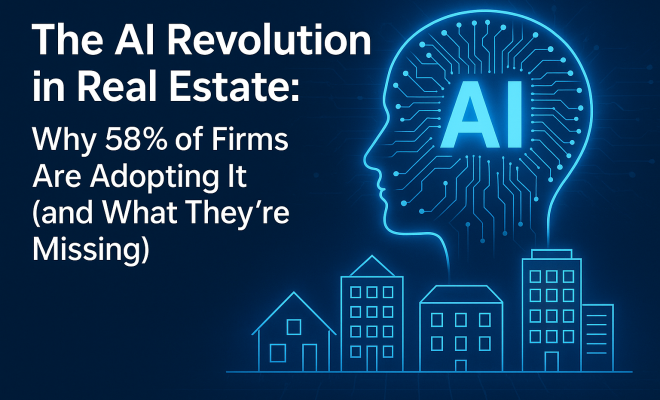
The AI Revolution in Real Estate: Why 58% of Firms Are Adopting It (and What They’re Missing)
The real estate world is in the midst of a silent, yet powerful, revolution. You’ve probably noticed AI popping up everywhere, but did you realize just how deeply it’s penetrated property management? A recent report, published on September 24, 2026, by IREM in partnership with AppFolio, reveals a truly staggering statistic: AI adoption in real estate management has soared to 58%. Think about that for a moment. Just three years prior, in 2023, that number was a mere 21%. That’s a dramatic leap, indicating that real estate professionals are quickly recognizing the immense potential these tools offer.
But here’s the kicker, and it’s a concerning one: despite this rapid integration, most companies are flying blind. The report highlights a substantial governance gap, with many firms lacking a written AI policy, and professionals often operating without formal training. It’s like giving someone a Ferrari without teaching them how to drive or providing a rulebook for the road. This creates both excitement about the capabilities and legitimate concerns about the lack of oversight. So, if you’re looking to understand the landscape of AI in real estate solutions comparison, you’re in the right place. Let’s dig into some of the leading AI tools that are reshaping how properties are managed, valued, and transacted.
1. AppFolio Property Manager: The All-in-One Powerhouse
AppFolio has long been a dominant player in property management software, and their embrace of AI has only solidified their position. It’s no surprise they partnered with IREM on that eye-opening report, given their deep understanding of the market. AppFolio Property Manager leverages AI to automate a vast array of routine tasks, freeing up property managers to focus on more strategic initiatives and tenant relations. Imagine AI handling rent collection reminders, screening tenant applications with predictive analytics, or even responding to common maintenance requests through intelligent chatbots. That’s the kind of efficiency we’re talking about.
Their AI capabilities extend to financial management, offering insights into budgeting, forecasting, and expense tracking. For instance, AI algorithms can analyze historical data to predict future cash flow more accurately, helping property owners make informed decisions about investments and operational costs. While specific pricing details often require a direct quote, AppFolio is generally considered a premium solution, tailored for medium to large-sized property management companies that need a comprehensive, scalable platform with robust AI integrations.
2. MRI Software: Enterprise-Grade Customization
MRI Software is another titan in the real estate technology space, particularly known for its enterprise-level solutions. Their approach to AI integration is often about providing flexible modules that can be customized to fit the complex needs of large real estate portfolios, including commercial, residential, and affordable housing. For example, their AI-driven analytics tools can sift through massive datasets to identify market trends, optimize pricing strategies for rental units, or even predict potential tenant churn before it becomes an issue.
What sets MRI apart is its ability to integrate with a wide ecosystem of third-party applications, making it a powerful hub for data analysis. This means you can pull in data from various sources – leases, financial records, maintenance logs, utility consumption – and have MRI’s AI engine process it all to provide a holistic view of your portfolio’s performance. Their pricing model is highly bespoke, reflecting the customized nature of their deployments, making it a significant investment but one that can yield substantial returns for large-scale operations seeking sophisticated AI in real estate solutions comparison.
3. Yardi Voyager: Holistic Portfolio Management with AI
Yardi Voyager is practically synonymous with comprehensive real estate management, particularly for large-scale portfolios encompassing diverse property types. Their AI initiatives are geared towards enhancing every facet of property operations, from leasing and accounting to maintenance and investor relations. Think about AI-powered chatbots handling initial tenant inquiries 24/7, or predictive maintenance algorithms flagging potential equipment failures before they happen, thus reducing costly emergency repairs.
Yardi’s AI also plays a crucial role in data analysis, helping property owners understand market dynamics, tenant behavior, and financial performance with unprecedented clarity. By automating data extraction and analysis from various documents, Yardi significantly reduces manual effort and improves accuracy. Like MRI, Yardi’s pricing is customized based on the modules selected and the scale of the operation, targeting larger real estate enterprises that demand an integrated, AI-enhanced platform for end-to-end management.
4. Zillow AI: Market Insights and Predictive Analytics
While not a property management platform in the traditional sense, Zillow’s extensive use of AI profoundly impacts the real estate market, offering tools that are invaluable for investors, agents, and property managers alike. Their Zestimate algorithm, powered by machine learning, provides instant home value estimates by analyzing millions of data points, including sales history, property characteristics, and local market trends. This tool has revolutionized how consumers and professionals gauge property values.
Beyond Zestimate, Zillow employs AI for personalized property recommendations, lead generation for agents, and even to help buyers visualize homes with virtual staging and 3D tours. For anyone looking at an AI in real estate solutions comparison from an investment or acquisition perspective, Zillow’s data and AI-driven insights are critical. While many of their tools are free for consumers, professional services and data access come with various subscription models, making their AI accessible to a broad audience.
5. OpenDoor: AI-Powered iBuying and Transaction Facilitation
OpenDoor is a fascinating example of AI completely disrupting the traditional real estate transaction process. As an iBuyer (instant buyer), OpenDoor uses sophisticated AI algorithms to make near-instant cash offers on homes. Their models analyze vast amounts of data—from property specifics and market conditions to hyper-local trends—to accurately price homes and manage risk. This allows sellers to bypass the conventional, often lengthy, process of showings, negotiations, and contingencies. (See: AI adoption in real estate.)
The AI not only prices homes but also optimizes the entire resale process, from renovation recommendations to marketing strategies. For real estate professionals, understanding OpenDoor’s model is crucial, as it represents a significant shift in how properties can be bought and sold. While their core business is buying and selling homes, the underlying AI technology offers a glimpse into the future of automated real estate transactions. Their ‘pricing’ comes in the form of service fees charged on transactions, reflecting the convenience and speed they offer through their AI-driven platform.
6. Local Logic: Hyper-Local Data and Urban Planning
Local Logic offers a unique AI solution that focuses on hyper-local insights, going beyond simple property data to analyze the ‘DNA’ of neighborhoods. Their AI processes billions of data points related to location characteristics – walkability, access to amenities, transit options, noise levels, and even social dynamics – to provide a comprehensive score for every address. This allows developers, investors, and even individual buyers to understand the true value and potential of a location, not just the property itself. For more context, see The Hidden Truth About AI Mortgage Tools.
For urban planners and commercial real estate developers, this AI in real estate solutions comparison is invaluable for site selection, understanding demographic shifts, and predicting the success of new projects. Property managers can also leverage these insights to better market their units and understand tenant preferences. Local Logic operates on a subscription model, providing access to their robust data and AI-powered analytics dashboard, making it a powerful tool for strategic decision-making in real estate development and investment.
7. Procore: AI for Construction Project Management
While primarily a construction management platform, Procore’s integration of AI is increasingly relevant for real estate developers and investors who oversee new construction or significant renovations. AI within Procore helps optimize project schedules, predict budget overruns, and identify potential risks before they escalate. Imagine AI analyzing thousands of past project data points to forecast delays or cost increases on your current build – that’s the kind of foresight Procore offers.
Their AI also assists in document management, automatically categorizing and tagging construction drawings, contracts, and communications, making information retrieval much faster and more accurate. This level of efficiency can lead to significant cost savings and faster project completion, directly impacting the profitability of real estate ventures. Procore’s pricing is typically subscription-based, scaled by the number of users and project volume, making it an essential AI tool for those involved in the development side of real estate.
8. RentRedi: Streamlined Landlord Tools with AI
For independent landlords and smaller property management companies, RentRedi offers an accessible entry point into AI-enhanced property management. Their platform uses AI to streamline common tasks such as tenant screening, automated rent reminders, and maintenance request management. The AI-powered screening tools can quickly analyze applicant data, including credit reports and background checks, to provide landlords with comprehensive recommendations, reducing the risk of bad tenancy.
RentRedi’s focus is on simplifying the landlord experience, making it easy to manage properties from a mobile device. While perhaps not as comprehensive as enterprise solutions like AppFolio or Yardi, it provides significant automation and intelligence for its target audience. Their pricing is subscription-based and quite affordable, making AI in real estate solutions comparison feasible even for those with just a few rental units.
9. CoStar Group: Commercial Real Estate Intelligence
CoStar Group is the definitive source for commercial real estate information, and their massive datasets are ripe for AI-driven analysis. CoStar uses AI to process vast amounts of market data, including lease comparables, sales transactions, property demographics, and economic indicators, to provide unparalleled insights into commercial property values and trends. Their AI algorithms help identify investment opportunities, assess market risks, and predict future performance for various commercial asset classes.
For anyone involved in commercial real estate investment, brokerage, or development, CoStar’s AI-powered analytics are indispensable. While they don’t offer direct property management software, their market intelligence informs strategic decisions at every level. Access to CoStar’s platforms is typically through high-tier subscriptions, reflecting the depth and exclusivity of their data and AI-driven insights, making it a crucial component in any AI in real estate solutions comparison for the commercial sector.
10. Qualia: AI in Real Estate Transactions and Closing
Qualia focuses on streamlining the complex and often cumbersome process of real estate transactions and closing. Their AI-powered platform automates many of the manual tasks involved in title, escrow, and settlement, from document preparation and review to communication and compliance checks. This significantly reduces errors, speeds up closing times, and improves the overall experience for all parties involved – buyers, sellers, agents, and lenders.
The AI within Qualia can parse legal documents, identify key information, and ensure that all necessary steps are completed in accordance with regulations. This is a game-changer for a part of the real estate industry that has historically been very paper-intensive and prone to delays. By automating these processes, Qualia provides a more efficient and secure closing experience. Their pricing is typically transaction-based or subscription-based for title and escrow companies, making it an essential AI solution for those focused on the transactional side of real estate.
The Missing Piece: Governance and Training
As we’ve explored this diverse range of AI in real estate solutions comparison, it’s clear that the technology offers incredible advantages. From automating mundane tasks and providing predictive insights to revolutionizing transactions, AI is fundamentally reshaping how the industry operates. However, the IREM/AppFolio report’s findings about the lack of governance and training are a stark reminder that technology alone isn’t enough.
Imagine the potential pitfalls: biased AI algorithms leading to discriminatory tenant screening, data privacy breaches due to inadequate security protocols, or simply misinterpreting AI-generated insights without proper understanding. The rapid adoption of AI without a corresponding investment in policy development and professional training creates a significant risk. Real estate firms need to prioritize developing clear AI policies, establishing ethical guidelines, and ensuring their teams are adequately trained to leverage these powerful tools responsibly and effectively. Without this critical oversight, the very innovations designed to propel the industry forward could inadvertently create new challenges. The future of AI in real estate is incredibly bright, but only if we handle it with the care and foresight it deserves. (See: AI and workplace safety.)
The Evolving Landscape of AI in Real Estate: Deeper Dive
The sheer velocity of AI integration into real estate isn’t just about efficiency; it’s about reshaping the fundamental nature of property operations and investment. We’re seeing AI move beyond simple automation to truly cognitive tasks, acting as a virtual analyst, strategist, and even a negotiator. This shift demands a closer look at the underlying technologies and their broader implications.
Natural Language Processing (NLP) in Property Management
Many of the solutions we’ve discussed leverage Natural Language Processing (NLP), a branch of AI that allows computers to understand, interpret, and generate human language. Think about the chatbots mentioned for AppFolio or Yardi. These aren’t just pre-programmed responses; advanced NLP enables them to understand nuanced tenant inquiries, categorize maintenance issues, and even gauge sentiment from communications. This means a tenant can type a free-form complaint about a leaky faucet, and the AI can not only understand the problem but also prioritize it, create a work order, and even schedule a technician, all without human intervention. For property managers, this translates to significantly reduced administrative burden and faster response times, boosting tenant satisfaction. For more context, see The Mortgage AI Scandal.
Computer Vision for Property Assessment and Marketing
Beyond text, AI is getting incredibly good at “seeing.” Computer vision, another AI subset, is rapidly transforming property assessment and marketing. Zillow’s virtual staging and 3D tours are prime examples. But it goes further. AI can analyze drone footage to assess roof conditions, identify potential structural issues from photographs, or even evaluate the quality of renovations. For marketing, AI can automatically generate compelling property descriptions from image analysis, suggest optimal photo sequencing for listings, and even predict which visual elements will most appeal to potential buyers or renters. This capability streamlines the listing process and helps properties stand out in a crowded market.
Predictive Analytics: Beyond Simple Forecasting
When we talk about predictive analytics in the context of MRI, Yardi, or CoStar, we’re not just looking at past trends. Modern AI models can integrate hundreds, even thousands, of variables to make highly accurate predictions. For example, a predictive model for tenant churn might consider lease length, payment history, maintenance request frequency, local job market data, and even social media sentiment about the neighborhood. This allows property managers to proactively address potential issues, offer incentives to retain valuable tenants, or adjust rental strategies before vacancies impact revenue. In commercial real estate, predictive analytics can identify emerging submarkets, forecast demand for specific property types, and inform large-scale investment decisions with a level of confidence previously unimaginable.
Ethical AI and Bias Mitigation
The “governance gap” is particularly critical when considering ethical AI. AI models learn from data, and if that data reflects historical biases (e.g., in lending, housing, or hiring), the AI will perpetuate and even amplify those biases. This is a significant concern in tenant screening or loan application processes. Developing ethical AI in real estate means actively auditing data for bias, designing algorithms that prioritize fairness, and implementing human oversight mechanisms to challenge and correct AI decisions. The industry needs to move beyond simply adopting AI to adopting responsible AI, ensuring that these powerful tools serve everyone equitably.
Expert Perspectives: What Industry Leaders Are Saying
We’ve discussed the tools, but what are the thought leaders in real estate saying about this revolution? Industry executives frequently emphasize two key points: the necessity of data quality and the evolving role of the human professional.
“AI is only as good as the data it’s fed,” says Sarah Chen, CEO of PropTech Innovators. “Many real estate companies are sitting on mountains of unstructured, siloed data. The first step to truly leveraging AI isn’t buying the software; it’s cleaning your data. Without clean, consistent data, your AI will give you garbage in, garbage out.” This highlights a critical, often overlooked, foundational step for successful AI integration.
Another perspective, from David Rodriguez, Head of AI Strategy at a major REIT, focuses on the human element. “AI won’t replace real estate professionals, but professionals who use AI will replace those who don’t. The role is shifting from purely operational to strategic and relationship-focused. AI handles the grunt work, freeing up our teams to build stronger client relationships, negotiate more complex deals, and innovate.” This sentiment underscores the idea that AI is an augmentation tool, enhancing human capabilities rather than fully automating them away.
AI in Real Estate Solutions Comparison: Tailoring to Business Needs
Choosing the right AI solution isn’t a one-size-fits-all decision. The optimal choice heavily depends on the specific needs, scale, and budget of your real estate operation. Here’s a quick comparison framework:
- For Large Enterprises (REITs, large property management firms): Solutions like AppFolio, MRI Software, and Yardi Voyager offer comprehensive, scalable platforms with deep AI integrations across all aspects of property and portfolio management. They require significant investment but deliver enterprise-grade capabilities.
- For Developers and Investors: CoStar Group provides unparalleled market intelligence, while Local Logic offers hyper-local insights for strategic site selection. Procore is essential for managing the construction phase with AI-driven efficiency.
- For Transactional Efficiency: Qualia streamlines the complex closing process, and OpenDoor represents a disruptive, AI-powered model for instant property transactions.
- For Independent Landlords/Small Businesses: RentRedi offers an affordable entry point for automating key property management tasks with AI, making it accessible for smaller portfolios.
- For Market Analysis and Consumer Insights: Zillow AI remains a powerful tool for understanding property values and consumer behavior, impacting both professional and individual decisions.
When making an AI in real estate solutions comparison, consider asking these questions: For more context, see How AI Is Reshaping Job Prospects. (See: AI in property management research.)
- What specific pain points can AI address in my current operations?
- What is the quality and accessibility of my existing data?
- How scalable is the AI solution as my business grows?
- What are the training and support resources offered by the vendor?
- How does the solution address ethical AI concerns and data privacy?
Frequently Asked Questions about AI in Real Estate Solutions
Navigating the AI landscape can bring up a lot of questions. Here are some common ones we hear:
Q1: Is AI in real estate just for large companies?
Absolutely not. While enterprise-level solutions like Yardi and MRI cater to large portfolios, platforms like RentRedi demonstrate that AI-powered tools are increasingly accessible and affordable for independent landlords and small property management companies. The scale of AI application varies, but the benefits are universal, from automating rent collection to streamlining tenant screening, regardless of portfolio size.
Q2: Will AI replace real estate agents or property managers?
This is a common concern, but the consensus among industry experts is that AI will augment, not replace, human roles. AI excels at repetitive, data-intensive tasks like generating market reports, screening tenants, or answering basic inquiries. This frees up agents and managers to focus on high-value activities: complex negotiations, building client relationships, strategic decision-making, and providing personalized service that AI can’t replicate. Think of AI as a powerful assistant, not a replacement.
Q3: What are the biggest risks of using AI in real estate?
The IREM/AppFolio report highlighted a major risk: the governance gap. Without clear policies and training, companies face risks like data privacy breaches, algorithmic bias leading to discriminatory practices (e.g., in tenant screening or lending), misinterpretation of AI-generated insights, and over-reliance on technology without human oversight. Ensuring data security, promoting ethical AI development, and providing comprehensive training are crucial to mitigating these risks.
Q4: How important is data quality for AI in real estate?
Data quality is paramount. AI models learn from the data they’re fed. If your data is incomplete, inconsistent, or biased, the AI’s outputs will be flawed. Clean, well-structured, and comprehensive data is the foundation for effective AI. Investing in data governance and data hygiene practices before or during AI implementation is critical for achieving accurate predictions and reliable automation.
Q5: How can a small real estate business start integrating AI?
Start small and identify your most pressing pain points. If tenant screening or rent collection is a headache, look at solutions like RentRedi. If you need better market insights, explore accessible tools that leverage Zillow’s data or similar analytics. Begin with a single, manageable AI solution that addresses a clear need, measure its impact, and then gradually expand your AI adoption. Focus on solutions that offer good support and clear integration paths.
Q6: What’s the difference between AI, Machine Learning, and Deep Learning in real estate?
AI is the broad concept of machines performing tasks that typically require human intelligence. Machine Learning (ML) is a subset of AI where systems learn from data without explicit programming, like Zillow’s Zestimate algorithm learning property values. Deep Learning (DL) is a more advanced subset of ML that uses neural networks with many layers to analyze complex patterns, often used in computer vision for property analysis or advanced predictive analytics. While these terms are often used interchangeably, understanding their distinctions helps appreciate the sophistication of various AI applications in real estate.
Q7: How quickly is AI evolving in the real estate sector?
Extremely quickly. The jump from 21% to 58% AI adoption in just three years is a testament to this rapid evolution. New AI capabilities are emerging constantly, from advanced virtual reality for property tours to sophisticated algorithms for energy optimization in smart buildings. Staying informed about new technologies and being open to continuous learning is essential for real estate professionals.
Trending Now
- This One Skill Is Quietly Reshaping Every Career — And How to Master It Now
- The Silent Threat: How AI Is Reshaping Recent College Graduates’ Job Prospects
- our breakdown of this crucial shift in ai will devastate millions of college grads
- read the full story
- The Urgent Truth: Why These Certifications Are Your Only Defense Against Zero-Day Attacks
Frequently Asked Questions
What percentage of real estate firms are adopting AI?
As of September 2026, 58% of real estate firms have adopted AI technologies, a significant increase from just 21% in 2023. This rapid growth indicates a recognition of the potential benefits AI offers in property management.
What are the main benefits of AI in real estate management?
AI in real estate management offers numerous benefits, including automation of routine tasks, improved tenant relations, predictive analytics for tenant screening, and efficient handling of maintenance requests through chatbots, allowing property managers to focus on strategic initiatives.
What challenges are real estate firms facing with AI adoption?
Despite the rapid adoption of AI, many real estate firms face challenges such as a lack of written AI policies and insufficient formal training for professionals. This governance gap raises concerns about oversight and effective use of AI tools.
How is AppFolio using AI in property management?
AppFolio utilizes AI to streamline property management processes, automating tasks like rent collection reminders and tenant application screenings. This allows property managers to concentrate on more strategic activities while enhancing tenant interactions.
Why is there concern about AI integration in real estate?
The concern surrounding AI integration in real estate stems from the lack of governance and training among firms. Without proper oversight and understanding of AI tools, companies risk mismanaging these powerful technologies, akin to driving a high-performance car without proper instruction.
Have you experienced this yourself? We'd love to hear your story in the comments.